"Armed Only With A Camera"
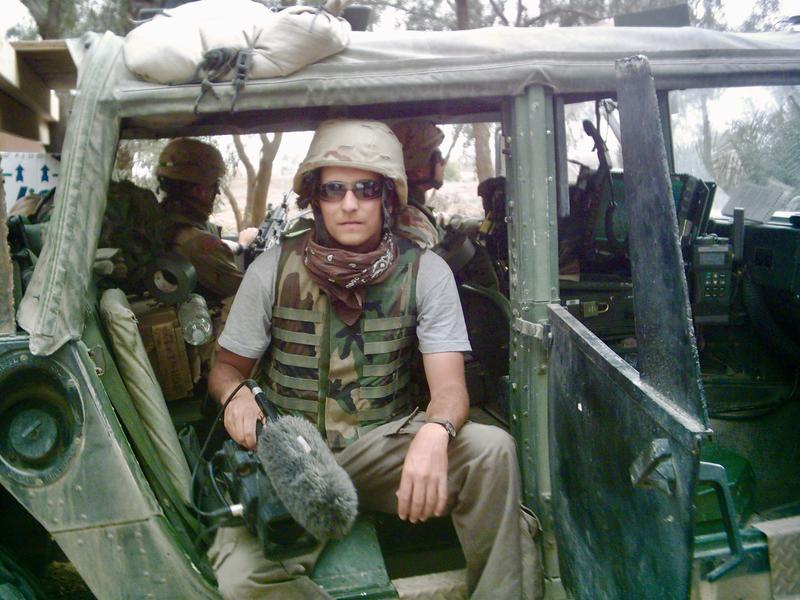
( Renaud Brothers )
Brooke Gladstone: Thanks for tuning in to On the Media's midweek podcast. I'm Brooke Gladstone. Micah Loewinger's out on the road this week, reporting for a series we'll be airing later in the spring. Stay tuned for that. But before he left, he recorded the following interview for us.
[music]
In 2022, Brent Renaud became the first American journalist to be killed by Russian soldiers while covering the war in Ukraine. Brent's collaborator for many years was his younger brother, Craig. When word got back to Craig that Brent had been shot, he did what he and his brother had always done. He kept filming. Craig and his producer, Juan Arredondo, used that footage, along with material from their archive, to make the Oscar-nominated short documentary Armed Only With a Camera.
The film is part tribute to his brother, part salute to war journalists who are still out there risking their lives. Micah spoke to Craig about how the brothers got started in the journalism business.
Craig Renaud: I can always remember there being cameras in our home. You know, when you see this film, you will see Super 8 film footage from throughout our childhood, and I always remember that camera being around. And then, when my brother was about 10 years old, my dad gave him a Minolta camera. That was the first time he envisioned himself as a journalist, so it was definitely from a very young age that we had this seed planted in our minds.
I also remember as kids, my brother had a very active mind and imagination, and my parents gave him a radio, a transistor radio, and we shared a bedroom, and he would lie awake at night listening to the BBC's, you know, international news every night.
Micah Loewinger: Tell me a little bit more about your partnership, your relationship working together. What do you think made it successful?
Craig Renaud: I think we complemented each other. Our personalities could not have been more different. I'm very social. I can get people to trust me very quickly, and for Brent, you'll hear him talk in the film. A cocktail party in Brooklyn is more terrifying than being in a war zone. You know, Brent had no ego, no pretense. We grew up in Arkansas, and I think Brent's autism and the way that he saw the world, you know, I just think people could really sense that he did really care.
In terms of our filmmaking, we got to the point where we could nod at each other in a dangerous situation, and we knew exactly what the other one was thinking. Even going back over 20 years of archives, making this film, I often had to stop, and really think who filmed this particular scene, because we had become so seamless in our work style.
One of the reasons my brother died is because of the style of filmmaking that we do. We can't just parachute in and film for 24 hours and parachute out. We spend months, and sometimes as long as a year. Like, when we were in Iraq, we were embedded for an entire year on the ground with the Arkansas National Guard, and each day that you stay doing that, you're risking your life exponentially, because you're putting yourselves right there, but I think the people that you're filming, really appreciate that, because you are putting your life at risk to tell their story.
Micah Loewinger: And you have time to actually build relationships, and trust and depth?
Craig Renaud: Yes, that's very important.
Micah Loewinger: You mentioned that line from the film, how Brent was more comfortable in a war zone than at a cocktail party. Tell me about the places and stories that you two sought out. What kinds of stories were you trying to tell?
Craig Renaud: Well, we always were very interested in character-driven stories. We both operated the cameras, we asked questions, we did the editing. The very first film that we did for HBO was called Dope Sick Love, where we spent a year and a half following heroin addicts in the streets of Manhattan.
[film clip]
Speaker 1: Tracy ain’t from this world, you know, this is all new to her.
Speaker 2: Essentially, that's what he does for a living, so it's the last thing he really wants to even, um, address, or deal with when he's with me.
Speaker 1: You can get trapped and caught up in this lifestyle, and once you cross a certain boundary, it's like no turning back.
Craig Renaud: When our approach, whether it was a film like that, or in a war zone, was very much with no judgment, and just a very fly on the wall, Cinéma vérité approach. Our goal was always to place viewers right in the present moment with what people were going through, and so if that was in a place like Haiti during the earthquake, or Somalia, it was really just as intimate as we could possibly be. We wanted to place viewers right there with people, as they suffered through what they were going through, often in conflict zones.
Micah Loewinger: I want to talk about the moments surrounding his death, which you capture the moment that Juan Arredondo, a fellow journalist who was injured at the scene, the moment he tells you that Brent had been shot in the neck by Russian soldiers in Ukraine.
Craig Renaud: He just kept repeating it. "We've been shot, we've been shot, we've been shot," and I said, "Where's Brent?" And he said, "He's been shot, too. I've been pulled away into a separate vehicle. He's still there." And I said, "Where was he shot?" And I said, "Did he have his vest on?" He said, "Yes". Then, I said, "Was he shot in the vest, or the face?" And Juan paused. He didn't answer me, and I knew right then Brent was gone.
Micah Loewinger: We later see you filming his body in his casket.
[film clip]
Craig Renaud: Right here. You can see where the bullet went in.
Micah Loewinger: And a voice out of frame asks you—
[film clip]
Speaker 3: Why are you doing this?
Craig Renaud: I just, I know this is what Brent would be doing.
Micah Loewinger: Why did you decide to feature his body so much in the film?
Craig Renaud: You know my answer was very concrete, because I knew exactly what Brent wanted me to do, which is to keep filming. That wasn't a guess. That was from conversations that we had had during two decades of being in war zones together. We had many conversations about, what do we do if one of us are killed? What do we do if one of us are kidnapped? The answer was always, "We keep filming."
It was incredibly difficult. It was the hardest thing I've ever had to do to keep documenting the murder of my brother, but I knew without a doubt that's absolutely what Brent would have wanted me to do.
Micah Loewinger: There's a very powerful moment in the film, where you show us the biggest car bomb in the history of Somalia. Brent goes to a hospital to document some of the victims, which is where he meets a man in a hospital bed who calls him over.
[film clip]
Speaker 4: What is your name?
Brent Renaud: My name is Brent.
Speaker 4: Brent?
Brent Renaud: Yes.
Speaker 4: Can I ask you something?
Brent Renaud: Yes, please do.
Speaker 4: The way you hold that camera. The way you hold that camera, it is not just, you're just holding it. You're doing it from your heart.
Brent Renaud: I am, man. I am.
Speaker 4: It really means a lot, dog. You know what I mean? We can change this world, dog. You and I. We can change this world if we wanted to. Believe that.
Craig Renaud: That's my favorite moment in the film, and when I was digging through 20 years of archives, I just happened upon this exchange between Brent and this man, and I just felt that it was such a powerful example of somebody recognizing Brent's compassion, but also this moment of shared humanity. It's interesting because, if you know about how Brent and I make films, the way that we hold our camera is physically from the heart, because we are the directors, we are asking the questions, and so we want to be making eye contact with people when we're speaking to them.
We don't bury our heads in a lens, or with the camera obstructing us, so part of it was the physical way he is holding that camera, but also he's recognizing Brent's heart, and the way that he had been interviewing all these wounded civilians and children that had just been injured by this car bomb.
Micah Loewinger: He said, "You and I could change this world if you wanted to." I'm just curious what you think he meant?
Craig Renaud: I heard that as, "We could all change the world if we wanted to," and I do think that goes back to compassion and decency and seeing each other as fellow human beings. I believe what that man is saying, too. I know for Brent, going into places like Somalia with his camera, it really was about trying to change the world, you know, trying to use his camera to pursue truth and peace in a way that could impact these conflicts. Because if people can see what these civilians are going through that are caught in the middle, I do think it can have an impact on people's perceptions of the wars that go on, and the suffering that they cause.
Micah Loewinger: It was interesting to me that you chose to juxtapose the image of that man lying in his hospital bed with the image of Brent lying in his casket, which is the very next scene in the film. Can you talk a little bit about your experience editing this documentary?
Craig Renaud: A lot of the editing was trying to find those scenes play off of one another, so that you would have this powerful impact on the viewer, but even the sound of a sheet of metal that's being glued to the top of Brent's casket.
[background noise]
We did not want to shy away from just the horror of war, and the violence of it, and for us, we had been documenting other people in conflicts, and people losing their lives or limbs, and why should it be any different in the moment that one of us are killed? I felt like I had to approach it the exact way I would have filming anybody, even though it was my brother.
Micah Loewinger: This is a film about grief, and as you say, it's also a reflection on your shared body of work, which is also very much about grief. You've alluded to sharing these moments with people, often family, a mother, a father's lowest moments. When you look back at some of these most intimate scenes that you've captured, which ones stand out to you?
Craig Renaud: There was a scene that we filmed in Iraq soon after Saddam went into hiding, and the bombing was going on, and there was an Iraqi teenager that was killed, and we were filming with his mother. You can hear Brent's voice behind the camera speaking to her.
Brent Renaud: They say the hardest thing is for a mother to lose a child.
Mother: It is. It is. It's true. It's true. I can't sleep. I keep looking to his picture, you know. [sobbing]
Craig Renaud: She had saved the bloody jeans that were cut off of her son in the operating room.
Mother: I'll show you his trouser. This is his leg. Look, all these holes from the bomb, and they said, "We don't hurt civilian people." Look, the blood. Look. [crying]
Craig Renaud: That scene still sits with me to this day. I mean, that was over 20 years ago, and I still have a hard time watching it. To just see her bury her face in these bloody jeans of her teenager, and you could feel the depths of her loss. It’s just unbearable.
Micah Loewinger: Since he was killed, it's become even more dangerous to be a journalist. You end the film with montages of memorials for other reporters killed, notably in Gaza, where nearly 250 journalists have been killed since 2023. Has your loss and those threats changed your approach to doing this work in the future?
Craig Renaud: Well, when we first brought Brent back, and started editing this film, you know, I had it in my mind that this was going to be a tribute to my brother, but it felt like there wasn't a day or a week that went by as we were editing, that another journalist was killed. Since Brent died almost four years ago, every single year there's been over 100 journalists killed around the world. It's become one of the most dangerous professions in the world, and there doesn't seem to be any signs that that's slowing down.
And so we, you know, Juan and I, especially felt like this film had to be bigger than that. It had to be also about all the journalists who are risking their lives to bring people the truth, and to us, that's very important, and we feel very connected to all these journalists that continue to go out with the risk of being imprisoned or killed, and Brent believed, and we believe that without journalism, there is no democracy.
Micah Loewinger: This film which you're last with Brent is now finished. Are you at a point yet where you're able to think about a future as a filmmaker without him as a partner?
Craig Renaud: Juan Arredondo and I will continue making films together, and it's-- I will continue making films under the banner of the Renaud Brothers. For me, the work is something that really got me through this every day. It got me out of bed every day. It kept me focused and it helped me heal through this process.
Micah Loewinger: How so?
Craig Renaud: Well, I felt like as long as Brent's name is being said, as long as his stories are being told, that he's very much still alive. The moment that I found out Brent was killed was both earth shattering, in the sense of, you've just lost your brother, but there was also this calm and this peace that came over me, where I felt like Brent had died doing exactly what he was put on this earth to do, and that his death would not be in vain, and that what he risked his life for is worth it, which is trying to tell the truth, and pursue peace through showing the horrors of war, and what people are going through, and so that is something that is very healing to me, because it makes you feel like it is worth it. It makes me feel like Brent's death was very worth it.
Micah Loewinger: Thank you so much for making this film, and thanks for doing this interview.
Craig Renaud: Thank you very much.
[music]
Micah Loewinger: Craig Renaud is the director of the documentary; Armed Only With a Camera: The Life and Death of Brent Renaud. You can watch the film on HBO Max. Craig has also set up the Brent Renaud Foundation in honor of his older brother to support emerging filmmakers.
Brooke Gladstone: Thanks for listening to On the Media's midweek podcast. The big show posts on Friday around dinner time. See you then.
Copyright © 2026 New York Public Radio. All rights reserved. Visit our website terms of use at www.wnyc.org for further information.
New York Public Radio transcripts are created on a rush deadline, often by contractors. This text may not be in its final form and may be updated or revised in the future. Accuracy and availability may vary. The authoritative record of New York Public Radio’s programming is the audio record.