An Internet Blackout Hides A Regime's Excesses
[music]
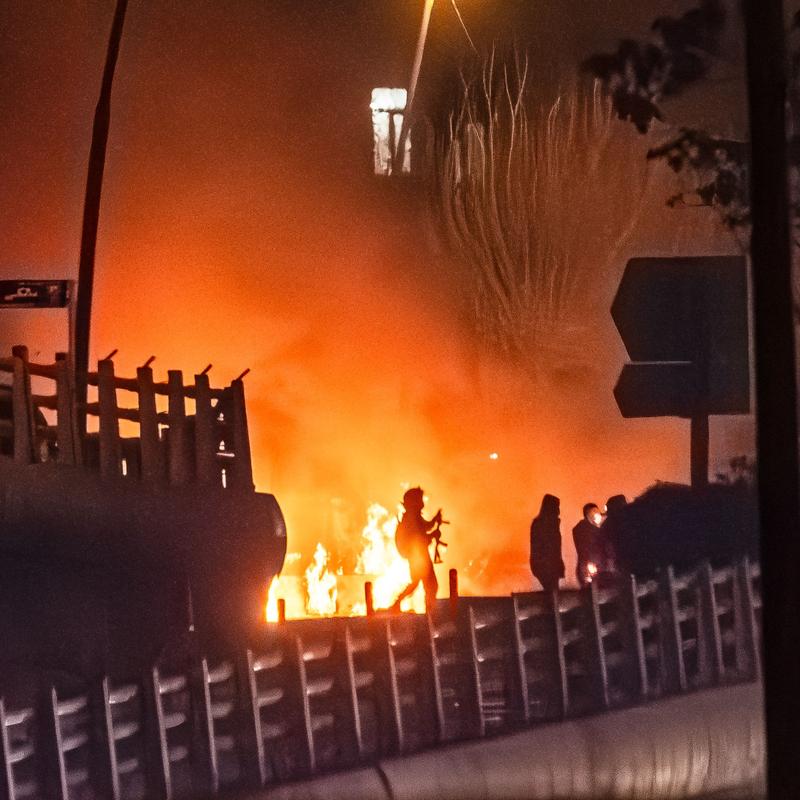
Brooke Gladstone: This is On the Media's midweek podcast. I'm Brooke Gladstone. At the end of November, familiar scenes of protest in Tehran were being documented and shared across the world.
News clip: Protesters have taken to the streets of Iran's capital city as the country faces some of its worst economic pressures in years.
News clip: Crowds cheering around this bonfire, dancing around the flames, chanting down with the dictator, blasting the regime over Iran's failing economy and soaring inflation.
Brooke Gladstone: On January 8th, the images stopped coming.
News clip: Iran's internet was cut off late on Thursday, apparently, an attempt by the authorities to prevent protesters from organizing, and also stopped them posting videos online for the outside world to see.
News clip: Activists say more than 6,000 people are now dead and 11,000 injured in the Iranian protests.
Mahsa Alimardani: I would say everyone I've spoken to in the diaspora knows someone at least one degree away from them who has been murdered.
Brooke Gladstone: Mahsa Alimardani is the associate director of the Technology Threats & Opportunities program at WITNESS, where she works on distinguishing visual truths in the AI age. She says that the internet has started flickering back on after a nearly three-week national blackout, the longest the country has ever seen, and yet a thick fog of disinformation still covers Iran.
Mahsa Alimardani: It's really unfathomable. The internet shutdowns is just one layer of what they do to ensure that the power to witness, the power to document, is extremely difficult.
Brooke Gladstone: You've noted that one of Iran's first global shutdowns happened in 2009. It was brief, but the government was spooked by an image that went viral, which let them know that this was a force that they were going to have to control, right?
Mahsa Alimardani: In 2009, we had the fraudulent election. There was an uprising. Millions of people went out onto the streets to protest. We saw security forces turn weapons onto protesters. The viral video of the young Neda Agha-Soltan became something that captivated audiences all around the world. I think it was one of these very first instances where we saw protest documentation go viral.
Brooke Gladstone: This young woman's face, dead, became an image of oppression all over the world. There was a protest roughly every two years. 2017 had censorship, but it was really 2019 when things took on a whole new level. That was the Woman, Life, and Freedom protests.
Mahsa Alimardani: By 2019, we did see them mobilize an internet shutdown for almost a week across the whole country. It's suspected they killed 1,500 protesters. The exact number has been hard to arrive at because that was the feature of the crackdown. It was to shut down the internet. It was to coerce families into silence, but that was one of the first times we saw something horrific on that scale.
Brooke Gladstone: You've said that Iranians have no real access to professional on-the-ground documentation and fact-finding, journalists basically. Give me a quick view of where the good information is coming from as we speak.
Mahsa Alimardani: We have some really incredible social media accounts that have been doing very quiet work of citizen documentation. There's one Twitter account called Vahid Online. It's an anonymous account. For years, it's been sharing protest footage. It's believed to be one person. This one person does say, 'I'm not able to do fact-checking. I can't verify everything. I'm just sharing what I have." He puts it out.
I know there's different fact-checking efforts like BBC Verify exists, various different fact-checking organizations. They take this content from his account and other social media and document it. You have the professional human rights documentation efforts. We have HRANA, which has been doing some of the most well-known documentation of the death tolls, for example.
There's different accounts of this. There has been a couple of reports from The Times of London and from The Guardian, where they have worked with medical workers, and even have had an account from someone anonymous within the Ministry of Health from the regime say that from what they've been able to document just from the hospitals, there have been 30,000 dead.
Then, of course, you have the firsthand documentation efforts that, story-by-story, verify the accounts, and the total protesters killed that HRANA has been able to verify firsthand is 6,476. They still have about 12,000 cases under review. In terms of the politics of disinformation the regime uses, they're like, "Well, if you add this up, they don't even reach the 30,000."
All of these figures are just lies, which HRANA doesn't have access to every single case. They will admit that they might never have access to every single case. Even through my own personal networks, I've heard of families that are so traumatized and so frightened by the process of just retrieving their loved ones' bodies that they refuse to talk to anyone. They're so scared to put their children's names on any sort of documentation.
Brooke Gladstone: You say that there's an effort by Iranians to try and use the internet as a cat-and-mouse game. Every few years, you say the government introduces a new level of internet censorship, so then Iranians try different ways to get online. Lately, it seems like Elon Musk's Starlink has become increasingly widespread. Is that useful?
Mahsa Alimardani: Whenever I try to talk about this, I reference a really great essay from a Sudanese activist and writer. Her essay was entitled the, Sudanese People Don't Have the Luxury of Hating Elon Musk. During the Sudanese civil war, Starlink was also a lifeline to many civilians during that crisis. During the weeks of the blackout in Iran, Starlink was the only way that documentation was coming out.
Without that window, it would have just been what the regime was saying. For the first few days, as the citizen non-governmental information was struggling to trickle out, they were trying to dominate narratives. Al Jazeera has a correspondent based in Tehran that looks like they likely cooperate with the state. They were just documenting how many security forces were dying and how these events were dangerous rioters who were terrorists.
Brooke Gladstone: This is how Al Jazeera was reporting it?
Mahsa Alimardani: It's actually been something that I've been following. How the way Al Jazeera has reported on protests in Iran has significantly changed from 2022 till now. I remember following during the Woman, Life, Freedom protests in 2022. Not that they were always perfect, but it was never like this. I remember in the first few days of the blackout, Al Jazeera was one of the first outlets to post an article smearing HRANA. I could see significant disinformation. This was not the case during 2022.
Brooke Gladstone: Now, the government has another tool in its online arsenal. A deadly game is afoot, which seeks to leverage what you call the "liar's dividend." Explain what it is and how it's relevant by describing a case.
Mahsa Alimardani: What the liar's dividend essentially says is that just the notion that people are aware or worried about AI or deep fakes creates this ability to cast doubt and be able to be a benefit to someone who wants to deny the truth. This has existed before AI. Of course, in the age of AI, it's much easier to cast doubt. The most famous was the Tank Man case. This was on December 28th. Someone was able to capture footage of a brave protester in Tehran confronting security forces with weapons on motorcycles and sitting in front of them. This was captured, and someone took a screenshot of it, and it went viral. Many people said it reminded them of the symbolic image of the Tank Man from Tiananmen Square in 1989.
Brooke Gladstone: That was the protester basically staring down a tank back in 1989 in China. Then what happened?
Mahsa Alimardani: This video was caught from a very tall building nearby, and it was zoomed in. Of course, the quality was quite low, and so a screen grab of that video ends up being shared. At some point in the information pipeline, someone decides to use an editing tool that uses generative AI. Some AI artifacts are present, like two of the security forces have merged into one.
Brooke Gladstone: Someone was trying to tidy up the photograph, in so doing, left these fingerprints of AI on it. I think the lesson here is don't screw with an original piece, because then the government could say, "Look, look, this has clearly been doctored."
Mahsa Alimardani: Of course, it didn't help that the Persian account of the Israeli state, which often likes to show that they're on the side of the people of Iran, also picked up this AI-edited photo and shared it, and then the narrative became, "Well, this is all just an Israeli conspiracy," which is a very dangerous narrative because we're seeing people, the protesters who are in jail, forced to confess they work for Israel, when they are just authentic protesters seeking liberation.
Brooke Gladstone: Then on December 30th, there was an account claiming affiliation with the Mojahedin-e-Khalq, an exiled opposition group known as MEK, which the US once designated as a terrorist organization. There was a video posted in which pro-Pahlavi, that was the name of the last Shah, so pro-monarchy chants, seemed to be dubbed over protest footage. This was another case of what's real, what's fake, and who benefits?
Mahsa Alimardani: I looked into some of the accusations. For example, I saw this one account claiming to be MEK. It was the first account to post this video of an allegedly manipulated audio over protest to show the real protest footage without the manipulation. They created the manipulation, and they created the accusation. Very quickly, this content was picked up by pro-regime accounts.
Brooke Gladstone: Why did they create the manipulation? What was going on there? I can't figure it out.
Mahsa Alimardani: One of the options that some people inside of Iran have turned to is the former Crown Prince. Of course, it was documented. A lot of people were chanting for his return. The regime wanted to create this narrative that this was all fake. They have this tactic where they have different social media accounts pretending to take on different identities of people in the diaspora. That account was pretending to be the MEK. They've been documented to do this. They place this seed of doubt into the information space. Then people were like, "Oh, okay. Well, this is probably fake," when indeed it wasn't.
Brooke Gladstone: There's a group called FilterWatch that monitors Iranian internet censorship from the US. It seems that the Iranian government is currently constructing a permanent system to grant full internet access only to certain elites, while corralling most of the roughly 90 million citizens into an intranet. This is called the "barracks internet"?
Mahsa Alimardani: We have already seen tiered access since systems of censorship were formalized across the Iranian internet in the early 2000s and 2010s. We've seen government institutions have uncensored access to the internet. While they declare that people shouldn't be accessing Twitter, they've had all the government officials on Twitter. This unequal access has always been part of the system.
Brooke Gladstone: Who gets special access to an open internet there? How is that pulled off?
Mahsa Alimardani: The internet service providers have a different infrastructure. It's not a simple switch when it comes to disconnecting people. You have to have ISPs cooperate and shut down. When the shutdown happened on January 8th, there's a famous story. One of the big ISPs in Iran, the CEO of the ISP, he took two hours longer than everyone else to implement the shutdown across the network he owned. They fired him. They replaced him with someone who was much more subservient to the orders from the top.
Brooke Gladstone: You've studied internet censorship for years and have concluded that even in the stablest of democracies, the internet is still embedded in a government infrastructure that enables governments to take partial or full control. This needs to be broken, reconstructed. One could say the same thing about capitalism in America today, but how do you reimagine it? What are the mechanisms whereby you could rebuild it in a way that would resist government control?
Mahsa Alimardani: I cannot think of any other point in history where we have had deaths at the rate that the Islamic Republic committed during those two days. This case in Iran should be a case study of how do we reimagine, and how do we create these mechanisms, and inspired by the case of Starlink about the opportunities it has presented. Of course, at the end of the day, Starlink is a private company. Obviously, not everyone can have a Starlink receiver. It's quite expensive, but this technology is moving forward, where direct-to-cell satellite internet can be possible.
It is possible with any smartphone made from 2020 onwards. It will soon have many more possibilities with newer models of phones that are able to connect much more easily to some of these direct-to-cell satellites that are in space. Not just relying on one company, but creating these human rights mechanisms where you have concrete commitments by the satellite operators to turn these services on in these very high-stakes contexts is really essential. Since the shutdown happened, I have been actively talking about it and pursuing with a coalition of different human rights organizations.
Brooke Gladstone: In an interview with The Verge, you brought up the 1988 fatwa, when the government killed between 2,800 and 5,000 political prisoners. You say there's very little collective memory of that event within Iran. How come?
Mahsa Alimardani: As someone who grew up mostly outside of Iran, an Iranian family that left Iran at that time, I grew up hearing the stories of the mass graves. I had so much access to family accounts and individual accounts of those massacres, where he's the son of someone who was in prison and somehow managed to survive, but his friends were massacred, didn't grow up with that collective memory. They only took the time to learn of this event that was so formative to their father's life when they left Iran because, of course, it wasn't documented.
It wasn't shared within the media. That collective memory didn't necessarily hold. That is one of the things that speaks to the power of the internet, the way that we can document and witness atrocities. It is a massive threat to regimes like the Islamic Republic because it is this collective memory. It is the power of witnessing that allows these movements to go on and, I am sure, will eventually bring the end of this regime. It's just very hard to understand how a society like this will not just collapse on itself.
Brooke Gladstone: Mahsa, thank you very much.
Mahsa Alimardani: Thanks so much for having me.
Brooke Gladstone: Mahsa Alimardani is the associate director of Technology Threats & Opportunities program at WITNESS. She's been researching digital rights in Iran since 2012. Thanks for checking out the midweek podcast. The big show hosts on Friday. See you then.
[music]
Copyright © 2026 New York Public Radio. All rights reserved. Visit our website terms of use at www.wnyc.org for further information.
New York Public Radio transcripts are created on a rush deadline, often by contractors. This text may not be in its final form and may be updated or revised in the future. Accuracy and availability may vary. The authoritative record of New York Public Radio’s programming is the audio record.