
A Russian Phrasebook for Surviving Authoritarianism
Brooke Gladstone: This is On the Media's midweek podcast. I'm Brooke Gladstone. Since taking office in January 2025, President Trump has moved quickly to consolidate his power and punish his enemies.
News tape: Over the weekend, President Trump continued his flurry of executive moves. He fired at least 15 inspectors general.
News tape: President Donald Trump vowing to send National Guard troops to more US cities.
News tape: The head of the Federal Communications Commission has warned that some broadcasters risk losing their licenses over their news coverage of the Iran War.
News tape: Breaking news with former FBI Director James Comey. He has been indicted by a federal grand jury in North Carolina. This is over this controversial Instagram post from last year, which was [fades out]
News tape: Democrats are worried that the president might try to influence voter turnout in the midterms by doing things like sending in the National Guard or ICE agents to poll sites.
News tape: "When you think of it, we shouldn't even have an election." That's what he told Reuters.
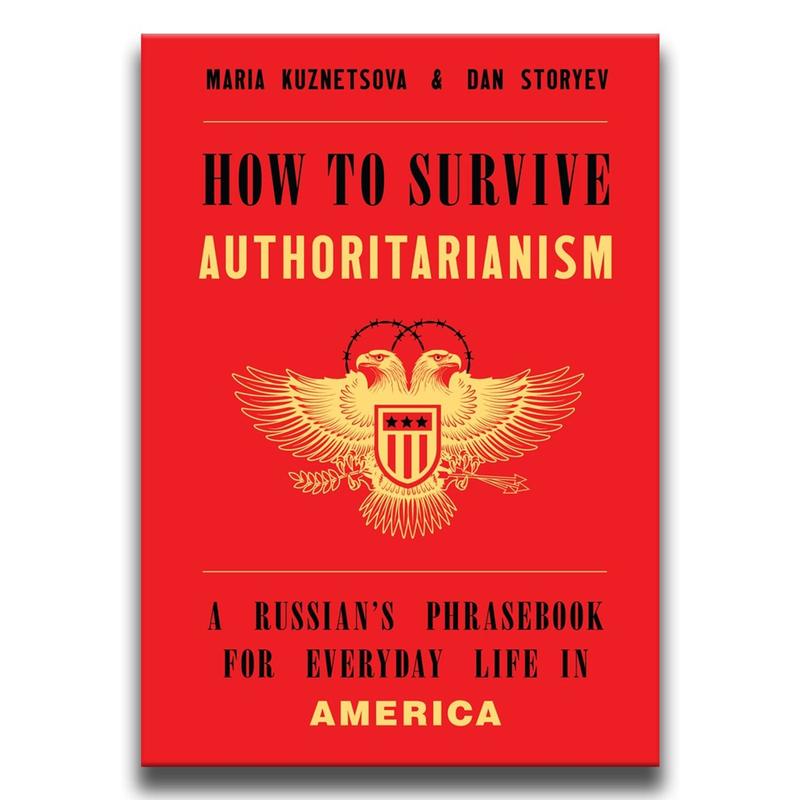
Brooke Gladstone: Sometimes it's hard to find the words to describe exactly what's going on since so many of Trump's moves are unprecedented in our democracy, the frequent frantic declamations of authoritarianism, unbridled corruption, and would-be king don't quite capture it. It's happening so fast we haven't had time to coin the words with the specificity required to describe how the wheels are turning. That's why Maria Kuznetsova and Dan Storyev decided to write a glossary of sorts. It's called How to Survive Authoritarianism: A Russian's Phrasebook for Everyday Life in America, and it'll be out in the fall. Maria and Dan worked as activists and human rights defenders in Russia for about a decade before Putin's crackdowns made it too dangerous to stay. They now live abroad in exile. Maria, Dan, welcome to the show.
Maria Kuznetsova: Hi. So nice to be here.
Dan Storyev: Thank you, thank you. Glad to be here.
Brooke Gladstone: You wrote that you wanted to share the wisdom of what's called Aesopian speech. When I was in Russia, I think the word closest to that was "mezhdusloviye," in between the lines? It's a hidden lexicon or a coded vocabulary that obscures meaning for the powerful while allowing you to communicate freely with your peers or others in the know.
Dan Storyev: Yes, it's something like that. The whole concept of it, it really goes back to czarist Russia.
Brooke Gladstone: I want to start with three concepts that you talk about, "ruchnoye upravleniye," which means manual control, and "chelobitnaya," which means knee-bent petition.
Dan Storyev: Ruchnoye upravleniye, the manual control. It's a newer term. It comes from Putin-era Russia, whereas chelobitnaya goes back to the times of Ivan the Terrible. Chelobitnaya literally means you're bowing so hard that you strike your head on the floor. In Russia, you see it all the time where people who need something as basic as having their road paved in their city, they essentially have to record these teary messages to Vladimir Putin asking him to intervene and do something about this.
Maria Kuznetsova: I want to add to that that a huge and important part of chelobitnaya is humiliation, and humiliation in this process is on purpose.
Brooke Gladstone: Like Trump buying shoes that don't fit for people to wear or have them all say he's a gift from God in cabinet meetings?
Maria Kuznetsova: Exactly.
Dan Storyev: I think there is the better example here, the showdown in the Oval back with Zelensky when Zelensky was attacked by J.D. Vance and then by Donald Trump.
Brooke Gladstone: How can you dress like that?
Dan Storyev: Yes, how can you dress like that? Do you own a suit?
Brooke Gladstone: You never once said thank you.
Dan Storyev: Exactly. What they expect isn't necessarily a thank you in a conventional sense of the word. What they expect is to have a chelobitnaya bestowed on them.
Brooke Gladstone: There's another one of these terms that I think show the dangers of authoritarianism, at least as a mode of government, and you can apply them directly to America again. The phrase is, and you can say it in Russian, "effective manager."
Dan Storyev: "Krepkiy khozyaystvennik." It denoted these technocrats within the Soviet systems who would run cities, they would run collective farms, they would run gulags in some cases. It is a successful yet ruthless technocrat, and it became especially popular in post-Soviet Russia, but then it became really popular within the Putin elite. Vladimir Putin and the rest of them being extremely impressed with the Chinese model, with the Singaporean model, with the UAE model, where you have pretty much zero political life, you have pretty much zero democratic freedoms and liberties, but at the same time, you have economic growth, the trains run on time, and the streets are immaculately clean.
This is exactly what we see the contemporary right in America: people like Curtis Yarvin, for example, allegedly J.D. Vance's favorite philosopher, people like Peter Thiel. This is exactly what they advocate. They advocate for something they call a corporate monarchy. The argument that these people give is that we need to delegate all our power to the single executive. This concentration will make sure that the trains run on time, the streets are clean, you can walk alone at night, and so on and so forth. Just give up your freedom of speech.
Brooke Gladstone: Right. Why the hell then would they be throwing their support behind a clear incompetent where the economy is in free fall, the streets are not clean, there is civil unrest and the whole thing. I don't know how to answer that question, but maybe it can lead us to the idea we haven't talked about yet, which is "manual control." That word.
Maria Kuznetsova: Ruchnoye upravleniye. What we see right now in America, what we see now in Russia is quite different from what we saw in dictatorships of the 20th century. Now the regimes are very personalistic, and basically, you find a person who is charismatic enough to lead the movement, and then you deal with all of the problems that arise with that.
Manual control basically means that all of the bureaucrats are afraid to make any decisions, and every time they have to make one, every decision is just kicked off upstairs till it reaches the most powerful person in the country, or at least the minister. The problem with such system is that it stops reacting to routine tasks, every task becomes political, and also problems are not resolved on time.
We saw so many things like that with Vladimir Putin when local authorities, for example, just didn't even want to react to emergencies because they didn't know if the federal government would approve of that. In America, there is a great example of that. Basically, Kristi Noem wanted to approve all big spending in DHS, which resulted in FEMA not getting money on time.
Brooke Gladstone: You're saying that by concentrating all of this power at the top, we are creating a situation where people are frightened to act on their own initiative to address problems.
Maria Kuznetsova: A lot of things about authoritarian regimes are in tension with each other, and it's kind of contradicting tendencies. On one hand, we have effective managers who are ruthless and who just try to run Gulag efficiently. On the other hand, authoritarianism is often quite chaotic because it doesn't prevent problems in time. It's actually in that way a fragile system that hurts a lot of people. It also makes a lot of things that should not be political, it makes them political. Again, fixing the road, having FEMA working on time on the ground, stuff like that.
Brooke Gladstone: There are a couple of Russian phrases that both relate to leaders staying in power longer than legally allowed. The words are in English: "castling and zeroing."
Dan Storyev: Castling is rokirovka in Russian, the chess move, where you shield your king with your rook. Putin, at one point, when he needed to leave the presidency so that he wouldn't be breaking the law, what he did is he created out of thin air replacement for himself. That replacement's name was Dmitry Medvedev, who indeed became a Russian president, but then ended up continuing the exact same policies that were going on under Vladimir Putin. In fact, it was under Medvedev that Russia invaded Georgia in 2008.
Maria Kuznetsova: What can happen in the US potentially, and I don't see people talking about that enough, is I don't see any problem with Donald Trump returning to power as vice president while J.D. Vance or someone else becomes a president.
Brooke Gladstone: I guess that is possible. Donald Trump is not a young or healthy man. I think time may run out. We have seen, though, precisely something you've pointed out, that a lot of people in the 21st century or a lot of nations, China, Venezuela, they just changed the Constitution to allow them to stay forever.
Dan Storyev: This is what zeroing is. Zeroing or obnuleniye, it's just basically canceling your term limits. What happened in Putin's case is that he-- Masha, maybe you could explain it better than I can.
Maria Kuznetsova: Yes, right. The thing that Putin ran into, and a lot of leaders do, is that it's really hard to change constitution. It's not only American case where constitution is very rigid, but even in countries where processes are easier to make amendments. Often, the presidential amendments are hard to change.
What Putin did basically was-- Officially, we still have term limits in Russian Constitution. Putin just proposed that because we are changing constitution substantially in 2020, and we had this pseudo-referendum that ran for seven days all over Russia to do that, we kind of reset the terms. Basically, the exception of not having two presidential terms only applies to Putin, and it will apply again to everyone after him.
Brooke Gladstone: Right. The clock stopped for Putin.
Maria Kuznetsova: Yes, basically.
Brooke Gladstone: You wrote about polittekhnologi or political technologists. These are people who exist to maintain the illusion that an undemocratic system is working democratically. Some call that illiberal democracy. Can you tell me about some of the more creative ways Putin's political technologists managed to pull this off?
Dan Storyev: These people treat politics as a machine. It's something that you can engage with technologically, cynically, and without actually believing in anything.
Brooke Gladstone: They don't really have any values, but they know how the thing works, and they know how to mess with it.
Dan Storyev: That's absolutely right. The term that we use in the book is "electoral activities." They are not really elections, they are electoral activities. They are a performance, and everything within this performance isn't about the real policies of the candidates as much as it is about the various trickery that political technologists use. For instance, in Russia, we have something called the Dead Souls. Now, the Dead Souls, of course, it's the title of the amazing novel by Russian imperial writer Nikolai Gogol.
Brooke Gladstone: It's a hilarious book.
Dan Storyev: Yes. Anyway, we actually have many cases in Russia where, during the elections or electoral activities, you have people "voting" again, and these people, they might have died years and years ago, or they may never have existed in the first place. Coincidentally, they always tend to vote for Vladimir Putin or they vote for his favorite party, the United Russia.
This sort of trickery, it wasn't invented in Russia. It's not new. In the US presidential election of 1876, Democrats were the pro-slavery party back then. The Democratic candidate Samuel Tilden, his ballots were actually decorated in some instances. They were decorated with illustration of Abe Lincoln right beside Tilden's name. The illiterate Republican voters would mix those two up and they would end up voting for a pro-slavery Democrat rather than a Republican.
Brooke Gladstone: You give a very contemporary example in Russia that echoes that, having to do with Boris Vishnevsky running in a city council election in Saint Petersburg.
Dan Storyev: What happened with Vishnevsky is one day, he looked at the list of candidates running against him and lo and behold, he saw two more Vishnevskys who were running on behalf of pro-Putin parties. Those two Vishnevskys, one of them legally changed his name, and both of them grew out their beards so they would resemble Vishnevsky some more. Vladimir Putin's political technologists basically created these two doppelgangers so that they could split the vote and get poor old Vishnevsky out of the race.
Brooke Gladstone: That's what you call electoral activities.
Dan Storyev: That's right.
Brooke Gladstone: There's a Russian phrase. We've heard it here quite a lot, "Svoyim vsyo, chuzhim zakon," which means everything for our own, for others, the law. Another phrase, "byl by chelovek."
Dan Storyev: "Byl by chelovek, a statya naydyotsya."
Brooke Gladstone: Yes, give me the man, and I'll find the crime. And all of these involve what in English is called undesirables, also a Russian term. These three terms have really uncomfortable echoes here at the moment, but one I really want you to focus on is this term "inner colonization." I think it's a really cool term. Masha?
Maria Kuznetsova: Basically, authoritarians start to use law just for their own purposes while still pretending that having some law implemented is a thing of democracy. They also start to use law selectively, and that's what phrases like "find me a man and I will find you a crime" refers to. We actually have such a prominent example right now in the United States. It's what's going on with James Comey and the fact that they're trying now to prosecute him based on an Instagram post that had 100 likes.
That gives me vibes of late Putin's regime, actually. You decide who you don't like, you decide who you want to prosecute, and then you find anything on them. That's why, for example, us as Russian activists, we always know that we either have to be saints or we have to be nuns. You have to be absolutely clear on everything so they cannot find anything on you. You have to follow absolutely all tax regulations to a letter. Ideally, you don't have any secrets that you are afraid of coming out into the world, because then they have leverage over you.
It's also what I think people in America don't understand right now, is that sometimes this kind of political prosecution, its goal is not to put a person into jail. The goal is to threaten you with the process, and it doesn't matter how this process ends. It basically deters a lot of people in power from even attempting to say something against the wannabe dictator.
Brooke Gladstone: Let's turn to "infopomoyка," basically an information dumpster. It's a phrase that depicts how tyranny can corrupt our perception of reality.
Maria Kuznetsova: Basically, what Putin's regime decided to do is to create as many versions of reality as possible to confuse people and to encourage people to disengage. In Russian, we use a phrase, "We will never know the whole truth," which means that there are so many contradictory versions out there that it's impossible to find what really happened.
What Russian propaganda does is creating a lot of content of low quality. That's what we call infodumpster, but it's everywhere. Hundreds of channels on all social media. It's on television. It's in newspapers. It's maybe even in the comments, and Russians use a lot of troll farms to even engage in that way with people. You create so many things that journalists have no time to fact-check them all. People get confused, and when people get confused and overwhelmed, they just disengage.
The idea here, because I think people misunderstand that modern dictators, they want you to believe what they do or they want to put you in prison. No, they actually much better off if you just don't do anything, you stay at home or you emigrate. That's where the concept of inner emigration comes in.
Brooke Gladstone: That's another Russian phrase we should highlight, "inner emigration."
Maria Kuznetsova: Inner emigration is when a person who understands the political reality, who understands that democracy is under assault, anyway chooses to disengage and only spend time doing their personal things and basically shut themselves from politics.
Dan Storyev: To add to inner emigration and to how important apathy is for modern dictatorships, another Russian saying is "moya khata s krayu, nichevo ne znayu," and it basically means "my house is at the edge of the village, and so I don't care what happens with the rest of township." It rhymes in Russian and it doesn't really rhyme in English, but that's the idea. You disengage as much as possible.
Brooke Gladstone: This relates to another Russian phrase, "budget people."
Dan Storyev: Oh, yes, "byudzhetniki." You have these large swaths of population who are dependent for their livelihood on the state. In Russia, it's quite a huge segment of the population. It's doctors, it's teachers, it's bus drivers, you name it, because only recently Russia was Soviet Union, and in the Soviet Union you basically had no private employment. Everyone was employed by the state.
That means that these people are very susceptible to pressure, especially when you need to pull off some sort of electoral activity. You need to provide some warm bodies for a demonstration in front of the American Embassy, for example, which is something that happens surprisingly often. You don't actually need to do this organically.
All you got to do, you got to send a top-down letter to a factory or a school and say, "Tomorrow at 1:00 PM, I need 100 people at this location with posters and flags. Whoever doesn't show up will get their pay docked, will get fired, will get expelled from a university." They love doing this with students, by the way. The main purpose of creating this byudzhetniki people is to justify and legitimize authoritarian rule.
Maria Kuznetsova: There is a good example of how byudzhetniki starts to form in the United States. It's when for the last year parade that Donald Trump organized, he made thousands of military personnel to come to DC and they had to sleep on the floor in some barracks and then to perform for the wannabe dictator on his birthday parade with no people watching. We saw that there were no audience, basically, and these troops were just marching through empty streets.
Brooke Gladstone: That's an excellent example. Can we have a quick discussion of "tusovochka" and how that relates to both the Russian and American scene right now? It's literally a little get-together.
Dan Storyev: Literally, tusovochka is a political party, a little get-together, people hanging out. What it means in the parlance of Russian dissidents is that these Russian dissident communities, they're prone to forming bubbles. Within these bubbles, people work together, they go to protest together, they date within these bubbles.
Brooke Gladstone: I wouldn't understand that, Dan, because I live in Brooklyn.
[laughter]
Dan Storyev: Exactly. If you've ever been involved with student activism, you will probably know what I'm talking about, or just activism in general. That's a problem within both Russian opposition circles, which ended up fighting between each other significantly more than they fought Vladimir Putin, and in the United States. In the United States, for example, when you look at the Democratic Party today, what is the Democratic Party doing?
Is it 100% focused on defeating Donald Trump? Not really. Is it 100% focused on providing an alternative and positive vision for America that every American can get behind? Not really. What is at the top of the headlines for the past few weeks is whether or not the Democrats should share a platform with Twitch streamer Hasan Piker. You have this constant infighting that is incredibly detrimental to the overarching cause.
Brooke Gladstone: Right. You've said that one of the key principles of this book is that language matters. What was your intention in assembling this phrasebook of Russian words?
Maria Kuznetsova: I moved to the United States a couple of years ago, and when Trump came back to power, I started to see a lot of similarities with what I knew from Russia. The problem was that I saw a lot of my friends, and I went to Harvard at the time, not being able to understand what was going on and not being able to see that some of the things that were happening were actually authoritarian. Again, not even being able to name what was going on, because that's the first step toward trying to work and resolve the problem.
I posted something on the Instagram to the fact of, "oh, hey, do you know how these phrases can be translated or how we can explain them? Because I feel like people around me don't understand what's going on." I also started to have my American friends directly ask me for advice and how to live in such circumstances. I was talking to one of my friends who was at the Democratic Party, and he was asking me for advice. He asked me, "Do we need to call ourselves dissidents now?" I felt like it's such a profound mind shift. Very early on, even before Trump officially took office, but after he won elections, people started to understand that the dynamics has changed.
Brooke Gladstone: They lacked a language that they could apply to the consequences and the techniques of the people who oppose democracy?
Dan Storyev: That's the thing. You know how in several indigenous northern languages like Siberian Yupik, for example, you have dozens of definitions for what snow is? The kind of snow, the snow with ice, falling snow, snow lying down, et cetera. It's just because these people live around and within the snow. Similarly to how Russia had existed for so long, for literal centuries, under the boot of authoritarian regimes. That means that Russians have developed this special language which allows us to talk about authoritarian developments, which allows us to categorize them, and which also allows us to talk about them in the open without actually being thrown in jail. That's a very important component of this.
I remember watching in 2025 the detention of Rümeysa Öztürk, who was a PhD student at Tufts University, and she was detained effectively for her pro-Palestinian stance. She was kidnapped by masked, plainclothed agents out in the open, just snatched up and dragged away. When you grow up in Russia, these kind of images, they immediately resonate with you, just instantly. We have the exact vocabulary to describe these plain-clothed officers. We call them "siloviki" or "eshniki."
In English, you got to say plain-clothed officers. You have to say this whole construction of terms. That, I think, that's the difference between this Aesopian language that is utilized by Russian activists, Russian dissidents and academics, that we have this vocabulary to describe a dictatorship. Americans just don't, and this is exactly why we wanted to write this book, so we could help our American friends name the things happening around them, because naming something is the first step towards resisting it.
Brooke Gladstone: Thank you both very much.
Maria Kuznetsova: Thank you.
Dan Storyev: Thanks for having us on.
Brooke Gladstone: Maria Kuznetsova and Dan Storyev are authors of the upcoming book How to Survive Authoritarianism: A Russian's Phrasebook for Everyday Life in America. It comes out on September 29th.
[music]
Dan Storyev: You can get the book anywhere the books are sold.
Brooke Gladstone: [laughs] Thanks for listening to this week's midweek podcast. Make sure to catch the big show out before dinnertime on Friday. I'm Brooke Gladstone.
Copyright © 2026 New York Public Radio. All rights reserved. Visit our website terms of use at www.wnyc.org for further information.
New York Public Radio transcripts are created on a rush deadline, often by contractors. This text may not be in its final form and may be updated or revised in the future. Accuracy and availability may vary. The authoritative record of New York Public Radio’s programming is the audio record.