
A Newspaper Raid and a Small Town Whodunnit
[music]
Brooke Gladstone: On this week's On the Media: a small-town whodunit filled with divorce, corruption, and backstabbing. The mystery: who is behind the brazen attack on a local newspaper.
Female News Reporter: KSHB 41 Senior Investigator Jessica McMaster continues to push for answers after police raided the small-town newspaper, the Marion County Record.
Eric Meyer: I don't know whether he feels that way about all journalists or not. I think this was targeting me personally. This hatred goes back decades.
Joan: The judge ordered it. On what reason?
Kari Newell: It was brought to my attention today that my private and personal information that was illegally obtained by a local reporter--
Jessica McMaster: She started talking to me. She was very stern that police did the right thing and that the truth was going to come out.
Brooke Gladstone: It's all coming up after this.
[music]
Brooke Gladstone: From WNYC in New York, this is On the Media. I'm Brooke Gladstone.
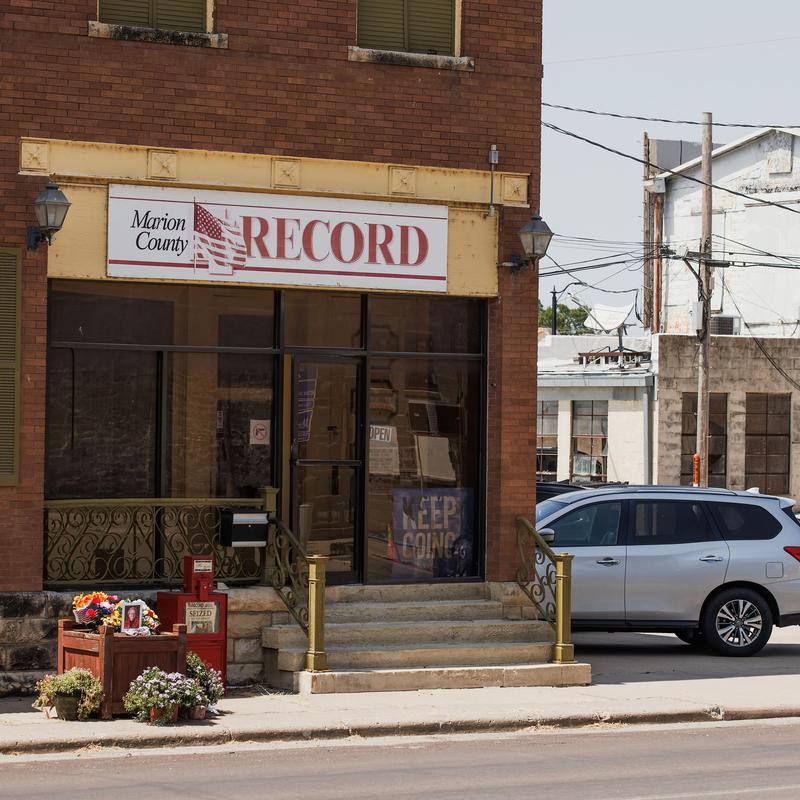
Micah Loewinger: And I'm Micah Loewinger. In August of 2023, police in Marion County, Kansas, brandishing a search warrant, raided the offices of the local paper and the home of the newspaper's editor and publisher, seizing computers and cell phones. The story made national headlines and caught the attention of Brian Reed. You might remember him as the host of the hugely popular podcast S-Town, a Serial and This American Life production. Now he has his own show in collaboration with the public radio station KCRW. It's called Question Everything. According to its tagline, the show looks into "How the truth gets buried, distorted and denied and the ways people are fighting to make it matter again."
The Marion County raid was squarely in their wheelhouse, and it's a great OTM story. This week we're handing over the hour to Brian to tell this small-town whodunit, filled with divorce, corruption, and backstabbing. The mystery: who was behind this brazen attack on a local newspaper?
Brian Reed: It was the summer of 2023, and the Marion County Record had been making a lot of enemies. There was the new police chief who'd come to town under suspicious circumstances from Kansas City, who the paper had been investigating. There was the local restaurant owner who'd recently kicked Marion County Record reporters out of a political event at her cafe. Then there was the mayor of Marion, who had just shared this post on Facebook. "The real villains in America aren't Black people. They aren't white people, they aren't Asians, they aren't Latinos, they aren't women, they aren't gays. They are the radical journalists, teachers, and professors who do nothing but sow division between the American people."
Eric Meyer: I have that posted on the wall in my office.
Brian Reed: This is Eric Meyer, editor and publisher and owner of the Marion County Record, a weekly newspaper. Before this, he worked at the Milwaukee Journal Sentinel and also taught journalism at the University of Illinois. Marion's a town of less than 2,000 in rural Kansas. There aren't too many people there with that resume.
Eric Meyer: I don't know whether he feels that way about all journalists or not. I think this was targeting me personally. This hatred goes back decades.
Brian Reed: The animosity from the mayor-- his name is David Mayfield; Eric says that dates back to at least 2003.
Eric Meyer: When he was city administrator, not mayor, and we had an outbreak of cyanobacteria, blue-green algae that affected the reservoir, which is the water supply for Marion.
Brian Reed: The paper got a tip that the town was taking water from the reservoir even though the Kansas Department of Health had not said it was safe.
Eric Meyer: We asked about it, and the mayor denied that. We then got proof that they actually had been doing it. Then the mayor said, "Oh, well, I didn't say that because I knew it was safe because I took my rowboat out to the reservoir and rowed to where the water comes in and there was no algae around it." We responded, "But the toxin in the algae is invisible." He didn't like that.
I was also there when the mayor and the city's economic development director, both of them, got divorced, and they are now married to each other. The economic development director took city money and set up a business by giving them a loan to purchase inventory with. The company was called Up In Smoke, and it was a cigarette shop. After they opened, their inventory mysteriously vanished in a burglary. By the way, they were set up in a building that she owned and rented to them. We reported this. When my father had a sudden cardiac arrest, and would have died had there not been an EMT who lived a block away. Reportedly, the woman who is now the mayor's wife went around to several people saying, "Too bad he got there that quick." She's denied this.
Brian Reed: The blood is clearly bad between Eric, the mayor, and his wife. When I reached out to Mayor Mayfield, he wrote me that none of the "false information" you have been spoon-fed by Mr. Eric Meyer is true. His wife, the former economic development director, told me it's crazy that she would wish death on Eric's dad. That she and Eric's dad were neighbors for years and got along okay. Though she did say her relationship with the newspaper was a constant battle. Plus, she said, "I can assure you, my husband has not been in a rowboat any time since I've known him."
The most recent thing Eric says Mayor Mayfield was mad at him in the paper about was that they'd been covering opposition on the city council to an ordinance the mayor wanted passed. A local government thing having to do with bond approvals that he'd been trying to squeak through without people noticing. That was the story du jour when the mayor had shared that Facebook post.
Watchdog journalism, pissing off people in charge, people like the police chief, the restaurant owner, the mayor, is a tradition in Eric's family. His dad's mom, his grandma, worked for the Wichita Eagle and was disappointed she had to take mandatory retirement at age 65 because she missed out on covering the Vietnam War. Then Eric's dad and his mom, they both worked at the Marion County Record. The Record's 155 years old. Eric's parents worked at it for decades before buying the paper in 1998 to stop it from being sold to a conglomerate. Then there's Eric, their only child.
Eric Meyer: I had started out there when I was a kid, stapling and assembling jobs. Then I became the darkroom technician and took all the pictures and developed the films and became the engraving technician.
Brian Reed: So you have journalism in your blood. Like, this is a family profession.
Eric Meyer: Yes, it is.
Brian Reed: In 2020, Eric decided to move back home full time to Marion. By this point, his father had died, and he wanted to give his mom a hand running the paper. She was 95.
Eric Meyer: I lived with her. I helped her with stuff. She was still working for the paper. She had a weekly column of the recollections: 15 years ago, 30 years ago, 45 years ago, stuff from the paper.
Brian Reed: Which brings us back to the summer of 2023. It's Friday morning, a little before 11:00.
Eric Meyer: I was sitting right where I'm sitting right now at a computer at my mother's house, and there was a ring at the doorbell. I looked up, and I looked out a window here, and I could see there were a couple of uniformed officers out there.
[knocking at the door]
Brian Reed: There's bodycam footage of this from the police.
Eric Meyer: So I went to the door.
[video excerpt]
Police Officer: Eric Meyer.
Eric Meyer: Yes.
Police Officer: Good morning. Hey, we're local law enforcement.
[video paused]
Eric Meyer: And they said, "We're here to serve a search warrant on you.
[video continues]
Police Officer: Here with the search warrant to take a look at your digital devices.
[video paused]
Eric Meyer: We want your cell phone, and your laptop, and your desktop, and anything you've used.
[video continues]
Police Officer: If you don't provide them, we're here to take them.
[video paused]
Brian Reed: In the video, Eric's standing in the doorway in an oversized T-shirt and shorts. A bit disheveled, a bit discombobulated. The cop hands him the warrant.
[video continues]
Police Officer: Okay, you're more than welcome to read through that. It's all in there.
[video paused]
Brian Reed: Eric scans the document. It says there's probable cause to search his and his mom's house because of allegations of identity theft and unlawful use of computers. It doesn't give any more details about those supposed crimes, and it doesn't mention the newspaper, but Eric suspects it must have something to do with their reporting. Thinking quick on his feet, he goes into journalism professor mode.
[video continues]
Eric Meyer: Okay, I'm going to object to this on the grounds of the Kansas Shield Law.
Police Officer: Okay, you can do that, sir.
[video paused]
Brian Reed: Eric knew that when police want info from a reporter, what they're supposed to do is subpoena it. Here, whatever the Marion police were after, they had not done that. Eric had not gotten a subpoena. Yet, waving around their search warrant, the officers walk through Eric's house and start rifling through his things, shield law be damned. He tries to keep it cool.
[video continues]
Eric Meyer: I understand. Which judge ordered it?
[video paused]
Eric Meyer: I was simply, "I'm going to inform you that I think that you're doing something wrong, and make a formal objection to it."
[video continues]
Eric Meyer: You're going to get a suit back against false search.
Police Officer: That's okay.
Eric Meyer: You understand that?
[video paused]
Eric Meyer: And try to do it in as even-tempered a manner as I can so that you can't say that I resisted arrest or resisted whatever.
Brian Reed: Though he did get some choice words in there.
[video continues]
Eric Meyer: Okay. I understand you're not people who are involved in this. Albert, you're in big, deep [beep].
Police Officer: Okay.
[video pause]
Brian Reed: Eric knows he needs a lawyer fast, but the police have already confiscated his cell phone with all his contacts. He picks up his mom's landline and dials the Marion County Record's office where his employees are, but they're not answering. He starts to worry. Are the cops over there, too?
Eric Meyer: I couldn't get through. Anyone there? Please answer the goddamn phone.
Brian Reed: The police won't say what Eric has supposedly done wrong, but he starts running through theories in his head about what could be behind this. Of course, the mayor comes to mind. He clearly was not happy with the paper. But there was also the police chief. His name was Gideon Cody, listed prominently at the top of the search warrant. He was the one who applied for it. He was in charge of the officers who were now raiding Eric's house. Chief Cody was new to town. He just started in the position a few months earlier.
Eric Meyer: Now, you have to understand, he had been a captain of police in Kansas City, Missouri, earning almost $120,000 a year. He was one year away from retirement there. He took a job in Marion, Kansas, at $60,000 to be the chief of a town of 1,900 people. Something didn't make sense there.
Brian Reed: When the record had published Gideon Cody's name, reporting that he'd be Marion's new police chief--
Eric Meyer: We got inundated with calls from people he had worked with previously who said that he had a terrible record. In fact, they called him the worst officer they had ever served with.
Brian Reed: Wow.
Eric Meyer: I'm talking about dozens of letters that we got that he was about to be demoted by the Kansas City police and that he was coming here because if he stayed there, he was supposed to be demoted to sergeant from captain, and his retirement would forever be limited by that. So he needed to leave before he got demoted.
Brian Reed: Eric and his team had been looking into this, of course, investigating the new police chief's past, but they hadn't published any of the reporting yet. They were still trying to get people to go on the record and nail it down. Is that why the police were coming after them, because they were investigating their new chief? Certainly seemed possible. Nervous about what's happening to his staff over at the Record's office, Eric calls a friend.
[video continues]
Eric Meyer: Can you go over [unintelligible 00:11:58] house? Can you go to the Record and tell them that I need them to talk to me right now? I can't get through to them. I have two police here seizing my letters. [inaudible 00:12:09]
Police Officer: Thank you.
[video paused]
Eric Meyer: I later learned that they'd been escorted out of the building and told to stand outside in 100-degree heat.
Brian Reed: Your staff had been?
Eric Meyer: Yes, and had their phones ripped away from them.
Brian Reed: So the cops were over at the newspaper office?
Eric Meyer: There were at least five of them there.
Brian Reed: Five cops at the office. At one point, there were seven cops at his mom's house. After handing over his devices, Eric leaves his and his mother's house, and he races over to the office. It's also been raided. Computers taken, folders torn through, all with a search warrant listing the same alleged crimes. Identity theft, unlawful use of computers, and the same lack of details about them. Though there was one line that gave another hint as to who might be responsible for this. In the list of items police were supposed to seize from Eric's house and from the office, number four read, "Documents and records pertaining to Kari Newell."
Kari Newell was a local business owner. She ran a restaurant inside the old Elgin Hotel, in the center of town, and a coffee shop across the street. Not long before this, the Record had leaked some documents pertaining to Kari, which they also had not yet reported on. They'd done some looking into them, but decided they didn't warrant a story. On its face, at least, this seemed like it could be the most likely explanation for what was happening, because Eric knew that Kari knew that the paper had this info about her because she complained about it at the most recent town council meeting.
[video excerpt]
Council Member: Kari.
Kari Newell: It was brought to my attention today that my private and personal information that was illegally obtained by a local reporter--
[video paused]
Brian Reed: And Eric had stood up to defend himself and the paper in front of the council.
[video continues]
Eric Meyer: We did not obtain it. Someone sent it to us. We actually consulted an attorney as to whether it was privileged information, whether we were in difficulty because we possessed it. Our attorney's advice was no.
[video paused]
Brian Reed: Kari Newell had also just hosted an event for a congressman at her cafe and refused to let Record reporters attend, which was a whole situation.
[music]
Brian Reed: These are the possibilities, Mayor Mayfield, Police Chief Cody, Kari Newell, that are running through Eric's mind as he tries to figure out who's behind these raids, what they're about. Though he was about to be distracted by a situation that was escalating with the police back at his house. We'll hear about that in a second.
[music]
Micah Loewinger: This is On the Media. I'm Michael Loewinger. We're jumping right back into the episode of KCRW's Question Everything. Here's the host, Brian Reed.
Brian Reed: Eric's running back and forth between the Record's office, where his employees are freaking out, and his house, where his 98-year-old mother is freaking out. Her name's Joan.
Eric Meyer: I'm an only child. She moved to this house the day before I was born. She'd lived there for 70 years. I was 70 at the time. She was very upset to have these cops, and they stood there for two and a half hours, just stood guard over her for two and a half hours. She got very upset about that. I was trying to calm her down.
Brian Reed: To be fair, your mom does seem pretty fiery in the video I've watched.
[video excerpt]
Police Officer: Thank you.
Joan: I'm not dumb.
Police Officer: Thank you.
Joan: I may be 90-some years old, but I know what's going on. What's going on is illegal as hell.
[video paused]
Brian Reed: Joan is in a nightgown, leaning on her walker.
[video continues]
Joan: You're all going to get in trouble.
[video paused]
Brian Reed: Berating the cops as they occupy her living room. At this point, Eric is gone, heading to the paper's office.
Joan: I worked at newspaper for a good many years. I followed the newspaper for a good many years. First time I've ever seen anybody allowed to do an illegal thing or ordered to do an illegal thing. Alexa?
Eric Meyer: No, she was very upset about it. She was demanding of her rights. She was trying to reach me. At one point, you can hear my cell phone ringing in the evidence bag sitting on the table.
Brian Reed: Joan glares at the cops, questioning them. Why are they here? On what authority? "The judge ordered it," a cop says.
[video continues]
Joan: The judge ordered it. On what reason?
Police Officer: That's all. I don't have access to all that.
[video paused]
Brian Reed: That was another odd thing about the search warrant. Eric knew who the normal judge was in the 8th Judicial District, which included Marion, but the signature on this warrant, it didn't look like that normal judge. Eric and Joan talk about it as the cops are hunting through their house. The county attorney, the city officials, they all should have known it's against the law to allow a raid of journalists this way. If not them, a judge absolutely should have known not to approve this.
[video continues]
Joan: I want to know what reason she did it.
Police Officer: I don't have--
Joan: This is my house. I own this house.
Police Officer: I understand that.
[video paused]
Brian Reed: Your mother's very upset in the video. She's yelling at them, swearing. She's slamming her walker. Had you ever seen her like that?
Eric Meyer: No, she's usually very calm.
[video continues]
Joan: Don't you touch any of that stuff.
Police Officer: Ma'am.
[video paused]
Eric Meyer: She knew that raiding someone who was involved in news gathering was wrong. If 98 years she hasn't convinced people of this town that she's an honorable person who doesn't do things wrong, why the heck are they standing in her house?
[video continues]
Joan: We were respected people. Oh, it's just plain terrible.
[video paused]
Eric Meyer: I tried to reassure her at some point. I said, "I think they've grossly overstepped what they can do legally. This is going to be on the front page of The New York Times."
Brian Reed: You had a sense that something big was happening, like beyond the normal scope of what happens in Marion, Kansas.
Eric Meyer: Absolutely, and I tried to tell her, I said, "Bullies usually get caught when they do the one thing too many, and they've done it. They've gone one step too far." Her answer to me was, "Yes, but I won't be alive to see it."
Brian Reed: Finally.
[video continues]
Police Officer: Okay, we're leaving.
[video paused]
Brian Reed: The police leave, but that doesn't make Joan feel any better.
Eric Meyer: Oh, she wouldn't eat that evening. She wouldn't go to bed. She sat in her chair. She was still sitting in her chair at 5:30 in the morning. At 6:30 in the morning, she'd gone to bed. Finally, a little after noon, I went in, and I heard that she'd stirred and gotten up, and gone to the bathroom. She came back to her bedroom, and I said, "You really need to eat something. You haven't had anything to eat since Thursday noon." She says, "I don't know, I don't feel to." She died in the middle of that sentence. The coroner listed the stress of this raid as a contributing cause for her death.
Brian Reed: The coroner's report says Joan died a natural death from sudden cardiac arrest. He describes the anger and the upset she felt from the raid leading up to it.
Eric Meyer: I'm not a crier. I'm somebody who was raised by my mother and my father to-- you react to a situation by doing what you can to correct the situation. So I tried to do what I could.
Brian Reed: He figured what he could do is put out the next issue of the Record.
[music]
Eric Meyer: I have to arrange for a funeral. I have to put out a newspaper, and by God, I'm going to put out the newspaper. There is no frigging way that I'm going to let them seize our equipment and keep us from publishing that week.
Brian Reed: The raids were on a Friday. Eric's mom died the next day, on Saturday. On Sunday, Eric went to the Record's offices and worked three days straight, pulling all-nighters and without any of their computers or electronics, only some crappy old desktops they had collecting dust in a junk room. He and his staff got an issue to the printers at 5:30 in the morning on Wednesday. What did you publish?
Eric Meyer: The top story was the story of the raid with a headline that says "Seized but Not Silenced".
[music]
Brian Reed: Eric was right when he told his mom that The New York Times would cover what the police were doing that day in their house. "Raid of Small Kansas Newspaper Raises Free Press Concerns" was The Times' headline.
[news reporters]
Brian Reed: CNN also covered it. The Washington Post, the BBC, NPR, PBS, Fox News, national press organizations like the Committee to Protect Journalists.
Male News Reporter: It's a clear violation of the First Amendment.
Brian Reed: It was a big international story. But there was also a journalist much closer to home, TV reporter Jessica McMaster, and it was her who would eventually get to the bottom of who prompted this raid and why.
Jessica McMaster: I wasn't familiar with Marion at all. That's not actually even part of our coverage area over here in Kansas City. What piqued my interest there was all this chatter on social media about who was behind this.
Brian Reed: A refresher on the suspect list. There was the mayor of Marion, who'd been clashing with Eric Meyer and the newspaper for years and had just made a nasty post online about journalists. There was the local restaurant owner who was also mad at the paper about their reporting and whose name was included on the warrants. There was the judge, maybe who appeared to be a fill-in for the normal district judge and who signed off on the search of the newspaper. Then there was the man who carried out the raid, Gideon Cody, the new chief of the Marion police.
Jessica McMaster: That's what really triggered my interest, was that we had this former police captain over here, where we live in Kansas City, who had gone over to Marion, was only on the job for a couple of months, and the next thing you know, a newsroom was being raided.
Brian Reed: Jessica focused on investigative stories for the regional TV station KSHB. She's busted open cases of local corruption and incompetence: elected officials taking taxpayer-funded vacations on the city council of Independence, Missouri. After a seven-year-old boy was murdered in 2015, Jessica exposed failings at the Kansas Department for Children and Families that led to new legislation being passed to protect kids. This former Kansas City police officer running a department that had just plundered a newspaper, it caught her attention. Jessica emailed Gideon Cody's office asking him to explain why he'd done this. After all, it's not legal for cops to raid a newspaper. Police Chief Cody responded with a statement--
Jessica McMaster: Saying, "I believe when the rest of the story is available to the public, the judicial system will be vindicated."
Brian Reed: Jessica wanted to know what the rest of the story was. She wanted to tell it to the public. Monday morning, after the Friday raids, Jessica and her cameraman make the two-hour drive from Kansas City to Marion. It's her first time there.
Jessica McMaster: Just to give you an explainer on what this town looks like, you have the newspaper, and right across the street you have the courthouse. Across the street from there is the Sheriff's Department. Up the road from the newspaper is the Elgin Hotel, and across the street from that is Kari Newell's cafe.
Brian Reed: Kari Newell, she's the restaurant owner whose name had been mentioned on the search warrants for Eric's house and for the Marion County Record's Office. Kari had beef with the Record in the weeks leading up to the raids over some documents they'd obtained about her. She'd even complained about it at a city council meeting. As Jessica is checking into the Elgin Hotel, the old hotel downtown, the owner of the place gets to chatting with Jessica. Turns out she's a friend of Kari Newell's.
Jessica McMaster: She started talking to me, and she was very stern that what police did was-- that they did the right thing and that the truth was going to come out and that if I spoke to Kari Newell, I would find out the truth.
Brian Reed: What did you make of that?
Jessica McMaster: I knew there was more to the story. It didn't make me think necessarily that anyone at the newspaper staff had committed a crime. I could tell that people were confused about the rights of the free press in this country. There wasn't a general understanding that what police did was extreme.
Brian Reed: Jessica goes to chat with Eric, who's still grieving his mom, while grinding to get a paper out without his computers. Reporter to reporter, they talk, and he tells Jessica the reason Kari Newell seemed to be mad at the Record.
Jessica McMaster: They received a tip that gave them her driving information.
Eric Meyer: A person by the name of Pam Maag said, "She's been driving illegally for many years. I've got proof of it."
Brian Reed: I hadn't really appreciated until I dug into this story how much the experience of running a small town newspaper can be like shooting a reality show for Bravo. People are always trying to drag you into their little feuds, and you have to figure out what's worth looking into, what could actually be newsworthy, and what's just gossip mongering. In this case, the source, Pam Maag, a former 911 dispatcher, DMed one of Eric's reporters a screenshot of a driving record for Kari Newell, indicating that Kari had a drunk driving conviction that she'd never resolved. It was from 15 years earlier. Meaning if you trusted this tip, Kari, a well-known local business owner, had been driving without a valid license for more than a decade.
Eric Meyer: The first thing you do is verify that it's actually true. This is a cell phone snapshot of a document that was sent very low res over Facebook.
Brian Reed: But it's real. A Record reporter checks it out in a state database. Is that a story, though? Eric thinks maybe if the cops know she's driving without a license, and are letting it slide. Then Eric's team gets a new tip from someone else.
Eric Meyer: The kid who mows the lawn for the husband of Kari Newell.
Brian Reed: Lawnmower boy tells them Kari Newell and her husband they're going through a divorce. This leak about Kari driving illegally, it came from her ex.
Jessica McMaster: It was her ex-husband who gave her driving information to her now ex-best friend, who gave it to the newspaper.
Brian Reed: Oh, yes, Pam Maag, the 911 dispatcher who ratted Kari Newell out, she was Kari Newell's ex-best friend.
Jessica McMaster: What it really is, is this messy divorce, this very personal feud between an ex-husband and an ex-friend.
Eric Meyer: So I decide that we aren't going to use this.
Brian Reed: The whole thing was such a nothing burger of a story that Eric didn't even bother contacting Kari Newell about it. Why then, Jessica wondered, had Kari been so mad at her ex-best friend and her ex-husband? Sure. But at Eric and the paper when they didn't even run with the story? Where did this whole idea of identity theft come from? Whatever the reason, this is the story that's getting spit out of the rumor mill in Marion in those early days that Kari Newell had filed a complaint about the paper with the cops and triggered the raid of Eric's home and newspaper office for accessing her personal driving information. Other news outlets start pointing to this as a likely explanation.
Jessica McMaster: For me personally as a journalist, I don't know any of these players. I know that there's very clearly some of that small-town riffs, if you will, going on, but I have no idea what's true, what's not, so I wanted to talk to Gideon Cody.
Brian Reed: After all, even if Kari Newell had lodged a complaint with the police, it was Police Chief Gideon Cody who decided to respond with multiple raids. Meanwhile, this is still all on that Monday. After the Friday raids, there's been a development. The Kansas Bureau of Investigation, the statewide law enforcement agency, KBI, it's called for short, has taken over the Marion County Record case. That proves to be an obstacle when Jessica tries to get Gideon Cody to talk.
Female News Reporter: KSHB 41 senior investigator Jessica McMaster continues to push for answers after police raided the small-town newspaper, the Marion County Record.
Jessica McMaster: I did stop by Gideon Cody's office and tried to speak with him.
Brian Reed: By now it's Tuesday.
Jessica McMaster: Tuesday morning, after not returning our calls and emails to request an interview, our I-Team showed up at Marion Police Department to ask Chief Gideon Cody a few questions. That went about how you thought it would. He shifted responsibility to KBI, saying, "I can't talk to you about their case. That would get me in all kinds of trouble." But KBI says that they weren't the one who issued the warrant. Can you tell me why, instead of issuing a subpoena, you raided?
Chief Gideon Cody: KBI will be angry at me if I start talking about their case at this point.
Brian Reed: Jessica does not leave with her questions answered.
Jessica McMaster: What would drive a person to do something like this? How did he not have awareness that this was going to become such a problem for him? Because he seemed so confident in the beginning. He just seemed to lack any fundamental knowledge of how big of a problem this was going to be for him.
Brian Reed: Jessica wonders, was there something more to know about Gideon Cody and Kari Newell? It was time to see if Kari would talk.
[music]
Brooke Gladstone: This is On the Media. I'm Brooke Gladstone with the final part of Brian Reed's investigation into the raid on a Marion County newspaper. Here's Brian.
Brian Reed: Jessica wants to talk to Kari Newell about why she filed that complaint with the police about any connection she might have to Chief Gideon Cody, but Kari's not returning her calls. As the weeks go on, Jessica is filing regular nightly news reports about what's happening in Marion, hustling back and forth from Kansas City, scarfing down one meal a day.
Female News Reporter: A significant update tonight as we follow through with our coverage of the raid on a Kansas newspaper.
Jessica McMaster: KSHB 41 News. I-Team obtained this video surveillance from the newspaper's cameras. Marion County District Court released the list of items seized from the newspaper. You'll see OS triage digital data. This is a clone of the newspaper's-- For the I-Team, I'm Jessica McMaster, KSHB 41 News.
Brian Reed: I remember following Jessica on Twitter during this time, and she'd update her followers about the latest documents her team had gotten their hands on or how she was quickly brushing her teeth in a parking lot before rushing to an interview.
Jessica McMaster: I think there's an impression, especially on TV, that I wake up and somebody's going to do my hair and makeup. No, [laughs] I can barely get my teeth brushed and get out the door. That's after I get my kids to school and everything else.
Brian Reed: Still no response from Kari. Then Jessica remembers the woman she met on her very first day in town, the owner of the Elgin Hotel, who's friends with Kari, who'd actually urged Jessica to talk to Kari to get the whole story. Jessica calls the hotel owner and convinces her to make a plea on her behalf for Kari to please do an interview.
Jessica McMaster: How I looked at this was, when I look at accountability, I really look at that with the people in power. Yes, Kari Newell is a local businesswoman, but she didn't have the power to raid anybody. Going after her in the same way that we would the police department for committing this act, I just wouldn't do that.
Brian Reed: The hotel owner, Kari's friend, she's successful. She gets Kari to invite Jessica to her cafe.
Jessica McMaster: Kari's cafe has this beautiful front porch before you walk into her coffee shop. We were sitting there in a couple wicker rocking chairs, and we were just chatting.
Brian Reed: How did she seem when you sat down with her?
Jessica McMaster: Nervous. She seemed like a woman who had been battered a bit on the internet.
Brian Reed: In the TV report Jessica later made about this, Kari Newell plays aloud voicemails she's been getting from angry callers since Joan Meyer's death.
Voicemails: Kari Newell, I hope you end up [inaudible 00:33:14]. Killer, killer.
Jessica McMaster: What are they saying?
Kari Newell: Calling me a killer nonstop.
Brian Reed: Did you have a top-of-mind question? Like, what did you want to know from Kari Newell?
Jessica McMaster: I wanted to know her level of involvement with this investigation. What I really wanted to know was how it started because what people had believed was that Kari was mad. Took this to Gideon Cody. He did her a favor and launched this raid.
Brian Reed: Chief Cody hadn't been in town long, but people had noticed that he and Kari Newell had become pretty fast friends. In fact, some people speculated that maybe they were more than friends, with Kari going through a divorce and all. As they sit down on the porch of her cafe, Kari tells Jessica that was not true. Their relationship was platonic. The way people thought these raids started. Kari says that's also not true. Kari tells Jessica one day, shortly before the raids--
Jessica McMaster: She mentioned she got a missed call from Gideon Cody, and he sent her a text message, said, "This is Chief Cody. I need you to contact me back as soon as possible. We believe you've been the victim of a crime."
Brian Reed: So Kari called Chief Cody back.
Kari Newell: I'm like, "What are you talking about?" He said, "I believe that somebody's stolen your mail."
Brian Reed: Cody told her someone had gotten a hold of her driving records and then gone to a state website.
Kari Newell: "And they accessed your case files and had downloaded that information." I said, "Who is they?" He said, "Phyllis Zorn."
Brian Reed: A reporter for the Marion County Record.
Jessica McMaster: This just infuriated you.
Kari Newell: Yes, of course it did.
Brian Reed: Jessica confirms with Kari.
Jessica McMaster: Were you driving on a suspended license?
Kari Newell: I was.
Brian Reed: But for Kari, that still wouldn't justify the paper committing a crime against her, like the police chief was now telling her that they had.
Jessica McMaster: I asked her, "Did you file a complaint?" She said, "Yes, I did. Because after he called me and told me this happened, he told me he needed something in writing from me."
Brian Reed: He directed her to file the complaint?
Jessica McMaster: According to Kari, yes.
Brian Reed: This is completely at odds with what Chief Cody has been saying. He told The Washington Post in an interview, "How am I supposed to look the other way when I have a victim who says, 'Are you going to do anything about this?'" As Kari says to Jessica in her wicker chair on the porch--
Kari Newell: I think people very much believe that I filed a complaint. I demanded that the raid happen, that I was in cahoots with the chief.
Jessica McMaster: She told me she had no idea that there was going to be a raid.
Kari Newell: Cody did say that he was seeking a warrant. In my pea brain, in no instance did I equate that to a raid.
Jessica McMaster: Her biggest reason for wanting to sit down with us, I think, is that she was tired of the narrative being controlled by Gideon Cody, that he was just looking into a tip.
Brian Reed: Jessica asked Kari to see the texts Cody sent her during this whole back and forth to verify what she's saying. Kari says she doesn't have them anymore, unfortunately, a little odd. A week or so later, Jessica gets a hold of an affidavit from Gideon Cody, and sure enough--
Jessica McMaster: It was in his affidavit that he called Kari Newell and informed her that she had been the victim of a crime, that some journalists with the Marion County Record had obtained her information. He told her this was illegal and that they didn't have any right to access that information.
Brian Reed: Five weeks after she first strode into Marion, Jessica has a big story.
Female News Reporter: Senior investigator Jessica McMaster dug deeper. She uncovered a series of events that led to that high-profile raid.
Male News Reporter: Finding that a story that went global started with a bitter divorce and small-town feuds.
Jessica McMaster: After the unprecedented raid, Kari Newell has been called a killer, a fascist, even Hitler, but now she wonders if she's a pawn. What do you wish people knew about all of this?
Kari Newell: The truth.
Brian Reed: Gideon Cody orchestrated the raids. But why? Why did he do it?
Jessica McMaster: The newspaper had told us we had been investigating Gideon Cody. We were working on a story about him. They told me that the first day I was there.
Brian Reed: This, remember, was a possible explanation that had gone through Eric's head as the officers were foraging through his house. Pretty quickly after Gideon Cody started in his new job in Marion, the Record had learned that he was not going to be the most forthright police chief.
Eric Meyer: There had been a procedure where every week in all the towns in our area, Hillsborough, Peabody, so on, they'd give us a little blotter narrative of what their officers had done for the past week, along with copies of the offense reports and the accident reports, which are open Public documents, and they'd give it to us every week. He refused to do so.
Brian Reed: When they first reported that Cody would be Marion's new chief of police, the paper had been bombarded with warnings about him from people who knew Cody during his time as a cop in Kansas City, where Jessica's from. According to Eric, the allegations they were hearing, they were bad.
Eric Meyer: Demeaning comments about female officers, sexual harassment, running over a dead body at a crime scene, a person who had leapt to a suicide, and he ran over their body. He reportedly told that when he was accused of sexual misconduct that they were going to transfer him to the dispatch section. We have a quote from him saying that "I'm just going to find the skinniest and prettiest dispatcher and [beep]." He was not a good guy.
Brian Reed: Eric's team hadn't published this yet. They were still reporting, but they had started putting some of the allegations to Cody.
Eric Meyer: He threatened to sue, had his attorney call us, blah, blah, blah.
Brian Reed: That's the beef that was ratcheting up between the newspaper and the police chief at the very moment when Kari Newell's ex-best friend sent her driving info to the Record. Here's something else, though, that Jessica discovers. A kicker, if you will. When Eric's reporter got the tip about Kari's suspended license, Eric worried that maybe the way Kari's driving record had been obtained by her ex-husband or by her ex-best friend, who again, had been a 911 dispatcher, that maybe they'd gotten it illegally somehow. So instead of publishing the info on Kari, Eric alerted the police. Eric was the one who told Chief Cody about the fact that Kari's driving record was circulating around, and Chief Cody then used it and Kari to go after Eric.
Eric Meyer: This wasn't about searching for anything. This was about trying to embarrass us, trying to harass us. This was intimidation, pure and simple. They bragged before the raid that this was going to be the biggest raid in the history of Marion County.
Brian Reed: At this point in Jessica's investigation, the county attorney has rescinded the warrants, saying they weren't valid. An officer who'd been sent the day of the raids to Eric's and his mom's house, who'd refused to go in because he knew it was wrong, has resigned from the department in protest. The Record and other outlets are now publishing their findings about Gideon Cody's time at the Kansas City PD: allegations of sexual harassment, of running over a corpse. The Record based their reporting on conversations with seven of his former colleagues. But Cody is still in office, still presiding over the Marion police, a powerful position in a town of 2,000 people. Eric is starting to consider his recourse. He's looking into suing the city and Cody. Then one night, as she's getting ready for bed, Jessica gets a call from Kari Newell.
Jessica McMaster: I just remember it was late, and she said, "Well, you asked me if I had that text message with Gideon Cody where he said that the newspaper had committed a crime against me, and I told you I didn't have them anymore." She said, "The reason I don't have that text message anymore is because the police chief asked me to delete those." I thought, "Oh, boy."
Brian Reed: After Joan Meyer died, and the raids blew up into a national story, Chief Cody had asked a key witness to delete text messages between her and him to destroy evidence that he had initiated the raids. You got out of bed?
Jessica McMaster: I got out of bed, and I asked her, "What was in your text messages?" She says, "It was nothing." She indicated to me that he was a little flirty with her at times, that if people got their text messages, he didn't want them to get the wrong impression because she sent him a smile emoji. The way she was explaining it to me was like she wasn't sure that it was that big of a deal, but that she wanted to be honest with me since she withheld that information from me earlier. I assured her, "This is a big deal."
Anytime a police chief asks a witness to potentially delete evidence, that's a big deal, potentially a criminal deal. It also highlights that there's some level of dishonesty with this police chief. On its face, it was just bad. It didn't look good for Cody. She says, "But you can't tell anybody this. I want this off the record. I just don't want anybody to know." I went to bed, and by the next day, she changed her mind.
Brian Reed: How did you verify that this had happened if she deleted the messages?
Jessica McMaster: I did say to her, "Have you had any discussions about this? Did he send you a text asking you to delete the text, things of that nature?" She says, "No, I don't have anything like that." Then she called me a day or two later, and she said, "Cody just called over here to the cafe. I'm going to talk to him about these text messages."
Brian Reed: Kari starts texting with the chief, says she's worried she might get in trouble for deleting the text messages like he asked.
Jessica McMaster: He text messaged her back saying, "Quit being paranoid." He says, "Our phones are moot." He used the word moot. Then he confirmed what she told me on the phone earlier, saying that he didn't want people to get the wrong impression because she sent him a smile emoji.
Brian Reed: Boom. Jessica has it scoop number two.
Female News Reporter: New tonight. A key witness in the raids on a Kansas newspaper accuses Marion Police Chief Gideon Cody of asking her to delete text messages.
Jessica McMaster: According to Newell, she deleted the text messages at the chief's behest.
Kari Newell: I did make mention that I didn't know the necessity of that because there was nothing inappropriate in the text messages.
Jessica McMaster: Newell says the chief asked her to delete their alleged text messages after the raids, as rumors began to circulate about Newell and Cody's relationship, which Newell says is platonic.
Kari Newell: He said it just removed the element of people being able to ask. I did delete those messages against my better judgment and instantly regretted it.
Brian Reed: What did you think when you saw that reporting from Jess?
Eric Meyer: First of all, I thought Jess had got a good story. That she'd gotten something that we hadn't been able to get. I suspected that there had been much communication that went on this way. The destruction of messages I had assumed this all along because we'd made an open records request for these messages, and we got stonewalled. We're still suing on that open records request, but it was nice to have the admission that Cody had told her to destroy it.
Brian Reed: Within days of Jessica's report, Chief Cody resigned. Prosecutors charged him with obstruction of justice, a felony. He's out on bond, living in Hawaii, last I heard. His trial is set for August. He didn't respond to my multiple requests for comment. Jessica, were these criminal charges a result of your reporting?
Jessica McMaster: Yes, it was. This is the only thing that they got him on.
Brian Reed: The charges were for pressuring Kari Newell to delete the texts, not for the raids themselves.
Jessica McMaster: The prosecutors really acknowledged that he didn't do this. They were stern in their report too, but drew the line, saying, "Does it amount to something criminal?" They decided it didn't, but then the one thing that they stuck with were these deleted text messages that we heard the story on. That's what they've charged him in relation to with that low-level felony. In the end, this was the only thing that Cody was held accountable for. It does feel good that we did our job. That we dug further, and we looked into things. Even if it's not being held accountable directly for the raid, it's something.
Brian Reed: Eric feels differently.
Eric Meyer: I was surprised that they did not charge him with more.
Brian Reed: For a long time, I saw this story as a triumph of local journalism. Yes, the people in charge in this small town had perpetrated a terrible violation of their local press. Yes, Joan Meyer had died in the midst of it all, tragically. But the reason the police and local leaders had done this, presumably, was because the Record wasn't just doing police blotters and graduation notices. It was covering them tough, tough enough to spur them to attack it in this egregious way. Then when that happened, a regional reporter, Jessica, came into this town that's outside her coverage area. Just because she cared and is a skilled, dogged reporter, she did force some accountability. It was imperfect; it was sad, but in some backwards way, I found it reassuring.
Then, as time went on, I started to second-guess that. I felt depressed about how fragile local journalism is, how vulnerable. For a long time, Eric was mired in all these drawn-out legal fights against the city and the county. They're expensive and onerous. One of his reporters quit after the whole ordeal. His mom is dead. And Jessica, infuriatingly, was laid off. KSHB eliminated her position in April 2025 due to budget cuts. Meanwhile, Chief Cody was sunning on a beach somewhere in O'ahu, maybe.
Now, as more time has gone on, the pendulum seems like it has maybe started to swing back. Jessica got rehired to do investigative reporting for a newish online outlet, Straight Arrow News. She's been covering ICE. The Marion County Record has continued to have an outpouring of support from around the country. Eric told me they have three veteran journalists who've come to Marion to report this summer just in exchange for housing. In November, Marion County settled with Eric and others, agreeing to pay over $3 million to him, his mother's estate, the Papers Publishing Company, the city's former vice mayor, and some of the paper's reporters. The sheriff's office issued a public apology for its role in the raid.
Eric Meyer: I do, ironically, think, and one of the reasons that I haven't probably reacted in great tears or anything else is that I also know my mother. When you're 98 years old, you have a feeling there's not much time left for you in the world. You're not going to make your mark on anything. To be able to go out at age 98 and have your death meaning something that would be something she would have appreciated big time.
Brian Reed: What does her death mean?
Eric Meyer: The raid attracted attention, but it attracted attention among people like you, people who are journalism fans and journalism-interest people. The video of her objecting to it put the human face on the story, made the general public understand it, made people say, "I want to be just like her when I'm 98 years old." That kind of stuff. They could relate to it. They could see the human impact. It's an abstract quantity to say, "We ran in a newspaper, and that may cause a chilling effect on future coverage," to "Here's this woman in her walker trying to stand up against seven cops in body armor."
[video excerpt]
Joan: Boy, you going to be in trouble? You take my computer. That's personal property.
Police Officer: Yes, that's his phone and his laptop.
[video paused]
Brian Reed: I think that's the right image to carry with us from what happened in Marion.
[video continues]
Police Officer: Thank you.
Joan: I may be 90-some years old, but I know what's going on. What's going on is illegal as hell.
[video paused]
Brian Reed: The image of Joan Meyer going out with a fight.
[video continues]
Joan: They've got power. Oh, we've got power. We're going to put out the newspaper.
[video ends]
[music]
Micah Loewinger: Brian Reed is the host of Question Everything. If you like this story and you want to hear more like it, check out Brian's show wherever you get your podcasts.
[music]
Micah Loewinger: On the Media is produced by Molly Rosen, Rebecca Clark-Callender and Candace Wang, with help from Ella Walsh. Travis Manning is our video producer.
Brooke Gladstone: Our technical director is Jennifer Munson, with engineering from Jared Paul. Eloise Blondiau is our senior producer, and our executive producer is Katya Rogers. On the Media is produced by WNYC. I'm Brooke Gladstone.
Micah Loewinger: And I'm Michael Loewinger.
Copyright © 2026 New York Public Radio. All rights reserved. Visit our website terms of use at www.wnyc.org for further information.
New York Public Radio transcripts are created on a rush deadline, often by contractors. This text may not be in its final form and may be updated or revised in the future. Accuracy and availability may vary. The authoritative record of New York Public Radio’s programming is the audio record.