
A Hundred Years of The New Yorker
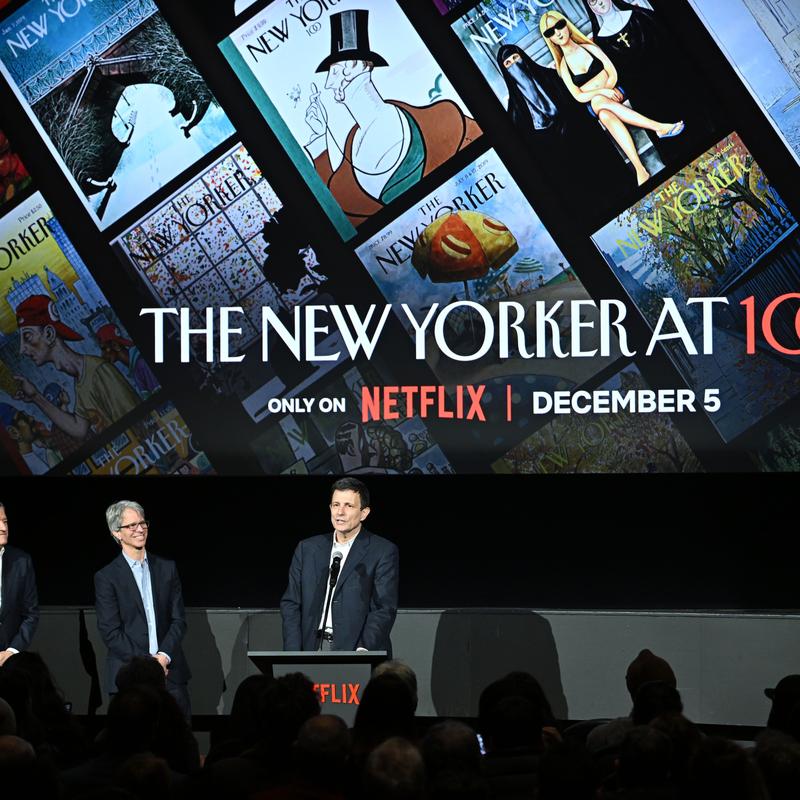
Brooke Gladstone: This is the On the Media's midweek podcast. I'm Brooke Gladstone. The New Yorker magazine turned 100 this year and marking the occasion is a new documentary film on Netflix. With some 5,000 print issues and 10 decades worth of reporting, illustrations, editing, where does one even begin? That's a question staff writer Jelani Cobb brought to the film's director, Marshall Curry, and executive producer Judd Apatow on The New Yorker Radio Hour.
Jelani Cobb: The thing that struck me about this film, among the things that struck me about this film, is that having a sense of the history and a sense of the magazine and all of the things that go into it, it would seem to me just an impossible task for a century. It'd be difficult to do this about one year at The New Yorker and even the Ted Danson joke about the stack of New Yorkers that are like, "I'm never going to get through those," that's just a year. I wonder how you all approached the daunting task of taking this sprawling, incredibly culturally significant publication, this idea that is The New Yorker, and turning it into this very taught, very disciplined frame that we just got to understand a century of its life.
Marshall Curry: That was definitely the challenge of the film was, you've got this unbelievable magazine. Even just getting a tiny fraction of the current writers was impossible, that times 100 years. It was an impossible task. Right before I started, Nick Paumgarten told me, "Trying to make a 90-minute film about The New Yorker is like trying to make a 90-minute film about America." I thought-
Jelani Cobb: Accurate.
Marshall Curry: -"There's something to that." We decided we're not going to be able to just have everything. We're going to pick historical events that have a great story that are about a piece that affected culture, that are about a piece that affected the magazine, and we're just going to pick a tiny number of them, the same was going to happen with the writers, the cartoonists, and the cover editor folks, and we were just going to make it a tasting menu.
It was going to be a sampler box of chocolates. We weren't going to be able to bring you the whole thing, but it was going to be enough to just give you a sense of what this magazine's history was. Somebody said that it should have been a 10-part Ken Burns series and it could have been. It would not have been boring if we'd had the bandwidth to do that.
Jelani Cobb: I don't know. Judd, did you have any trepidation? Did the scope of this give you any trepidation as a producer?
Judd Apatow: You're scared because it's something you respect so much, and you don't want to do a really terrible version of it. I think that we knew that encapsulating it was going to be impossible. For me, I just always think, "Can every part of it be great?" When David Remnick says they want the magazine to be great and humane, I think that's what Marshall captured in showing the people and how it's crafted each time it comes out.
My main thing that I did was to say, "I'm not going to direct it. Let's get Marshall to do it." He just did such a beautiful job because I feel like making this was like trying to make an issue of the magazine.
Marshall Curry: That's what it felt like.
Judd Apatow: He had a limited amount of time. We knew, "Well, this is when the anniversary is." How many months was it, the whole project? 15?
Marshall Curry: 11 months, from start to finish.
Judd Apatow: It's like making Saturday Night Live. You have a week of a certain amount of time, and I just think he did such a beautiful job making all those really difficult and also heartbreaking decisions, because we all know of other things that were like, "Oh, how come they didn't talk about that?" The choices are really great.
Marshall Curry: It did feel, sometimes, like our team was in this field of fireflies with a jar, and you just run and catch one, and then you catch one more, and there was just this incredible constellation of fireflies everywhere we looked.
One of the things that was new to me to hear articulated was that irreverence has always been part of The New Yorker, and we tried to include that in the making of the film. I think you brought a lot of that to what we were doing. I think also you were the one who suggested the Carol Burnett-- you said, "Have you ever seen the thing where she pulls the wig off?" We looked that one up and we're like, "That's going in the movie."
We had an amazing team, including some who are here, and I just want to take two seconds to call out some of the folks who are here, because this was made by a group. Xan Parker produced with me. She's amazing. Elizabeth Martin, who's a producer, also my wife. Peter Yost, Steve Bennett, Lizzy McGlynn, archival producer, Norn Jordan did the unbelievable animation. Josh Church, Helen Estabrook, Sarah Amos, and, of course, everybody at Netflix who's made this whole thing happen, and everybody at The New Yorker. I know there's some New Yorker folks here. You guys were incredibly patient with us in your space and incredibly generous with your time.
Jelani Cobb: I'm curious, given the amount of material that there is to work with, how did you approach the archive, and how much stuff did you look at from previous eras and previous decades of the magazine's life?
Marshall Curry: We probably started with, I don't know, 15 or 20 greatest hits stories that if you ask anybody who knows The New Yorker, "What are the stories that are the main stories," the top 20 or so come up frequently. We started with that. Then, like I said, we were looking for things that affected the magazine, that affected the history, and of course, we're making a movie, so it also had to be something that had a visual component.
I remember the first time I met David when I was pitching myself on the project, I said to him, "Frequently, young filmmakers will ask me for advice about what makes a good documentary. My stock answer is, there are some stories that are great New Yorker stories, but they're not documentaries, because a documentary has to be visual." I said, "David, I got to tell you, I feel pretty weird because I'm here pitching my cautionary tale that I tell hundreds of young people not to do."
It just seemed like there were so many brilliant people and so many amazing stories that it was worth figuring it out. Finding things that were visual was part of what narrowed our list down, and then we edited more of these historical stories then finally made in the film.
We shot more writers, Adam Gopnik and Jill Lepore and these amazing people who I loved, and then as the movie had to get smaller and smaller, we couldn't include it all. It was reading books, it was watching documentaries. Our archival team did an unbelievable job of scrubbing archives and trying to find what could you make a little mini film from?
Jelani Cobb: Is it okay if I turn your own question back on you and ask both of you how you became aware of The New Yorker, or what your earliest consciousness about The New Yorker is?
Judd Apatow: I'm very embarrassed to answer this question, but it wasn't that long ago.
Jelani Cobb: It was last week.
[laughter]
Judd Apatow: It is pretty bad. I'm from Long Island, and my magazine of choice, I don't know if you've heard of it, it's Us Weekly. That was most of what I was reading. TV Guide. I'd read it like a book, because there were articles at the front.
I was writing a movie with Owen Wilson, and I went to visit him in Texas. His parents are very cool people, and his mom, Laura, was Richard Avedon's assistant and did the Old West photo collection and is an amazing photographer. Owen was talking a lot about The New Yorker. I had heard of The New Yorker before, but I don't think I had read it. I was so embarrassed that it sounded smart and I couldn't talk to Owen about it.
I was embarrassed that Wes, obviously, was very into The New Yorker, and I just thought, "What kind of a Long Island idiot am I that I don't know about this?" Then I started reading it then. The answer is 42 years old.
[laughter]
Jelani Cobb: Marshall, what about you?
Marshall Curry: I grew up in New Jersey mostly, and my parents got The New Yorker. It was this thing that I would look at the cover and flip through the cartoons, and that was it. Then over time, I started reading the Talk of the Town and then maybe a few more articles. Then in my 20s, I got my own subscription. I actually have always liked it.
Making this film, I realized that there are real fanatics about The New Yorker. I couldn't have named all of the editors. There are people who really know The New Yorker. I was not one of those. I was a casual consumer, but I liked it. I knew how smart the people were who worked there and how creative they were and how unusual their obsession was, and so that was what drew me to it.
Judd Apatow: I'm sorry. One thing I just wanted to say that I also think Marshall did so well, that we were excited about, is just telling the story of the people who work at The New Yorker because people are so tough on journalism. I never understand it when everyone's mad at the media at the level they are, but when you watch something like this, you see how dedicated, honest, and amazing everybody is. I think it's really important to put things like that out in the world.
[applause]
[music]
Brooke Gladstone: Judd Apatow and Marshall Curry at The New Yorker Radio Hour. We'll continue in a minute.
[music]
[applause]
Jelani Cobb: I have to say, one thing I really appreciated, I laughed out loud, was the inclusion of Bruce, office manager. When I first got to The New Yorker, every problem that I had, they sent me to Bruce. It could be anything, like, "I feel like I'm getting a toothache." "Go talk to Bruce. He'll know what to do." It was every single thing. At every institution, probably at your job, or at your kid's school or whatever, there's that one person that seemingly makes all of the things, all the engines work. It's always like, "Bruce, what exactly is in your job description?"
I do want to ask, aside from the scope, which we've talked about, if there was anything else that was a particular challenge in doing this project.
Marshall Curry: The number one challenge was scope. How do you get it all down? The other challenge was that there wasn't an obvious arc to it. Most of the movies that I make are one or two people who want something, and then they have obstacles, and at the end they get it or they don't get it. We had to figure out, "How do these scenes fit together? How do all of these characters who are connected by this magazine, but don't necessarily all work in the same space together, interact with each other? How do we build something that feels linear, like a movie?"
I'll say the other big challenge was that everybody who works at The New Yorker knows how a profile works, and that makes them hard to make profiles about. I remember there's a trick that you learn as a documentary filmmaker very early, when you're interviewing somebody, you ask a question, and then you let the person answer, and then you don't speak.
Jelani Cobb: Yes, that's right.
Marshall Curry: Your temptation is to jump onto the next question, but if you leave that hole there, then it creates this socially awkward silence, and frequently, the person who you're interviewing will fill that silence, be drawn to fill that silence, and they'll say something that's a perfect summation of the thing that they had just said in a long winded way, or it's a surprising twist on the thing. It's, frequently, the best stuff. I was interviewing David, and he said something, and I waited. He looked at me and he nodded, and I looked back at him and he said, "I know this trick, too."
[laughter]
Marshall Curry: I was like, "Urgh."
Jelani Cobb: Also, I should say Marshall has just ensured that no one from The New Yorker will interview anyone in this room now.
Marshall Curry: The awareness of how these stories, how their stories were going to be told, is a constant cat and mouse challenge, but if you spend enough time around somebody, and they're willing, I think that the people who we profiled were the people who were willing to share themselves, then you can get surprising, delightful insights.
Jelani Cobb: I think also the film did a good job of, from my vantage point, seeing how something that I submit, which I think of as just a bunch of words, goes through this process and gradually becomes a New Yorker article. You send it to them and they send back edits. You go back and forth with your editor and then you send it back after you've addressed all the edits, and they send it back to you, but now it's in New Yorker font. That looks different. You go through copy edits and then they send another galley back and now it has cartoons.
Over the course of it, it turns into this thing that you wrote but you don't wholly own. It becomes a part of this entire collective undertaking, especially the fact-checking, which I thought was a really great depiction of what that experience is like. I will add an addendum to David's point, however, which is that, he said it's been compared to a colonoscopy. I think that the entire thing is that it has been compared to getting a colonoscopy while being audited by the IRS.
[laughter]
Judd Apatow: I've been on the other side of that, where you get the call, they want to go over all of it with you, and you can't believe that you have to do it. Why do you have to do it? Because you did an interview, you have to talk to someone for an hour and a half on the phone and say, "I did say all the stuff you're saying," but then every once in a while you say something really terrible to a reporter and then they go, "Did you say that?" You're like, "No," and they're like, "It's on the tape." "I don't know. It might be AI."
[laughter]
Jelani Cobb: I do want to talk a little bit about history, which is that, you pointed this out, it had never occurred to me prior to you making this point, but four of the five editors in The New Yorker's history have been non-native New Yorkers. I wonder, in the course of doing this and getting an assessment of who Harold Ross was and who William Shawn was and so on, if that registered any way, if you came up with any kind of armchair theory about what binds these people together or what, maybe, common themes there are in these figures that have led the publication.
Marshall Curry: That was something that surprised me. If you asked me the day before I started this project, "Who do you think founded The New Yorker?" I would say, "Some Princeton guy from the Upper East Side," or something. No, it turned out it was a high school graduate from a Colorado mining town. That is a big part of what makes The New Yorker The New Yorker, I think, not to say they don't have any Princeton guys there.
Also, there is an outsider perspective to New York, and I've heard Susan talk about it, too, that if you have an outsider's view, you can see things that insiders can't see. There's a famous E.B. White quote that we considered putting at the beginning of the film that basically talked about the three New Yorks.
Jelani Cobb: That's right.
Marshall Curry: There's the first New York, which is the New York of the locals who have been here forever, the native New Yorkers, then there's the New York of the commuters, and then there's the New York of the settlers or the pilgrims, the people who come to New York looking for something. E.B. White says that the first gives it its stability, the second gives it the churn and the money, and the third gives it its passion. That third group is a surprisingly significant number of people who've run The New Yorker, the people who built The New Yorker, and the people who are there now. There are lots and lots of folks who work there, who are outsiders, and bring that love of New York, but outside perspective.
Jelani Cobb: It seems like that is the quintessential New Yorker, which is-- I'm a native New Yorker, but my mother came here from Alabama and my father came here from Georgia. In some ways, I feel like they were more New Yorkers than I am because I've always taken the city for granted in that way. Judd, I wondered, you were attached to this project first, if I understand correctly. What was the draw? What was the appeal? Was it, "I'll show that Owen Wilson."
Judd Apatow: I love the magazine. I love this festival.
Jelani Cobb: You can applaud for that. Thank you.
[applause]
Judd Apatow: I also love movies like this. This is the kind of movie and documentary that I want to exist, and that's basically how I decide what to do. I've also had such a nice relationship with the magazine over the years. I always remember being at this festival in 2007 with Seth Rogen, right after Knocked Up and Superbad came out, and it was just one of the most fun nights of my entire life. David Denby interviewed us and it was so great.
Also, this sounds strange, but when I made The 40-Year-Old Virgin, there was a review that David Denby had for it. At the end he said something that really inspired me in my writing afterwards. He was talking about Catherine Keener's relationship with Steve Carell, and he said something like, "You know that this relationship is going to be really hard, but it's going to be worth it."
I felt deeply understood in what I was trying to express in the movie, and it gave me the courage to write Knocked Up, like, "Oh, you could write complicated relationships that are rough at times." I've just always felt that connection with the magazine and people like Richard Brody, who's always been very kind to me, and so I was happy to be a part of this in a tiny way so I could pretend I'm part of The New Yorker.
[laughter]
Jelani Cobb: Since this is so deeply concerned with history, is there any idea that the materials that you generated that didn't make it into the film-- will that ever be available? Will that ever be part of The New Yorker's archive? Will someone, say, a researcher in the future, be able to go and look at three interviews that didn't make it into the-
Marshall Curry: That's probably a Netflix question, really.
Jelani Cobb: People in Netflix, you have some people from Netflix here, let's make that happen.
Marshall Curry: In the old days we would have DVD extras that you would put at the end of the DVD, because we do have scenes that we cut, long interviews that we did with lots of folks, history that we explored.
Judd Apatow: I think Netflix is here tonight.
Marshall Curry: Let him know.
Jelani Cobb: You should cheer for this.
[applause]
Jelani Cobb: Ramp up the pressure.
Judd Apatow: We'll have to follow up later and see what they think.
Jelani Cobb: We have some questions from the audience. What was something about the current magazine or its history that surprised you during your research or the filming?
Marshall Curry: To be able to witness the level of obsession was surprising. I'd heard people talk, "Oh, The New Yorker has this fact-checking department," and, "Oh, The New Yorker's obsessed with their work." To see a five-hour meeting where they literally go through paragraph by paragraph and argue about whether a word could be a better word, not even factually, but just like, "Would this be more precise? Would this be better?"
To see how ridiculous some of the obsession is, ridiculous in the-- Let's just say inefficient. They have 20-something fact-checkers on staff. They spend so much time. They're competing with magazines and Internet stuff that's just slop, that's just pouring out, and it's admirably inefficient. It's like monks who are copying the books over as the barbarians are destroying the libraries. That's what it feels like. Sometimes you're like, "Are these people Amish or are they the saviors of culture and intellectualism?"
One of the movies that I looked at when I was trying to find models was Jiro Dreams of Sushi, which is a weird choice for a movie about a magazine, but it's about obsession. It's about picking something that you love and being totally obsessed with it.
I started to think that it was a metaphor for what The New Yorker does, which is they're not trying to compete with McDonald's hamburgers. They're going to make carefully crafted sushi from that day's fish, piece by piece for a very small setting of people who really appreciate it.
I frequently have a question that I want to know the answer to. That's what propels me. In this case, the question was, how does a New Yorker exist when Newsweek, Time, US News Report, Life and Harper's, to some extent, that all of these things have been either shut down or are tiny shadows of themselves? How did this magazine do it? I think that the answer is they make a product that you cannot get for free on the Internet and they ask people to pay for it. It's amazing.
[applause]
Jelani Cobb: Newyorker.com if you'd like to fill out your subscription or renew or give one as a gift-
Marshall Curry: Use purchase code "Marshall Curry" [unintelligible 00:24:36] I get 10%.
Jelani Cobb: What stories or sequences in your time filming did you love but had to cut? I know.
Marshall Curry: A number of things. Jill Lepore is just a genius and hilarious. She was working on a piece at the New York Public Library, which has the archives of the magazine. I don't even want to tell you because you're going to all be thinking, "What the hell? Why is that not in the movie?" They say you have to kill your darlings, and it was incredible darling of darlings. We had a scene with Adam Gopnik, who also embodies the history and the knowledge of the magazine that couldn't make it in. There were a lot of heartbreaks,
Jelani Cobb: Was there more that you would have liked to say about the magazine's coverage of race and the long absence of Black writers and editors during its history?
Marshall Curry: Yes. You could make a movie about that, probably, but it was quite a while before they began to explore the Black experience in a serious way and before they started to have Black editors and Black writers. Each of these three-minute historical beats in our film could be their own film.
Jelani Cobb: Charlayne Hunter-Gault, who was the first Black staff writer at The New Yorker, talks a little bit about her entree to the magazine in her new latest collection of essays. If you look that up, she does talk a little bit more-- you can get a little bit more of a full exploration through her viewpoint of entering the magazine and the climate that she came into and so on. I think Jamaica Kincaid has talked some about that as well.
Marshall Curry: There could be a sequel to this, don't you think? Isn't that what we're trying to say to Netflix, who's here somewhere?
[laughter]
Jelani Cobb: When we were backstage, we were talking a little bit about this, about how central humor is in this film, which is, when I first sat down to watch it, I was expecting, "We'll just go through the history of the magazine and we'll see." Tina Brown's era brought these changes and so on, but like the audience, I laughed out loud. I wondered if that was meant to be a reference to the magazine's origins as a satirical publication? How did that editorial tone come about?
Judd Apatow: We talked about it from the beginning. There's a version of this that feels very dusty, and then there's a version that's what the magazine is, which is very alive and in the moment of today.
Marshall Curry: It does structurally mirror, as you said, the fact that the magazine was founded as this comic weekly and then over time, became more serious. Our profiles that we ordered do that too. We focus on the cartoons near the front and then the politics happens. Then closer to Tina Brown's era, we discover celebrity profiles and things like that. It has a rough structure that follows the tonal changes of the magazine through history.
Jelani Cobb: Is there anything that we haven't talked about that you think is important for the audience to know?
Marshall Curry: Being a journalist is really hard today. Being a fact-based journalist is really hard today. This movie is intended to be a celebration of that hard underappreciated work. I think some of our favorite responses after we've screened the film, I've heard a couple of young people say, "I never thought about being a journalist before, but from watching the film, it seems like something I'd want to do." To me, that's a great review for it.
Jelani Cobb: Did you tell them to come to Columbia Journalism School?
Marshall Curry: No.
Jelani Cobb: It's like, "I'll give you some cards for the next time."
Marshall Curry: One other anecdote is that as we were finishing the film, we needed a song for the final sequence. We needed something that was New York themed, but it needed to have a dynamic range that could both sit underneath David Remnick talking about the importance of the magazine and also under party footage, and then would have a little punch when you go to the credits that would say, "New York." We were just trying all these different songs.
I texted Kelefa Sanneh, the brilliant music mind that's featured in the film, and I said, "Do you have any ideas for a New York song that would work?" He said, "What if you got somebody like Matt Berninger from The National, this cool indie rock band, to record Taylor Swift's Welcome To New York?" He didn't know, but I'm super good friends with Matt Berninger. Matt's wife was a fiction editor at The New Yorker. I had been talking to Matt, as well, of like, "Can you think of any song?"
I called him and said, "Hey, I just had this idea. Would you be willing to do this?" He said, "Well, the problem is-" we were talking on a Saturday, "-on the day after tomorrow, I'm going to California to rehearse. I'm about to go on tour. Tomorrow I could go into the studio and record the song, but I don't know if Taylor Swift's going to let you use the song. She's Taylor Swift." He said, "I'll record it. If you can get the rights, then you can use it. If not, then whatever."
He recorded the song. He sent it to me the next day. We cut it into the film. It was perfect. It had all that fun dynamic range. It was cool, it was smart. It was poppy. I write Taylor Swift an email, two days later, she says, "Sure."
Jelani Cobb: Wow. How do you have her email?
[laughter]
Jelani Cobb: Taylor Swift never replies to my emails.
Marshall Curry: That's the song at the end of the-- It's an unreleased version of Taylor Swift's Welcome To New York. I think it'll be coming out at some point.
Jelani Cobb: Ladies and gentlemen, Marshall Curry, Judd Apatow. Thank you for your work. Thank you for the film.
[applause]
[music]
Brooke Gladstone: The New Yorker at 100 is on Netflix. Thanks for listening to the On the Media midweek podcast. Tune into the big show on Friday for a look at the wild ride we had in 2025. Happy holidays.
Copyright © 2025 New York Public Radio. All rights reserved. Visit our website terms of use at www.wnyc.org for further information.
New York Public Radio transcripts are created on a rush deadline, often by contractors. This text may not be in its final form and may be updated or revised in the future. Accuracy and availability may vary. The authoritative record of New York Public Radio’s programming is the audio record.