
A History of Terrifying, Demonic, B*tchy Women
Brooke Gladstone: This is On The Media's Midweek Podcast. I'm Brooke Gladstone. President Trump is planning to strike yet another blow to women's reproductive rights, a partial rollback of a law securing workplace allowances for pregnancy and reproductive health, allowances that a University of Wisconsin study found contributed to a 10% drop in miscarriages. This follows a slew of administration attacks on abortion rights this past year.
Speaker 2: Well, the Justice Department plans to intervene in the Texas lawsuit against Planned Parenthood for more than 10 million in Medicaid payments. Texas joined the case in 2022, accusing Planned Parenthood of improper billing while the state tried to cut it off from Medicaid. Texas is also seeking more than 1.8 billion in penalties and fees.
Speaker 3: Missouri US Senator Josh Hawley is introducing a bill that would strip FDA approval from the pill mifepristone. It is the most common method for getting an abortion in the United States.
Speaker 4: Health Secretary Robert F. Kennedy, Jr. has launched an FDA review of mifepristone, the drug used in two-thirds of all abortions. Abortion rights advocates are worried the FDA could restrict access to the pill even in states where abortion is legal.
Speaker 5: The Trump administration quietly implemented a near-total abortion ban at the VA. VA's final rule prevents more than 460,000 women veterans of reproductive age from receiving abortion care at the VA now.
Brooke Gladstone: Of course, it isn't just here. A UN Report earlier this year tracked women's rights regressing worldwide this year. Globally, women have 64% of the legal rights of men.
Sara Hendricks: More than half of the world's countries do not actually define rape by law on the basis of consent.
Brooke Gladstone: Sara Hendricks, director of the Policy Program and Intergovernmental Division at UN Women, at a press briefing last spring
Sara Hendricks: Justice, however, is where equality is decided, and yet it's far too often where it's also denied. Many justice systems were built by institutions that are defined by power, specifically by patriarchal power, and continue to be implemented where this power prevails. Across the world today, violations of the rights of women and girls are indeed accelerating in a growing culture of impunity.
Brooke Gladstone: Eleanor Johnson is a professor of English and comparative literature at Columbia University. To wrap her head around the horrific misogyny of this moment, she dove into the past and found depictions of women as demons and monsters across thousands of years. Her new book, Monstrous Bitch: A History of Terrifying Women, chronicles an archetype that's been around for so long it almost feels like a natural part of human history.
Eleanor Johnson: This archetype of female monstrosity has existed in Western patriarchal culture for as long as Western patriarchal culture has had writing. What typifies this monstrous bitch archetype is three traits, plus a bonus trait. She's loud, reproductively autonomous, and hypersexual. She's demonized for voice, sex, and reproduction. Her fourth trait is that she's also often associated with dog-likeness or with being wolf-like or having the head of a wolf, and that's why I called the book Monstrous Bitch, because I want to run straight at that dehumanizing trope of the demonization of women.
The genesis of the book was on my Substack, eleanorshorrors.substack.com, because I was writing this mini series of short essays about "monstrous bitches" just picking them at random, like, "Ooh, I'll write a little bit about this medieval monstrous bitch," and, "Ooh, I'll write a little bit about this ancient Greek monstrous bitch." By the time I had about six of these little posts on my Substack, I realized that this archetype of the bad-voiced, bad-sexed, reproductively bad dog woman appears in different cultures, different periods, different regions, and different languages across a very, very long time scale.
That's when I thought, maybe what I'm looking at is a continuous phenomenon. Actually, the last piece that became clear to me is the piece that comes first in the book, which is the ancient Mesopotamian part. I had never even dreamed of trying to write something about ancient Mesopotamia. I felt that I had to when I encountered this original monstrous bitch named Lamashtu, who's a Mesopotamian demoness.
Brooke Gladstone: Start with Lamashtu, a demoness who emerged during old period Mesopotamia. That's something like 2300 to 1800 BCE.
Eleanor Johnson: Lamashtu was, in effect, a reproductive demoness. Loud, hypersexual, but her biggest risk was that she posed a tremendous threat to infants, fetuses, and pregnant women. She slinks around by night and messes with human reproduction. Mesopotamian people, women in particular, were so terrified of her that they would wear amulets against Lamashtu during their pregnancies.
Brooke Gladstone: Let me ask you about Lamashtu's origin story. Didn't she really offend the other gods? The male gods-
Eleanor Johnson: Yes.
Brooke Gladstone: -because she wouldn't shut up?
Eleanor Johnson: She had been up with the other major deity figures in the Mesopotamian pantheon in this period. She's half divine, and she said things to the patriarchal gods that they could not accept and did not like, and so they banished her down to the realm of people. If you think about it, her origin story really is that a female character speaks out in a way that the patriarchy doesn't like. The result is that the patriarchy weaponizes her against women of reproductive age.
Brooke Gladstone: When in Mesopotamian history did she emerge? This was a time, you wrote, when patriarchal rule in the area hadn't quite reached its zenith.
Eleanor Johnson: Mesopotamian patriarchy had not fully coalesced. What happens over the course of about the next 1500 years, Mesopotamian patriarchy gels a lot more. It gets more doctrinaire. One of the ways that that manifests is that Mesopotamian culture produce this epic poem quite similar in spirit to Genesis from the Hebrew Bible. This story is called The Enūma Eliš. In that story, we read about how this one male patriarchal god called Marduk rises up above all the other gods.
The condition for his being allowed to rule over all of the other gods in the pantheon is that he first has to destroy the original goddess of the pantheon, which is basically his grandmother, and her name is Tiamat, the goddess of the sea. She is understood in Mesopotamian culture of this period to have been dangerous because she is reproductively dysregulated, sexual in the wrong way, and very, very loud.
The thing that everyone is afraid of is her capacity to use language in a way that is terrifying. When Marduk destroys her, that's understood to be the beginning of a really decisively patriarchal religion in ancient Mesopotamia, and it's supposed to correlate with the consolidation of governmental patriarchy as well.
Brooke Gladstone: Now, Tiamat was in the shape of a massive sea dragon, and she's giving birth to demons nonstop.
Eleanor Johnson: Yes.
Brooke Gladstone: The fate of Lamashtu and Tiamat is very revealing.
Eleanor Johnson: What Marduk does to her is he's the third in a series of divine male heroes who tried to defeat her. The first two ran away in terror because her speech was so loud and her incantations so terrifying that they couldn't bear up under the pressure of her words.
Brooke Gladstone: The bitch wouldn't shut up.
Eleanor Johnson: Yes. Which is badass. I'm into that. Those two guys run with their tail tucked between their legs, and then finally, it's Marduk's turn to go forward, and he approaches her, and she's whelping forth her army of demons on the sea and being really loud, and he, too, finds her terrifying. It's not the case that Marduk is somehow immune to the fearsomeness of her language. What he is, instead, is better outfitted with weapons.
One is this bag full of wind, and the other is he has arrows. When she opens her mouth to spell cast at him, he unleashes the bag of wind, and they all fly into her mouth. Once they fly into her mouth, she can't speak anymore, and it swells up her belly almost as though she's been impregnated by Marduk via these winds. He shoots the arrow into her abdomen and basically pops her; in effect, Marduk, and I'm gonna say something that's hard to hear, but he basically rapes her to death with that arrow. Once she dies, he fillets her, and he uses her body as the ground on which we all now stand.
The patriarchy has literally trodden down this powerful, loudmouthed, reproductively autonomous female entity, but on the other hand, the ground we're all standing on is Tiamat's body. She's not gone, she's not forgotten, and on some level, we need her. She is the ground on which we stand. Part of what's so fascinating about the Enūma Eliš story as an origin story for consolidated Mesopotamian patriarchy is that it both recognizes the necessity of defeating the primal monstrous bitch. It also recognizes the necessity of keeping her nearby. She has to be on hand, or in this case, literally underfoot.
Brooke Gladstone: Then the monstrous bitch slithers into classical Greek drama. First, Aeschylus wrote about Clytemnestra, the Mycenaean queen who takes revenge against her husband, Agamemnon, for sacrificing their daughter in the Trojan War and bringing back a lover, unwilling lover, Cassandra, with him. She's also taken a lover of her own, and she stabs Agamemnon repeatedly in the tub. She's unremorseful, but very eloquent. Uses her voice to consolidate power in the kingdom after his death. She's the ultimate monstrous bitch. Then Euripides writes about Medea. That is a major glitch, as you call it. A glitch is when the slow evolution of the MB becomes suddenly very different. Would you talk about Medea written by Euripides?
Eleanor Johnson: Yes. Medea embodies the traits of the monstrous bitch in pretty obvious ways. She's infanticidal. Her love and lust for Jason is what motivates her monstrosity. Of course, she's a witch. What Euripides does with her, that's extraordinarily interesting; he makes Medea decidedly human. She's got supernatural powers, but she's not a demon.
Brooke Gladstone: That's a big glitch.
Eleanor Johnson: It's a huge glitch. Because as soon as you have monstrous bitches who are real human women, it becomes possible to use the idea of the monstrous bitch to attack real human women, yet at the same time, he makes Medea very empathogenic. We feel sorry for Medea. This is a very important duality: that Medea is made into a human and that she is made more empathogenic. Those two things matter a lot in the evolution of this trope.
Brooke Gladstone: I'm going to be jumping from glitch to glitch.
Eleanor Johnson: Great.
Brooke Gladstone: Let's go to the second part of the book called Monstrous Bitch Meets Jesus.
Eleanor Johnson: Yes.
Brooke Gladstone: At this point, we're seeing the rise and coalescence of Christianity in the second century. Christians tell the story of the MB in a new way.
Eleanor Johnson: In Christianity, the lamia, which is this word that comes to mean witch by the end of the Roman period. Lamia derives directly from the name Lamashtu. Same history, same trajectory, same iconography. You're right. What Christians do is they say the notion of witchcraft in the medieval and early modern period is uniformly that someone signs away her will to Satan in exchange for being able to use some of his powers on his behalf. Witches are no longer totally autonomous in the way, for example, that Medea was, or in the way that any number of Roman witches lamiae were held to be.
On the one hand, it seems a good thing, maybe Christianity saying, "Oh, women aren't actually really evil; they're just renting evilness from an evil dude," which is to say, Satan. In actual, real-lived practice, that idea was fatal for 100,000-plus European and American women, because once the patriarchy is saying any woman could sign herself away to Satan, suddenly any woman can fit the bill.
Which meant that the ideology of the Lamia, this monstrous bitch, who, as always, is charged with having a dysregulated voice, dysregulated sexuality, and dysregulated reproductive practices, she could be anyone. Could be you. It could be. It could be your sister, your mother, your niece, your aunt, your husband's secret girlfriend on the side, or your midwife. Any human woman could be a witch because of the elasticity of this definition.
Brooke Gladstone: In this period, witches were made into the devil's bitches. As you wrote, "Their powers are on loan." You say this played out catastrophically, in part because of a guy named Heinrich Kramer.
Eleanor Johnson: Oh, yes. Heinrich Kramer wrote a book in the 15th century called The Malleus Maleficarum: The Hammer of Witches. It's a diagnostic manual for figuring out who's a witch in your community. What he says is that witches have certain predictable traits. One, they're hypersexual. Two, they use their voice to make incantations and spells or to swear or to hex people. Then three, they mess with human reproduction. In one particularly frankly nauseating passage, he says, if you're confused about whether or not a woman from your town might or might not be a witch, ask yourself this: is she a midwife? Because if she is, she's probably a witch.
Brooke Gladstone: Why?
Eleanor Johnson: Because midwives were and have always been advocates for women's health and reproductive autonomy. One of the things that irritates me about our current discourse around women's reproductive rights is that people who oppose women's reproductive rights seem to have this passive belief that women having reproductive autonomy is brand-spanking new and therefore is up for debate. That is garbage. There's been reproductive autonomy of different kinds and different levels of safety forever. In the Middle Ages, that took the form of midwifery.
Midwives would help women space their pregnancies, regulate their pregnancies, sometimes end their pregnancies. If we're saying that what makes a witch a witch is she's an infanticidal maniac who signed her name away to Satan, that's pretty easy to collapse into the category of midwifery. This notion of the lamia, the witchy, monstrous bitch who messes with babies, that became a mechanism by which the patriarchy persecuted and targeted female healthcare workers in the medieval and early modern period.
Brooke Gladstone: Paint a picture of just how lethal these beliefs became.
Eleanor Johnson: Somewhere in the ballpark of 100,000 totally innocent women were executed as witches across a long period of a couple of hundred years. Those numbers are hard to understand. I find that it's hard to have an emotional reaction at that scale. The part of my research for this book that really brought me to my knees and brought me to tears was when I read about a particular practice that was common during this period of forcing the daughters of convicted witches to stand in front of their mothers while their mothers were being incinerated to death, and the members of the community would beat and flog the little girls.
That, to me, indicates that the patriarchal powers that were basically the church and state had decided that intergenerationally, the monstrous bitch had to be stamped out. It wasn't enough to just kill the accused, but innocent witch; you had to also shame and torture her female progeny. I find that so harrowing, it's hard for me even to talk about, but I will say this. If we enter into a thought experiment where we try to identify a little bit with that little girl who's seeing her mother be burned to death at the stake, we can get some deep traction in how catastrophic this ideology was for real women.
If you're a little girl and you're watching your mom be burned to death while you're being beaten up by the men in your community, I think there are two cognitive paths you can go down. One, you decide that your mother was innocent and that everyone is against her. How a little girl recovers from that experience is beyond my capacity to explain. How do you then live in that town where the men that you know burned your innocent mother to a crisp while beating you simply for the accident of your birth? I don't know that that is a survivable psychological injury.
The other path that little girls could have gone down in this time period would have been to conclude tragically that their mother was guilty. Either you regard everybody as a vicious killer, or you have to buy in the psychological gymnastics that these tortured little girls had to go through. Think about the numbers. If 100,000 women were killed, probably at least 200,000 little girls were tortured in this fashion. That is an enormous amount of cultural trauma for women to process, because there were actually very few people in those days; they had been dealing with plagues that devastated the populations in Europe. This is a sizable percentage.
It's not trivial at all. One of the things that I feel like I gained insight into as a feminist and as a writer over the course of writing this book is I now feel that I have much greater compassion for women who, in my view, vote against their own best interests by being afraid of women using their voices, women having reproductive autonomy, and women having liberated sexuality. The reason I feel like I have more compassion for them is now I'm like, "Oh, a couple hundred years ago, your ancestor had to come to grips with the idea that maybe her mom was guilty in order to find a way to live in her town." Which is to say, I believe there is a cultural epigenetics at work where women believe that the safest way to be a woman in an oppressive patriarchy is to demonize other women.
Brooke Gladstone: A side note that really fascinated me in your book was that the persecution of witches accelerated in lockstep with the increased privatization of property in the 16th century. You could even track places where that privatization was advanced, had much higher levels of executions.
Eleanor Johnson: Yes. The reason for that is that as patriarchy consolidates its theory of private property, it wants to make sure that private property can be cleanly transmitted intergenerationally from father to son. It doesn't want land going to a bastard, land going to anyone other than the genetic and biological offspring of the man who owns the property. Now you have to really regulate and control both female sexuality and female reproduction. I would note here that part of the reason that the patriarchy in ancient Mesopotamia gets so rabidly misogynistic in the Marduk period is that private property was becoming more and more of a reality in that period as well.
Brooke Gladstone: In the mid-18th century, witch fever finally petered out with the rise of the Enlightenment, and a treatise from a religious minister, Francis Hutchinson, who very convincingly called witch fever irreligious, a distortion of the Bible.
Eleanor Johnson: He says witchcraft is this collective delusion that's propagated to allow people to torment and persecute the vulnerable. He points out that older women, disabled women, single women, these are the women that are most frequently targeted, and it's because they have no one to help them. That's very unchristian. My absolute favorite thing: he says that if we assume that Satan is running around recruiting laborers left, right, and center, and that there's tens of thousands of witchy women in every region of Europe, aren't we saying that God is weak?
He says that all these people who persecute women as witches "do religion no service by it." Actually, witch fever is unchristian. A very shorthand way to say that is that Francis Hutchinson was the James Talarico of the 18th century. He's saying, "Hi, I actually just want to throw a flag on the way in which Christianity is being deployed here, because I think it is preferentially harming the very parties that Christianity is supposed to help."
Brooke Gladstone: Hopping ahead to the 19th century, Europe is caught in the throes of vampiress fever. We all know about Bram Stoker's Dracula, but you emphasize that vampires during this period were primarily female.
Eleanor Johnson: It's an odd quirk of history that we tend to think of vampires as male, and the quirk of history, as you said, has a name, and the name is Bram Stoker. Normally, vampires in this period and before were female. The earliest recognizable descriptions of vampires are of female blood-sucking, monstrous bitches in 3rd-century Romanitas. They have this big resurgence in the 19th century, basically because Christianity's explanatory power is slowly eroding.
Brooke Gladstone: What do you mean? Christianity's power was waning?
Eleanor Johnson: In the Scientific Revolution and the Enlightenment, it no longer had the universal, totally satisfying power to explain human reality that it had had in prior centuries. For example, Mary Shelley, who wrote Frankenstein, her father was one of the first out atheists in England. There weren't any out atheists in the medieval period. One of the things that happened in the wake of that was the rise of new monster typologies, one of which is the vampiress.
Brooke Gladstone: They're autonomous, supernatural, predatory. Now the Monstrous Bitch is autonomous again,
Eleanor Johnson: For sure. Interestingly, she's also sapphic, which is to say she tends to be lesbian in the way she targets her prey. One of the most famous lesbian vampire stories of the period is Sheridan Le Fanu's 1872 novella Carmilla.
Brooke Gladstone: You say that's your favorite monstrous Bitch of this era?
Eleanor Johnson: Of the era? Yes. Bram Stoker read this novella and was hugely influenced by it in writing Dracula. Basically, the story goes like this. There is a female vampirist, Carmilla. She targets this young woman named Laura. She cuddles with her and loves her and seduces her with her words, and eventually she starts draining her blood. When Laura, our human protagonist, describes what it feels like to be in the embrace of Carmilla, the language is extraordinary. She describes it as super duper erotic, but also something she feels intense shame about. Laura is experiencing lesbian pleasure, but also experiencing it as a wasting sickness that she's ashamed of. Carmilla has to get killed and decapitated. Why? Because you can't have lesbian eros just floating around 19th-century Europe unchecked.
Brooke Gladstone: This is the Victorian period.
Eleanor Johnson: Yes.
Brooke Gladstone: Moving forward to the modern period, please tell me about Sigmund Freud's role in formulating the modern monstrous Bitch.
Eleanor Johnson: I should out myself as not a particular fan of Freud. He starts writing right around the same time as Stoker. The big glitch that Freud and his psychoanalytic friends contributed to the history of the evolution of the Monstrous Bitch is that they said, "All of this female monstrosity, it's not supernatural, it's not witchcraft. It's not some blood disorder that manifests as vampirism. What it is is a psychological problem that can and should be curbed, controlled, contained, and corrected by the psychoanalytic methodology." Some of which were very painful.
Brooke Gladstone: Painful how?
Eleanor Johnson: One was clitoridectomy. There was a significant amount of female genital mutilation at work in and around the psychoanalytic field.
Brooke Gladstone: He found women to be fundamentally flawed, narcissistic, physically weak, suffering from penis envy. What else?
Eleanor Johnson: He didn't believe them when they spoke. He thought that they were unreliable narrators. That's another form of that bad voice thing. One of my favorite/unfavorite Freudian case studies is the case study of Dora. Dora is abused as a child. Freud disavows that. At first, he thinks he's in love with her abuser, Herr K., and then he concludes that, no, it's actually Herr K.'s wife. That, Freud thinks, is very bad, and he wants to treat her, but Dora comes into a session one day, and she's like, "You know what, bro? I think we might be done here."
Freud loses it. He writes down, "What she did to me was horrid and monstrous." He's encoding her as a monster precisely because she uses her voice simply to say no. He says that he thinks she has ended the therapy specifically to hurt him. Which, in case anybody's still wondering what narcissism looks like, that's exactly what it looks like. Freud had a whole different way of weaponizing the idea of the monstrous bitch, and it was to keep women in treatment forever, who maybe were not actually sick in the first place, or if they were, they needed compassion more than anything else, and instead he demonized them.
Brooke Gladstone: Now we enter the '40s and the '50s, the period known as the "feminist void." It's after the furor of the Suffragettes movement died down because they got the vote, and at the same time, though women are entering the workforce in bigger numbers, that's happening in this feminist void. They're taking up more space in society than ever. Although you described this at the beginning of the book, the silver screen is the chief purveyor of the modern image of the monstrous bitch.
Eleanor Johnson: You have a new technological mechanism for propagating images of the monstrous bitch at a scale that was unheard of in human history before then. The other thing which I have to say I'm grateful to silver-screen Hollywood for is that it looks at the monstrous bitch paradigm, and it looks at Freudianism really dead on. Many, many films have this monstrous female character in them who will, at one point or another, allow herself to undergo psychoanalytic treatment. In all cases, it fails, which I find fascinating. That which is monstrous in women is revealed by the film to be more ancient, more supernatural, more autonomous, and more intractable than the psychoanalytic methodology wants to acknowledge.
Brooke Gladstone: Is that a good thing for women?
Eleanor Johnson: Depictions of women on the silver screen as less than human were probably, on balance, mostly bad for women's actual status and perception in society. I have to say that I imagine that it gave certain women a visual vocabulary for what they were feeling inside. Like the 1936 film Dracula's Daughter, I have to imagine that young feminist women and young lesbian women saw the vampiress Marya Zaleska as an icon of resistance.
Brooke Gladstone: Tell me about Dracula's daughter.
Eleanor Johnson: The basic storyline is that Marya Zaleska, who's the daughter of Dracula, doesn't want to be a bloodsucker anymore. She wants to get well. She goes into psychoanalytic treatment with this rakish young fool called Dr. Garth, and he predictably falls in love with her and tries to cure her. He's like, "Oh, you have daddy issues." Which is hilarious, because she absolutely does. Her daddy issues are that her dad is a vampire. It's a Freudian misfire. As he's trying to cure her, she finds herself walking around the street at night and grabbing a young woman and sucking her and seducing her and draining her. The method fails.
[playing Dracula's Daughter]
Marya Zaleska: All your skill can't help her now. She's under a spell that can be broken only by me. I am Dracula's daughter.
[end of play]
Eleanor Johnson: In the end, the only way to take out Marya Zaleska is to shoot her through the heart with an arrow. Like Tiamat from millennia of yore, she has to get taken out in order for the patriarchy to reconsolidate.
Brooke Gladstone: Let's hop ahead to the '60s and '70s, the rise of second-wave feminism. Women agitating for equal pay and rights, better education. The pill was released in 1960. Women secured the right to abortion in '73. Then the monstrous bitch was amped up again. Pick a couple of films that would suggest how.
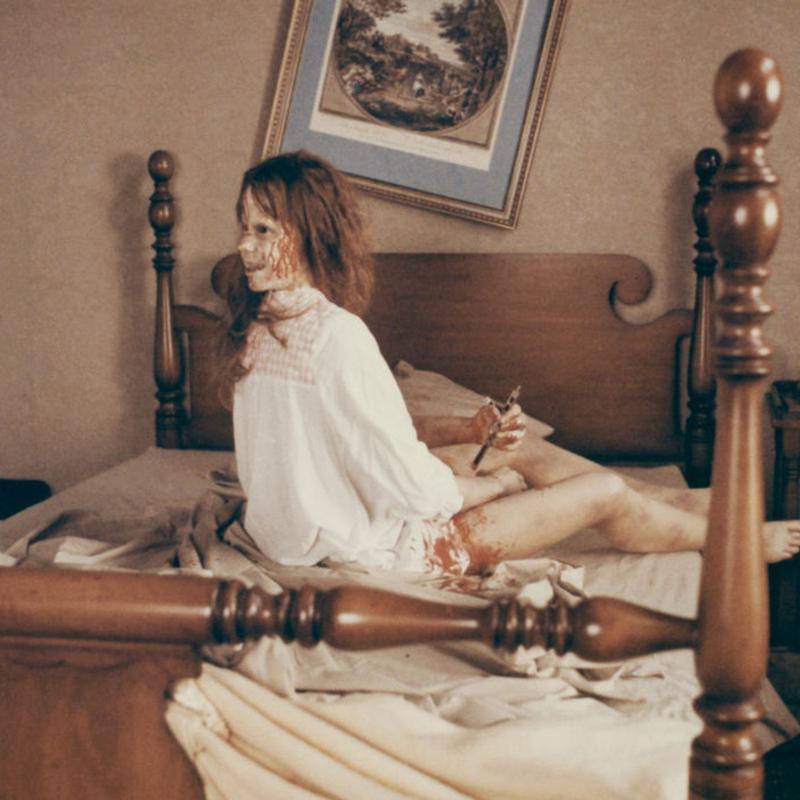
Eleanor Johnson: My favorite example to go to in this period and for this question is a very famous and frankly brilliant film, The Exorcist, from 1973. Of course, 1973 was a watershed year for feminism in the United States because it was the year that Roe v. Wade passed, and The Exorcist was released at the tail end of that year. Like a Christmas, hilariously.
As people know, in The Exorcist, a young girl named Regan gets possessed by this demon, and all hell breaks loose. She's being raised by a single mother, Chris MacNeil, played by Ellen Burstyn. Over the course of the film, part of what's revealed is that the demon who's possessing Regan is a Mesopotamian demon. The beginning of the film opens on this archaeological dig site in Iraq. If you look at the director's cut of the film, you'll see that this icon of the Mesopotamian demon fetish appears a bunch of times as a flash.
Regan becomes a monstrous bitch in exactly the same way that monstrous bitches have always been monstrous bitches, which is to say, her mouth gets really dysregulated. She swears like a maniac. She's got this bad voice thing going on. She's sexually dysregulated, as anyone who has seen the film will easily remember. I think it's one of the most striking things about the film. She is violent against women and children because she's violent against her mother and she's violent against her own body.
Brooke Gladstone: She stabs herself in the genitals with a crucifix.
Eleanor Johnson: She is absolutely in the tradition of the specifically Mesopotamian monstrous bitch. In fact, the demon who's supposed to possess her is called "Pazuzu" in the second film. Pazuzu was a demon who, in ancient Mesopotamia, was very closely and specifically associated with Lamashtu. The film franchise is really deliberately going to that iconography. What I find so interesting, all the doctors and the psychiatrists who try to treat her all conspicuously fail.
Brooke Gladstone: Actually, some of the medical scenes there are the most terrifying scenes in the movie.
Eleanor Johnson: Oh, my God.
Brooke Gladstone: Let's now go to the 2000s and the 2010s, when the monstrous bitches start biting back.
Eleanor Johnson: Now we're starting to see films that depict the monstrous bitch not really as an evil, horrible antagonist villain, but as the character that we root for and like maybe in spite of ourselves. You see that in a big way in the werewolf movie Ginger Snaps from 2000. You see it again in the 2009 film Jennifer's Body. My all-time favorite example, because I love this movie, is the 2015 film The Witch. What you have is this family in colonial New England who've been banished. This family strikes out on their own to live by this haunted forest in colonial New England, and the forest is occupied by a witch.
The witch perfectly satisfies the traits of monstrous bitchery. She's infanticide; she casts spells, and she's a seductress. Everything we expect, we're conditioned to think: the witch in the woods is the monster, but in the end of the film, the daughter of the family is the sole survivor after the witch has preyed on everyone, and you start thinking, "Oh no, the witch is going to kill her too."
Instead, this young woman, her name is Thomasin, and she's played by the wonderful Anya Taylor-Joy, goes out into the shed and meets Satan, who gives her a book so that she can sign up to become a witch. She joins the witch. She goes out into the woods to this evening fire-lit witches' Sabbath party. For only the second time in the entire film, we see this human main character smile and seem happy.
Brooke Gladstone: Not because she's evil, but because her mother had bought into the idea that Thomasin was a witch and her father was a tyrant.
Eleanor Johnson: Yes, that's right. It's not the case that the witch does something bad to Thomasin and turns her into another witch. What's actually the case is that the patriarchal family Thomasin had been horribly abused by has become intolerable to her, and so joining the witch is a path out.
[playing The Witch]
Black Phillip: Wouldst thou like to live deliciously?
Thomasin: Yes.
Black Phillip: Wouldst thou like to see the world?
Thomasin: What will you from me?
Black Phillip: Dost thou see a book--
[end of play]
Eleanor Johnson: Robert Eggers' film is re-theorizing the witch not just as a monster, but also as a parachute out of patriarchy for abused young women. There definitely is a reclamation of the monstrous bitch archetype in that film as something potentially beneficial for women.
Brooke Gladstone: Let's go to the 2020s now. The decade you wrote, shaping up to be the single worst in the atrophy of women's rights in our lifetime. Reproductive rights are under profound threat. Politicians are talking about stripping women's right to vote, some of them,-
Eleanor Johnson: Unbelievable.
Brooke Gladstone: -and you look to horror films about monstrous bitches for answers. You mentioned quite a few. I thought The Substance was pretty interesting.
Eleanor Johnson: The Substance is a fascinating film. Came out in 2024. To say that it's a film about female monstrosity is very obvious. The part of that film that I found so powerful isn't the depiction of Demi Moore descending from being this beautiful aerobics instructor to being this wizened old chicken leg eating, swollen-kneed witch character in her apartment, nor was it the splitting off of Margaret Qualley's character Sue from Demi Moore's character Elisabeth Sparkle. For me, the most interesting scene in the film by far is when Elisabeth Sparkle and Sue morph together into the weird Chimera monster, ElisaSue.
[playing The Substance]
Monster ElisaSue: Don't be scared.
Audience Member: Monster.
Monster ElisaSue: It's still me.
Monster ElisaSue/Elisabeth: It's me.
Monster ElisaSue: I'm Elisabeth. I'm Sue.
[end of play]
Eleanor Johnson: Then ElisaSue gets on stage and bursts and gets her blood all over the horrible executives who had dehumanized and, in effect, monsterized Demi Moore's character in the first place. It's a film that invites us way down the garden path of dehumanizing women, either by depicting them as old, witchy crones or hypersexual young women, leads us all the way down that garden path precisely to then slap us around and say, actually, the real monster here is the corporate men who literally have the blood on their hands. I thought that was very, very powerful.
Brooke Gladstone: You end the book on a story from 4,300 years ago about a Mesopotamian priestess named Enheduanna.
Eleanor Johnson: Yes, Enheduanna.
Brooke Gladstone: She's the first named author in history.
Eleanor Johnson: Yes. If you want to tell any little girls one thing from this book, it might be that. For as long as we've had writing, women have been writers. The first named writer in any language in the world was a woman. She wrote poetry about many things, but also about this goddess named Inanna. Inanna is a fascinating goddess. She's contemporaneous with Lamashtu and also with Tiamat, but she is not the same. Inanna is fierce and powerful. She crushes skulls. She looks like a lion; she's fast, she's dragon-like, and she's an advocate for the oppressed. She's a nurturer and a comforter. She does it all. She's the Virgin Mary and the Whore of Babylon rolled up into one.
I ended the book with her because I wanted to end the book on a thought experiment: What would it look like to live in a culture in which kids were taught the story of Inanna, taught that women's power could be fearsome and also consoling, monstrous and also beautiful, vengeful and also just. Inanna's the goddess of justice. That's not an accident. In ancient Mesopotamia, it was thinkable to assign this rich panoply of seemingly different traits to a single female entity.
We have trouble with that now. We have trouble allowing women to be powerful and beautiful, nurturing and ferocious, but we haven't always had trouble with that kind of multiplicity. In ancient Mesopotamia, even while Lamashtu's running around, so is Inanna. Look, we have a cultural precedent for doing things differently. Let's do it this way. Let's live with Inanna.
Brooke Gladstone: You said you wanted to see the story of the Monstrous Bitch no longer as a horror story.
Eleanor Johnson: I think it would be irresponsible for me as a historian to not acknowledge that most of the history I tell in Monstrous Bitch is tragic. These are cultural mechanisms that have been used to persecute, prosecute, and sometimes execute women and female children in particular. We need to look at the tragic history of the Monstrous Bitch head-on in order to begin to envision something better. Growth requires mourning, and I think that we're ready to do it. I have to say I'm very, very encouraged by these midterm results. I feel like many, many Americans are choosing to dare to question orthodox and to think that maybe, just maybe, there's a way to exist in a nation-state together that is not about monstrosity at all.
[music]
Brooke Gladstone: There's been an awful lot of dehumanization recently,
Eleanor Johnson: That's for sure.
Brooke Gladstone: Eleanor, thank you so much.
Eleanor Johnson: Thank you. Thank you so much.
Brooke Gladstone: Eleanor Johnson is a professor of English and comparative literature at Columbia University. She authored the recent book Monstrous Bitch: A History of Terrifying Women. Thanks for listening to On The Media's Midweek Podcast. Check out the big show on Friday. It usually posts around dinner time.
[00:40:43] [END OF AUDIO]
Copyright © 2026 New York Public Radio. All rights reserved. Visit our website terms of use at www.wnyc.org for further information.
New York Public Radio transcripts are created on a rush deadline, often by contractors. This text may not be in its final form and may be updated or revised in the future. Accuracy and availability may vary. The authoritative record of New York Public Radio’s programming is the audio record.