A Good Sign For the VOA?
( Jonathan Raa/NurPhoto / Getty Images )
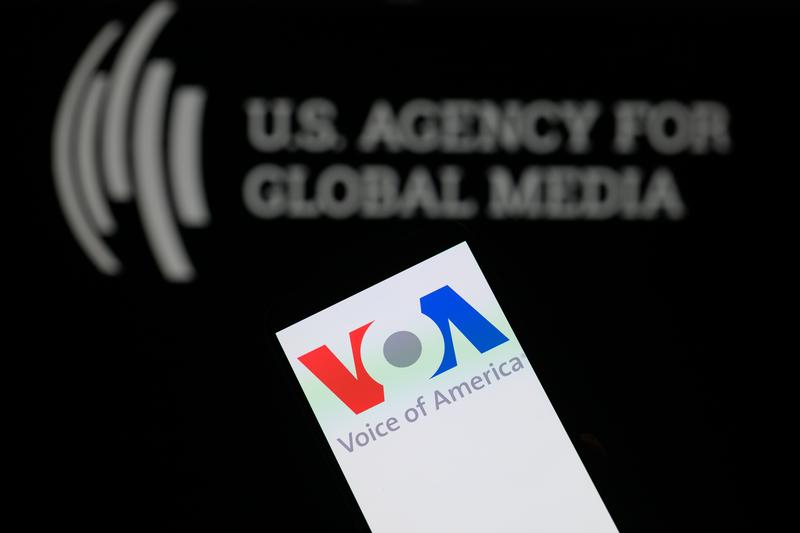
Micah Loewinger: Hey, you're listening to the On The Media midweek podcast. I'm Micah Loewinger. On Saturday, a surprising ruling came down from US District Court Judge Royce C. Lamberth. The Reagan-appointed judge found that Kari Lake, formerly best known as the loser of two statewide races in Arizona, had acted unlawfully in running the United States Agency for Global Media, the body that oversees Voice of America and the handful of other government-assisted media outlets. Here's a recap of some of what she's done so far.
News clip: All full-time employees and contractors working for the government-funded international broadcaster Voice of America were put on leave.
News clip: Also part of the cuts, Radio Free Europe and Radio Free Asia, organizations whose intention is to provide unbiased news to countries who otherwise might not have access to it. They broadcast to more than 40 countries, including Russia, Ukraine, and China.
News clip: Programs and broadcasts have been going off the air, and at this hour, the VOA is effectively silent.
Micah Loewinger: As the judge put it, Kari Lake "Satisfies the requirements of neither the statute nor the Constitution, potentially making all of her actions this past year null and void." Lake, who once described herself to a gaggle of reporters as "Your worst fricking nightmare," told NPR that she would appeal the ruling. Last February, when Lake started slashing and burning the 80-year-old service, I spoke to Nicole Hemmer a historian at Vanderbilt University. She began by telling me the history of the VOA, and about Robert E. Sherwood, the man who coined the organization's name.
Nicole Hemmer: He had seen the rise of fascism in places like Germany and Italy, and had seen the way that radio had enabled that by spreading propaganda across those countries. And so he came to this idea of Voice of America with that idea that there could be this alternative voice that was accurate, that was telling the truth, but that was also showing the war through American eyes.
Micah Loewinger: By 1944, VOA was broadcasting in over 40 languages. What would early listeners have heard when they turned on Voice of America?
Nicole Hemmer: Listeners would have heard some straightforward news reports--
[playing archival VOA news recording]
VOA News Anchor 1: This is a voice speaking from America--
VOA News Anchor 2: A voice from America at war.
Nicole Hemmer: But they would also hear American music, like jazz, being played across the airwaves.
[jazz music playing]
VOA Radio Host: The music of jazz parallels the freedom that we have in America, something that not every country has.
Micah Loewinger: The idea here is that by promoting jazz music, listeners would be more open to American influence?
Nicole Hemmer: I mean, it sounds kind of funny now, but in both World War 2 and then in the Cold War that followed, American soft power, which is what VOA represented, was about showing that America could help other countries by helping them rebuild after the war. But also, they were saying this is what you get with the American way of life. You get this innovative music, you get cool fashion and art, and that's what you get when you have a free and open and democratic society. It's not just about constitutionalism or rule of law, but it's about these things that make every day just a little sweeter.
Micah Loewinger: Okay, and so how is that different from American propaganda?
Nicole Hemmer: [chuckles] That's a good question. It is American propaganda, but I think that part of its propaganda was that it was an open and accurate news source. It's written in the mission of VOA that it has to offer accurate information, and they were doing that in countries that they believed were closed systems that were only getting totalitarian messages, countries that didn't have a free press.
Micah Loewinger: On OTM back in 2003, we had Alan Heil, who was a former VOA director, who explained it this way:
Alan Heil: You had, at the very beginning, among the pioneers, those who believed that the best policy was to tell the truth. General Stilwell, for example, said, "The Japanese gave us a hell of a beating in Burma." Now, that became a matter of some contention between the policymakers in Washington and Voice of America, but the VOA staff held its own. Later we learned, following World War 2 from some of the Japanese who were interrogated about their listening experiences, that that made them really believe the Voice of America.
Nicole Hemmer: Right. This was part of VOA's strategy. You couldn't straight up lie to people and expect them to trust you as a source of news. You had to tell them what was really happening. After the Cold War, there is a new regulation put in place for VOA, that creates a kind of firewall between the organization and the federal government so that administrations aren't trying to take political control of the journalists.
Micah Loewinger: What happened next? How did the VOA's mission change after the Cold War?
Nicole Hemmer: There is another moment of soul searching. Democracy seems to have won--
Micah Loewinger: The end of history. [chuckles]
Nicole Hemmer: Right. There's belief in the early 1990s that, well, everywhere is going to be free now, and so the US can kind of pull back. But then I think there is also a reevaluation of how much democracy has actually won at the end of the Cold War. You have all of these new countries that are being born and civil wars that are breaking out, and it is not clear that these are going to be democratic countries. They could very easily become totalitarian countries, and so the VOA mission sort of becomes to continue modeling a free press, continue to push for more open societies in these countries that are going through transition.
Micah Loewinger: You've used this term "soft power" a few times. How successful has VOA been in spreading this kind of influence? Do we have any way of knowing that it's hit its mark?
Nicole Hemmer: We can't necessarily say, well, this government regime toppled or this press regime became more open because of the presence of VOA, but that's kind of the idea behind soft power, that it's-- that's influence, right? It's providing a service that may not otherwise be available in the country where they are airing, and that that is going to essentially make people think more warmly of the United States and its form of government.
Micah Loewinger: Promoting democracy, espousing the values of freedom of information and freedom of speech-- This all sounds so great, but are there examples of moments where the VOA didn't live up to these lofty goals?
Nicole Hemmer: You know, where's the line between promoting a free press and promoting a certain economic form, promoting the hegemony of American culture and businesses in ways that have often made countries feel a little intruded upon? Because when American culture starts to push out national culture, that's not ideal for the countries where VOA is broadcasting. And so I think there is this tension between soft promotion of democracy and free press, and a kind of cultural imperialism, and that is always going to be an issue with an organization like VOA because of its mission.
Micah Loewinger: We're talking about an organization with hundreds of millions of dollars in its budget, which, to be fair, is a lot of money, given how hard it is to measure its success.
Nicole Hemmer: That's right. It is one of those organizations that I think it is fair to have a debate about, is this the best way for the US to be spending its money? The world has changed a lot in the last 80 years or: are there better, more efficient, more effective ways of promoting a free press both within the United States and abroad? I think it's worth having a conversation about the best ways to do that.
Micah Loewinger: Despite the laws attempting to shield the Voice of America from political interference, the White House issued a press release titled "The Voice of Radical America," which referred to a series of claims that it seemed to back up with a series of articles in right-wing media outlets, among them a National Review piece claiming, "Voice of America staff ordered not to call Hamas terrorists." What are they talking about?
Nicole Hemmer: There was a directive from VOA to avoid using the word terrorist when talking about members of Hamas. Now, people are free to call Hamas' activities acts of terror, terrorist acts-- The word terrorism is not verboten, and nor is it banned to call members of Hamas terrorists. But what they're responding to, and this is something that a number of media organizations within the US adhere to as well, is that the word terrorist in the US is a particularly politically-loaded term that is used unevenly depending on who is being spoken about. But there is no ban on the word terrorist. That's part of a much more nuanced conversation that is just one of journalistic protocols.
Micah Loewinger: That same White House press release that I quoted before also pointed to articles from Breitbart, Fox News, and The Daily Caller, including one piece from The Daily Caller with the headline, "Multiple Voice of America reporters have posted anti-Trump content on social media."
Nicole Hemmer: Now, it is true that people who work for VOA have said anti-Trump things on social media, but there has been no evidence that that has influenced reporting at VOA, and that's always the trick, right? That reporters might have opinions, but you have to show that it's influencing the way that they cover the news, and that's the missing piece in that particular accusation.
Micah Loewinger: Nevertheless, some members of the right-wing media are ecstatic. Here's Glenn Beck this week:
Glenn Beck: Now, I don't think we've had a problem in the east part of Europe for a while now with them not being free. You know, when Donald Trump says, "Hey, I want you to go into this agency and fix it," it's kind of like, "Hey, there's a problem with your doggies in the shed. Can you go fix Old Yeller?"
"Yeah, I can. I can, dad."
It's going to hurt, but it's the right thing to do.
Nicole Hemmer: It's a fascinating viewpoint that has become much more prevalent on the right in the last 10 years or so, that the US doesn't have a role to play in the world. Glenn Beck would go on to say in that segment that NATO should be done away with, and so there is this larger set of goals that the dismantling of VOA plays into that makes right-wing audiences so happy. VOA stood for a defense of democracy and free press across the world, and this is an administration that does not stand for those things. This is an administration that doesn't believe in the liberal world order that's based on a set of rules, that's based on human rights, but believes in a world order that is based on power. And that means that the US alliances in that world are with regimes like China, like Russia, these strongmen states. And so to see the US begin to withdraw from the institutions that were built to guard against totalitarianism says a lot about where the administration sees the US in the world, and that's, I think, particularly worrisome.
Micah Loewinger: Something you said earlier caught my ear, which is that one of the implicit ideas in the VOA early on was this idea that soft power, or propaganda, or whatever you want to call it, is more compelling if it's true. I wonder-- if you look around at the internet and our information ecosystem today, and you can confidently say that that theory is right.
Nicole Hemmer: I don't think it holds true anymore at all. It's why things like fact-checking aren't particularly effective pushback against propaganda, because people aren't necessarily persuaded by facts. They're led much more by seeing things that they want to believe and believing them, especially in a media environment where all of the signals of expertise and authority and experience have been stripped away. I think this is the biggest problem facing journalism right now, is that we're in an entirely different ballgame when it comes to how people come to understand the world around them.
Micah Loewinger: Nicole Hemmer is a political historian at Vanderbilt University, and the co host of the podcast This Day. Nicole, thank you very much.
Nicole Hemmer: Thanks so much, Micah.
Micah Loewinger: Thanks for listening to the podcast extra. Don't forget to listen to the big show on Friday. By the way, Brooke and I have been doing something a little bit new for us, we're making short-form videos on Instagram and TikTok. There are video clips from our interviews on the show, there are little reflections on things we're covering or thinking about in the media. We'd love to know what you think, so please drop us a comment. I'm Micah Loewinger.
Copyright © 2026 New York Public Radio. All rights reserved. Visit our website terms of use at www.wnyc.org for further information.
New York Public Radio transcripts are created on a rush deadline, often by contractors. This text may not be in its final form and may be updated or revised in the future. Accuracy and availability may vary. The authoritative record of New York Public Radio’s programming is the audio record.