[advertisement]
Manoush Zomorodi: Hello friend. This is an episode of Note to Self, but from when we used to be called New Tech City. Same good content, just the old name. Enjoy.
[music]
Manoush Zomorodi: From WNYC, this is New Tech City, where digital gets personal. I'm Manoush Zomorodi, and welcome to the Bored and Brilliant Project, where we are rethinking our relationship with our phones and jump-starting our creativity. This is challenge week. It's day number one. Over 14,000 people have signed up, and we've been measuring how much we usually use our phones. We've been using some partner apps, and we are averaging just under two hours a day of screen time. That is our baseline. Now we're going to try some challenges and see what happens to that number. Here's what some of you told us as you prepared for this week.
Eli Mendel: To prepare for the week of being bored and brilliant, I have been going on a cell phone binge and getting my fix as much as possible before the challenge begins.
Frances Coco: I haven't done much to prepare except download the app, and I've been looking at it every so often and crying over my terrible usage statistics.
Amanda Katz: I've been practicing leaving my phone at my desk when I get up to do things around the office.
Manoush Zomorodi: Those were bored and brilliant participants, Frances Coco, Eli Mendel, and Amanda Katz. Now, some instructions. Okay, so for the next six mornings, here's what's going to happen. You're going to start your morning with a Bored and Brilliant mini podcast. Each mini podcast will explain your mission, your challenge for the day, and these challenges have been designed to guide you through a week of rethinking your relationship with your phone to start discovering the lost art of spacing out, and then have some big ideas.
When it makes sense, we're also going to include the latest research, a personal story or two. Definitely some great inspiration. It's way more intimate listening to those than just getting a list of rules. For those of you who've signed up to track your phone usage with one of our partner apps, we'll be posting the stats every day at newtechcity.org/bored. Now, let's start with challenge number one.
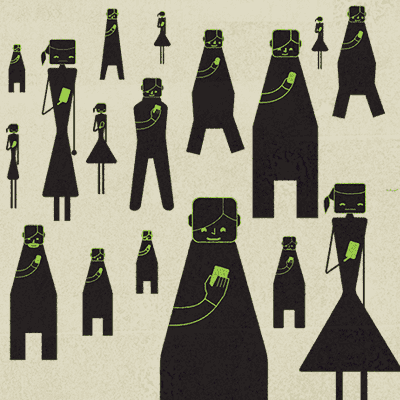
A few months ago, I wanted to know, when I walked down the street, does it just feel like everyone's on their phone, or are they really all on their phone? One day, I sat on a Manhattan street corner, and I counted. Don't worry, I brought a chair. There's actually a video of my little experiment that you can watch at newtechcity.org. Of the 1,000 people who passed me by, including the actress Emily Blunt, 315 of them were either typing on, looking at, listening to, or just gripping their phone. That's almost one in three people.
For your first challenge, do not look at your phone as you move about your day. Whether it's on the train, the bus, the sidewalk, in the passenger seat, during carpool, keep your phone in your pocket, or better yet, in your bag. Try to only look at it when you've reached your destination. The goal is to make some space for deeper thinking.
Alex Soojung-Kim Pang: That sense of being able to lose yourself in a problem was one of the most satisfying things I'd ever experienced in my life.
Manoush Zomorodi: Alex Soojung-Kim Pang got his PhD in the history of science and technology in the early 1990s. He's been a visiting scholar at Stanford for over 15 years, and now--
Alex Soojung-Kim Pang: I work as a technology forecaster and futurist.
Manoush Zomorodi: Alex is extremely smart, very accomplished, but something even happened to him when he got a smartphone. Maybe you can relate. Things started to pile up. There never seemed to be enough time in his day.
Alex Soojung-Kim Pang: I began to feel like I was losing my ability to really concentrate seriously on the things I needed to do.
Manoush Zomorodi: That satisfying feeling of really thinking through problems and finding solutions.
Alex Soojung-Kim Pang: I felt that slipping away.
Manoush Zomorodi: Alex being Alex--
Alex Soojung-Kim Pang: I wrote the book that would have helped me when I went through my own crisis with all these technologies.
Manoush Zomorodi: His book is The Distraction Addiction. It's a guide to something that Alex calls contemplative computing. He started out by tweaking his tech habits.
Alex Soojung-Kim Pang: Even if it wasn't the only thing that made a difference, it was certainly an essential first step toward regaining the ability to pay attention to all kinds of things in my life.
Manoush Zomorodi: Alex believes we can live more harmoniously with technology. I'm going to give you Alex's basic phone hygiene, and it's going to help you with your challenge today. First, and this is pretty obvious if you're not doing this, he turns off all the notifications on his phones, but Alex created one new one for himself.
Alex Soojung-Kim Pang: I have a little message on there to breathe.
Manoush Zomorodi: That's the message that appears on the home screen of Alex's phone when he turns it on.
Alex Soojung-Kim Pang: When we check our email, when we're waiting for webpages to load, we unconsciously hold our breath. This matters because it means that holding your breath is something that you do in moments of anxiety.
Manoush Zomorodi: Okay, so next, he sets his phone to have a special ring for the people who are most important to him.
Alex Soojung-Kim Pang: In an emergency in the zombie apocalypse, who do you want to be able to reach? Those people I've given one ringtone. In my case, it's the opening bars of Derek and the Dominos Layla. The whole rest of the world gets Brian Eno's Ambient: Music for Airports.
Manoush Zomorodi: Okay, so pretty basic stuff, but how many of us actually do it? Last, yep, it's your challenge for today.
Alex Soojung-Kim Pang: Unless you are, I guess, a doctor or you're a hedge fund manager or something like this, where microseconds really matter, doing things like not carrying your phone right against your body but carrying it in a bag can help ease some of that sense that you always need to be to have a little of your tension turned toward the phone.
Manoush Zomorodi: Okay, you overachievers, put your phone in your bag when you're in transport. Those of you like me, who want to ease into this whole no-phone thing while we're walking, let's just put it in our pockets. This is day one. We're just going to walk instead of texting and checking. Let's get bored.
Alex Soojung-Kim Pang: Good luck to absolutely everyone in this challenge. Remember, you can do it.
Manoush Zomorodi: Let us know how it's going, preferably while you're sitting in front of a desk or a laptop at newtechcity.org/bored. I will be posting my updates tomorrow, challenge number two, and the person we found who we think does the most mind wandering in the whole world. Talk to you then. I am Manoush Zomorodi, and this is New Tech City's Bored and Brilliant Project.
Alex Soojung-Kim Pang: There is something called phantom cell phone syndrome, which-
Manoush Zomorodi: Oh, I have it.
Alex Soojung-Kim Pang: -for people who don't know, Phantom cell phone syndrome is that feeling that your phone is buzzing even when you're not carrying it.
Manoush Zomorodi: You know what it usually is, actually, Alex?
Alex Soojung-Kim Pang: What is it?
Manoush Zomorodi: It's my stomach growling, and I think it's my phone, but it's my stomach.
[advertisement]
Copyright © 2026 New York Public Radio. All rights reserved. Visit our website terms of use at www.wnyc.org for further information.
New York Public Radio transcripts are created on a rush deadline, often by contractors. This text may not be in its final form and may be updated or revised in the future. Accuracy and availability may vary. The authoritative record of New York Public Radio’s programming is the audio record.