
Sportswashing and Money Win the Day in Golf
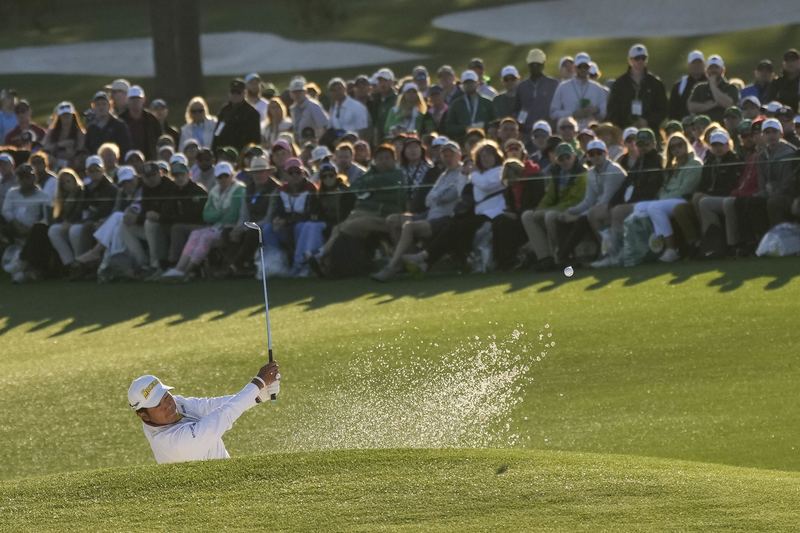
( AP Photo/Jae C. Hong )
[MUSIC]
Brian Lehrer: It's the Brian Lehrer Show on WNYC. Good morning again, everyone. Now sports business meets human rights. Have you heard about that proposed merger between the PGA Tour, the powerhouse in the world of golf in this country, and LIV Golf, a professional tour that's barely two years old, which has prompted outcries, the merger has, from 9/11 families, defenders of human rights, and all those who remember the horrific murder of the Washington Post journalist Jamal Khashoggi.
LIV Golf has the backing of the Saudi Sovereign Wealth Fund, known as the Public Investment Fund. With billions of dollars at its disposal, it has lured top golfers with huge payouts and purses away from the PGA. Critics point to this as just the latest in a number of high-profile big-money schemes on the part of Saudi Arabia to launder its image. Now there's a proposed merger and that's causing a backlash.
My next guest is Sarah Leah Whitson, the Executive Director of Democracy for the Arab World Now, an advocacy group founded by Jamal Khashoggi which puts it this way, in a quote to the New Yorkers John Cassidy, our guest does, "The PGA Tour had staked its ground on making the moral case against LIV and the Saudis to discover that was nothing but a negotiating tactic to get a higher price for the PGA came as a bit of a shock."
Sarah Leah Whitson joins me now to talk about the ethics of the merger and why even if you don't care about golf, you should care about this. Sarah Leah, welcome to WNYC. Hello.
Sarah Leah Whitson: Thank you for having me.
Brian Lehrer: Remind us how the PGA, as you put it, had staked its ground on making the moral case against LIV and the Saudis.
Sarah Leah Whitson: Well, the Commissioner of PGA Tours is on record and had given press conferences explaining that part of the problem with LIV golf was that it's owned by Saudi Arabia, a notorious systematic human rights abuser, a murderer of journalists connected obviously to the 9/11 attack on New York City.
The argument challenging players who were signing up with LIV Golf was that they were effectively accepting to work for an authoritarian dictatorial government, and yet now they're selling themselves to this authoritarian, dictatorial government.
Brian Lehrer: How did the PGA Tour and its commissioner,, Jay Monahan make such a complete 180?
Sarah Leah Whitson: think that's a question better for Jay Mohan and the PGA Tour, but what he said in the media is, well, this is just the best value for PGA Tour. I know what I said before, but-- and it's very clear that the Saudi government, Mohammed bin Salman threw a number at PGA Tour that they weren't able to say no to.
Basically, they sold their values. Their values, their beliefs, their principles that they said they had were for sale. We don't know yet how much, but they clearly have sold them to Saudi Arabia.
Brian Lehrer: Listeners, we can take some phone calls on this. Is anybody paying attention and has an opinion or a question about the proposed PGA Tour and Saudi-backed LIV Golf merger which has prompted outcries from 9/11 families, defenders of human rights, all those who remember the murder of Jamal Khashoggi, the Saudi-born journalist who worked for The Washington Post?
We invite you to weigh in, make your case for or against the merger, ask your questions, 212-433-WNYC, 212-433-9692. You can also text us at that number or tweet @BrianLehrer. Again, my guest is Sarah Leah Whitson, executive director of Democracy for the Arab World Now, or DAWN, which was founded by Jamal Khashoggi.
This is being talked about in the sports media, I think, in general as a done deal, but then when I scratch below the surface, it's not a done deal. Is it a done deal?
Sarah Leah Whitson: Not yet. First of all, the PGA Tour Board has to vote on it. Each board member is going to have to put its own stamp of approval with their name behind it. Second of all, the Justice Department has suggested that they may be doing an antitrust review of the merger.
You will note that LIV Golf's lawsuit against PGA Tour was that it was operating as a monopoly and now ironically LIV Golf wants to be part of that monopoly. That may be another problem. A number of senators in Congress have suggested that they have problems with Saudi Arabia owning such an important cultural institutional asset in the United States, particularly because of the real estate ownership that this gives.
I think it's very important to understand that LIV Golf isn't just Saudi-backed, it's owned by Mohammed Bin Salman and his personal kitty, the Public Investment Fund. It is the 93% owner of LIV Golf, and we've yet to see how the ownership structure is going to look in the merged entity including DP Tours, the golf tour outside of the United States.
There's going to be some serious congressional scrutiny of this, and they may say that they have national security grounds for opposing the deal. They may not be able to stop it, but they could certainly throw some screws in the wheels.
Brian Lehrer: I'm seeing that NBC News reported yesterday that the Justice Department's antitrust division will probe the merger, and California Congressman John Garamendi, a Democrat, introduced a bill that would strip the PGA Tour of its tax-exempt status.
Weird, I guess, that an organization that brings in millions every year retains tax exempt status [chuckles], this deal notwithstanding. I guess they have it because they're not the actual golfers making the money, they're the umbrella organization that just facilitates it?
Sarah Leah Whitson: Well, it's a puzzle to me how PGA Tour has any kind of tax-exempt status. I assume that this is some kind of relic from the past when it was merely a club organizing tours before it evolved into the commercial mammoth that it is today. It is a very important vehicle. LIV Golf has been a very important vehicle and PGA Tour will become a very important vehicle for Mohammed bin Salman to launder money.
He will launder money through PGA Tours, through LIV Golf to pay President Trump, and that is what LIV Golf has been used for since its founding with tens of millions of dollars steered to Donald Trump's golf resorts, effectively Mohammed bin Salman paying Donald Trump for golf tours. Now, it will be a much, much, much bigger market of golf games that can be steered to Donald Trump for whatever prices they choose to pay.
Brian Lehrer: We have a text from a listener who writes, "It is also a direct way to launder money to a certain golf course owner from his Saudi friends," so obviously referring to Trump. Do you see Trump having a hand in this?
Sarah Leah Whitson: Well, certainly Trump has been a significant beneficiary of Mohammed bin Salman's payments to him via LIV Golf. The exact amounts are still unknown, but we know it's been tens of millions of dollars. He has been basically blacked out by PGA Tour since this LIV Golf conflict started, but now the PGA Tour games will come to Trump resorts.
Now that Mohammed bin Salman will be the ultimate decider of where golf tournaments are held, we can expect that there will be more shifting of business to Trump.
The other interesting point is 93% of LIV Golf is owned by Mohammed bin Salman's Public Investment Fund. Who owns the other 7% we still don't know. I would wager to guess that there has been some reward scheme in the other 7%, and I wouldn't be surprised, I'm speculating here, if Trump Golf Resorts owns a piece of LIV Golf and will end up owning a piece of PGA Tours.
Brian Lehrer: Let's take a phone call from Beth in West Orange. You're on WNYCC. Hi, Beth.
Beth: Hello.
Brian Lehrer: You ready?
Beth: Hello?
Brian Lehrer: Yes.
Beth: Yes. Can you hear me?
Brian Lehrer: I hear you. Do you hear me?
Beth: Yes, I can. I just wanted to say I'm so glad you're discussing this issue because I pay pretty close attention to it.
Brian Lehrer: Oh, did we lose Beth? Beth, call us back. Let's try it again because I see that you're a golfer. You both play and you watch, and you have a strong opinion. Call us back. Meanwhile, we'll go to Alexis in Red Bank. You're on WNYC, Alexis. Hi.
Alexis: Hi, Brian. This merger is anti-American. It is antitrust. It is part of the--
Brian Lehrer: Did we lose her too? I don't know if something's going on with our phone bank, but Alexis's line dropped off.
Let me ask you, I think you heard where Alexis was going even though in those few seconds, Sarah Leah. Let me ask you as a leader of the group, Democracy for the Arab World Now, taking a step back from just this PGA and LIV Golf merger, how much do you think the United States should or shouldn't do business with Saudi Arabia? It's a complicated question for the United States generation after generation with some of the things that the Saudis do for and against their own people, for and against the United States.
I see that the Biden administration has been reported recently to be trying to warm up to the Saudis again. We want the Saudis for various things, oil, Middle East relations among the countries there. Is it an all or nothing? Where do you come down? Should we not be doing-- Some people will argue that there isn't a perfect, powerful country in the world, and we shouldn't just not do business with them.
Sarah Leah Whitson: Brian, that's a false binary. The question isn't whether or not the United States should be doing business with Saudi Arabia and many businesses in Saudi Arabia. There are many ways for the United States to have normal engagement with Saudi Arabia, including business, social, cultural, educational, technological exchanges, transactions, and so forth.
The problem is that United States has an abnormal relationship with Saudi Arabia. We don't just do business with them; we provide them with billions in dollars of lethal destructive weapons, and we provide them with political and security protection. That really makes us an aider and abettor of the Saudi regime, that really makes us complicit in their crimes, including seven years of a catastrophic war in Yemen that has brought tens of millions of people on the brink of starvation, and killed over 370,000 people using the weapons we have sold them, using the military assistance we have given them.
This is not about doing business or not doing business. This is about being complicit and supporting a brutal, ruthless, and reckless dictatorship that has gone around, in addition to, of course, torturing and murdering Jamal Khashoggi, continues to repress, and torture, and jail, activist voices, journalists, writers inside Saudi Arabia, that continues to threaten and harass people in the United States, that continues to impose an embargo on Yemen, limiting its ability to import food, fuel, and medicine. That is what needs to be reassessed.
Now, the Biden administration came in promising-, President Biden came in promising to make Saudi Arabia the pariah that they are, those are his words, promising to end arms sales to Saudi Arabia. Instead, they have done a 180-degree capitulation, completely abandoning the promises, humiliating our country, with President Biden appearing on bended knee to fist bump with a murderer, the man responsible, as our own CA tells us, for torturing and murdering a journalist, and completely abandoning any of the commitments, any of the realization that providing military and political support to this unhinged sociopath is bad for national security, is bad for the region, and it's bad for America. [crosstalk]
Brian Lehrer: I guess supporters in the US government would probably say something like, "Yes, but Saudi Arabia is our main bulwark in the region against Iran which is much worse and more of a threat," maybe Saudi Arabia plus Israel are the bulwarks, but certainly Saudi Arabia. The world is complicated and we are right to give the Saudis military aid for that reason.
Sarah Leah Whitson: Well, I would strongly disagree and I would strongly oppose a view that allows the United States to provide military assistance to murderous dictators because they're opposed to a different military or rather murderous dictatorships somewhere else. If the value, if the principle for opposing Iran is that they're committing human rights abuses and that they are committing bad acts in the region, then certainly that's the same principle that would argue against not just aligning with Saudi Arabia but providing it with military protection.
What the Saudi government wants now is NATO-level bilateral security guarantees from our country. They want us to be the security guards, the boots on the ground to protect their unhinged dictatorship. That's a step too far and it doesn't serve our interests.
Brian Lehrer: Julia on Cape Cod, you're on WNYC. Hi, Julia.
Julia: Is it me?
Brian Lehrer: Yes.
Julia: Because my name is not Todd. Okay, I'm calling because [unintelligible 00:15:43] [crosstalk]
Brian Lehrer: Sorry, I said Cape Cod. Are you on Cape Cod?
Julia: Sorry. Yes, I am, sorry. I'm outraged about this on the basis of both the connection to the LPGA and the PGAs non-profit 501c3 status. Those two things alone are terrifying. I wouldn't want to be a woman in the LPGA that gets subsumed and forced to play in some way connected to LIV. It's outrageous on so many levels.
Brian Lehrer: Thank you very much. Here's a couple of tweets that have come in. One says, "It's sportswashing, plain and simple, much like what we saw with the World Cup in Qatar. To a larger extent, it reflects a failure in US energy policy that these countries in the Middle East loom so large on the public stage." Someone else tweets, "There's an episode of Ted Lasso that addresses this." "Spoiler, billionaire defeated, but this deal as a Saudi to Trump pipeline is way more interesting," writes another listener.
Sarah Leah, would you like to tell our listeners a little bit about the work and mission of the group that you're the executive director of, Democracy for the Arab World Now? It's obviously about a lot more than golf, so want to talk about that?
Sarah Leah Whitson: Sure, thank you. DAWN is a research advocacy and publishing organization that is focused on reforming US foreign policy in the Middle East and ending America's support for abusive regimes in the Middle East and North Africa. As a US-based organization, we're focused on the governments with the closest ties to the United States because that's where we believe we can have an impact, and that's where we believe we have the greatest responsibility as Americans.
We seek to hold culprits accountable and we seek to hold lobbyists for abuse of governance, who are here in the United States, accountable for contributing to human rights abuses and benefiting from human rights abuses for a few dollars.
We are opposed to weapons' transfers to abusive governments in the Middle East. We think that the long-standing US policy of supporting unaccountable abusive dictatorships in the Middle East is bad for American interests and disastrous for the interests of the people in the region. It hinders democracy. Doesn't promote it.
Brian Lehrer: Laura in the Bronx, you're on WNYC. Hi, Laura.
Laura: Hi. I had just a comment. I think the prior woman mentioned this. Women in sports historically have been paid less than men, and this piece will exacerbate it. I also just think that our moral compass is floundering right now. The United States is really floundering in terms of what we want to convey, what we want to project to the world. It just shows that money talks, money sells, money buys. That's it. We have nothing else to show.
Brian Lehrer: Thank you very much. To the idea, Sarah Leah, of the Saudis not reaching out to the LPGA, it's a separate issue, but it's also an issue, right?
Sarah Leah Whitson: I suppose, I mean, I don't know if that could be part of the scheme, and could be part of the plan down the road. One thing I think it's important to understand in terms of the acquisition of PGA Tours and maybe one day LPGA Tours as well, is that this really isn't just about sportswashing, and it really isn't just about sports. There is a massive Saudi purchasing campaign underway in our country that cuts across sports, art, technology, finance, banking, water, massive swaths of real estate in our country that isn't just designed to launder Saudi Arabia's image, but is designed to have influence in our political and economic system. First of all, to avoid the kind of hiccup that Saudi Arabia experienced after the murder of Jamal Khashoggi when so many American businesses cut ties with Saudi Arabia, refused to play ball with the Saudi Arabian government. They want to make sure that doesn't happen again and a way to do that is by controlling and owning important stakes in important American businesses.
Second of all, it's also about buying our government. The Saudi Arabian government, Mohammad bin Salman man isn't just buying a golfing and technology and gaming in the United States. He's buying American government officials, and that's the thing that should worry all of us. There are no US laws that prohibit Mohammad bin Salman, sociopathic tyrant, from paying off government officials, including nearly 500 former military officials were now on the payroll of Saudi Arabia and the UAE.
The billions of dollars paid out to former Trump officials, the paychecks that await current members of the Biden administration when they leave government should they go to work for Saudi Arabia, that taints the decision-making of our own democracy, and it proves Mohammad bin Salman's point that his dictatorship can buy our democracy.
Brian Lehrer: Let me ask you one last question before you go. Are you appealing to the golfers on the PGA Tour, especially the big-name golfers to take a stand on this? I know there's been some focus on Rory Mcllroy, who I'm reading from the Sports Site Bleacher Report now. It says "Rory Mcllroy isn't happy about the merger between LIV Golf and the PGA Tour, but he told reporters he's resigned himself to money being the ultimate driver to professional sports."
Then it has a quote of him, "At the end of the day, money talks, and you'd rather have them as a partner." Though he has previously said he hates LIV Golf, there's the quote. Oops. This just popped off my screen, but there was another quote that said, "I still hate LIV Golf." Are you disappointed in Rory Mcllroy in particular, who I think might have been a leading voice against LIV when it first formed and did not join that tour, or any other big-name golfer and put some responsibility on them?
Sarah Leah Whitson: Well, absolutely I would put an individual responsibility on them because they have a choice. They're not starving for their last dollar to save their family from hunger. These are very wealthy people who are choosing to prioritize greed over principles and values. I suppose there's nothing new there. I'm very disappointed, obviously, in PGA Tours, which by being owned by Saudi Arabia is contributing to the abuses in Saudi Arabia and is benefiting from the abuses in Saudi Arabia.
It's really hard to demand that US businesses take a more ethical stand when unfortunately the behavior that the blanket administration is modeling is not much better because they have given the green light to American businesses to reestablish a cozy relationship with Mohammad bin Salman.
When you have every senior official of the Biden administration appearing before Mohammad bin Salman, smiling for the cameras, shaking his hand, he's been rehabilitated by our own president, by our own government.
Unfortunately, I spare my largest condemnation for the Biden administration. They could have made a different choice. They could have invested more in energy alternatives rather than allow us to remain beholden to cheap oil, but instead, they have taken the most politicized, expedient, cheap, and harmful way out.
Brian Lehrer: Sarah Leah Whitson is executive Director of Democracy for the Arab World Now or DAWN, founded by Jamal Khashoggi. Thank you so much for joining us.
Sarah Leah Whitson: Thank you for having me.
Copyright © 2023 New York Public Radio. All rights reserved. Visit our website terms of use at www.wnyc.org for further information.
New York Public Radio transcripts are created on a rush deadline, often by contractors. This text may not be in its final form and may be updated or revised in the future. Accuracy and availability may vary. The authoritative record of New York Public Radio’s programming is the audio record.
