
One City, Under Protest
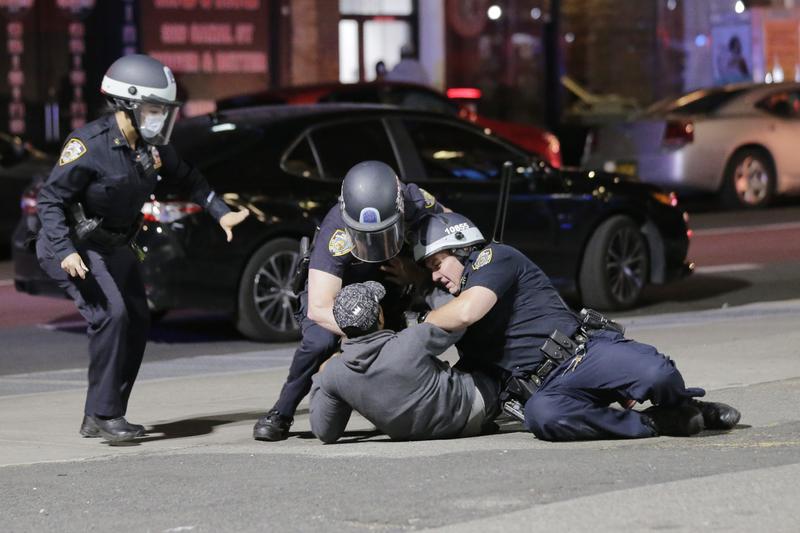
( Seth Wenig / AP Photo )
Speaker 1:
WNYC studios.
Crowd:
I can't breath. I can't breath. I can't breath...
Brian Lehrer:
Protestors here in the city chanting, "I can't breathe," over the weekend as we continue our coverage to the uprisings against police brutality and systemic racism generally here in New York and around the country. And we continue to invite your calls if you were among the protestors this weekend and would like to say something about that experience. (646) 435-7280. We do have a couple of open lines now, after we got through a lot of people in the first segment, (646) 435-7280.
Brian Lehrer:
And with us now is Brooklyn Borough President, Eric Adams. Borough President, thank you so much for making the time for us on an intensely busy day I realize. Welcome back to WNYC.
Eric Adams:
Oh, thank you Brian. And it has been a dizzy of 50 plus days for me because with the appearance of protests does not mean the disappearance of Corona virus, and we have to remain vigilant on all fronts.
Brian Lehrer:
How much do you think the context of the pandemic is relevant or irrelevant to the extent of the uprising?
Eric Adams:
Oh, very much so. What you are seeing on our streets is not about the knee on Floyd's neck, it's about the knee that has been on the neck of people of color, immigrants, of those who have been living in poverty, and really they have not had their voices heard by our government or responded to. And Dr. King said it best, paraphrasing him, a riot is the voice of the voiceless. And we have to deal with it. I know people want an instant change. They want to just go back to normalicy, but that normalicy was abnormal behavior for a countless number of people and it cannot be ignored.
Brian Lehrer:
How's Brooklyn this morning?
Eric Adams:
Quiet. And I have used the opportunity for the last seven days during the morning hours and the daylight to speak with those who are protestors, who have a righteous complaint. I have been communicating with them, some of the representatives from Black Lives Matter Brooklyn, and telling them how to identify those professional provocateurs that really they're in the city, not to fight against police abuse, but to burn down our city.
Eric Adams:
We have a professional group of people, and New Yorkers need to understand that this is a very dangerous moment. When you have individuals who are trained to make incendiary devices, individuals who had scouted out our city and have trained EMTs to assist them when they're injured and have backpacks full of rocks to resupply of their comrades, they have infiltrated and hijacked of a righteous complaint by our young people.
Eric Adams:
Our young people have protested before, you didn't see police cars burned and we need to be concerned about that. One of the previous callers stated that someone's just break a window of a target, it shouldn't be a big issue. No, this is not about breaking the window. This is throwing a fire bomb in a car with four cops, and if we realize it or not, we are made up of people in the city that includes doctors and nurses, and also police officers. We're all human beings and we all want to go home to our family. And we need to be very concerned about the violence that has hijacked the righteous movement.
Brian Lehrer:
So let me play a clip to that point of mayor DeBlasio from over the weekend, that's become very controversial. And this was in relation to the incident that I'm sure you saw caught on video in which a police car drove into a crowd, two actually. The mayor defended the officers on the grounds that as shown on the video members of the crowd had placed a metal barricade in front of the police car, penning it in and threw some things at it before it charged forward. Here's the mayor yesterday,
Mayor:
They've been surrounding police cars, surrounding police vans, attempting to do violence to police officers and to the vehicles, and that's exactly what you saw in that video. It is a troubling video, and I wish the officers hadn't done that, but I have to be clear. They were being surrounded by people who were attacking that vehicle.
Brian Lehrer:
And Borough president, you referenced a minute ago the context of a previous incident where an actual Molotov cocktail apparently was thrown at a police car. So how much do you and the mayor see that incident the same way?
Eric Adams:
We see it differently. And I think the mayor has been trying to really control the very difficult situation. But in reality, the role of police is to protect people and property, but properties should never go on top of police policing. Let the car be destroyed. You cannot run a vehicle, a police vehicle over people. That is not acceptable. We should not allow that. We must have a zero tolerance on both ends. A zero tolerance of those who are attempting to harm law enforcement and innocent people. But we also must have a zero tolerance for police officers who are gone beyond the call of duty and use it in an offensive way not a defensive way. Not seeing too many cases of that.
Eric Adams:
When you pull down a mask of a young person with his hands up and spray mace in his face, or you push a young lady to the ground to hit her head on a pavement or drive the vehicle through a crowd, that's not acceptable. They should be immediately identified, removed from service immediately and those criminal actions, they should be prosecuted. And that's important. You got to have a zero tolerance on both ends of the spectrum, or you lose control of this. We are the professional. We must not act like those professionals who are bringing violence into our city.
Brian Lehrer:
What would have been the appropriate response on the part of the police in that vehicle when the metal barricade was placed in front of them and things were being thrown at the car?
Eric Adams:
Exit the vehicle. If the vehicle is destroyed call for assistance, call for backup. If the vehicle is destroyed, that's something that we don't want to see but in reality the vehicle can be replaced, a human life can't. If that vehicle would have been successful, we had in each circumstances... Because it wasn't one vehicle involved, it was two. Circumstances we had anywhere from 10 to 15 people in front of the vehicle. Losing 10 to 15 lives because of two metal objects as vehicles is not acceptable. And we need to keep that in mind.
Eric Adams:
And that brings out a larger compensation that we need to ship out through that I've been attempting to share with the mayor and the police commissioner. Because you are in a career, it does not mean you are suitable for every assignment in the career. When we do a mobilization of an emergency in our city, with our police officers, a level one, two or three, call the police or respond to a particular incident, we do nothing to determine the mental capacity of the individuals who are responding.
Eric Adams:
Some people in offices are not made for every level of assignment. It doesn't mean they can't do a policing job, but they're not made for every level, just as every doctor should not be in emergency room. Every doctor is not a surgeon. Every teacher is not a high school or special ed teacher. We don't treat police in the same way. We need to rethink how we have individuals on the frontline of these protests and whether they're meant to capacity to be able to deal with the high intensity of a protest of this magnitude.
Brian Lehrer:
Let's hear from some more callers. People who were protesting outside this weekend. Natalie in Suffolk County, you're on WNYC. Hi Natalie. Thank you for calling in.
Natalie:
Hi, thank you for having me. I was in Brentwood this weekend on Long Island. I went to a very peaceful protest. I had been home for 93 days because of Corona virus, but I really felt like I had to be out there. As a non-black Latina I felt like I had to go support the black community, especially in light of the very anti-black coverage that has been on air on the large Latinx media outlets, like Telemundo and Univision. Our protest was very peaceful, but I can say that for my friends protesting in Brooklyn, police were definitely agitating. And then once my friends were trying to get home, the police were blocking them in which created a lot of chaos.
Brian Lehrer:
What do you feel you've been seeing on Univision and Telemundo?
Natalie:
A major focus on the looting actions and a moralizing tactic to try to say and tell people how they can protest something that is not our place to tell people how to feel their grief or how to engage in this work. And kind of relatedly I just want to say that the outside agitator narrative which is certainly true, in some cases, it does ultimately take away from the actions of justified anger in this moment. And it will also justify violence towards groups within the protests that are seen as other.
Brian Lehrer:
Natalie, thank you so much for your call. Moon Changho in Crown Heights, you're on WNYC. Thank you so much for calling in.
Moon Changho:
Thank you for having me and thank you to president Adams. You're good man and you do good work. Everybody know that you've been helping everybody during the COVID-19 to help everybody. So thank you very much. I thank you so much. I don't usually... I used to go to protest when I was younger and I went on a Sunday and I didn't mean to do it. I wasn't going to and I didn't tell my friend, the family that I was going to go, but I had to go because this is not acceptable.
Moon Changho:
How can we be doing this to people. I've seen this for over 30 years now. This has been happening to people and it's been happening even longer than that. This happened... Eric Garner, 60 years ago, he's killed by police, but he's not... Nobody charged for that. Or few years ago, Saheed Vassell, our neighbor, he's killed by police. Nobody charged for that. It's over and over again, keeps happening. And the protest itself is scary because I see the police acting... I'm not from New York originally. I come from another place, then I come to the West Coast, then I come here. And so I happened to live in Seattle when the WTO protest happened and all the things I saw at the WTO protest and I see the police do the same things during the Bush years when they... People anti-war protest and the police shoot grenade and they shoot tear gas and they hurt people. But those times nobody believe it.
Moon Changho:
They order, they say maybe other thing happened but this is different. This is different because all these kids... And I'm so worried about all these kids, they're going to get the COVID-19 and they got to survive because all of these kids are out there. They have the phones and they show everybody what happened. And so nobody can deny what happened in the New York and every other city, like right now. So I'm sorry. I'm very upset. I don't need to yell right now. So.
Brian Lehrer:
That's okay.
Moon Changho:
I apologize for doing that.
Brian Lehrer:
You're being very respectful actually and restrain to my ear. And I think people were very glad to hear what you had to say. Thank you and please call us again.
Moon Changho:
Gam-sa-ham-ni-da. ("Thank you" in Korean).
Brian Lehrer:
So Borough president Adams, to his big sweep of history point. Many of our listeners know many do not that you started the group 100 Blacks in Law Enforcement Who Care decades ago, you spent 20 plus years on the NYPD yourself. We've been through Bloomberg trying to make the department better at working with the community after Giuliani, but then mass stop-and-frisk, and then DeBlasio trying to make the department work better with the community then under Bloomberg, but still all these incidents that even just in the last few months we've seen with social distancing policing. And now some of the events of this weekend, it's no wonder people are exhausted and not optimistic. How much do you see the arc of NYPD history bending toward justice during your time in public service? And how much do you see it as stagnant?
Eric Adams:
Well, let's be clear. My fight for justice in law enforcement did not stop when I put on a blue uniform. I was arrested, beat bad by police and went into law enforcement because community leaders came together and asked us to go into the police department. And that's how we started 100 Blacks in Law Enforcement Who Care. I marched during the day for the end to stop-and-frisk and at night I had to put on a uniform and protect marches. Testified in federal court with Floyd versus New York City Police Department. The federal judge mentioned my testimony in her decision. And so this is my life vow of dealing with the issues in law enforcement. And we have to make real changes in the honest protests of those who attempted to do so was doing a good job, but the young lady who stated the narrative of outside agitators is not correct.
Eric Adams:
The organizers of the march here in Brooklyn, they are saying also, we don't want these outside agitators hijacking our righteous fight to protest. We have a right in America to protest. We don't have a right to burn down buildings. We don't have a right to stop buses with passengers on it, or on their way home and threaten their lives. We don't have a right to take the life of another person in our pursuit to save the life. And that is so important. And this is a long battle.
Eric Adams:
And let's be clear, the changes in America did not come through violence. It came from people like the Rosa Parks and the Dr. Kings and the other leaders, Harvey Milk, who fought for gay rights. The various leaders in this city that fought for immigrant rights. This is what America is about, forcing change. But you don't do it under the flames of destroying our communities. And I would never accept that. And so I know the passion that's involved, not only professionally as a police officer, but personally as someone that was beat bad by police. And this is my life vows and will continue to be still so.
Brian Lehrer:
Well, how much is it your impression that the core uprising against police brutality and racism generally is being hurt by anarchists with their own agendas? And how much do you think some of the violence is part of the rage and exhaustion at the injustice?
Eric Adams:
I think it's a combination of two of... Let's be clear. There was a reason that Yamani Williams and I sent the letter to the department of justice to investigate how people of color across America was treated during the Corona virus epidemic or there's a reason people in NYCHA are frustrated with having lead base paint and the lack of decency in our children that have in supplies, our hospitals that are our safety net not receiving the same level of resources. You add the police abuse of this. So it's not the knee on Floyd that is causing this outrage, is the knee on black and brown American, immigrant Americans.
Eric Adams:
And there's something else that we can't ignore it here. Is that decent human beings have remained silent. We knew that a million black and brown people were being stopped in the city a year. And yet we didn't raise our voices of too many people who are decent or walking their dogs in central parks. Yet they call the police on black men. Where's the outrage from our business community. Where's the outrage for those of us who live a comfortable life, watching other people live in this country. And we need to be honest as Jack Nicholson said in A Few Good Men, many of our Seattle city is misrun, and we really don't want to know the truth. We have ignored what has happened to a countless number of people.
Eric Adams:
So return to at normal behavior can be an abnormal behavior, normally one part of the city in abnormal and another. That's what you're seeing on the ground. I've been out here every night, talking to these young people, watching the march, finding out what they're feeling. And during the day, talking to them about how do we keep our message clear without destroying our city. Our city can't be destroyed.
Brian Lehrer:
Let me take one more phone call for you before we run out of time. And our coverage continues with other guests along the way. Ijeoma Oluo will be next and we'll continue to take many phone calls. Vic in Freeport, you're on WNYC with Brooklyn Borough president, Eric Adams. Hi Vic.
Vic:
Hi, thank you. Hi, thank you for taking my call. I wanted to actually talk about, I went to the protest in Jersey city yesterday, and it was very peaceful and we got some very unique perspectives. The police footprint was very small. But the reason I called was I feel like racially, I look very ambiguous. I belong to the Sikh community. My brother wears a turban, I don't. And we both live in very different Americas. And it's crazy that depending on how tanned I am, people's responses, or at least the system, the way... The America I live in changes based on just how much pigment I have it by skin. And going back to this protest yesterday, I feel like a lot of that. I relived a lot of those experiences and I kind of understood where the detachment, where the disconnect was between people that have experienced racism and those that haven't.
Brian Lehrer:
Whoops! Did we lose Vic's line? Hang on, let me see if I can pull you back up here. Vic, are you there?
Vic:
Yep. I'm here.
Brian Lehrer:
Go ahead. Finish your thought. Go ahead.
Vic:
Hello!
Brian Lehrer:
I don't know what happened. Yeah, go ahead. Yeah, you can continue.
Vic:
Yeah. I feel like, depending on what race you are, we live in very different Americas. And I think the healing process will only start once we empathize with the other side, not just by listening to them, but walking in their shoes. That's it.
Brian Lehrer:
Thank you very much. Borough president Adams, he mentioned being at the protest in Jersey City. I'm seeing another Jersey article colleague sent this to me, headline in Daily Kos. Camden sees no violence, white police chief locks arms and marches in solidarity with protesters. I don't know if you're familiar with Camden or its police chief, or if you think that could be a model for New York and elsewhere.
Eric Adams:
Yes. It could be a model. And today at 12:30, we're going to the 88 precinct, where was one of my formal commands as a platoon commander and where the firebombing attempted to take place. We're joining police officers and community and religious leaders in protests. And we're taking a knee because we know this is about talking to each other and not at each other. We are not going to be able to have a cosmetic approach to this. That is why Brian, I was doing the breaking bread, building bonds, forcing and moving people to get to the table and share a meal together and learn what it is to be a Sikh, what it is to be a Hasidic, an African American, a Caribbean America.
Eric Adams:
We live in this diverse city but let's be honest, we don't know each other. We walk past each other, we ignore each other, we don't communicate with each other, and then we wonder why we are responding the way we're doing. It is time for us to understand that if we don't deal with the underlying problems we're going to have responses like these. So many of my affluent friends say, "Why don't we just call in a National Guard? Why don't we just do a curfew? Why don't we just end this tomorrow?" No, this is not that simple.
Eric Adams:
If we have to deal with what is causing this blaze, then this is our opportunity to do so. And it's about face to face interacting, getting out of our comfort zones, going into other communities in neighborhoods, join into protest, being tutors, being part of solving these problems that are in our cities. The cities no longer could run. One part of the city is successful and healthy and thriving and another part is in despair. That it can't be America anymore.
Brian Lehrer:
Borough president Adams. We always appreciate your time. Thank you today.
Eric Adams:
Thank you very much. Take care.
Copyright © 2020 New York Public Radio. All rights reserved. Visit our website terms of use at www.wnyc.org for further information.
New York Public Radio transcripts are created on a rush deadline, often by contractors. This text may not be in its final form and may be updated or revised in the future. Accuracy and availability may vary. The authoritative record of New York Public Radio’s programming is the audio record.
