
The NYC and NYS 2024 Budgets
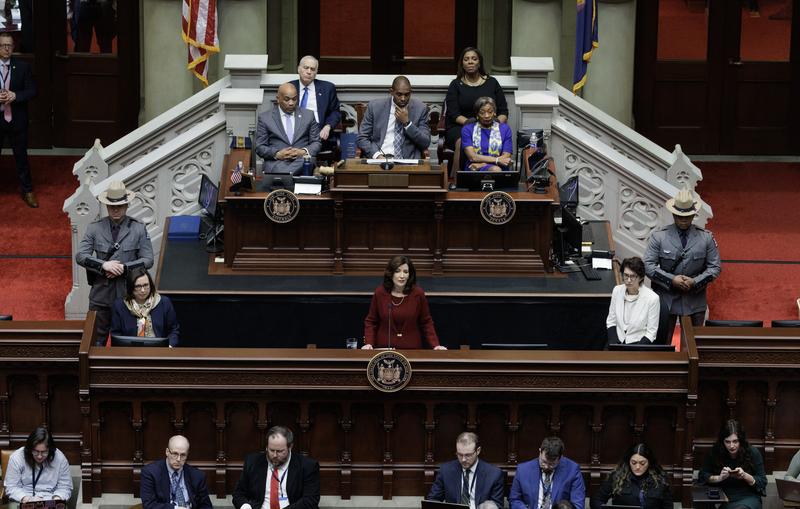
( Mike Groll, Don Pollard, Susan Watts / Office of the Governor )
[music]
Brian Lehrer: Brian Lehrer on WNYC. Now, as we usually do on Wednesdays after Mayor Adams Tuesday news conferences, our lead Eric Adams reporter, Elizabeth Kim, joins us with clips and analysis. Today we have a special edition because our Albany reporter, Jon Campbell, is joining too. Why? Because yesterday both Mayor Adams and Governor Hochul, just to make the heads explode of reporters like us, gave their annual budget addresses on the same day. If that sounds bureaucratic and wonky, Oh, budget addresses, remember the budget is where the rubber of nice political speeches meets the road of what actually gets funded and who gets helped or hurt.
Most of you know about the tensions around the budget recently, especially in the City with the cuts to libraries and so many other things that the mayor had imposed, caused he said, by the overwhelming new expenses from so many asylum seekers coming all at once. He's actually dialing some of those cuts and that language back a bit, as we'll hear. As for Governor Hochul, she's got her own budget issues. Here's what she says her budget can accomplish.
Governor Hochul: This budget proves that you can have fiscal discipline, and that can coexist with people-driven progressive policies.
Brian Lehrer: Progressive policies like rebalancing which districts get how much state education funding, already causing a backlash in some school districts that we'll explain. Hi, Liz and Jon. Welcome to our Wednesday meetup.
Elizabeth Kim: Good morning, Brian.
Jon Campbell: Hi, Brian.
Brian Lehrer: Liz, my head is exploding from the two of them giving their budget addresses on the same day and me trying to get familiar with the details of both, enough to have this conversation in a non-stupid way. Why did they time it this way, which I think is unique or at least very unusual?
Elizabeth Kim: I think you're right. I think it is unusual, and the mayor was asked about it. Technically, he does have to deliver it by the 16th. Although I'm saying technically, but it's not like anything is going to happen if he decides to give it a day or a few days later. When he was asked why, he says, "Because it's due by the 16th." I think the mayor is a person who likes to adhere to deadlines.
The other theory was that the political press corp now has to split their attention and coverage on these two different speeches. Hochul gave hers in the morning, and then Adams followed. It's a lot for the political press corp to digest. I don't know, cynics might have their own theory about why they decided to do it that way.
Brian Lehrer: A lot of people might say, "Hmm, I could think of a lot of other rules that Eric Adams decided not to follow," but that's another show. Jon, same question from the governor's side.
Jon Campbell: It's a similar explanation. The governor constitutionally has to deliver the speech by the-- It fell on the 16th this year, so it's the same idea. They don't ever do anything early in Albany. That said, usually you've got the governor's budget addressed first, the budget proposal, the City gets a better understanding of what kind of state aid they might be getting and then the City goes, but it didn't happen this time.
Brian Lehrer: I'm looking at the headlines on Gothamist of each of your stories. Liz, yours is, "Mayor Adams reduces cuts to schools, libraries, and elderly services with his $109 billion budget." Jon, your headline is, "Governor Hochul unveils 2024 budget with 2.4 billion for migrant spending." Let's go through each of these a little bit. Liz, I see you asked the mayor yesterday at the news conference about the library cuts. Want to set up the clip of his response?
Elizabeth Kim: Sure. Over the weekend, the mayor said that he would not impose another cut on the libraries. Now, that another cut would have meant that many branches would lose Saturday service. Now, if you remember in November, they also got a cut, and that resulted in them losing Sunday service. I reported the news, and then Mayor Adams later in the day came out with a video confirming that.
What I wanted to ask the mayor was, some critics said, "Okay, so he didn't impose another cut," but, "Hey, mayor, what about restoring?" In his video, he talked about how important libraries are. He called them the great equalizer. Then it begs the question, why not restore the cut that you made last fall? Really just it's $24 million. Many people would consider that a drop in the bucket. This was his response.
Mayor Adams: The libraries had the decision to determine how they were going to do their pegs. They made the determination of taking away those weekend services. They made the decision of doing that. We thought that was too draconian, and we held them harmless, but they have to make the decisions. This is all-hands-on-decks moment. Some of them have almost $1.5 billion in endowment. Come on, we've got to all step up.
Brian Lehrer: Wow, burn on the heads of the libraries in New York City. Have the library leaders responded?
Elizabeth Kim: When the mayor came out with his announcement on Sunday that he would hold the libraries harmless, they did come out with a statement in which they thanked the mayor for sparing them. You have to remember the libraries are really good at doing what they do when it comes to budget cuts, but they do have to be careful too. The mayor, in a way, blaming them for those cuts is an interesting move. The libraries, in the past, they've pointed out that the City has a mandate, basically. They are obligated to provide operating expenses for the three library systems.
That goes back to an agreement that the libraries made many, many decades ago. They often point to that agreement as to why the City has to provide them with operating expenses. Aside from that, I think people who are professional fundraisers will often point out that you don't typically use an endowment to pay for keeping the lights on. The endowment is often used for very big capital investments, like you want to start a new wing, you want to expand the children's section. That's usually what the donors come to the library to want to give. It's not, "I'm going to give you money so that you can maintain the Sunday service." I think that's a more difficult ask of donors.
Brian Lehrer: All right. That's the libraries for the moment. Then there's the big picture, and Jon, be patient, we'll come to you in just a minute for the Hochul budget and how it ties into all of this. Then there's the big picture of the better news overall on the City budget that the mayor announced. Here's the mayor on that.
Mayor Adams: Could we have properly forecasted the actions of Governor Abbott? We saw real fiscal responsibility of a moving target. One week, he has surge, one week, he wouldn't. Did we know that we were going to automatically be able to get 60% of the people out of our care? No, we did not. As we went on, deputy mayor Williams-Isom came up with these various ideas. This amazing feat of stabilizing and having people become self-sufficient was all part of it. I understand that some people want to politicize this, and I get it, but we have to remain focused during these times.
Brian Lehrer: Liz, should we hear that as something other than the budget dance that takes place every year, but this is a somewhat more extreme version of it. The mayor always announces that the cuts are going to be more draconian than they're going to need to be. The City Council always starts to push back, and then, "Oh look, we're getting more tax revenue than we anticipated," and they come to some agreement that includes some cuts. It feels good because they stop beating your head against the wall for more cuts, like you were describing about the libraries before or is this something really different?
Elizabeth Kim: Everybody's been trying to dissect this. I spoke to a longtime veteran fiscal expert about this, and whether this felt different to him. The answer he gave me was, Yes because it does feel like there have been some dramatic swings in messaging in really only days up until he announced his budget yesterday.
Brian Lehrer: Meaning dramatic swings in the amount of burden that the asylum seekers are placing on the City budget services in all other respects, right?
Elizabeth Kim: What happened was last week, the mayor started restoring certain cuts that he had made in November, they were unpopular cuts. He restored some cuts to police, fire, sanitation, parks, and schools. The timing of that was very interesting because in the lead-up to his budget, he decides that he's going to restore money. In the large scheme of things, it's not a lot of money. It's around $200 million, and he made roughly $3.7 billion in cuts in November. It was interesting, and he was forced to explain this because we've been told for months consistently and even in the lead-up to last week, that we are facing a very dire situation, that mayor said he doesn't want to make these choices, but he has to.
Then all of a sudden, we see this coming around. One of the Council members has said, Justin Brannan, who chairs the Finance Committee, he made this joke that the budget dance, but who is the mayor dancing with? It looks like he's dancing with himself. A couple of other people have repeated that too because the question becomes the budget dance is about posturing. In the beginning, we all assumed that to a certain degree, the mayor wanted to send a message to Washington and also Albany, that the City needs help with the migrant crisis.
Then all of a sudden, one week before he's scheduled to give his budget, he then shifts and rolls back some of those cuts. Then on the day of the budget itself, we do see him also scale back plan cuts to other agencies as well. He's not leaving this up. He's not waiting for the negotiation with the Council to start. He's already rolling back some of the cuts even prior to that negotiation with the Council.
Brian Lehrer: Listeners, if you're just joining us, we're talking to our City hall reporter, Elizabeth Kim, and our Albany reporter, Jon Campbell about the confluence of Mayor Adams and Governor Hochul releasing their major budget proposals for the forthcoming fiscal years on the same day, yesterday. This isn't so much of a call-in segment because we have a lot of material to get through just explaining the likely impacts and the politics of how these will or will not get through the City Council and state legislature.
We could take a call or two if you have a very relevant question. 212-433-WNYC, call or text 212-433-9692. Now, Jon, related to what we were just discussing with Liz, one of the headlines from the state budget is an increase of about $500 million in funding for the City to help with migrant services. Here's a clip of the governor on why she's proposing that.
Governor Hochul: We also know that companies won't do business in New York if there are thousands of people sleeping on the streets, or the quality of life is dramatically impacted because the City is forced to cut essential services.
Brian Lehrer: Give us the basic numbers in this area, Jon, and what the governor announced that's new.
Jon Campbell: The basic numbers are about $2.4 billion total in migrant services spending in the governor's budget proposal for the coming fiscal year that starts April 1st. That's $500 million more than the $1.9 billion in the current years. The big difference there is the state is going to take on the costs associated with two of these temporary shelters, these tent-based shelters that are out there. It's the Randall's Island shelter and the Creedmoor facility in Queens. That's about 3,000 beds that the state is going to take on the cost of. The state already is funding the Floyd Bennett Field temporary shelter in Brooklyn.
They're going to add those other two to the mix. That is the big thing. Now, one of the interesting things here is that extra $500 million is going to come from the state's reserves. They're rainy day funds, which Governor Hochul has built up to about $20 billion. It's been a source of pride for her. She's going to tap into that for that extra $500 million. It's really the first time she's tapped into that fund.
Brian Lehrer: What does that do for the City? The state was already giving the City about $2 billion for those various things you just mentioned that are ongoing. Now, it's $2.5 billion. I guess this question is really for you, Liz. Is the mayor reacting with a lot of gratitude or with a shrug like, "Hey Gov., it should be a lot more than that."
Elizabeth Kim: I would say the tone he struck was he was cautiously optimistic. Yesterday he said we need more time to dig into the numbers, but if it looks okay, there's a chance that he might-- He was going to order cuts again in April. He said based on these numbers, he might consider not going ahead with another cut.
Brian Lehrer: With these cuts still on the horizon, to some degree, as you've been explaining, both the mayor and the governor happened to mention that they are not raising taxes on the wealthiest New Yorkers or businesses. Here's another seven seconds of Governor Hochul.
Governor Hochul: Today New Yorkers will learn about how we're presenting a solid balanced budget without cuts or added burdens.
Brian Lehrer: By added burdens, Jon, she means no tax hikes?
Jon Campbell: Specifically, she's referring to income tax hikes. Income tax is the state's biggest generator of revenue. Governor Hochul, since she's taken office, has been steadfast against increasing income taxes in New York, including on the wealthiest New Yorkers. That really sets her up into this battle with some of the more progressive members of the legislature who have been pushing for higher income tax rates on the wealthy and are going to continue to do so, so they can fund some other projects that they want, added public transit, things like that.
That's why they want higher taxes on the wealthy. The governor has made the case that we have to live within our means and also that increasing taxes, you don't want to drive out the wealthiest New Yorkers who contribute an oversize share of the state's tax revenues.
Brian Lehrer: Right. We've been talking on this show and people have been talking elsewhere about the recent research that seems to show wealthy people in businesses are not leaving the state to avoid New York tax rates, rather it's lower and middle-income people leaving because they can't afford housing and other private sector costs. Do you expect to see progressive legislators try to add an income tax hike on the wealthiest individuals or businesses in the state, and that's going to be a big fight between them and the governor?
Jon Campbell: Absolutely, I do. The governor undercut her argument a little bit last week. She had made a point that a lot of the people who move out of New York State are moving to, say, New Jersey and Connecticut, who also have high income tax rates. That was surprising. She made that point last week.
Brian Lehrer: California was another state that's a destination high-tax state as well. They're not going to Florida and Mississippi so much.
Jon Campbell: Absolutely. The idea is this is going to be a battle between the governor and the legislature. I'm not quite sure where the legislative leaders, the senate leader, and the Assembly leader are going to land on that, but there will be a sustained push from progressive lawmakers and progressive advocacy groups to increase taxes on the wealthy.
Brian Lehrer: Listener texts this question, "Question for Brian and the budget team. Lots of talk of cuts, did anything get increased spending? Seems like migrant spending got the bulk of the increases." I'll ask each of you. Liz, at the City level.
Elizabeth Kim: There's a lot of pages to go through, but from what the mayor talked to us yesterday, he did restore cuts that he made last year. If you consider that an increase, although it's not really, like I said, that was roughly $200 million that he restored. That's not really adding, but no, generally what happened was he ordered most agencies to take a 5% cut. Then what ultimately happened was he scaled back some of those cuts. I don't believe there was--
Brian Lehrer: No real new initiatives there. Jon, what about at the state level? Because the governor's State of the State speech last week was long on the need for new affordable housing and taking more seriously mental health in the state. Do we see that language translated to numbers in the budget?
Jon Campbell: The short answer is yes, especially on the mental health side. There's a lot of different new initiatives that the governor is pushing and putting money behind. She's putting $40 or so million behind a plan to open more mental health clinics in schools. She's putting $65 million behind an effort to open 200 new inpatient beds for mental health support. Things of that nature are throughout this budget. She did put her housing plan. That's more of a policy area that she added to the budget that's always happened to New York budgets. She put through her plan that she wants to incentivize housing growth by only allowing local governments to apply for certain state grants if they create new housing, if they become a "Pro-Housing Community", as the governor calls it.
Brian Lehrer: Jon, in our last 3 minutes or so, let me ask you to touch two other state budget issues, which are really huge, and probably we should do separate segments on them in the coming weeks. One is the education funding formula, state aid to school districts, and why that is instantly controversial.
Jon Campbell: The governor wants to eliminate a policy called hold harmless. Basically, it's been in place for years, and it says, "School districts, we're going to plug the state aid into a formula. It's going to cough out the number of dollars that you're going to get from the state. It's based on population, it's based on enrollment, but if that formula says that you're supposed to get less money than you got the year before, we're going to scrap that. You're going to get at least as much money as you got the year before."
The governor wants to get rid of that because essentially she says it's outdated, and there are many, many schools that have had decreases in enrollments and are still getting the same amount of state funding. She wants to get rid of that provision. That is going to be a huge fight, particularly on Long Island, in the Hudson Valley, areas that she's battled with before and areas that are very important suburban battlegrounds. That's going to be a big battle going forward.
Brian Lehrer: Right. We've talked on the show many times about how basing school district budgets on local property taxes perpetuates inequality because obviously, high-income districts with very valuable homes generate a lot more property taxes, and so there's a lot more money per student in those school districts. It's state aid that is intended to level that playing field somewhat.
It seems like the governor is trying to do that a little more aggressively and there's going to be backlash from some of those better-off districts. Tell us very briefly about the Medicaid burden increasing for the state financially speaking. We've been talking about private health insurance going up. Is Medicaid going to cost New York State a lot more this year and why?
Jon Campbell: Short answer, yes. The reason why in part is because the population is aging. There are baby boomers who are enrolled in Medicaid that need long-term care. That is something that has increased significantly in recent years, and particularly this year. Yes, that's going up. At the same time, the governor is pledging certain cuts, but we don't really know what those cuts are going to be, at least $400 million of them are not yet determined. There's $200 million in cuts that she's going to negotiate with the healthcare industry. We don't have a ton of details there. Overall costs are going down, but at the same time, she's trying to identify some savings.
Brian Lehrer: All right. To come in these coming weeks on the show as the Albany budget debate goes on before the fiscal year begins April 1st. The education funding formula has a discrete conversation and the cost of Medicaid and what to do about it has a discrete segment. For today, we thank our Albany reporter, Jon Campbell, and our City hall reporter, Elizabeth Kim. Read both of their articles on both the City and the state budgets on Gothamist. Jon and Liz, thanks so much.
Elizabeth Kim: Thanks, Brian.
Jon Campbell: Thanks, Brian.
Copyright © 2024 New York Public Radio. All rights reserved. Visit our website terms of use at www.wnyc.org for further information.
New York Public Radio transcripts are created on a rush deadline, often by contractors. This text may not be in its final form and may be updated or revised in the future. Accuracy and availability may vary. The authoritative record of New York Public Radio’s programming is the audio record.