
Monday Morning Politics: Iowa Caucuses Preview, NY Reparations Study Bill and More
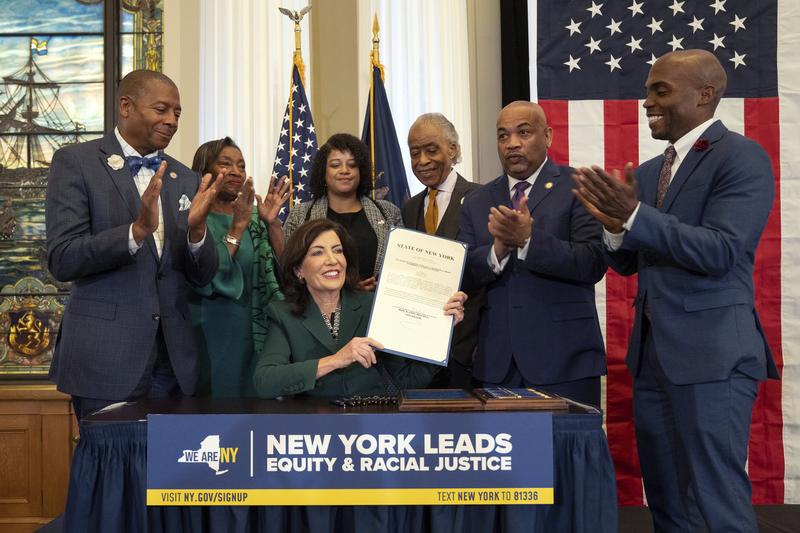
( Don Pollard/Office of the Governor via AP / AP Photo )
Brian Lehrer: It's The Brian Lehrer Show on WNYC. Good morning, everyone. Welcome to this kind of weird confluence of Martin Luther King Day and the Iowa caucuses. The first voting day in this presidential election year is today. It's a Republican voting day, specifically, as you know, Trump and his various challengers.
I was reading up this weekend because I was curious on how this confluence came to be. Because my first impulse would be to think, well, wouldn't they avoid King Day out of respect for the national holiday and Dr. King's legacy? The Iowa caucuses are usually on Mondays, not Tuesday, like most other elections, but usually a few Mondays later in January or early February. In 2016, they were on Monday, February 1st. In 2020, they were on Monday, February 3rd. Why not keep putting the caucuses around there and let people do MLK events today? Yes, there are King Day events scheduled in many places in Iowa. I looked it up. Don't just write it off as flyover country.
Here's what I found as to why in an Associated Press article from last July, which is when they set today's date. The AP quoted State Party Chairman Jeff Kaufmann saying, committee members hadn't considered the possibility of the contest falling on the federal holiday. That's a little vague. That's the language from the AP story. The Party chairman of the GOP in Iowa said committee members hadn't considered the possibility of the contest falling on the federal holiday.
A little vague, but it makes it sound like the Iowa Republican Committee sort of forgot that there even is a national holiday on a Monday in January. If they were scheduling for February, would Presidents' Day not have occurred to them as a Monday in the month that they might want to work around? If it was Columbus Day, I don't know if they also call it Indigenous Peoples' Day in Iowa yet, probably do, second Monday in October. Would they have forgotten that that exists? Are there no Black people on the Iowa Republican Committee who would more likely have been remembering that January has a Monday national holiday, this particular one? I don't know.
Then the Iowa Republican chairman tried to make it sound- once he got caught by the AP in this interview, it seems like, make it sound like a good thing. When the AP asked him about it, he said, "As Republicans, we can, I, we see this as honoring the legacy of Martin Luther King in terms of having a caucus here." Maybe he was just squirming to find something acceptable to say, or who knows. Since King was so much about voting rights, maybe they even did this on purpose, but the reporting by the AP last July and that squirming quote, "We can, I, we see this," make it sound like not that.
Here we are. We will talk about the subzero-weather caucuses in Iowa today. We will also talk about the bill signed by Governor Kathy Hochul in New York just recently that establishes a commission to study reparations for slavery. Then later in the show, we'll air an interview that I did for the WNYC King Weekend event at the Apollo Theater that took place yesterday. In honor of Nikki Haley, kind of, we'll have a call-in for teachers off from school today in Iowa or anywhere else. Did you know the schools closed today, Iowa? I hope Republican Committee members remember to cover child care. A call-in for teachers off from school on how you teach what caused the Civil War, as well as how you teach MLK. For experienced teachers, for those of you who've been at it for maybe 20 years, has that changed very much over your career? That'll be at the end of the show.
With us to talk about the Iowa caucuses and New York's new Reparation Study Commission Act is Christina Greer, expert in both national and New York politics. She is a Fordham University political science professor. She's a Moynihan Public Scholars fellow at City College. She's host of the podcast FAQNYC, host of the podcast The Blackest Questions on The Grio, and author of the book Black Ethnics, which I have the full title of here. It is Black Ethnics: Race, Immigration, and the Pursuit of the American Dream.
Christina, always great to have you on. Happy Martin Luther King Day and opening day of the presidential election season. Welcome back to WNYC.
Christina Greer: Thank you, Brian. I love spending Martin Luther King Day with you. This is like several years in a row now.
Brian Lehrer: Do you know anything more than I just quoted from the AP about why the caucuses are on the same day as the Martin Luther King national holiday?
Christina Greer: No, I don't know more about that, but I think it says a lot about the Republican Party and how they view not just voters of color, but Black voters in particular. While you were putting together that intro, I was thinking about the Iowa Brown & Black Forum that's been going on since 1984, and they actually had to cancel it this year because none of the leading candidates bothered to even go to talk about their issues and policy proposals and their vision for the Party in the country with the members of the Iowa Brown & Black Forum. The fact that they forgot that it was Martin Luther King's birthday when they scheduled this isn't surprising.
Brian Lehrer: I read that some Iowans are now having to choose between caucus events, which of course are in-person at night, and King events in their towns also scheduled for this evening. Any sense that some people there are feeling angry or erased by this caucus schedule?
Christina Greer: Yes. Different colleagues of mine who are in Iowa and who have traveled to Iowa over the past several election years, I think the largest story is the weather, to be quite honest. Just a reminder for our listeners, this is a caucus and not a primary. That means they don't just go cast their ballot and leave and possibly make both events. This is you stay until your candidate presumably wins. That definitely sets up a different dynamic this evening where if you are, let's just say, a Nikki Haley or Ron DeSantis caucus-goer with such a lead that Donald Trump has roughly 50% going in, those people might have an incentive to stay and skip all other events. I don't know how many events are going to be canceled largely because of the weather that has been coming into Iowa for the past few days and creating very dangerous conditions.
Brian Lehrer: Yes. Certainly, the big story out of Iowa besides the voting itself is the weather. I looked it up just before we went on. It's currently minus-9 in Des Moines according to my weather app, minus-24 with the wind chill. It'll be about like this during the caucus hours. Officially, the state there, I think, is advising people not to go out if they don't have to, but then we have the caucuses where you have to go out and stay for a while in the way you were just describing. Think that favors anyone?
Christina Greer: Well, we have to remember, caucus-goers tend to be a little bit older. You don't really hear a lot about like 18 and 20-year-olds really staying. We have to have concerns about, will older people want to be on those types of treacherous roads? I think Donald Trump has made it very clear. He said in a speech like it doesn't matter if you essentially die going to caucus, like it'll be worth it for the larger mission. I think this is where we get to Tip O'Neill, where all politics is local. I think county by county will see advantages and disadvantages.
We do know that Trump supporters tend to be voracious and die-hard, literally and figuratively. For people who really love Nikki Haley or Ron DeSantis, if they've inspired some folks in Iowa like that, that gives them an incentive to stay until the very end despite the weather. Now we know that Nikki Haley tends to lean a little bit more upper-middle-class with her supporters, so I don't know if they'll feel that it's imperative for them to stay and really get their message across until the very end. I do think that if all projections go well, weather aside, Donald Trump will have a pretty significant victory. Keep in mind, this is not his first time in Iowa, and his caucus-goers presumably know their districts very well and know how to persuade others in doing so.
Brian Lehrer: Listeners, anyone [crosstalk]--
Christina Greer: Even thought he didn't win the first time.
Brian Lehrer: Ted Cruz won in 2016, right?
Christina Greer: Yes.
Brian Lehrer: Listeners, anyone in Iowa listening right now, you can answer the question how cold is it, 212-433-WNYC, and give us any political analysis you have of who's going to do well there today and why. 212-433-9692. Or anyone else not from Iowa with any questions or comments about caucuses versus primaries, caucusing on a Monday, caucusing on Martin Luther King Day, how the candidates are running on or away from racial and other forms of inequality, or forgetting what caused the Civil War or anything related. 212-433-WNYC, 212-433-9692. If you're in Iowa right now. We get calls from Iowa sometimes. If you're somebody originally from Iowa or with some roots or connections in Iowa, call us up too with anything you want to tell us or even ask about the caucuses today and anyone else. 212-433-WNYC, 212-433-9692, for Christina Greer from Fordham and CUNY, and the podcasts FAQNYC and The Blackest Questions. 212-433-WNYC, 212-433-9692. Call or text.
Do you know, by the way, why they do this in Iowa on Mondays in general, when just about every other election day in the country in a presidential or any other year is on Tuesdays?
Christina Greer: No, I don't. I should probably call Walter Shapiro who's the resident expert of all things primaries and caucuses. Unfortunately, he's in New Hampshire getting ready for the primary there, but I don't know why Iowa has chosen Monday for their caucus. I can look that up and maybe the next segment, discuss [crosstalk]--
Brian Lehrer: Maybe one of our Iowa people or Iowa-connected listeners can fill us in on, why did they put this on a Monday? Maybe they wanted a lot of people to forget that it was election day. Like, "Let's stay home. It's tomorrow, right? Tuesday, is it? No, it's Monday." Can you put on your professor hat and give us a little bit more even than you did before on what a caucus is compared to a primary, and what the pros and cons are considered to be, or why some states or state parties prefer to do it this way?
Christina Greer: Right. Let's start with the easy one, which many of New Yorkers listening have participated in, hopefully. A primary is you go, you cast your ballot and you leave, and depending on your district, you might get a little sticker that says, "I voted," and that's the process. The difference between a primary and a caucus is the caucuses are run by political parties. Primaries are usually run by the state, not always, but [unintelligible 00:12:22], and they're held usually in the evening, and voters must attend in-person. We know that there are certain states where in a primary, you can vote absentee. For a caucus, you must attend in-person in order to participate. Of course, every rule has like tiny little asterisks, but for the most part you have to attend in-person. You essentially, Brian, sit in a room with other supporters for your candidate, but also supporters for your candidate's opposition, and you all go round by round to see who will emerge victorious.
It's really important for you to have a strong ground game in Iowa so that you get that political headwind going into New Hampshire. If our listeners remember, in 2008 with Barack Obama versus Hillary Clinton, obviously Hillary Clinton was going into the presidential race with an incredible advantage for a host of reasons: last name, had, I would say, a much longer political history as Senator of the state of New York than Barack Obama who'd just recently become a senator, but he had such a strong caucus game in Iowa, he went into New Hampshire with a very robust energy. Now Hillary Clinton ended up winning New Hampshire for a host of reasons we can get into for another time, but it didn't essentially cancel out Barack Obama. Now had he lost Iowa, Hillary Clinton would've gone into New Hampshire and the rest would be history, but since he won, it really showed that he had the mobilization of individuals who were willing to go toe to toe, round for round [crosstalk]--
Brian Lehrer: Among other things, a caucus is more of a measure of enthusiasm, because you have to go and stay the evening and have that commitment before you set out, compared to a primary where even if you're voting in-person, you go to the polls, you cast your ballot and you go home.
Christina Greer: Right. Now this is where it gets tricky, where a lot of people don't like caucuses realistically. Because they're run by political parties, it sets up relationships that many people feel are a little more elite level. If I'm a candidate and I establish strong relationships with members of political party structures, they will help put together my caucus voters and build that enthusiasm, which is great, but it does differ from one person, one vote in a lot of ways.
Brian Lehrer: Here is Carolina in Astoria, who says she has a sister in Iowa. Carolina, you're on WNYC. Hi, there.
Carolina: Hey. Yes, I have a sister who lives in Red Oak- well, outside of Red Oak, Iowa, which is where Joni Ernst theoretically still lives, but where she's from. My sister lives-- [crosstalk]. Yes. She lives probably four or five miles outside of that town. It's like 10,000 people. For the last five days, she had been saying, I don't know if I'm going to even be able to get to work on Monday because of how terrible the snowdrifts were. It's the middle of nowhere. There's not- well, at least in parts of Iowa, there's not that many trees, so even with a little bit of snow, depending on the wind patterns, you get these massive, massive drifts that you just can't drive past. I'm sitting here wondering, "Gosh, I wonder how many very, very rural voters physically cannot get to a caucus."
Now typically, okay, they would get on a snowmobile, but it's too cold out. It's literally too cold out to do that. There might be people going there in tractors. I don't know. It'll be interesting to see if that has an effect. Then if the wind picks up again later today, because sometimes-- I didn't grow up in Iowa, but I grew up in rural Nebraska, and very much the same, where you could clear the drift, but if the wind picks up again, it's closing again. If the wind were to pick up later, it could be very interesting. Some people might have to leave the caucus early that weren't planning to, or they're going to be sleeping in the gym where they're caucusing.
Brian Lehrer: Very interesting, Carolina. Very interesting. Thank you for your call, and it kind of addresses one of the texts we just got from a listener that maybe other people were thinking too. Do the caucuses happen outside? If they're indoors, which they are, wouldn't it not matter how cold it is? But there's Carolina's explanation of how, particularly in rural areas, the cold and the wind, et cetera, might be an obstacle even to getting there. Thank you for that.
Here's Craig in Manhattan, who's originally from Iowa. Craig, you're on WNYC. Thank you for calling in.
Craig: Yes. Good morning, Brian. Thank you for taking my call. I am originally from a very small town in northeast Iowa. I was back to Iowa in September, and I had two reunions, one with high school friends and another with family and large, pretty much rural-oriented family in Elkader, Iowa, and I did not find any avid Trump support. I was not obviously poking for political discussions, I knew it could be fraught, but it turned out that we had some political discussions at my class reunion at the end of the stay after everyone was sort of trusting each other.
There was one guy who was a very strict Republican, conservative, Chamber of Commerce-type, small budget and that sort of thing. He was not talking about Trump or anything like that. He was a very reasonable guy, and I was a little bit heartened. Obviously, it looks like everybody in Iowa was an extremist, but I don't think that's true.
Brian Lehrer: Craig, thank you very much. It's what we call an informal, unofficial, thoroughly unscientific sample [chuckles] of Craig's friends. Certainly, the big Iowa poll that came out over the weekend, like a lot of other polls recently, seemed to show Trump with a very commanding lead for the caucuses in the state, but Mark in Queens, who says he grew up in the Midwest, is going to have a different take on those polls.
Mark, you're on WNYC. Thank you for calling in today.
Mark: Yes. Hi. I did grow up in the Midwest. I've never been to Iowa, though. I'm somebody that's petrified of the chances of Donald Trump being re-elected. I think that in terms of people of color increasing support for Trump, for example, I think I heard that somewhere around 20% of Black men are planning to vote for Donald Trump, which could be very significant in states like Michigan and Wisconsin. If Donald Trump is re-elected, I'm not going to blame Black men. Because I'm a white male. There's a lot more white males in the country, and I'm sure well above 50% of white males are fighting to vote for Trump. I guess with your guest, are you hearing that, particularly like Black men are drawn to Trump, and I guess the question is, why? [chuckles]
Brian Lehrer: Mark, thank you for the question. I think that was one poll and others have not had anything like that 20% figure, but Christina, have you looked at those?
Christina Greer: Yes. I'm actually writing a paper with some colleagues about that, looking at conservative podcasts by other Black men. Much of the conversation isn't necessarily supported with data, and yes, Mark is correct. There are way more white men and white women who will vote for Donald Trump than the small percentages of Black men, and obviously the vast majority of Black women are completely immune to the Republican Party and Donald Trump.
What I do think is interesting is this conversation about this shift to the Right for Black men, and it largely comes with economic concerns, a purity test that Joe Biden is failing. We also have to remember that when you dig through the data a little more closely, oftentimes when they've asked Black men these questions, a follow-up question is, "Did you vote and are you planning on voting?" As someone who's run focus groups, oftentimes people with very strong opinions about the Democratic Party and possibly the disappointment and wanting to move Rightward, those people have not voted and do not have a voting plan. I'm not saying that we ignore people who don't vote, but when we're having an analysis of what the future of the Democratic Party looks like especially in a presidential election year, I want us to also focus on people who are actually planning to vote.
Brian Lehrer: Well, I feel like there's also this cognitive dissonance today. We'll hear a lot on the holiday about the persistence of racial inequality as a legacy of slavery and Jim Crow, and other Northern state forms of discrimination that deprived and do deprive Black people of economic and other kinds of equality. Then on this Martin Luther King Day, we have candidates like Ron DeSantis banning AP Black history in Florida high schools, and Nikki Haley dancing around the cause of the Civil War to not offend some Republicans. The vote comes on King Day, and yet the polls show at least some of this leaning with a few more percentage of Black men and maybe a tiny more percentage of Black women leaning Trump than they did in the past elections.
I guess my question is, do you know if the Republicans are campaigning at all explicitly on how they would promote more racial equality?
Christina Greer: No. I think the Republican Party also has been pretty clear about some of their anti-Blackness as mentioned with Ron DeSantis. We've seen he's not the only governor who's cherry-picking ways to uplift anti-Blackness in his particular state. I think some of this trending to the Right, if it is in fact the case, has less to do with support for the Republican Party and Donald Trump and more to do with a disappointment in what the Democrats have not delivered, Joe Biden, in particular, and so this enthusiasm gap that many political scientists talk about.
I think when we're dissecting the policies of the Republican Party, we know that every year on Martin Luther King Day, like clockwork, they cherry-pick a few quotes that they like, with no context. We know that Martin Luther King wrote several books, many of which are on my shelves, and they're the antithesis of many of the policies and proposals put forth by the Republican Party, but on Martin Luther King Day, they choose a quote or two and say, "Listen, this is our ideal vision," which is not the vision of Dr. King at all.
When we are thinking about Black voters and the Republican Party and the ways that many Republican electeds not just ignore Black voters, but actively work against the interests of Black voters on local state and national levels, this slight trend, if true, to the Right has less to do with what they're promising and more to do with trying to show Democrats a level of disappointment. I don't think that that strategy will bear fruit, but people are entitled to obviously have feelings of disappointment or excitement in whatever direction they feel.
Brian Lehrer: I've heard one other point of analysis come up on this, which is just a feeling that Trump or the Republicans might be better for their personal finances. They'll look past the anti-Blackness and other things if they think, "Well, we actually did better during the Trump years before the pandemic, and we want to go back to that because we're hurting financially." I don't know if you've looked into that, but that's a common analysis that I've heard for these few points of potential swing.
Christina Greer: Oh, absolutely. There's always the economic argument. This is why Donald Trump does so well with white voters because they feel as-- all voters go to the polls for pocketbook issues. If we look closely at the data; for college-educated Blacks, it's loan forgiveness under the Biden administration is real. The price of gas is lower. There are so many economic parameters that the Biden administration has succeeded in. One, they don't advertise it to their own peril. Two, there's a perception gap between the Biden administration and the Trump administration.
Many people are doing better economically under the Biden administration; the perception isn't there. If you don't feel like you have more money in your pocket, whether or not the facts are true, that does affect how you want to go to the polls. There's also a difference between the economy and people's personal pocketbooks. Yes, the economy is much stronger under the Biden administration, by and large, in projections in the future, but if that doesn't make people feel better personally, then that obviously is affecting how we've seen many African Americans look at the Biden administration.
Brian Lehrer: One more call in this section. Pauline in Queens, who says she participated in the Iowa caucuses four years ago. Pauline, you're on WNYC. Hello.
Pauline: Hi, Brian. This is Pauline Park. You've actually had me on as a guest a few times-
Brian Lehrer: Oh, yes. Hi, Pauline.
Pauline: -to talk about transgender issues. I may be the only listener to The Brian Lehrer Show who's actually participated in the Iowa caucuses. Four years ago, I was canvassing for Bernie Sanders, and I was canvassing in Des Moines with an activist who is Hmong, and he organized the first ever caucus focused on Asian Americans and Pacific Islanders. It was open to everyone, but it was organized by this activist under the auspices of the State Democratic Party to draw in API voters in particular. A majority of the caucus-goers to that caucus were in fact of Asian American descent. It was really quite fascinating. I did not vote, obviously, because I'm registered to vote in New York, not in Iowa, but it was really pretty revealing about the extent of enthusiasm for various candidates four years ago.
Brian Lehrer: How did it express itself, that enthusiasm?
Pauline: Well, so on the first vote, what happens in the caucus, it's quite fascinating because I've only lived in primary states. I've voted in primaries in Wisconsin, Illinois, and New York. I've never lived in a caucus state. Basically, you get to the site, and this was held at a university in Des Moines, and everyone crowds into a room and they literally stand. On the first ballot, people are asked to stand for candidates. There were 88 people; 74 of them stood for Bernie Sanders. Interestingly enough, only six stood for Andrew Yang. Two stood each for Elizabeth Warren and Pete Buttigieg. Amy Klobuchar got one. Only three people stood for Joe Biden on the first ballot.
Brian Lehrer: Were there speeches, or were you just able to observe people standing for their candidates?
Pauline: The way it worked was people did not give speeches, but after the first ballot, people then broke down into groups. Essentially, what happens is the people who did not vote for the person who won the most votes are then encouraged, essentially, to agree on one candidate. Had the people who did not stand for Bernie united around one candidate, they would've gotten one delegate that could have gone for Biden, it could have gone for Klobuchar, could have gone for Elizabeth Warren, or Pete Buttigieg, or Andrew Yang.
What happened was because they all basically stuck with their candidate, they did not get one delegate, so all the delegates from that caucus went to Bernie. At the end of the caucus, and it lasted a good more than two hours, probably close to three hours, the chair of the caucus then declared Bernie the winner. Then he tried to report the results to the State Democratic Party on the app, a new app which had never been tested by anyone [crosstalk]--
Brian Lehrer: Oh, yes, they had that app problem four years ago. Pauline, I'm going to leave it there for time, but thank you so much for that detailed description of your experience as a New Yorker observing an Iowa caucus four years ago. I guess we heard from Pauline there a description of why they call it caucuses. Because after that first vote, they caucus in groups and figure out how they're going to vote in round two. So much for the secret ballot, right? I guess people have to publicly declare in front of their neighbors who they're for, unlike other elections.
Christina Greer: Right. So much of the voting process is supposed to be about your personal vote choice, but in the past, it was secret ballot, and now it is out in the open, and you sort of express full-throatedly who you want as your candidate. Brian, obviously, I'm biased, but I do love, obviously, political action in work. I do like the fact that people need to engage in their democracy. I understand that there are a lot of constraints: weather, work, kids, parent issues. When in the more idealized sense some of the individuals who put together these structures, as abstract and inane as they may appear in modern days, I do get excited about the possibility of engaging in the political process.
I know we go to the polls a lot in New York. We usually go to the polls, if you're participating in an election year, sometimes four times a year. I have the luxury of being able to do that, and I understand that a lot of people cannot, but I do get excited every time, especially as an African American who's able to vote and knowing the trials and tribulations we've gone through as a nation to try to be more inclusive, even though we're far from our ideal.
Brian Lehrer: All right. Thanks for your Iowa-related calls, everybody. When we continue, Christina is going to stay with us, but we'll focus more locally here on this King Day, specifically on the law Governor Hochul just signed, creating a reparation study commission in New York State. Stay with us. We will hear some really interesting speech clips on that from the signing ceremony. Brian Lehrer on WNYC.
[MUSIC - Marden Hill: Hijack]
Brian Lehrer on WNYC. We've covered on this show some of the last-minute vetoes that Governor Kathy Hochul issued in December, reversing the legislature on some contentious subjects. We'll talk now about one of the bills she signed, one to create a New York State commission to study reparations for slavery at the state level. Here on Martin Luther King Day is the Governor during the signing ceremony on December 19th.
Governor Kathy Hochul: Let me say this. I know the word reparations brings up a lot of conflicting ideas for people. A lot of people instinctively dig in when they hear it without really thinking about what it means or why we need to talk about it. I'm the daughter of social justice Catholics. My parents, not politically active but very socially active, they taught their six children about Dr. Martin Luther King when we were very young, and his message of nonviolence and the fight for equality. Parents themselves were involved in the civil rights movement, and they tried to integrate our blue-collar community where most people worked at the steel plant, hard work by day through the night.
This blue-collar community back in the 1960s, my parents were trying to be part of a program to integrate, allow Black families a chance to escape the city and move out. Was a conservative town. Didn't go well. My parents ended up comforting one family who had a cross burned on their lawn in the town I grew up in. They came to our house. I was a little kid, but I remember a lot of tears. Despite the criticism my parents received at that time, they knew it was the right thing to do. Those are the values I was taught. Just do what's right.
Brian Lehrer: Governor Hochul from the reparation study commission signing ceremony on December 19th. I'm going to play another Hochul clip here before we talk about them with Christina Greer from the ceremony. This is kind of long for us, nearly five minutes, but I think it's worth it because here's the Governor of the state of New York describing in some detail how New York, despite being in the North, benefited from slavery despite being in the North and sacrificing New York lives on the right side of history in the Civil War.
Governor Kathy Hochul: We can say we're the heroes, we're the ones who fought against slavery, and indeed many did. What is hard to embrace is the fact that our state also flourished from that slavery. It's not a beautiful story, but indeed it is the truth. In 1847, Frederick Douglass-- and I just left his exhibit moments ago. You should go visit this to see his journey. He spoke at Market Hall in New York City, and he declared that he would hold America up to the lightning scorn of moral indignation over slavery. He called this the duty of a true patriot, because someone who really loves their country will rebuke it and not excuse its sins.
Today I challenge all New Yorkers to be the patriots and rebuke and not excuse our role in benefiting from the institution of slavery. According to the New York's Historical Society, where we are today, as many as 20% of colonial New Yorkers, 20% of us, were enslaved Africans. A fifth of our entire population was in bondage. Beginning in 1630, some 15,000 people died and were buried in the African Burial Ground, just feet from City Hall, or from Broadway, and the Stock Exchange. Think about that. It's not talked about a lot. That's a problem.
New York has long been the center of American commerce, Wall Street, banking, shipping, insurance, the economic engines of our entire country, and they thrived because they can trade in commodities that were produced by slaves. There was a slave market. Yes, here in New York, there was a slave market where people bought and sold other human beings with callous disregard. It happened right on Wall Street for more than a century. Even though it officially closed when slavery was abolished in New York in 1827, our state still remained a dominant player in the illegal slave trade. The practice continued, and our financial and business institutions prospered. Even when the Confederacy surrendered at Appomattox in 1865, the end of that terrible bloody conflict, it didn't mark the end of slavery's terrible wounds. It didn't end then. If it did, we wouldn't be having a conversation today.
Former slaves and their children and their children's children across our nation have been haunted for generations by racism and disenfranchisement. Millions of people, even though free on a piece of paper, were still trapped by Jim Crow, stripped of their rights, even including the right to participate in our democracy: the right to vote. Others were stalked by death by men in white robes, the Klan and the Lynch Mob. It didn't stop in the early days. Redlining, housing discrimination, segregation, economic oppression, all were designed to keep Black and brown Americans from reaching that first rung on that ladder of success, the ladder of opportunity, and many were kicked down when they finally got there. It's an ugly truth, but as patriots, as Frederick Douglass said, we must bear witness to it.
Now in New York, it was no different. Some of you may know this story. In 1892, Port Jervis was a quaint little hamlet, about 9,000 people, just a few hours by train from here. People traveled up there to get fresh air and fish for trout. It was idyllic. It was mostly white. Then one June morning, a gentleman named Robert Lewis, a Black man who drove a carriage for a hotel, was dragged down the street by an angry mob. He was beaten and hung from a tree after being accused of attacking a white woman, although it was actually her boyfriend who had been involved. Let me repeat this. This happened not in the deep South, not in Tulsa. It happened right here in New York. This is an American story, it's a New York story, and we all share in it.
Brian Lehrer: Governor Kathy Hochul. Because we have the luxury of time on this show, a full five minutes from the reparation study commission law signing ceremony that she held on December 19th after the state legislature passed an act designating such a commission to be formed. We'll talk about it for a few minutes with Christina Greer, associate professor of political science at Fordham, a Moynihan Public Scholars fellow at City College of CUNY, host of the podcast FAQNYC, and host of The Blackest Questions podcast on The Grio, as well as author of the book Black Ethnics: Race, Immigration, and the Pursuit of the American Dream.
Christina, I thought that was pretty stunning to hear the Governor of New York go on that long, in that much detail about how New York benefited from slavery, really white people benefited from slavery and hoarded the wealth over time, and there's something to make up for.
Christina Greer: Yes, it was a great speech. Brian, what we oftentimes hear is, "Well, I'm in New York. I had nothing to do with slavery." It's like, well, in the economic endeavor of anti-Blackness, we have to remember that every state benefited from excluding Black people in a very specific way. I'm going to quote Malcolm X on Martin Luther King's birthday, but he essentially, I'm paraphrasing, says, any state south of the Canadian border is the US South, and so we have to understand the larger national ways that anti-Blackness has worked.
I will say, one little quibble I have with that pretty phenomenal speech is that I don't use the word slave. Slave is a noun like table, chair, pen, hat. I use the word enslaved because it helps us remember that the institution of slavery was a relationship between many people. People aren't born slaves. They are born enslaved. That helps us remember and understand that someone else is doing the enslaving, and it makes it a two-person relationship as opposed to just one person who has this identity, which isn't their identity. We know that many enslaved people had hopes and dreams and families and friendships and relationships that were stripped from them because of the institution of slavery that went on for so long in this country and in very formalized ways in the South, formalized ways in the North and then many informal ways in the North as well.
Brian Lehrer: Good distinction and good way to describe that distinction. Because I think a lot of our listeners have probably heard that the trend now is to say enslaved persons, enslaved people rather than slaves, and you described why so clearly. California is a few steps ahead of New York on this. I'm going to read from a New York Times article that was pegged to the Hochul signing ceremony, and their state legislature had already passed, and Governor Newsom out there had already signed a bill that created a commission, and the commission has already met and issued its report.
From The Times article in December, it says, "The California commission approved a report in May that recommended a sweeping, statewide reparations program, as well as a formal apology to the state's millions of Black residents. The payments, which could reach more than $1.2 million per person, would cost billions of dollars at a time when the state faces fiscal challenges, including a $68 billion revenue shortfall. It is now up to state lawmakers and Governor Newsom to agree on any money to be paid or any policy changes recommended by the commission."
With that as background, what is New York State actually facing now that this law has been signed?
Christina Greer: Yes, I never really give much credence to critics who are like, "Well, it's a lot of money." It's like, well, we have a lot of money in this country. We always find money for the things that we want to do, so that argument I don't really subscribe to. I think if we're looking at the California Task Force and the reports that they've put out; if New York is following suit, there are going to be ways that they're going to look more closely at the ways that New York has upheld housing segregation and unequal education and larger racialized, dare I say racist environmental structures that have limited the opportunities and life chances of Black people in this particular state in the ways that wealth creation was not able to happen because of education and housing and overall neglect, to say nothing of the prison system and policing and larger, I guess, instances of racial terror is what we would classify that as, and then the shadow of the legal system.
I think, Brian, what we also have to remember is that the legacy of not just slavery, but Jim Crow and segregation and highly racist practices aren't something from the distant past. I think it's been so great to see so many colored photos of Dr. King this year, just because black and white photos imply that this happened a long time ago, but we know that many of the racist policies of New York weren't that long ago. My mother, who's 75, never went to an integrated school in her life. My father, integrated, all the schools that he went to, from high school on up. My grandparents couldn't have certain jobs because of being Black. We know that many New Yorkers couldn't live in particular neighborhoods. We can look at neighborhoods in Long Island that had very clear and specific codes of who could and could not live there.
When we zoom out 30,000 feet, this isn't necessarily a conversation about 1860. This is largely a conversation about 1960, or 1980, or even the 2000s, when we're seeing these unequal practices and when we have external people coming in and saying that New York City schools are some of the most segregated in the United States. This is Governor Hochul's attempt to undo some of the anti-Black measures that have been put in place for so long. When you think about her opponent, someone like Lee Zeldin, these gains are only going to be made from largely a Democratic governor. Because Lee Zeldin was very clear, with his support for Trump and book banning and all the other things, January 6th, that this is not something that he would support if he were ever governor of New York.
Brian Lehrer: When you talk about the recency of all that, you perfectly set up the last clip that we're going to play from the signing ceremony and the last clip that's going to close out this segment. Christina Greer, I want to thank you very much for spending so much time with us today on this Martin Luther King Day and talking with your national politics hat on about the Iowa caucuses and everything about that, and with your New York politics hat on a little bit about this Reparation Study Commission Act.
Christina Greer from Fordham and CUNY, and the podcasts The Blackest Questions, and FAQNYC, and her book Black Ethnics. Christina, thank you so, so much.
Christina Greer: Thank you, Brian. Happy Martin Luther King Day.
Brian Lehrer: Here's this one last clip from the signing ceremony. This time it's the Senate Majority Leader Andrea Stewart-Cousins, who is Black, and now she's one of the three most powerful people in New York State politics, Senator from Westchester and the majority leader in the New York State Senate. Just as Christina was talking about how this is not just about 1860, this is about 1960, 1980, et cetera, we're going to hear Andrea Stewart-Cousins talk about her parents.
Andrea Stewart-Cousins: I'm the daughter of a woman who was born in Harlem, New York - yes, Harlem [laughs] - who wanted to be a lawyer. She couldn't be that, but she was the best secretary you could find, typing 100 words a minute, but corporate America did not, would not hire her. She said she used to go by the storefronts and watch white women typing, and they would call it hunting and pecking. And her fingers could fly, but not here, not in New York.
I remember Adam Clayton Powell, my mother told me, led marches begging corporate America to hire qualified Black people. Didn't happen. My dad, World War II, Purple Heart, Bronze Star, injured in battle, served in a segregated army and came back to a segregated country and in New York, worked for a corporation that guaranteed he would stay in the basement because there would not be any promotions for him. People came, yes, from all over, Poland and Ireland. They were my father's boss because they were entitled. The G.I. Bill did not pertain to Black soldiers. Did not.
[applause]
People talk about the gap of wealth. My father was told that public housing was the government's answer for the redlining and the discrimination, and that's where we lived.
Brian Lehrer: Andrea Stewart-Cousins, the New York State Senate Majority Leader at the signing ceremony on December 19th for the bill that creates a reparation study commission in New York State. We will, of course, follow the work of that commission and its findings and its recommendations on this show.
Copyright © 2024 New York Public Radio. All rights reserved. Visit our website terms of use at www.wnyc.org for further information.
New York Public Radio transcripts are created on a rush deadline, often by contractors. This text may not be in its final form and may be updated or revised in the future. Accuracy and availability may vary. The authoritative record of New York Public Radio’s programming is the audio record.
