
How Fathers Are Teaching Masculinity
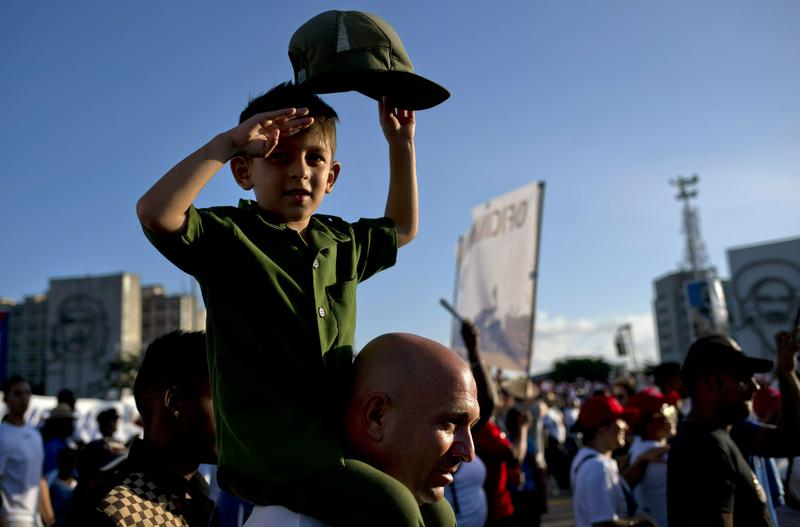
( AP Photo/Ramon Espinosa / AP Images )
[music]
Brian Lehrer: Brian Lehrer on WNYC and we'll end the week like this, ahead of Father's Day this Sunday. Yes, it's Father's Day this Sunday. Not that you forgot a present, but just saying. We'll open up the phones for fathers of any background to call in and tell us how did your father represent masculinity to you and how do you represent it to your kids? 212-433-WNYC, 212-433-9692. Again, how did your father represent masculinity to you and how do you represent it to your kids? What does it mean to be a man and how do you transmit that, fathers? 212-433 WNYC.
Another way to put it in this era of questioning gender norms and the gender binary, how are you teaching or modeling masculinity to your kids, maybe differently than your father taught or inadvertently modeled it for you? Call us at 212-433-WNYC, 212-433-9692. Do you grapple with this dads? If you have a specific cultural take on this, we would also love to hear it. Anything about white, Black, Latino, or Asian masculinity or more specific. Those are very broad categories I know to a particular nationality that you come from or whatever that you think about, Jewish or Christian or Muslim masculinity as well in the religion context, 212-433-9692, or any kind of cultural take that's specific to your background, 212-433-9692.
Maybe you grew up in a culture where the older, more conservative take on masculinity was imparted on you, maybe being macho was considered not just common, but a positive characteristic. This, of course, could apply to many cultures. Maybe you grew up in a religion that strongly influenced your views on what it means to be a man and a father. I didn't pull a clip but did anybody listening now hear the morning edition story yesterday about the Southern Baptist Conference and how they are doubling down on banning women from being pastors in the Southern Baptist Church and saying it's about gender roles?
"We don't believe in this breaking down of gender." I'm obviously not getting the exact quote, but basically digging in on traditional gender roles in one way or another among other ways by banning women from being leaders in the church at the level of pastor. Maybe you grew up in that particular religious tradition. Do you still agree with whatever vision you got from your religion or have you tweaked it along the way or from your nationality values or whatever you define your culture of origin as being? 212-433-WNYC. That certainly includes "American".
Any gay or bi or trans dads out there listening, what does masculinity mean to you, and how do you share that with your kid? Does your sexual orientation or gender expression, if you're a trans man and a dad, you're somebody who obviously felt so much like a man that you went trans. What does that mean to you if you're a father? In any way at all, how did your father represent masculinity to you and how do you represent it to your kids? John in Catskill, you're on WNYC. Hi, John.
John: Hello Brian. My father taught me I think the greatest gift I got from him was a sense of honor and to be a gentleman not just in the sense of gentlemanly manners, but a sense of honor of being the man of the house and being responsible dealing with challenges without whining or griping. I try to live up to those standards.
Brian Lehrer: Certainly positive human values, but what makes them about being a man as you put a man of the house rather than also the woman of the house who would also be interested in being gentle and having honor, the things you mentioned?
John: Oh, I think it includes that respect for others and respect for everyone regardless of gender. In particular, Brian, I'd like to say it's in contrast to what I hear from the likes of the proud boys who have grievances and blame others, and don't take responsibility for contributing to society in a positive way. That's the honor that my father's gentlemanly behavior really stood for.
Brian Lehrer: John, thank you so much. John in Brooklyn. You're on WNYC. Hi, John.
John: Hi, how are you? Thanks for having me on.
Brian Lehrer: Sure.
John: I was telling the screener, unfortunately, it's almost like the other John just said. My father taught me about being honorable, keeping your word, not be afraid to take risks, be strong, be courageous, and having honor like that. It's disappointing and I hear this from women also, it's disappointing to hear the "mainstream message of toxic masculinity". I think that's a bunch of garbage. Certainly, people like the proud boys would fall into that, but not the everyday man like you or I would.
Brian Lehrer: You told our screener you have a daughter. I wonder if you think about what kind of masculinity you want to display as the father of a girl and if it would be any different if you had a boy.
John: To be honest with you, the immediate answer is that I just be myself with her and I wouldn't do anything that would upset her or make her feel uncomfortable. If I had a son, we would probably do other activities together. It's not to say that women can't do the same activities. It's just there seems to be a proclivity towards certain things. I'm grateful to God that I have her.
Brian Lehrer: John, thank you very much for your call. Ken in Stanford, you're on WNYC. Hi, Ken.
Ken: Hi. How are you? My dad was born in 1908. He grew up in Chisel, Minnesota with his three other brothers. They didn't have central heating. They had to sleep in the same bed to keep warm. At any rate, he was kind and loving, and supportive. He became an eminent musical artist. Never bragged about it. My idea of masculinity, even at age 79 here is I'm puzzled by all this talk about masculinity and machismo because my idea of what being a man is based on that. I think it gets to what some of the previous speakers have said. Just being yourself, being confident, taking care of yourself and your family. I haven't even thought about trying to do it for my kids. I've just done it.
Most of the time, I work out of the house, the kids have seen that. Actually as far as equality too, my mom, later in life, there was some adversity in economics. My mom went back to school and became a teacher, and the two of them seemed to work very well together. My wife opened a violin studio in the house. I was working downstairs as a psychiatrist, she upstairs, and it just seemed-- The kids they saw that. There wasn't any necessity to prove oneself or even talk to the kids about how to be a man. They're now 31 and 35, and they seem to have managed okay.
Brian Lehrer: Ken, thank you very much. Colette in Brooklyn, not a father, but wants to talk about her father. Colette, you're on WNYC. Hello.
Colette: Hi, Brian. Thanks for taking my call. I think you rock Brian, first of all.
Brian Lehrer: Thank you.
Colette: Second of all when I was about 14 years old, I had a little part-time job at the TV repair place in this little tiny strip mall near my father's house. On payday, one day I went to get my pay from the guy and he was in a bad mood. He said, "I'm not paying you today. You have to come back and see me." When I insisted, he grabbed me and threw me over a table. When my father found out, he said, "Okay. All right." Then months later, I was going by the store, and it looked abandoned, but I just put it on my mind and the guy in the store next door said, "Did your father ever catch that guy?" I was like, "What are you talking about?" He said, "Your father came out here and sat in front of this store every single day and that guy abandoned his business and he never came back." But my father never told me this. This is coming from a man that I never heard curse and I never even heard him raise his voice. Anyway, I always felt protected by my father. He didn't brag about his masculinity. He was just very comfortable in it.
Brian Lehrer: Colette, thank you very much. We've been getting some very, very nice stories about people's dads. David in Brooklyn might have something a little darker. David, you're on WNYC. Thank you for calling in.
David: Unfortunately, my father was a monster, a sociopath. Just to pick one of his many crimes so you don't think I'm exaggerating, he raped my sister for years. Only stopped when she was 12 and threatened to kill herself and that's only the beginning, maybe the worst, so I got an example of how not to be. I am a father, it was very important for me to have kids and to have a good relationship with them.
Brian Lehrer: I do appreciate the courage that it must have taken to call in and tell that story about your dad. Interesting that you grew up after that wanting to have kids rather than maybe not wanting to have kids, and it sounds like you're trying to be a better dad than the one you grew up with. Michael in Hawthorne, New Jersey, you're on WNYC. Hi, Michael.
Michael: Good morning. Thank you for taking my call. I was born in 1951, grew up with a sister three years younger. My dad was a career in Navy man. There was a good side and there was a bad side complicated by alcoholism through the '50s and '60s. Well, by 10th grade, I was entering my 15th school. We were raised both of us to learn how to sew a button on, to hem a pair of pants, to change the oil on the car. It didn't matter. My father was a hands-on dad, with the changing of the diapers and he did the windows, he did the mopping.
He did those kinds of things and my mom would just take whatever kind of a job she could to meet people when we moved into new community, but then there was times when he was drinking and that was very, very tough and all the rules about being a gentleman and well-behaved went out the window. As much as we had a family policy on not lying like many families that have alcoholism, we lied about it. You might be having the worst day of your life because of something awful happened last night but the neighbor says, "How are you doing?" And you say, "Fine, thank you. Mrs so and so."
It complicated my adult life. Very glad to be a dad myself. She's now 42 and I brought her up to know girl stuff, to know boy stuff in the traditional labels. She's married happily and she and her husband had fallen into traditional gender roles, which I find amazing but they bust each other's chops, and they're like two characters out of a sitcom.
Brian Lehrer: Michael, I'm going to leave it there. Nice ending to that story. I want to get one more in here. Ephah in Brooklyn. Ephah, we've got about 45 seconds left in the show and they are yours.
Ephah: Hi. How are you doing? Ephah [unintelligible 00:14:10] actually. Can you hear me?
Brian Lehrer: Yes.
Ephah: Hope, you can hear me. Ephah [unintelligible 00:14:14] is actually my name. I just want to expand the way we're talking about masculinity because there's not just one masculinity, there are masculinities. I'm a queer Black Bi identified. I was at Grand Marshal Pride Parade in 2015. I'm a father of two kids. My father was part of the Black Panther Party and so part of the way that he defined community for me was not just taking care of yourself and your family, but who you are in a community as an elder, who you are in terms of the mentor, who you are in terms of a beacon.
He was one person that allowed me to be who I am, as a queer Bi identified person and then my children to see me as that person in the community and as an activist, so I was going to expand the definition of fatherhood and the definition of masculinity.
Brian Lehrer: Ephah, thank you. A good way to end. Listeners, dads, and a few others thank you for your calls, and to all you dads out there, Happy Father's Day. Brian Lehrer on WNYC. Stay tuned for Alison.
[music]
Copyright © 2023 New York Public Radio. All rights reserved. Visit our website terms of use at www.wnyc.org for further information.
New York Public Radio transcripts are created on a rush deadline, often by contractors. This text may not be in its final form and may be updated or revised in the future. Accuracy and availability may vary. The authoritative record of New York Public Radio’s programming is the audio record.
