
Having Trouble Registering for a COVID Vaccine? Maybe We Can Help
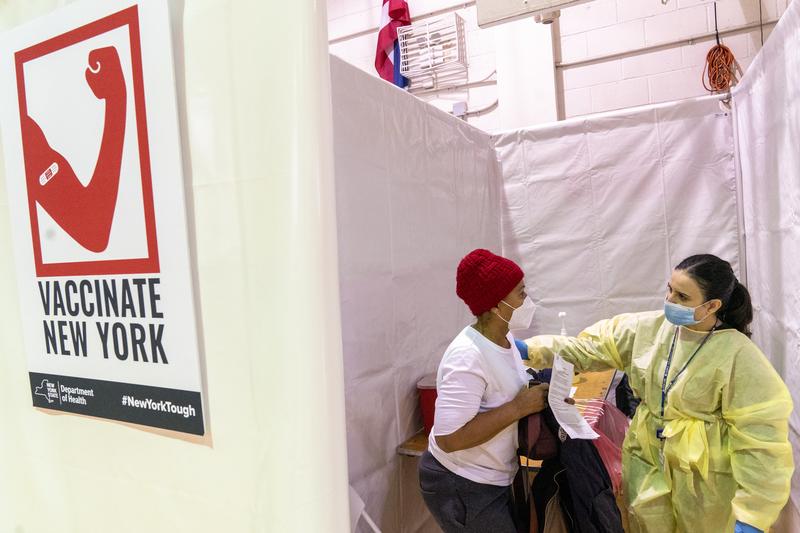
( Mary Altaffer / AP Photo )
[music]
Brian Lehrer: Brian Lehrer on WNYC and obviously, we had a little technical difficulty there. I think it's all resolved now. As I mentioned at the top of the program, this week, New York city released data that provides an insight into who's getting the vaccine. Residents of wealthier, whiter zip codes are being vaccinated at as much as eight times the rate of residents in parts of the city that are predominantly Black and our colleagues at Gothamist reported yesterday that the Mount Sinai Health System canceled vaccine appointments again. Folks, it is not easy to get a vaccine in this city right now, but maybe we can help.
With me now are Lois Bookhardt-Murray, M.D., Chief Medical Officer of The Morris Heights Health Center., what they call a federally qualified health center in the Bronx, and Tomas Ramos, founder and CEO of The Bronx Rising Initiative, a non-profit organization that works with private companies to secure funding for Bronx-based healthcare organizations. Now, since last month, The Bronx Rising Initiative and The Morris Heights Health Center. have been helping seniors and essential workers in the Bronx and elsewhere across the city register for vaccinations. Tomas and Dr. Bookhardt-Murray, welcome to WYC.
Tomas Ramos: Thank you. Thank you for having me.
Lois Bookhardt-Murray: Thank you.
Tomas: It's a pleasure being here.
Brian: New York City listeners, particularly those of you who have underlying health conditions, or over 65, first responders, or frontline workers, we're going to open up the phones right away. If you've been having trouble registering for a vaccine, maybe you can get some advice here if you ask a specific question. 646-435-7280. 646-435-7280. As those calls are coming in, Dr. Bookhardt-Murray, in addition to being the medical director of The Morris Heights Health Center..
I see you're also a consultant to the office of the medical director at the AIDS Institute, which is a branch of the New York State Department of Health and I'm wondering what lessons you might've learned from the AIDS epidemic, which is still ongoing, that can be applied to the current epidemic, particularly around disparate impacts of infection and access to treatment, especially as we talk about who has trouble accessing vaccines?
Tomas: There are quite a few similarities. Of course, this is on a much wider scale with the COVID 19 issues, but just one clarification. I'm no longer with the AIDS Institute. I've been absorbed by my current work so that no longer stands, but I still have a very good connection with them. The AIDS epidemic, for those of us who were around then, pretty much I won't say prepared us, but gave us some backbone when it comes to dealing with COVID-19, the rapidity with the onset of the disease, not quite knowing exactly what we were dealing with and then adapting to the vaccines coming out pretty rapidly. I think we have seen that before with the AIDS epidemic in how they utilize information and put it into action immediately.
What we want to do is to prevent suffering and death. At the end of the day, that's the ultimate goal. I think we're on our way. Dr. Khullar said it well in his segment. We are seeing some light at the end of the tunnel with the vaccinations being available now.
Brian: Tomas, your organization, The Bronx Rising Initiative, I see has a door-to-door outreach campaign that's helping eligible residents of public housing sign up for vaccines. Again, that includes the elderly, first responders, frontline workers, and now people with certain comorbidities, or certain illnesses, or conditions. How's it going? How do you do it?
Tomas: Just to give a little background context, our main goal from when I founded Bronx Rising Initiative in March, was to secure critical resources in a timely manner so we can come into our community and partner up with organizations like Morris Heights Health Center and get things going. In early January, I started fundraising. I raised a little bit over $2 million and a lot of people don't know the financial restraints that a lot of clinics and hospitals are going through right now. That's one of the main reasons I think that the Bronx is getting less vaccines.
When you look at the economics of this all, the vaccine is free, but the cost to hire registered nurses, clerk, or support medical providers, call center staff, et cetera, is very, very costly. Poor communities like our community in the Bronx rely on Medicaid and Medicare and the reimbursement numbers per patient vaccinated are about one-fifth of what the typical private insurance provider pays. When we're talking about upper-middle-class communities, they have private insurers and they get reimbursed a lot more of $17 per patient. That's not enough. The average costs to vaccinate from what I've heard ranges from $100 to $150. That's one of the main issues.
We partnered up with Morris Heights Health Center so we can help increase capacity and go out to the community like we're doing. It's twofold because a lot of seniors that are living in public housing, particularly, don't have access to technology, don't know how to navigate that system. We are doing a real grassroots approach to this where we're going out to the community, knocking on their doors, educating people about how safe this vaccine is, and then also letting them know that we will be at their community center or senior center in the coming weeks. We're creating an ongoing list of people that are interested. We're taking the grassroots approach and collaborating with organizations that are running these centers as well.
Brian: What happens when the people you're reaching out to say, "Yes, but I can't get an appointment?"
Tomas: What we're doing is just keeping a list of everybody that wants to get vaccinated because what essentially is going to happen eventually is the supply is going to increase and it's going to be more readily available. At that point when it does become more valuable, we can navigate and help them either have one of our pop-up sites or one of Morris Heights Health Center's facilities as well. We're keeping our own database. We've hired a staff just to do call, just to do that outreach and ensure that they will get vaccinated and we're here to ensure that as well.
Brian: Doctor, I see The Morris Heights Health Center. in addition to partnering with The Bronx Rising Initiative has also partnered with the YMCA of Greater New York and the New York State Department of Health. Early this month, you were vaccinating people at the Flatbush, YMCA. Is that something you'll be doing in the future at other sites? How can you build on Tomas' answer there about matching people, especially in underserved neighborhoods with vaccine appointments?
Lois: First of all, I want to say that we really appreciate the partnership with Tomas and the Bronx Rising. It's been amazing. The grassroots approach for certain communities for the communities we serve is really the best way to get to people to dispel some of the myths, and some of the fear around vaccinations and the healthcare industry, in general. I really appreciate that. We have done through the COVID pandemic.
We started with COVID testing pop-up sites and we did that. We learned from that and now we seem to be doing it with the COVID vaccines. We are partnering, we have our partners and we do pop-up sites. The Flatbush, YMCA, we were there over the weekend, we got a special shipment of vaccine from the state, and we did that. We will need to be back there again to do the second doses. We're doing our own vaccination at our primary care sites, but in the meantime, if we get a call and we have partnership and we get some of the support we needed that Tomas spoke about, we will do a pop-up site anywhere.
We want to get the vaccines out and especially to neighborhoods that don't generally have access to the vaccine. For us at Morris Heights, once you call our call center, our mainline, and I can get that to you, patients will go on a waitlist. I know that Tomas has his own list that he runs and they put together, and I ask that people be patient. Once their name is on the waitlist, be patient so they can receive a callback. When you call today chances are, you're not going to get the vaccine today or tomorrow. It may be a week or two, and that's unfortunate right now, but we're depending on the supplies as they come in and as manufacturing goes up, we should have those supplies more readily.
Brian: Are there too many eligibility groups being added in your opinion, or even too many physical locations for vaccines? I mentioned earlier in the show the Gothamist story about Mount Sinai canceling first dose appointments that had been scheduled for this week. They say they have no first dose of vaccines this week at Mount Sinai and a letter from an administrator there according to Gothamist, went on to imply that the supply strategically being shifted from hospitals to city and state-run vaccine sites probably like yours, as a result, this letter from the administrator states, we like other health systems across the region and the state will be getting no new supply of first dose vaccines this week.
Lois: I think the problem is the speed of manufacturing and distribution which none of us have any control really over how many vaccines are made and sent to the state. That's unfortunate. I don't think the eligibility group is too big. I think that early on we thought was very restricted and the complaint was that sites were actually wasting vaccine because they weren't getting the people who fit that criteria and there wasn't enough time to really get other people in. I think eligibility is fine. I think we just don't have the supply to meet the demand right now and that will change and it will change quickly. I'm sure.
Brian: All right. In a minute, when we continue, we'll go to your calls, asking specific questions about getting vaccination appointments for our two guests. Stay with us.
[music]
Brian Lehrer WNYC as we continue to talk about, who's getting vaccination appointments and who's not, disparate access in New York City, and how to get over that. Let's take a phone call right away. Jack on long Island City in Long Island City. You're on WNYC. Hi, Jack.
Jack: Hi. Thank you, Brian. Thank you very much. I'm 90 years old. I'm not complaining about my age. I'm not underprivileged. I'm not underserved, generally speaking. I just want to get a place in line and wait and be registered and not play dodge ball with these people. It's the design of the system. I'd appreciate some help, but the main thing is my grandson could design a system that would take care of-- My problem is that I go playing these games and losing out and not being lucky on the-- Just give me a number and I'll wait till it comes up.
Brian: Give us a little of your story, Jack. Because I have a feeling a lot of people will be able to relate to it regarding what you're doing to try to get an appointment. Are you going to certain websites? Are you calling certain phone numbers? Where are you running into these walls?
Jack: Yes. I start with a locator and then I fill out a form and then I look at the sites and they say this place is two miles away. Of course, there's no appointments. When I see an appointment by the time I get filled out and everything else, I'm behind. I'm like that woman who you spoke of when you started the show, it's just a--
Brian: It's a mess.
Jack: It's just a shell game.
Brian: Jack. Thank you very much. Tomas. My guests are Tomas Ramos, founder, and CEO of The Bronx Rising Initiative, a nonprofit organization that works with private companies to secure funding for Bronx-based healthcare organizations, and Dr. Lois Bookhardt-Murray, chief medical officer of The Morris Heights Health Center.. Tomas, have you heard similar stories like a zillion times?
Tomas: All the time. Anytime that we're out there talking to the community, it's the same exact story. They're having difficulties getting appointments. They don't know where to go, and it's tough because the supply is just not there and like Moris Heights Health Center, they have an amazing system where anybody that calls them, they put them on a waitlist and they keep in contact with them the same way that we do, but it's tough. It's a very difficult situation that we're all dealing with.
Just to let you know, this week alone we had to cancel one of our pop-ups because the supply just wasn't there. We had to call our 150 seniors to let them know that we have to reschedule because we're relying on the department of health to distribute these vaccines. I just tell people, "Be patient, we'll be in contact with you," and just reassure and let them know that they will get vaccinated. It's the same story I'm hearing every single day.
Brian: When you're helping people in the housing developments that you work with get vaccination appointments, in addition to the pop-ups that you may control more directly or work with more directly. One of the things that Jack is pointing out and that I've heard from others is that there are so many different sites that you have to try. It's not all coordinated. He was saying, "Just have one centralized thing, put me at the back of the line. I'll wait my turn. It's fine, but I'll know what it is."
As it is if you want to try to get an appointment at a Rite Aid, you have to go on to Rite Aid site and look at the various pharmacies that are offering them. If you want it from Walgreens, you have to go on their site. If you want it from the Cornell Weill New York Presbyterian System, you have to go on their site, et cetera, et cetera all down the line. Is that how you do it? Do you have a list of five, 10 different websites or phone numbers that you're going to for the clients who you're trying to help?
Tomas: We do not have a list of that. It's just it's too much and to the caller's point, we should establish a centralized system where we're in constant communication with the other providers that are vaccinating everyone. What we try to do is since we targeted specific areas where there's less access to vaccines, that's what we do. We have our ongoing list of, "This is when we're going to come out to do this popup," or, "This is where you can go with Morris Heights and a couple of other clinics that we have partnerships with." We take a very targeted micro approach because the reality is that we just don't have the capacity to do all of that. It's a lot.
Brian: Dr. Bookhardt-Murray, will you add anything to that?
Lois: Yes. It seems to be-- I agree with the caller. It's a little disjointed. I think we're all just scrambling to do the best we can do, and the turnout of the vaccine is a little behind the demand, but there is a New York City website that I go on from time to time. Most of the time there is no availability. There is a phone number I call for New York City. Once a while I get through and I would like to share that number because I know the caller lives out-- Not the Bronx. Could I share that number right now, Brian?
Brian: Yes, of course.
Lois: That number for New York City is 833-697-4829.
Brian: Give it again.
Lois: 833-697-4829. When you get through, then they will assist. I try that from time to time and for the most part, seems to be working. Our phone number to Morris Heights Health Center we have had people drive from West Chester, Long Island, Staten Island to get the vaccines. We do keep a pretty tight waitlist. Right now, we have about a thousand people on our waitlist, but we're working that list as we get the vaccine. Our number at Morris Heights Health Center is 718-716-4400. 718-716-4400. Certainly--
Brian: Go ahead.
Lois: I was going to say, certainly, someone who is elderly is certainly in a population that we want to get to.
Brian: This is WNYC FM HD and AM New York, WNJT-FM 88.1 Trenton, WNJP 88.5 Sussex, WNJY 89.3 Netcong, and WNJO 90.3 Toms River. We are New York and New Jersey public radio. As we continue John and Mamaroneck you're on WNYC. Hi, John, you have tips.
John: Hi, thank you for taking my call, Brian.
Brian: You have a success story, right?
John: I do. I just got back from the Javits center, I'm in the newer high-risk pool that just was admitted for vaccines on Sunday or they took registrations on Sunday and by a miracle, I was able to get my vaccine this morning at 8:00 AM.
Brian: How did that miracle work? There are probably technical details that add up to what feels like a miracle.
John: There were technical details. I researched what websites to go to. I had them all up the night before. I populated all the forums the night before, and I woke up early and about 7:30 AM, I started reloading all of these portals. It sounds crazy, but about 8:02 AM, I finally got through and popped a portal that said-- In the New York state vaccination popped a portal that said vaccines were available at Javits center. I signed up and I got an appointment on Sunday for Wednesday.
Brian: Was it clear to you how many different sites and how many different locations that New York state vaccine portal was checking?
John: Well, I was on the New York state portal. I had the New York City portal open the Walgreens' portal, the Rite Aid portal, the Cornell Weill portal, and the Mount Sinai portal all open at the same time.
Brian: There you go, Tomas, that's the ballgame and it shouldn't probably have to work that way. He didn't even have-- Coming from a Mamaroneck, he's really close to the Bronx, he didn't even have the Montefiore portal open, which is another major medical system where you only get information about sites at their hospitals and clinics. That was a perfect representation of the maze, the puzzle, the jigsaw puzzle, the so many different dots that people have to try to connect to see the sum total of what's potentially available to them.
John: That's a prime example. A lot of people in our community can not navigate the system that way. I also forgot, there's the SOMOS vaccination that you can go on their site. They do really good work as well, and they're in partnership with the state. For other callers that are listeners, that want to get vaccinated.
Brian: That's a good one SOMOS, S-O-M-O-S. I'm going to let Carol in Manhattan represent all these people who are having their vaccination appointments canceled for the first dose vaccines this week, Carol, you're on WNYC. What happened to you?
Carol: Yes, I love your program. I did have what turned out to be a good experience. I waited four weeks and I had another week to go with the Mount Sinai appointment and it was canceled last week. A friend of mine who cares about me called and said that, "I'm in Queens," so a lot of his friends were going to Walgreens, he called it. I got online for Walgreens or actually, my daughter did. I got an appointment within three days and I got the shot last Friday.
Brian: Congratulations, Carol, I'm glad you--
Carol: My original appointment was yesterday, the one that was canceled.
Brian: Your original appointment was canceled by Mount Sinai. That's both halves of the equation. Partly because one of the newer things and Dr. Bookhardt-Murray, I don't know if you can comment on this specifically, but as I understand it, one of the newer things and therefore newer places to try is that just as of last Friday, a lot of pharmacy chains, pharmacy chain locations went online for the first time and only for people based on age, so 65 plus.
All these new eligibility groups that were coming online at the same time, restaurant workers, taxi, and Uber drivers, people with comorbidities, not necessarily going to get it at the pharmacies, but that for people over 65, just based on your age, that that's a decent thing to try right now. Do you have any information that confirms that?
Lois: Well, I think it is a very decent thing to try, especially because some of our older community individuals just don't use the computer in the same way a younger person does. It will make it much easier for them to contact their pharmacy. Still, they may have to go online.
Brian: They may have to go online, but my understanding is many of these pharmacies, it's not like the mass vaccination clinics where they have dozens of vaccination stations and you can't get any personal service. My understanding is that many of these local pharmacies are not giving that many shots a day. You might still be able to get through to that pharmacist with the number that you've used in the past, who you have a relationship with, to at least get information about how to do it. I'm not sure they can sign you up over the phone, but that's one way.
Lois: Yes. You just want to get your foot in the door. For the places that do take waiting list, it's important to get your name on that waiting list. For the places that have canceled, I hope they are keeping that with the people so they can recall them.
Brian: One more possible tips and tricks caller here. Amy in Washington Heights, you're on WNYC. Hi, Amy.
Amy: Hey Brian, can you hear me?
Brian: Yes.
Amy: Okay, awesome. Similarly to the second to last caller, I'm able to get a vaccine on Monday. I became eligible in this new group of folks. The main tip is just refresh, refresh, refresh, refresh over and over, have like 12 different browser tabs. Just to keep at it all day. They seem to pop up at random, but I wanted to share two resources that really helped me. I am not affiliated with these, but they were helpful to me, which was a site called turbovax.info, which aggregates various appointments.
As well as nycvaccinelist.com. I've been sitting on them just out of curiosity while I've been on hold and there have been appointments that have popped up. That was really helpful to me. Then, I had a question which is, I am somebody with a lot of free time and I'm able to navigate the internet, is there any way that I can help people who don't have that access get appointments? Because it really is just a mess in the system. Thanks.
Brian: Tomas, do you need volunteers? Can you take virtual volunteers as you try to match senior citizens in Bronx public housing buildings with appointments?
Tomas: Yes. Most definitely. We are always looking for volunteers. I would love to connect with you and definitely have you on board and helping us. If you want you can contact me directly. Can I give my email?
Brian: If you want to give your email to the general public, otherwise, we can take her contact off the air and get it to you, but if you want to use this opportunity to solicit volunteers, in general, for this really and good work that you're doing, feel free.
Tomas: Okay. You can go to our website, actually bronxrisinginitiative.org. There's a place where you guys can enter your information and just give a little memo that you want to volunteer. We have somebody on it on a daily basis. They'll get back to you as soon as possible. You can do that and I would love the caller's information as well.
Brian: All right. Amy, hang on, we're going to take your contact information off the air and put you in touch with Tomas. For anybody else with time on your hands who wants to help this very relevant and new volunteer opportunity for the city of New York, there's that information that Tomas just gave. Tomas Ramos is founder and CEO of The Bronx Rising Initiative, which along with The Morris Heights Health Center. from which came our other guest, Dr. Lois Bookhardt-Murray, is helping seniors and essential workers in the Bronx and elsewhere across the city register for vaccinations. Thank you both so much for joining us and sharing so much helpful information.
Tomas: Thank you for having me.
Lois: Thank you.
Copyright © 2020 New York Public Radio. All rights reserved. Visit our website terms of use at www.wnyc.org for further information.
New York Public Radio transcripts are created on a rush deadline, often by contractors. This text may not be in its final form and may be updated or revised in the future. Accuracy and availability may vary. The authoritative record of New York Public Radio’s programming is the audio record.
