
Fox News Settles Dominion's Defamation Lawsuit
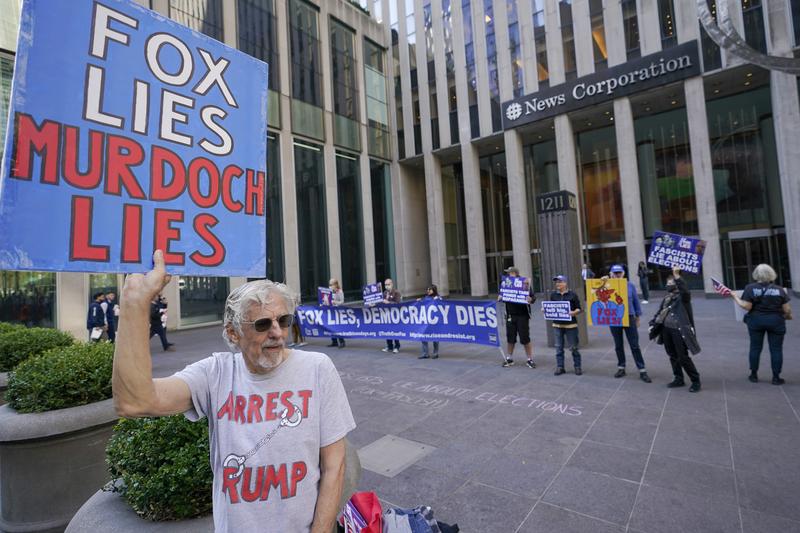
( Mary Altaffer / AP Photo )
[music]
Brian Lehrer: It's The Brian Lehrer Show on WNYC. Good morning, everyone. What do you think about the settlement between Fox News and the Dominion Voting Machine company? Was Fox held accountable for spreading lies about the 2020 election even though they knew the statements to be false? Fox will pay Dominion more than $750,000,000, but it only admits to airing things that were false, not for doing it knowing those things were false. Those things matter. That difference matters. Is this real justice that will make it harder for Fox or others to lie to try and overturn true election outcomes in next year's presidential elections and other future elections, or is the message here that settling a lawsuit is just the cost of doing business if your goal is ending democracy for fun and profit? Here's the president of Dominion Voting Machines, John Poulos, just after the settlement was announced.
John Poulos: Fox and Dominion have reached a historic settlement. Fox has admitted to telling lies about Dominion that caused enormous damage to my company, our employees, and the customers that we serve. Nothing can ever make up for that. Throughout this process, we have sought accountability and believe the evidence brought to light through this case underscores the consequences of spreading lies.
Brian Lehrer: Maybe, but what are the consequences for the fake news conspiracy theory echo chamber when Fox itself hardly reported the settlement to its own viewers, those Americans most likely to believe in the lies? Another question, kind of an opposite one, are there any consequences for freedom of the press when a news organization is held legally liable for speech that it chooses to air true or not? We'll talk about the settlement now with the legendary First Amendment lawyer Floyd Abrams, who has long represented media companies, including The New York Times in the Pentagon Paper Supreme Court Case of the 1970s, and many others. Floyd is currently senior counsel at the law firm of Cahill Gordon & Reindel. As a First Amendment advocate, though he also filed a Supreme Court brief, we should remind you, on Mitch McConnell's side in the landmark Citizens United case, which gave corporations the same rights as people to spend unlimited amounts of money in support of political candidates.
That ruling is infamous to many, but Abrams' bio page describes it as defending the rights of corporations and unions to speak publicly about politics and elections. He sees himself as consistent, an advocate of the First Amendment. We'll see what he thinks about the First Amendment issues here, as well as the accountability ones. Floyd, it's always good to talk to you. Welcome back to WNYC.
Floyd Abrams: Thanks very much. It's been an extraordinary day with respect to the First Amendment and with respect to, hopefully, the ability of the public to get more truthful news, or at least less lies.
Brian Lehrer: Listeners, your reactions to or questions about the Fox News' Dominion Voting Machines lawsuit settlement are welcomed here with First Amendment lawyer Floyd Abrams. 212-433-WNYC, 212-433-9692. Floyd, as a defender of freedom of the press and to elaborate on what you just said now, I know you want media companies to have very wide lanes to air controversial statements, but you just said what you said, and I see you were quoted in The Washington Post this week saying Fox committed grievous and indefensible journalistic sins. How would you describe those sins as you see the evidence in this case?
Floyd Abrams: Well, the basic sin was a pattern, a repetitive pattern of lying, purposeful lying, knowledgeable lying with respect to this company that no one ever heard of before, which made election machines. There are limits, inherent limits to what the law can do to make people or institutions, corporations too, whole, and even this vast amount of money, and in American legal historical terms, it is a vast amount of money that Fox will be obliged to pay, doesn't really [chuckles] equalize, it doesn't mean that this company is as it was before Fox began its pattern of lying about them.
Brian Lehrer: You mean Dominion as a whole?
Floyd Abrams: Yes, Dominion itself. It's not as if Dominion is what it was before the lies started.
Brian Lehrer: Let me ask you this, to your ear, did Dominion prove with the evidence that it was able to bring out in the discovery process that Fox News aired lies about the election or about the company that they knew to be false?
Floyd Abrams: Yes, I think it was a very strong, very powerful case with respect to just that issue. Internal people at Fox, Tucker Carlson standing there while watching an interview and muttering, saying in so many words that this person was lying, that "She's a liar. I know she lied to me."
Brian Lehrer: He said that off the air?
Floyd Abrams: He said off the air, yes, but for whatever reasons, everything that Fox people said to each other seemed to have been recorded, and s we have the exact language. He's speaking about a person that Fox put on again and again, a woman who was lying about what was going on, and he knew it. Not just he knew it, but he's a very good example of the discomfort at some levels by some people in Fox. It's not that I give him credit for anything about this, but I think that when someone who holds that position, I guess he's their number one ratings getter anyway, was standing there listening, watching, and saying in almost the words I'm about to use, "We purposely put on someone who is lying. I know she's lying. She's lied to me." That's not the only evidence, but there was enormous body of evidence. If there hadn't been, believe me, Fox would never have agreed to pay what was involved here.
Brian Lehrer: 750 plus million dollars. I thought it might be interesting for some listeners who haven't been following the case, the developments leading up to yesterday's opening of the trial, and then settlement of the trial, an example of the evidence that Dominion was able to bring into the open. This is audio evidence, so perfect for radio. Here's part of a phone call between a Fox News producer and a Trump campaign official. This was on December 5th, 2020, so about a month after the election, a month before January 6th, they aired this excerpt on MSNBC. Once it became public, you will hear the campaign official tell the producer how little they can prove about alleged Dominion machine rigging in a particular case.
Speaker 1: I know it was on War Room the other day with Steve Bannon. Have any of the machines been looked at? He had said that one was looked at in Georgia.
Speaker 2: I'd have to check on that in terms of Georgia. I know during the audit, they did check on those machines. Can we just go off the record for one second here?
Speaker 1: Yes, of course. I don't want us to say it if it's not. That's why we're checking.
Speaker 2: I think they have looked at the machines. When the Secretary of State did its audit, there was I think a fair bit of looking at the machines. The audit came in pretty darn close to what the machine count was with the receipts. I don't know the outcome of those, but our understanding, again, this was the Secretary of State's office, is that there weren't any physical issues with the machines on those inspections.
Brian Lehrer: So there weren't any physical issues with those Georgia machines on those inspections, according to a Trump campaign official there, but being careful to speak off the record. The Fox News producer, to her credit, was doing her job as a journalist there, trying to learn what was true. Yet, here's what Trump was saying in public that very same day, December 5th, 2020.
Donald Trump: In one Michigan county using Dominion Voting Systems, nearly six thousand votes were discovered that were wrongly switched from Trump to Biden. They called it a glitch. You know a glitch? That's like the machine broke. Numerous times we found glitches, and every single time, the glitch went 100% to Biden and no percent to Trump. The same systems are used in 30 states.
Brian Lehrer: The contrast is obviously huge, Floyd, and if Fox was airing Trump or descriptions of Trump's language without adding what it was told was real by Trump campaign officials because that was off the record, that's the story we're talking about here. Right?
Floyd Abrams: You bet. That's the story that we're talking about here. When issues like this came up within Fox, you heard one word used a lot, we have to respect our audience. Respect our audience means the audience wants really pro-Trump stuff, bad stuff about his opponent, Trump to win, et cetera, et cetera, and therefore, we can't go too far down the road of truth-telling. They were also, and this was very clear in listening to tapes that were made public, they were also very, very concerned that if they started telling the truth about the election and who won it and who lost it, that their viewers would go to Newsmax or another right-wing station. For that reason as well, they continued down this pattern of lies. This is why, again, the settlement was surely so high, and in American legal terms, it's an extraordinarily high judgment agreed to, is it happened again and again. They knew, all the people there on top knew what was going on. Some of them made mild objections, we really shouldn't put so and so on anymore, but my heavens, the core of it was again and again, this is what we need to do to keep our viewers, and so they went [crosstalk]--
Brian Lehrer: You're arguing that the motive was to save its ratings, therefore, to save its profitability, rather than true belief on the part of whoever however high up the chain people were true belief in Donald Trump's cause trying to take the election despite knowing it was not stolen?
Floyd Abrams: Correct. Correct. I really don't think on viewing and listening to what was made public here that you can give them credit for believing what they were putting on. The higher you went up, and there were depositions of Rippert Murdoch in which he was, what should I say, in a soft voice saying that they'd gone too far, that really, they ought to be careful about it. One thing Fox found is that when they told the truth, such as Arizona had voted for Biden and they were the first ones to do it, the first network, it's the sort of thing journalists crawl over, they congratulate themselves, "We were first, we got it first," the reaction of their listeners, their viewers was so negative that within Fox, there was turmoil because their viewers, at least in their view, probably correctly, wouldn't accept that and were angry, very angry at Fox. Now, believe me, that's no excuse for the journalistic malpractice that went on here. If one asked the question, why were they doing this? Why did they keep doing it? In my view, it was because they thought it profited them and that they were really concerned about their viewers, once unhappy because Fox was a truth teller about this, leaving to go to other much smaller than right-wing networks.
Brian Lehrer: I'm looking at our caller board, and you won't be surprised, Floyd, to hear that all our lines are full on this. If you're just joining us, folks, my guest is the legendary First Amendment Floyd Abrams as we talk about the Fox News, Dominion Voting Systems settlement out of court yesterday. If I did a word cloud on the word that's coming up the most often from the callers on the board, it looks like the word is disappointed. Let me take one of those callers who told our screener that she's disappointed about this settlement in some respect. It's Rena in Hoboken. Rena, you're on WNYC, you represent about half the callers on the board right now. Thank you for calling in.
Rena: Hi, Brian. Great show as you do every day. Yes, I am extremely disappointed. The damage Fox has done to our country, to our democracy, should be exposed at every level, and it's not now. They're going to spin this whatever way they want to spin it, and that's very disappointing.
Brian Lehrer: What did you want to hear, Rena? What were you hoping to hear at trial?
Rena: I wanted them to all have to get on the witness stand or whatever, and also to hear how it was just a lie. Expose things for what they truly are, and they're not going to be exposed now.
Brian Lehrer: Rena, thank you very much. Let's take one more. Let's see if Mike in Manhattan are saying exactly the same thing or a different wrinkle. Mike, you're on WNYC. Hello.
Mike: Hi, Brian. Good morning. I'm very disappointed also. I was hoping for two things. One, a billion sounds a lot better psychologically. Also, the fact that I wanted to make the Fox News host, the Carlson, Ingram, what's his name, the other guy who was very big also on Fox News, all have to say on air they lied. That would've been my requirement because Fox News viewers only watch Fox News, and Fox News is not going to advertise this on their channel. To me, it's cost of business for Murdoch, that's what it boils down to.
Brian Lehrer: Mike, thank you very much. Cost of business for Murdoch without real accountability in your opinion, Floyd Abrams?
Floyd Abrams: To a considerable degree, yes. Cost of business, high, high cost of business paying that amount, and remember, they have another case coming up in which they may even be in more trouble for the same lies, and that's this case by the company called Smartmatic, another company that made valid, useful, truthful voting machines that were also defamed again and again by Fox. Boy, I share the view of your listeners that it would've been, and this is my language now, not theirs, a bit or more satisfying and more meaningful if Fox had been forced to apologize or forced to engage in an abject truth-telling. That is just something that the law doesn't require, even if they tried the case and lost, we wouldn't have gotten that. I think that in terms of the future of any chance of persuading the people who watch Fox that they really couldn't count on them to be providing the truth, I would say what you really would need is television in that courtroom. They weren't going to have television. Delaware doesn't do that, or [crosstalk]--
Brian Lehrer: We wouldn't have seen video or heard audio of Tucker Carlson or Rupert Murdoch being cross-examined, that kind of thing?
Floyd Abrams: That's right, yes. We would not have seen it. We would've read about it. We would've heard about it on, what, MS or on CNN, and your callers are right. That's not the same as, it's not at all the equivalent of the Fox viewers being, in a way, almost force-fed to hear the truth.
Brian Lehrer: Well, why do you think Fox did settle?
Floyd Abrams: I suspect it was a few reasons. First, I think that what would have happened, even though the Fox viewers may not have bought into it, is a much higher level of humiliation at Fox and a lot of concessions. Rupert Murdoch said during his deposition something to the effect that he didn't really agree, they'd gone too far, things like that. It was necessary, I think, from a corporate PR point of view to end this thing and then to go back to being Fox again. Now, are they going to change at all is a really good question. Whatever forces there are within Fox that ever had any doubts about the programming that they've been doing, might they be strengthened to say, "Whatever else is true, why should we run the risk of another $800 billion settlement and maybe no settlement, maybe trial?" One can hope that at least they'll be a bit, what, shyer, somewhat less likely to engage in the same sort of journalistic misconduct with all the harm that that does. It's enormous harm to the American public.
Brian Lehrer: Then there's the question, if this case was so strong, why did Dominion settle out of court? Larry in Oceanside has a theory about that, I think. Larry, you're on WNYC. Hi there.
Larry: Hi there. Good morning, Brian, Mr. Abrams. In terms of an [crosstalk]--
Floyd Abrams: Good morning.
Larry: Good morning. Good morning. In terms of an apology from Fox to Dominion and the country, this was never a serious consideration for Dominion. It was primarily about the money. I say this, and I welcome you to comment, it's based upon a 2019 posting on Senator Elizabeth Warren's website. I'll just read a paragraph. Let me see. The three vendors, Election Systems & Software, Dominion Voting Systems, and Hart InterCivic, collectively distribute voting machines and software that facilitate voting for over 90% of all eligible voters in the United States. Private equity firms reportedly own and control each of these vendors, which have long skimped on security in favor of convenience, leaving voting systems across the country prone to security problems. So I guess it's this. Is there veracity to what Elizabeth Warren states on her website, and other senators have signed on to that, with regards to private equity, in fact, owning Dominion, and that would certainly put incentive motive ahead of everything? I'll take my comments off the air.
Brian Lehrer: Larry, thank you very much. Floyd, what I hear him saying, tell me if you heard it the same way, is that Dominion didn't really have the public interest of airing this all out in the way you were just describing you hope would have happened at heart at all. It's a company. It's owned by private equity. All they really cared about was the money. They got what they want and were willing to sacrifice the public interest of fuller disclosure by Fox in the process.
Floyd Abrams: They did get what they wanted. Did they want more? Would they have preferred a trial? No. I mean, remember too that had there been a trial in federal court, you need a unanimous jury. No matter how strong your case is, you wind up with one person who didn't tell the judge that she really can't stand Joe Biden and anything Donald Trump says is okay with her, there were risks, however strong the case was, for the case to be pursued, and risks that had to be weighed in terms of whether there was pressure by the entities that invest in or have a lot of money in the company. I don't know that it happened, but it wouldn't surprise me at all. Their interest, the investors' interest has not been the sort of what's the good thing for the country that we've been talking about so far. Yes, you're right that their interest is to have a profitable and then a more profitable company and to do it without the risks that would otherwise have come had this gone to trial.
Brian Lehrer: We'll continue in a minute with First Amendment lawyer Floyd Abrams on implications of the Fox News, Dominion Voting Machine Systems settlement. We're going to broaden it when we come back into some more, I don't want to say abstract or theoretical because they're really very practical, but sort of bigger think questions about the First Amendment, which Floyd has thought about and advocated for for his entire career. We'll put it into that context when we continue in a minute.
[music]
Brian Lehrer: Brian Lehrer on WNYC as we continue with the legendary First Amendment lawyer Floyd Abrams on the Fox News, Dominion Voting Systems out of court settlement yesterday. Here's Dominion lawyer Justin Nelson on Morning Edition today for about 30 seconds.
Justin Nelson: Oh, I think this was in the heartland of the First Amendment. I think what this really showed was that the actual malice standard is something that all journalists should embrace, we certainly embraced it, and that what we have here is how we balance the different rights and to make sure that we're protecting the reputation. I think what we did is really defend truth. As we said, the truth really does matter and that lies have consequences, and that's totally consistent with the First Amendment.
Brian Lehrer: Dominion lawyer Justin Nelson. Floyd, would you do a little law school lesson in brief for our listeners here? He referred in that clip to the standard that you have to prove in order to win a defamation case against the media company that says things about you, and that's what's called actual malice. Can you describe what that means in real life?
Floyd Abrams: Sure. The first thing you have to know is that the words actual malice doesn't mean what anyone who speaks English would think actual malice is. It's not about malice. The Supreme Court has made clear again and again that what they mean by actual malice, and therefore, this is what the law is, is that to win a libel suit against a public figure when it's a case involving a public figure, to win a libel suit, you have to show that what was said was either knowingly false, a purposeful deliberate lie, or said with quote from the Supreme Court, "a high degree of awareness of probable falsity". Either you have to know that what you're saying was false or suspect it to the point that it is all but knowing it. Anything short of that, there's no recovery. The purpose of that is to protect the free press. We do give more protection under our First Amendment to the press than any other democratic country in the world, more than Canada, more than England. There are other ways to structure a legal system to protect free expression, but other countries and other democratic countries lean a lot more in the direction of protecting lost reputation than we do because of our concern about suppressing speech, particularly speech about the government or speech about powerful entities like Fox News. That's where we come out.
Again, unfortunately, and I think the Supreme Court knows it now, they couldn't have used a more misleading characterization of the legal test than to call it actual malice. Again, you really have to prove knowledge of falsity or serious doubts about truth or falsity, and that's what they would have had to have proved. I think they could have, but that's what they would have had to have proved against Fox if this had gone to a jury.
Brian Lehrer: Mary in Manhattan has a First Amendment-related question on the case. Mary, you're on WNYC with Floyd Abrams. Thanks for calling in.
Marion Manhattan: I thought the amendments restricted what the government could do, so I don't understand why a suit between two companies is being described as a First Amendment case, and I can take my answer off the air.
Brian Lehrer: Great question. Floyd?
Floyd Abrams: Yes, and the reason is that the courts are the government, so if you wind up with a court saying, after a jury or not, depending what the system is, if you have a court saying you've got to pay a billion dollars, that is the government saying it, and the First Amendment protects to a very great degree against the government limiting speech. Libel law is an exception to the notion that you can say anything you want, but our libel law, as I've said earlier, has deliberately been read by the Supreme Court in order to be consistent with the First Amendment as requiring a lot of proof about someone public or something public that the speaker knew it was false or had serious doubts about the truth of what was being said. At the end of the day, also, we have to decide, do we want to have libel law or not? There was one great Supreme Court Justice, Hugo Black, who thought all libel law violated the First Amendment. The court didn't agree with him, I don't agree with him, but if we're going to have libel law at all, it means that there will have to be a governmental entry into the fray, and the government in our system is the court and the whole judicial system.
Brian Lehrer: Last question, and I know you got to go in a couple of minutes. The media landscape is so different from when you got into the freedom of the press business. So many people get the news, as you know, from social media, not professional media. How much does that make this case matter less in terms of keeping political arguments based on real facts in the United States that people can then disagree on, even if Fox News is chilled now from reporting lies as aggressively as they did in this case?
Floyd Abrams: You got a good point. On the ground, so many people now get information, I hate to even call it news, but information of one sort or another from social media often spoken or contributed by people who either don't know what they're talking about or are deliberately misleading for the purpose of persuading listeners and viewers that the body of law that has been built up, and as you say, since I started practicing law more than a while ago, it's less relevant in a way. It's not that you can't bring a libel suit about somebody on social media, but it's a different world on social media, and it's very often not a world that's really conducive to truth telling.
Brian Lehrer: The legendary First Amendment lawyer Floyd Abrams. He's senior counsel at the law firm of Cahill Gordon & Reindel. Thank you for joining us on this, Floyd. Good to talk to you.
Floyd Abrams: Thank you very much. Bye-bye.
Brian Lehrer: Listeners, thank you for your calls.
Copyright © 2023 New York Public Radio. All rights reserved. Visit our website terms of use at www.wnyc.org for further information.
New York Public Radio transcripts are created on a rush deadline, often by contractors. This text may not be in its final form and may be updated or revised in the future. Accuracy and availability may vary. The authoritative record of New York Public Radio’s programming is the audio record.