
The City's June Primary Elections
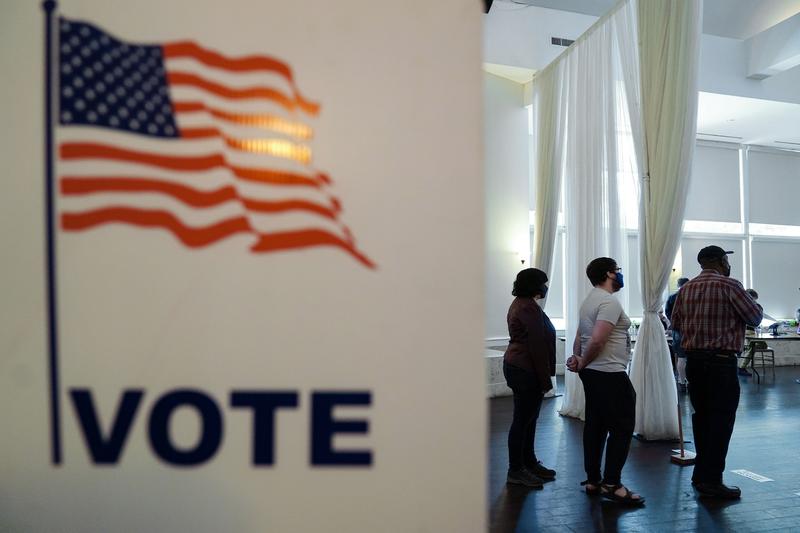
( Brynn Anderson / AP Images )
[music]
Brian Lehrer: Brian Lehrer on WNYC. We'll talk to Congressman Espaillat's office about that. You want to be on the radio? You really got to come on a better phone line. All right. Early voting begins tomorrow in this year's New York Primary. At stake this year, most prominently are all the New York City Council seats. About a third of them I've read are being actively contested. Also, the Bronx and Queens District Attorney positions and there are some intense politics in Yonkers right now with Mayor Spano up for reelection.
We'll take on Yonkers in a dedicated segment next week. We'll talk about some of the most interesting New York City council races and the DA campaigns right now with Rachel Holliday Smith, associate editor for the news organization, THE CITY. Rachel leads the newsroom there on explanatory and service journalism. She calls herself the Explainer In Chief on Twitter, and local kid makes good. Rachel was previously a Brian Lehrer Show producer, among other accomplishments. Rachel, thanks for coming on to do some New York City primary explaining today. Welcome back to WNYC.
Rachel: Thank you, Brian. It's a pleasure.
Brian Lehrer: Listeners, we invite your calls, ask a question about your local city council or district attorney race, or about ranked-choice voting, which we'll get into. 212-433-WNYC, 212-433-9692. Electioneering, welcome here. If you support a candidate, you can call in. If you are a candidate, you can call in, 212-433-WNYC. Just have a decent phone. Again, voters, your questions about the races in your neighborhood, very much welcome, 212-433-WNYC, 212-433-9692. You can also text your question to the same number or tweet at Brian Lehrer. Rachel, let's establish some basics first. Early voting begins tomorrow at 9:00 AM. Primary day itself is Tuesday, June 27th, so about a week and a half later. Some of these races are using ranked-choice voting, some are not. Can you explain which ones are in?
Rachel: Yes. If you have a city council race on your ballot in your neighborhood, you're going to use ranked choice the same way we have in recent elections, in recent primaries, I should say. The district attorney races confusingly for voters in Queens and the Bronx is not ranked choice. That's because, technically they are state offices and only municipal or city elected officials or seats in municipal government use ranked-choice voting.
If you're a voter in Queens or the Bronx, just make sure that you don't try to rank your district attorney picks because that's only for the city council. There are some other smaller down-ballot things on the ballot. Things like judicial delegate candidates and smaller positions. It's really for city council where it really matters, especially because there are races where there are many candidates, so the primaries are crowded in some of these races. Not a ton of them, but some of them and ranked choice will really come into play
Brian Lehrer: In a minute we'll get into one of the races that some people view as the hottest race in city council land right now. Where ranked-choice voting has been playing a role in the campaigning. Before we get to that, didn't we just elect the whole city council two years ago, and aren't they supposed to have four-year terms?
Rachel: [laughs] Great point, yes. This is a special year because of redistricting. Because we got together as a city and decided on new district lines for every city council district, that means that this term that is currently on for city council is two years, and then if they're reelected, they get another two years. The reason for this is so that we can have people representing these newly drawn districts, which of course correspond to population changes from the 2020 census. You can think of it as a four-year term that's truncated into 2-year terms, if that helps you. Especially if there's somebody in your neighborhood that is running uncontested and is basically going to just walk into a reelection. It's two 2-year terms because of redistricting and the census
Brian Lehrer: Remind people a little bit of how ranked choice voting works. They can choose one candidate and leave it at that if they want, or they can choose more than one in ranked order?
Rachel: Yes, exactly. They just rank by preference. You rank up to five. I don't think there are any primaries that have five candidates in a primary. It'll have to be at most four. I think the only district with four candidates in a primary is in Throggs Neck in the Bronx, so there you go Throggs Neck folks. You just ranked by preference. A little-known thing is that you don't have to rank everybody. If you really don't like a candidate, you like maybe three people, but not the fourth, you don't have to rank them. Rank-choice experts I've talked to say never vote for someone you hate. Very simply. If you don't want them to be in office, don't rank them. You can go up to five if you've got feelings and preferences for five people.
Brian Lehrer: Let's go down some of the interesting city council primary races and then we'll get to the Queens and Bronx DAs. The race for District 9 in Harlem is very interesting this year. It includes one of the Central Park 5, The Exonerated Five, but certainly other candidates as well. I see there's an article on your new site, THE CITY called In Tight Harlem Race, Pair of candidates say, "Rank us" to push out Third. Ranked choice voting is a strategy. Who are these candidates?
Rachel: Sure. This is a really interesting race because it's the only one that does not have an incumbent. The incumbent, Kristin Richardson Jordan in Harlem decided not to seek this other two-year term. She served two years and she's not going to seek reelection for the next one. We've got Yusef Salaam, who you mentioned is an Exonerated Central Park 5 member. We also have assemblyman Al Taylor who has represented Harlem and they have cross-endorsed each other and said, if you like me, rank this guy number two, and vice versa.
They are doing that because the third candidate, Inez Dickens, is probably the favorite here. She actually has the endorsements of much of the Democratic establishment in Harlem, including your previous guest, Representative Adriano Espaillat. It's looking like she got some serious support. She also has represented Harlem in various ways for almost 20 years. She's served in the city council previously. She is now representing them in the state legislature.
A lot of people know her. She's got a lot of name recognition and these two other candidates, while they also have name recognition in their own way. Al Taylor is a representative up there and Yusef Salaam, he's been in the news not as an elected official, but he's been getting a lot of attention for his past life and his story. They don't necessarily have the institutional recognition that she may have. They are saying rank us so that maybe they've got a chance to pull ahead with their second-place votes to perhaps pull ahead of her.
Brian Lehrer: This is, again, some ranked choice voting strategy math. If you decide that you want one of those two, but not the third person, then if you rank one of them first and one of them second, but you don't rank the third person at all, then that helps knock out the third person and one of the two will get in. Most voters don't strategize at that level. Are there issues here, are there reasons why Taylor and Salaam have endorsed each other and not Dickens?
Rachel: I don't know if there's issues like controversies where they don't, I think they just want to see a new face in Harlem. She's been representing it for so long and especially Yusef Salaam, he presents himself as sort of a new direction for the area. I also will say, just on the subject of Harlem and ranked choice voting, Richardson Jordan, the current council member actually was one of very few candidates in 2021 who won her race. We used with ranked choice voting. She was in second place and then overtook Bill Perkins for the number one spot. It was a very crowded race then, she won because of all those second-place ranked-choice positions that people had put down on their ballot and actually overtook the number one spot. Maybe that will happen again. I don't know.
Brian Lehrer: Do you see any other races where the existence of ranked-choice voting is having an effect on either how many people are running or how they're running?
Rachel: Well, we've seen in also a Manhattan race in Lower Manhattan in the Lower East side there was just another cross-endorsing situation going on there. Two women who were running, trying to knock out Chris Marte, who similarly to Harlem actually won his race against Margaret Cho in the previous election very narrowly. They're seeing him as maybe a weak target or somebody who they can knock out. We're seeing it there.
I don't know if anyone has cross-endorsed and done the strategic rank choice thing in that Throggs Neck race that I mentioned earlier, but that race has the most candidates. It has four Democrats in the primary and three Democrats in the Republican primary. Republican and Democratic voters have serious choices there and I could definitely see rank choice being a factor there just because there are so many candidates and voters have a lot of choices and they might rank interestingly. Then we'll have a second-place person perhaps take the top spot.
Brian Lehrer: I'm looking at some of the data on that district. That's District 13, Throggs Neck, Pelham Bay, Morris Park, 45% Latino, 31% white, 12% Black, 8% Asian. The incumbent is Marjorie Velázquez. Why does she have so many challengers?
Rachel: It's a great question. It really comes down to this controversy over a rezoning proposal on Bruckner Boulevard in Throggs Neck. It really made a lot of people angry and riled up the neighborhood, and people were not a fan of this concept of bringing more density and more building to Bruckner Boulevard. Marjorie Velázquez was against it but then supported it ultimately. I think that that change of her mind really made a lot of people mad and at least two of her challengers have cited that as reasons why they want to run against her. They're running against her record on that proposal.
Similarly, some of the Republicans are also running for that reason too. She's getting it from both sides. She might be in trouble there and even if she pulls out a win in the primary, it will almost certainly be a very interesting contest in November as well because it's likely that the Republican winner of the primary will be quite a strong candidate, so she'll have this primary to win and then probably another election in November to [unintelligible 00:12:14] [crosstalk]
Brian Lehrer: Oh, that part of the Bronx might elect a Republican?
Rachel: It's possible. We created a district lookup tool at thecity.nyc to see how districts are voting and how their registration patterns go, and even though this district is 61% registered Democrats, which is a lot, about one in five people are unaffiliated with any party, so there are a lot of independents too. It's a long shot that Republicans might win that seat, but it's not inconceivable, especially, I think, because a lot of people in that neighborhood have been mobilized by this rezoning issue.
Brian Lehrer: Let's take a call in the Harlem race from Tom in Harlem. You're on WNYC with Rachel Holliday Smith from the news organization, THE CITY. Hi, Tom.
Tom: Hi, Brian. My question is a simple one. I live in the 9th councilmanic district and by coincidence I got a knock on my door yesterday from a campaign worker for Inez Dickens. My question is, why would incumbent assembly members like Dickens and Al Taylor want to switch to the city council? What makes a councilmanic seat more attractive than a state legislative seat? That's my whole question.
Brian Lehrer: That's a pretty interesting question. Taylor is a member of the state legislature, but he'd rather be in city council, I guess.
Rachel: That's such a good question. I love that question. I'll take a stab at that. I've heard that some people simply don't want to go to Albany all the time and they actually like to be in the city a little bit more. We've seen this a couple of times, the Barrons out in East New York have done this a lot. They've been in politics for so long and they've switched between state legislature and city council back and forth. It's a way for people to continue to hold power in a neighborhood. Maybe they're term-limited and they want to just continue serving.
In some ways, I've heard that you can actually do a bit more as a councilperson, depending on what you want to do, of course, but in the state legislature there's only so much you can do. It's a very big state, the state budget is huge, you get lost. In the council, you can directly help people block by block, and you can really talk to constituents, and you're around more. Those are just some guesses.
Brian Lehrer: Thank you for an interesting question, Tom. Let's go to Pearl in Forest Hills, who's got a competitive race in her district? Pearl, you're on WNYC. Hello?
Pearl: Hello. Can you hear me?
[crosstalk]
Brian Lehrer: I can hear you. We all can hear you.
Peal: Hi.
Brian Lehrer: Thousands of people can hear you.
Pearl: [laughs] Go ahead. Hello, thousands of people. Well, I lived in Forest Hills and it's District 29. Two years ago we elected Lynn Schulman, and quite frankly, I think she is just as ineffective as Karen Koslowitz is, and I think the quality of life is going down. With the rezoning and putting up all of these apartment buildings, condos which are super expensive, which puts the strain on the E and F line going into Manhattan. I just feel right now in the primary, I'm going to vote for Ethan Felder only to shake things up. I think the Democratic Party in Queens is too kumbaya with each other, and just to shake things up. I don't think Ethan could be-- I think he would be more effective only because he's new.
Brian Lehrer: Pearl, thank you. Thank you very much. Rachel, I don't know if you've been following that particular race. For a little bit of background for listeners, that's the 29th district, which includes Forest Hills, Kew Gardens, Rego Park, around there. I noticed that Attorney General Letitia James did bother to endorse the incumbent, Lynn Schulman, who the caller is going to vote against. Let's see, she got Grace Meng, Congresswoman from the nearby district, Congressman Ritchie Torres, and there are three challengers, Ethan Felder, who she mentioned, who just lost the race for the assembly last year, plus Sukhjinder Nijjar, and Danniel Maio. Do you know anything about that race?
Rachel: A little bit because I actually live in that district too.
Brian Lehrer: Ah.
Rachel: I've been getting the mailers from Ethan Felder and Lynn Schulman, and I think that Ethan, just by the fundraising numbers, he's raised a lot and he's really making a real push. He's definitely a real challenge to Lynn Schulman, but as you said, she's got some pretty key democratic, big democratic endorsements, and just because she's got the incumbent advantage, she's got a real uphill climb.
Also, it's interesting to hear the caller say that they want to shake things up and get some new blood in there because Lynn Schulman is a relatively new member herself. This is her first term. I hear the caller, I'm not arguing with it, but I think some of these council members are so new, and perhaps people aren't familiar with them. They're going to choose somebody else even two years later just because they haven't yet made their mark.
Brian Lehrer: This is WNYC-FM-HD-AM New York, WNJT-FM 88.1, Trenton, WNJP 88.5, Sussex, WNJY 89.3, Netcong, and WNJO 90.3 Toms River. We are New York and New Jersey Public Radio and live streaming at wnyc.org. Here in the Brian Lehrer show. A few more minutes with Rachel Holliday Smith, associate editor at the news organization, THE CITY, as we're going over some of the interesting New York City Council primary races with early voting beginning tomorrow. We're going to touch on the Queens and Bronx DA primaries, which are also happening.
I want to stay in Queens for a minute and go even a little east of where we just were around Forest Hills to District 19, Northeast Queens College Point, Bayside, Whitestone. This is an interesting district for a few reasons. One is it's one of only 5 out of 51 city council districts that elected a Republican the last time around, Vickie Paladino. Previously was represented by a Democrat. It's also the district where George Santos won. There were Paladino, Santos voters.
I'm sure a lot of people are second-guessing themselves on at least that latter one, but Congress isn't on the ballot this year. Vickie Paladino is running for re-election. This district, from the data I'm looking at, is 40% white, 40% Asian, almost 20% Hispanic, and just about 1% Black. A very heavily White and Asian district that we now see can go either way, Democrat or Republican. There's no Republican primary. Vickie Paladino is running for reelection. On the Democratic side, we have Tony Avella very familiar to that district, used to represent them, Christopher Bay, and Paul Graziano. What are you seeing on the Democratic side there?
Rachel: First of all, this is going to go to November. This is going to be a really contested race. We're seeing a lot of talk of law and order, safety. As you said, Christopher Bae formerly in the NYPD. We're hearing a lot of talk about that. You said that this is one of the only Republican districts, but just to paint a picture of how much it's a Republican district.
When we broke down past voting histories in this district, Zeldin actually won this district in the last gubernatorial race. In the 2021 mayoral race, Curtis Sliwa actually won it over Adam. It's quite a Republican race despite the fact that 49% of registered voters are Democrat. They have the plurality, but they go very Republican.
Similarly, to the previous race we were talking about, Vickie Paladino is very new. She just won this district, and she's been quite a little bit controversial. She was actually taken off of a committee for some comments she made about drag reading hour then she was taken off of that by her other colleagues in the city council. I think that the Democrats are more conservative Democrats. There's no one who I would say is definitely of the far-left progressive part of the city, and they--
Brian Lehrer: In fact, people might remember that Tony Avella was in the state senate from that district, and I think he got ousted in a primary because he was part of that group known as the independent Democrats who actually helped keep Republicans in power in the state Senate. He's not exactly Alexandria Ocasio-Cortez.
Rachel: Right. I also want to correct myself because Christopher Bae is a former Queens prosecutor, not a member of the NYPD.
Brian Lehrer: I saw a leaflet from that district from Bae, a mailer. The photo is of him standing in front of a police car. I could see where you would've gotten that impression.
Rachel: [chuckles] Right. As I said, emphasizing safety, law, and order, exactly.
Brian Lehrer: Exactly. I also saw a UFT mailer from that district that said, "Vote for either Bae or Avella." I thought that was unusual. I don't know much about Paul Graziano, but here they're saying vote for Bae or Tony Avella, they're picking two of the three candidates, two candidates to endorse by the union.
Rachel: I wasn't aware of that. It's almost they're saying, not those exact words, but they're saying, these are the people you could rank. I wonder if we'll see results of that on the ballots from the UFT endorsement. That's interesting.
Brian Lehrer: We're going to run out of time pretty soon. You want to pick any one other city council race to highlight maybe the one in Brooklyn where redistricting is in play because they're trying to empower a growing Asian population?
Rachel: Yes, so District 43 in southern Brooklyn is super interesting. That's one I'll be keeping my eye on because it is fully new, almost entirely new. It's been carved out of areas in southern Brooklyn that are very Asian, very Chinese specifically. Justin Brannan has been, he's technically the incumbent there, but he's not running there because it's almost wholly different than what he represented previously.
We've got three Democrats running in the primary. On the other side, two Republicans running in their own Primary. This is another one where, unlike many districts in New York it's not going to be determined and locked up in the June primary. It'll likely go to a competitive November election as well.
Some of the other races we're talking about, it is 51% registered democrats, so more than half, but Zeldin won this district in the last gubernatorial election, and Curtis Sliwa also won in 2021. It's surprising. You can look at the voter registration in this area and it looks like, "Oh wow, that's super blue, that's super Democrat, but people vote differently." This'll be an interesting one.
Brian Lehrer: Curtis Sliwa, you mentioned he ran against Mayor Adams as the Republican in that race. Interesting that he won that district. We're almost out of time. Briefly, on the Bronx and Queens DA primaries, Melinda Katz, the incumbent in Queens trying to stay in office. Darcel Clark, the incumbent in the Bronx trying to stay in office. Are these considered competitive?
Rachel: Yes. Maybe, but they also have incumbents that have a lot of money behind them and a lot of pretty strong endorsements. It will be very hard to unseat them. In Queens, we've got two candidates challenging from the left and the right Melinda Katz. I have to say, as a Queens resident, I've been just papered with mailers from her. She has a lot of money. I don't see her necessarily getting out of office, but we'll see.
In the Bronx, we have a more progressive person Tess Cohen, who is making the case that Darcell Clark, the incumbent district attorney there is too conservative, not making enough reforms when it comes to the criminal legal system. Like many other races we've seen in the country, really is taking the tack that prosecutors should be progressive and she's making that case. Even though she's--
Brian Lehrer: Go ahead. I'm sorry. Go ahead. Finish your thought.
Rachel: That's okay. She's raised quite a lot of money. She's actually raised more money in this past calendar year than Darcell Clark has. In a low-turnout race, it will be hard for her to win, but we'll see.
Brian Lehrer: In racial terms, is a White candidate running to the left of the Black incumbent DA.
Rachel: Yes, correct.
Brian Lehrer: The DA races are so interesting and so consequential. Right now with criminal justice reform being debated at every level, we see what's happened to DA Bragg in office as well as things that he has done. People will remember in some cases that Melinda Katz got into office after a hotly contested primary with Tiffany Caban, who was very much running to her left.
Caban is now in city council. How much criminal justice reform issue? That's really in play in these DA races. You said Katz has a challenger both from the left and from the right. That's really interesting. The Tess Cohen challenge to Darcel Clark. We don't have time right now to go further into these, but listeners in Queens and the Bronx, these are interesting races. These are consequential races.
Rank choice voting does not apply for district attorney. Study up on these races in Pick a Candidate, Rachel Holliday Smith is doing a great job covering the races, and helping lead the coverage of the races at the news organization, THE CITY. Thanks for joining us here, Rachel.
Rachel: Thanks so much, Brian.
Copyright © 2023 New York Public Radio. All rights reserved. Visit our website terms of use at www.wnyc.org for further information.
New York Public Radio transcripts are created on a rush deadline, often by contractors. This text may not be in its final form and may be updated or revised in the future. Accuracy and availability may vary. The authoritative record of New York Public Radio’s programming is the audio record.
