
Your Highlights from the Winter Olympics (So Far)
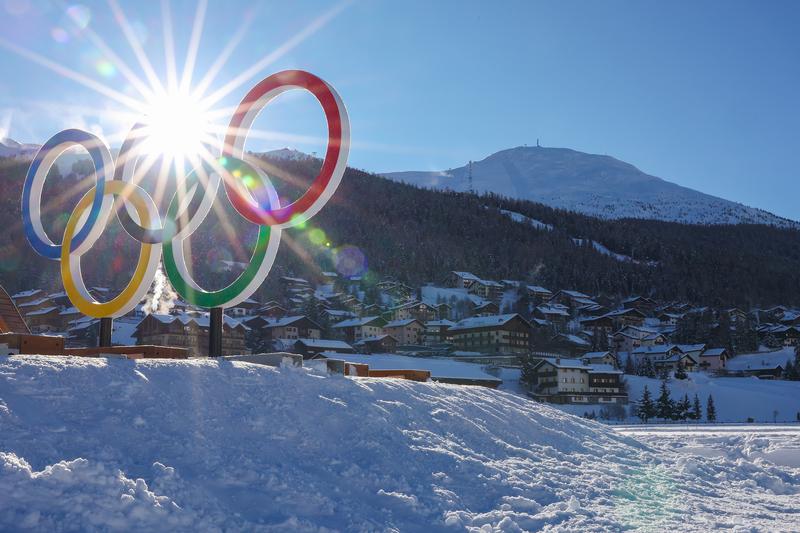
( Patrick Smith / Getty Images )
Brigid Bergin: It's The Brian Lehrer Show on WNYC. I'm Brigid Bergin, filling in for Brian today. Now we're going to talk about some highlights and maybe some lowlights from this year's Winter Olympic Games, which are in full swing right now in Italy. It's true the Winter Olympics don't usually get quite the same level of hype as their warm-weather cousins in the Summer Olympics, but this season in Milan is shaping up to be pretty interesting athletically and culturally. Maybe you've been watching the so-called "Quad God" figure skater and his unparalleled jumping skills. Perhaps the dramas surrounding the celebrated skier Lindsey Vonn has kept you up at night.
I know it. Watching her skiing certainly was disturbing for me. In the name of giving the Winter Olympics their rightful time in the spotlight, we're going to spend these last few minutes talking all things Milan and take your calls about the moments from this past week that have stood out to you. Justin Peters is a correspondent for Slate, who's been covering the Olympics since the opening ceremony, and he joins us now to run through some of the highlights. Justin, welcome to WNYC.
Justin Peters: Hey, Bridget, thanks for having me on.
Brigid Bergin: Listeners, before we dive in, we want to hear from you. If you've been tuning in, what have been the standout moments? Who are your favorite athletes? Without getting too mean, who are your least favorite and why? What events are you actually paying attention to? Are you picky, or will you tune into just about anything? Maybe you watched heated rivalry and decided there's no better time to get into hockey, or are you a diehard figure skating fan? Have you fallen for one or more of the niche sports like skeleton, and want to make a case for it? Maybe a slightly more controversial question: how are you feeling about rooting for Team USA this year?
You can call or text with your picks, pans, and any other thoughts or questions you want to share. The number is 212-433-WNYC. That's 212-433-9692. Justin, I've teased it multiple times during the show, and that's in part because my daughter is obsessed with him. Let's talk about the Quad God. Who is he, and how'd he earn that nickname?
Justin Peters: He's really incredible. Ilia Malinin is a 21-year-old figure skater from Vienna, Virginia, who holds the distinction of being the only person to ever successfully land a jump called the quadruple axel in competition. This is really nuts because four years ago in Beijing, perhaps the most exciting moment in figure skating for true heads was when the Japanese skater Yuzuru Hanyu tried and failed to land a quad axel during his routine. It was thought to be an incredibly brave thing to do, not least because up to that point, nobody in history had ever landed this incredibly difficult jump.
Then months later, here comes this, at the time, 17-year-old kid from Virginia who just effortlessly lands one in competition. Since that point, he's landed 12. When he attempts one during his free skate, and he will, and if he lands it, which he will, it'll be one of the most exciting things that's ever happened at a Winter Olympic Games, bar none.
Brigid Bergin: I saw him for the first time, I had never heard of him, over the weekend, during the team skate, and between the quad jumps and the backflip, where he landed on one leg, it was quite a spectacle, quite something to see. Let's talk about some of this year's other breakout stars. You've written about the record-setting American speed skater Jordan Stolz. Tell me about him and why his gold medal win is so significant.
Justin Peters: American speed skaters were crossover celebrities for a long time. Everyone remembers Bonnie Blair and Apolo Anton Ohno, who won Dancing with the Stars, of course, back in 2007, I think. Classic guy. Then, for about 12 years, American speed skating really took a nosedive, and no one's quite sure why. We went from being on the podium all the time and really competing with the Dutch, for whom speed skating is the true national pastime, to maybe winning a bronze every now and then. Erin Jackson, the speed skater, won gold in the 500-meter in Beijing in 2022. She was the only person to win gold.
Now here comes Jordan Stolz, who's this 21-year-old from small-town Wisconsin, who has this preternatural feel for the mechanics of skating and has spent the last several years training with this 75-year-old physical therapist who has been pushing him to improve his conditioning. As a result of this, he's become unequivocally the fastest and best male speed skater in the world. The other day, he came from behind to beat his top rival, the Dutch skater Jenning de Boo, in the 500-meter and setting a new Olympic record in the process.
Brigid Bergin: Wow.
Justin Peters: It's a great thing, and he's got to be considered the favorite for all of his other races.
Brigid Bergin: Listeners, we're taking your picks and pans of the Winter Olympics. The number is 212-433-WNYC. That's 212-433-9692. One listener texts, "Curling 24/7, the best Olympic Sport." Justin, that's one of those probably more obscure sports for some of our listeners. There's only one new sport that's been added to the roster of Winter Games this year, and that's ski mountaineering. Can you tell me about the new event and how it's going so far?
Justin Peters: "Skimo," they call it "Skimo."
Brigid Bergin: That's so great.
Justin Peters: It's like a fun little nickname. It's like what you call your two-year-old. It's incredible. I don't know how it's going to translate to television, but basically, the competitors have to clamber up a mountain on skis. Then, when they get to the designated top, they take their skis off, switch to a pair of different skis, and then ski all the way downhill. It's super fun.
Brigid Bergin: Wow.
Justin Peters: I cannot wait to see it.
Brigid Bergin: Speaking of skiing, can you get us up to speed on how Lindsey Vonn is doing? Just for context here, it tripped me up even introducing it because the celebrated skier decided to compete this year despite a recent injury and perhaps maybe predictably took a tremendous fall. It was just absolutely terrifying to watch. What's the status of her injury, and at the risk of being somewhat insensitive, who seems to be her likely successor as the next great American alpine ski racer?
Justin Peters: Real quick, I just want to clarify for everyone's benefit, this was not a vanity project on Lindsey Vonn's part to come back to the Olympics. I know a lot of people are thinking, "Well, she got what she deserved." She was the fastest woman in downhill skiing in this year's World Cup season. The day before she broke her leg, she finished third in the qualifier. She wasn't just returning to skiing for her own egotistical purposes. She had a real shot to medal. Unfortunately, she crashed within the first 13 seconds of the race, broke her leg. She's had three separate surgeries. She's recovering well, but I don't think we'll ever see her again on a ski mountain and competing for the USA.
Breezy Johnson, on the other hand, who just got engaged today at the foot of the slope. I know, it's a fun story. She missed the 2022 Beijing Olympics because she also crashed in Cortina on a training run. She took gold in the downhill. She's a fantastic skier, and I don't think she's done at all. I think we're going to see her for many Olympics to come.
Brigid Bergin: I want to get some callers in here. Somi in Chatham is calling in to make a point that several of our listeners are texting about. Somi, you're on WNYC.
Somi: Hi, thanks for taking my call. I don't know how many years ago it was, I don't know her name, but she was a Black figure skater who did a backflip on the ice. The judges noted that that was not allowed and nobody would be marked on it. Now we're saying that Ilia is the first one to do it, but he's not.
Brigid Bergin: Right. Just to be clear, the skater you're talking about, I believe, is Surya Bonaly. I observed that Ilia had done the backflip, but Justin, maybe you could talk a little bit more about the controversy faced by Bonaly, who did land that one-legged backflip. What is the different standard that Ilia is being judged on this year?
Justin Peters: 50 years ago, an American skater named Terry Kubicka was the first person to do a backflip in Olympic competition. No one had ever imagined that any skater would bother trying to do a backflip. After that, the powers that be were like, "No, no, no, that's an illegal move that's not allowed." When Surya Bonaly backflipped on the Olympic ice and got dinged for it, she was doing it at a point in time where it was, for whatever reason, an illegal maneuver on the ice.
In 2024, for some reason, the ISU reversed themselves, and it is now legal to turn a backflip on the ice again. That's the salient reason why Malinin didn't get in trouble for doing it. He's just benefiting from a rule change that happened a year and a half ago.
Brigid Bergin: Surya, I believe, did that backflip back in 1998. Let's go to Susan in the Village. Susan, you're on WNYC.
Susan: Hello. I love the Winter Olympics. I want to precede my comment with that. I will not be watching them again. I am calling NBC to tell them why. I am so appalled by the grotesque ban of that Ukrainian athlete, the skeleton athlete who had pictures of his dead friends on his helmet, and the IOC called that political, while they're running apparently the Russia propaganda games. Please call NBC and tell them this. I can give you their number because I called them.
Brigid Bergin: Well, Susan, we're going to take you off the air just for that, because I want to give Justin a chance to comment and maybe give some context to what Susan was saying there. Justin, if you're familiar with the story of that particular Ukrainian athlete.
Justin Peters: Yes, I am. He was adamant that he'd be allowed to wear a helmet with his dead friends portrayed on it. The IOC has a rule where in competition, you can't have any political messaging. Kirsty Coventry, the president of the IOC, said today that they tried and tried to find a solution with him, maybe allowing him to wear it during practice runs or immediately after he finished the race. He was adamant that he wear it in the race, and they banned him from it. I think it was just a tone-deaf move. I'm with Susan on this. The Olympics are inherently political. I just think it's tone-deaf to say you can't race because you want to call attention to the atrocities happening in Ukraine. I'm with Susan on this one.
Brigid Bergin: There's a lot more of the politics that we could get into. Before we let you go, Justin, I wonder if you can tell us what you're going to be paying attention to between now and the end of the games? What athletes or events should we be keeping an eye out for in the next week or so? If you could tell us in about 20 seconds.
Justin Peters: I think you got to keep an eye on American female figure skaters. It has been a long time since they have reached a medal podium. Team USA has a great team this year, and I think this is the year that we're going to see American women win a figure skating medal again.
Brigid Bergin: Justin Peters is a correspondent at Slate, who's been covering the Winter Olympics. Justin, thanks so much for joining us.
Justin Peters: Thanks, Bridget.
Brigid Bergin: We're going to have to leave it there for today. The Brian Lehrer Show's producers are Lisa Allison, Mary Croke, Amina Srna, Carl Boisrond, and Esperanza Rosenbaum. Our interim producer is Sasha Linden-Cohen. Our interns are Arlo Bivins and Jack Walker. Megan Ryan is the head of Live Radio. Juliana Fonda and Milton Ruiz are at the Studio Controls. I'm Brigid Bergin. Stay tuned for All Of It.
Copyright © 2026 New York Public Radio. All rights reserved. Visit our website terms of use at www.wnyc.org for further information.
New York Public Radio transcripts are created on a rush deadline, often by contractors. This text may not be in its final form and may be updated or revised in the future. Accuracy and availability may vary. The authoritative record of New York Public Radio’s programming is the audio record.
