
Working Families Party on Mamdani's Win; 2026 Midterms
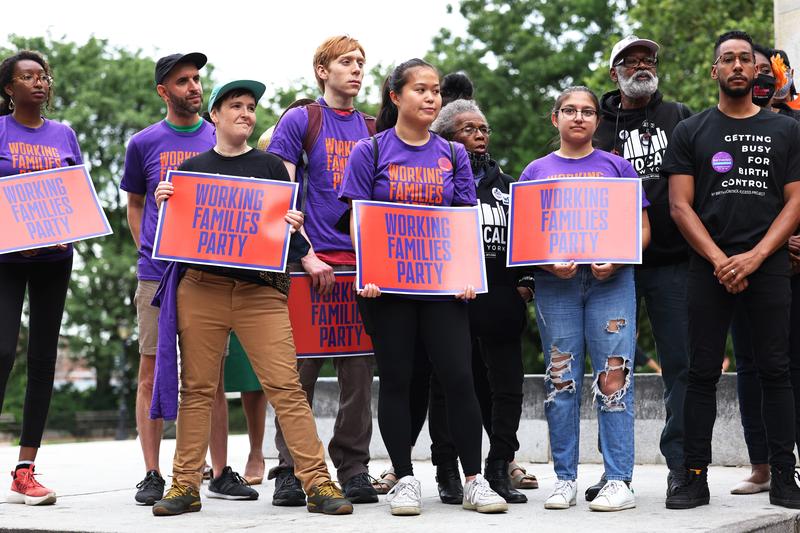
( Michael M. Santiago / Getty Images )
Brian Lehrer: Brian Lehrer on WNYC. Now we'll catch up with the Working Families Party after their first-ranked candidate in the Democratic primaries, Zohran Mamdani, won the primary and then, obviously, the general election. Did you hear that on Election Day, Zohran Mamdani voted for himself on the Working Families Party line rather than the Democratic Party line? More on that on the Mamdani transition in this conversation.
We will look ahead to what will surely be a busy 2026 for the party with this victory in the rearview mirror. There is a governor's race, and there are congressional races. Maybe the Working Families Party will be yet more aggressive in challenging some more centrist Democrats in Democratic primaries with Working Families-backed candidates, or maybe even, in some cases, running their own third-party candidates. We'll talk about all of that now with Jasmine Gripper and Ana María Archila, co-directors of the New York Working Families Party. Jasmine and Ana María, welcome back to WNYC. Hi.
Jasmine Gripper: Thanks for having us.
Ana María Archila: Thank you so much, Brian.
Brian Lehrer: For the uninitiated, either of you can start. What's the Working Families Party?
Ana María Archila: I'll take this. This is Ana María. The Working Families Party is a real political party in the state of New York that was founded in the late 1990s in response to what we perceived as the move of the Democrats away from working-class voters. It's a coalition of labor, community, organizations, and individuals. We are to the left of the Democratic Party and often challenge Democrats to be more aggressive in defending and standing up for working-class people instead of bending the knee to millionaires and corporations.
In general elections, we often lock arms with Democrats to make sure that we defeat Republicans and continue to build a government that sides with workers, with tenants, with students, and not the rich and well-connected.
Brian Lehrer: Jasmine, can you keep going on that? Like what kinds of policies that Democrats were supporting when the Working Families Party was formed were seen as too much of a giveaway to millionaires and billionaires, and not enough in support of working people?
Jasmine Gripper: The interesting thing is that when the Working Families Party was started, Republicans were in control across New York City and New York State. We had a Republican mayor, we had a Republican governor, we had Republican control of our state Senate. Dems weren't even in a winning posture in a state like New York, where there's overwhelmingly a large population and registration of Democratic voters. They weren't even commanding a lead and energizing their base to come out and vote.
In that chaos, the Working Families Party emerge as a coalition of labor and community groups and individuals coming together to build a force of a third party here in New York to move the electorate to the left and to demand real change for New Yorkers. Because of the Working Families Party, New York is now a leader on the minimum wage fight. We are a leader when it comes to paid sick days and paid family leave.
The Working Families Party has been instrumental on winning key reforms and changes on behalf of New Yorkers. Just thinking about this election cycle right now, campaign finance reform and having access to public matching funds has transformed who's in City Hall and who's at the helm of our government, especially locally, that you don't have to be rich and well-connected to be an elected official in New York.
We have the most diversity council that we've ever had. We have more women in office than we've ever had because we have broken down the barriers that prevented working families and working people from stepping into the halls of power and controlling how government can work on our behalf and for all of us.
Brian Lehrer: Just a little bit of timeline before we get to the president and Zohran Mamdani. In Mayor Bloomberg's three elections, 2001, 2005, 2009, did the Working Families Party support the Democratic nominee in each of those losing cases?
Ana María Archila: I'm trying to put on my history hat.
Brian Lehrer: [chuckles] Mark Green, Bill Thompson, Fernando Ferrer.
Ana María Archila: The party was founded in 1998. I'm actually not sure if, in 2001, we-
Brian Lehrer: That's okay.
Ana María Archila: -endorsed someone. In the last Bloomberg election, the party sided with Bill Thompson. In every one of those elections, even when the party didn't make an endorsement, for example, in the first election for Bill de Blasio, the party didn't ultimately make an endorsement in that race before the primary. The party was still the place that was pushing the discourse and the debate to be centered around working people.
If you remember when Bill de Blasio was running for the first time, the big debate was about paid sick days, and it was the Working Families Party that was the engine behind that fight to make sure that the candidates for mayor would have to take a stand on whether or not they would fight for workers to get paid, if they got sick, if their family members got sick.
Those are the kinds of fights that the party always put at the center, even in the moments when we didn't make endorsements, which, in some of the mayoral races, we did not. This year, we not only made an endorsement, but we also set the stage for a primary that would unite all the different progressive candidates as part of a slate of Working Families candidate and prevent the fragmentation that happened in 2021, the division amongst progressives that happened in 2021 that gave the space for Eric Adams to rise and win by a very narrow margin of just 7,000 votes.
This time around, we brought all the candidates on our side together. We said, "Yes, you are rivals. We're going to build a team of rivals to make sure that the person that becomes the mayor of New York City is not owned by the billionaires, but it's actually he or she," and in this case, Zohran Mamdani became our number one, is the person whose power derives from a coalition of working class voters from across the city.
Brian Lehrer: In a few minutes, we'll get to some of your, I think it might be accurate to say, tortured relationship with Andrew Cuomo in his three gubernatorial elections and some of the things he did as governor and how that sets up how you might be with or against Kathy Hochul next year. Next, I'm going to play a short clip of Mamdani from NBC's Mayoral General Election debate.
Zohran Mamdani: Look, a lot of people have called even my campaign a non-starter when we first began. Now I stand before you proud to be the Democratic nominee who got the most votes in city primary history.
Brian Lehrer: We hear Mamdani defending the legitimacy of his candidacy while Andrew Cuomo is still running against him in the general by highlighting his win in the Democratic primary. He said he was proud to be the Democratic nominee. Yet, on Election Day, he voted for himself not on the Democratic Party line, but on your Working Families Party line. Whichever of you wants to take this, what should that signify to the public?
Jasmine Gripper: Many Democrats are deeply committed to help building the strength of the Working Families Party and will identify as Working Families Party voters. We have a strong loyal base of voters who come out on Election Day and always look for Row D and vote down the WFP line. We have people who've been with us for years. Tish James shared the story on election day of remembering when she was a candidate on Row E for the Working Families ballot line. We are a third party--
Brian Lehrer: Which is an interesting story. I'll just throw that in for our listeners, who don't know this detail of history, and you can expand on it if you want. Tish James first got elected to New York City Council way before she was State Attorney General, New York City Council, only on the Working Families Party line. She was running against the Democrat, as well as maybe there was a Republican in that Brooklyn race. That was a significant moment, too, for the party, right?
Jasmine Gripper: Absolutely. It was history in the making. Tish James, our now Attorney General, was the first candidate to win an election only on the Working Families ballot line. We're proud to say that on Tuesday, this past Election Day, we had two new candidates make history. One, a city council member in Newburgh, and one, a county legislature in Onondaga, who also won their elections only on the Working Families Party ballot line.
We are building power here in New York State, and voters know and trust the Working Families Party and usually go to look for our line when they go to cast their ballot. It is a symbol of the values that they share. It is a symbol that say we're not just Democrats, we are Working Families Democrats. We are Working Families Party committed voters who believe in the values of the party, which is that we center the many over the few. We center fighting for working families and not the ultra-rich. We are committed to fighting and delivering for the working families of New York.
Not surprised that Zohran has been a WFP voter, back when he used to wear T-shirts, used to have don his Working Families Party T-shirt on Election Day. Most people, once they become a WFP voter, remain a WFP voter for their lifetime.
Brian Lehrer: Who has a question about the Working Families Party, or who has a story about how you voted for anybody on the Working Families Party line, or raise any issue? 212-433-WNYC, 212-433-9692, as we get ready to preview as we go here the role that they may play in what might be a very contentious 2026 election year within the Democratic Party and the Working Families Party, technically without it, outside of it, but related to it for some members of Congress locally and Governor Hochul.
We hear Mamdani in that clip. Well, it might be particularly sweet. Let's say the victory might be particularly sweet for the Working Families Party, given that Mamdani's opponent was former Governor Cuomo. Your party's endorsement of Cynthia Nixon back in the 2018 primary unleashed what maybe we should call a quiet Cuomo vengeance campaign in which he tried to end fusion voting, which, listeners, this gets a little bit wonky, but the process that allows candidates to run on multiple party ballot lines like Mamdani did. Ana María, he tried to destroy the Working Families Party. I mean, let's not mince words, right?
Ana María Archila: Oh, Andrew Cuomo absolutely tried to destroy the Working Families Party because we were willing to challenge him, not just on elections. We thought, considered really strongly challenging him in 2014 with Zephyr Teachout, and then challenged him with Cynthia Nixon in 2018. Also, we were always demanding of him to actually side with workers and tenants and parents. He was always very willing to ask working-class New Yorkers to wait, to endure, this is not their time, while he facilitated the enrichment of the richest New Yorkers and always lent his ear to corporations.
We were a thorn on his side, and he tried to destroy us. He changed the rules for third parties to make it very hard for the Working Families Party to survive. In fact, what happened is we became stronger and we were so happy to defeat him in the primary with the most progressive mayoral candidate we have had in a long time and defeat him again in the general election when he not only was the candidate of the billionaires, but he was also the candidate of Donald Trump, who tried to meddle in our elections to make sure that he would have someone who would facilitate Trump's agenda in New York City, and we defeated him again.
Really, what Cuomo represents is the Democratic Party of the past, is the party that is bitter, that punches left, that tells young people to sit down. What Zohran represents is the Democratic and the Working Families Party of the present and the future, a party that listens to immigrants, that protects immigrants, a party that listens to young people, a party that demands a government that is not subservient to the richest few, but actually uses the power to protect working-class New Yorkers.
Brian Lehrer: In fairness to Andrew Cuomo, I'm sure he would say he did a lot of liberal and progressive things as governor. $15 minimum wage, gay marriage before the Supreme Court, banned fracking. He would list other things and say he certainly was not running to carry Trump's water in New York City. That debate is for the past. I think in fairness, just to reference how he would see himself.
Ana María Archila: I agree with you that he would certainly say that, but all of those victories were hard-fought battles that we and others forced him to acquiesce to. It wasn't like Andrew Cuomo was championing marriage equality; he was forced to do it. He wasn't championing increasing the minimum wage; he was forced to do it. That was always the dynamic with him.
Brian Lehrer: Just to that point of history, on the way that he tried to kill the Working Families Party, or let's say severely disable it, it's that, correct me if I'm wrong, because this might be interesting for people to know how this works, if a party gets 50,000 votes in a gubernatorial election, you automatically have a ballot line that you can use in any election in New York for the next four years. Cuomo tried to dramatically up that number to make it harder for the Working Families Party to keep its line automatically without having to go race by race and gather petition signatures every time. Is that an accurate description of what he tried to do?
Ana María Archila: That's right. He changed the rules around how many votes are needed on a ballot line for the governor's race for a party to keep its ballot line. Now, the rules are a party has to get 130,000 votes or 2% of the vote, whichever is higher. What he achieved with the changes is that he killed the Independent Party, the Green Party, and the Liberal Party, and only the Working Families Party and the Conservative Party survived. In this election, Zohran Mamdani alone got 157,000 votes for him on our ballot line. Jumaane Williams got 217,000 votes for him on our ballot line. Almost 25% of the vote went for Jumaane in Brooklyn, on our line, and in parts of the city. A little bit lower than 20%.
We are a force that is growing. Andrew Cuomo's machinations totally failed. Now, thank to the voters and the energy of all the thousands of people that did not give in into the fear and did not assume that he was going to be victorious. Thanks to them, we have New York being led by Zohran Mamdani with an agenda that really speaks to the challenges that people are facing, and New York leading the fight against authoritarianism.
Jasmine Gripper: I'll just add that not only did Andrew Cuomo try to kill the party by raising the threshold, but if you remember, he also created his own party, the Women's Equality Party, the WEP, to confuse voters with the WFP, the Working Families Party. Again, Andrew Cuomo is no longer in office or in power. The Women's Equality Party is no longer there either, but the Working Families Party is still here and stronger than ever.
Brian Lehrer: Created the Women's Equality Party to put himself on that ballot line while he was-
Jasmine Gripper: He did.
Brian Lehrer: -running against a woman, just to put an even finer point on that history in the Democratic primary. Andy in Westchester, you're on WNYC. You want to push back a little, I see, Andy, huh?
Andy: Yes, I do. Even if you are on the left, I have to say that the Working Families Party can be seen as somewhat of a Potemkin party, a fake party, because the thing is, most Democrats want to stay Democrat so they can vote in the national Democratic primary and be involved in their local Democrats. Where I live, there are local Democrats. There's no local Working Families Party meeting that I can go to. What ends up happening is they get on the ballot because of these strange--
It's only in New York State where you have this fusion voting, as far as I know, not in any other state where you can have multiple lines for the same candidate. Then the people who actually control the party are this very small number of people who are not really representative of anything. If they really wanted to have influence over the Democratic Party, they could go into the Democratic Party and try to pull it to the left from the inside, but instead of standing on the outside, this small group of people that control this line. I just feel like it's a very undemocratic way of being involved in politics.
Jasmine Gripper: Oh, that is so far from the truth. We have a really strong Westchester Party led by two people of color that live in Westchester, who are registered as Working Families Party registrants on their voter registration, who are actively holding meetings and talking about Westchester politics that exist all across New York State. Yes, there are people who are embedded in the Working Families Party. We are not the only state with fusion. Fusion used to be widely accessible across the US, but as the two parties attempted to consolidate power, they removed fusion voting everywhere except for three states.
New York still has fusion votings. You can be a Working Families Party voter and still be a registered Democrat and participate in your Democratic club. Some people choose that route. Then there are some people who will choose to change their registration and become a part of the Working Families Party party and actually do party business with us and also collect petition signatures and get our folks on the ballot.
We have six regional advisory councils across the state, and we have various chapters and clubs all across New York State that are controlled by local volunteers who spend a lot of time and energy on the local politics and making sure that we are a representative party and not just controlled by the few.
Brian Lehrer: A Kathy Hochul question, I think.
Ana María Archila: Brian, can I say--
Brian Lehrer: I want to keep moving. I think I'm going to take that as the answer to that caller, because I want to get to at least two more things, and we're going to run out of time. Laura in the Bronx has a Kathy Hochul question for you. Laura, you're on WWNYC with the two co-directors of the Working Families Party. Hi.
Laura: Hi. Thank you so much for taking my call. I'm very upset about this. I have voted Working Families candidates before, especially Zephyr Teachout, who was wonderful, and I wish she'd won. My question is about Kathy Hochul's betrayal of our environment. Maybe the only good thing that Cuomo ever did was to ban all of this fracking in New York State. Now, Kathy Hochul is making it easier by endorsing the permitting of oil and gas infrastructure running underwater. I guess it's to the Rockaways, and it must be in the mouth of the harbor. It's between New Jersey. It involves New Jersey as well. As soon as Hochul turned coat and made this permitting easier, that was a reversal of policy.
Brian Lehrer: Yes. Laura, I'm going to leave it there. I will tell you, you'll be interested to know, probably a lot of people will be interested to know, we're going to do that as a separate segment on tomorrow's show. With everything else going on, people may not have noticed this, which I think it is fair to call it a reversal by Governor Hochul on the pipeline. Climate activists are very upset at her for this. We're going to look at why she thinks it was a good idea and why other people think it was a bad idea. That's going to be our Climate Tuesday section tomorrow.
For you, Working Families Party leaders, it sets up the question for next year with Hochul facing a challenge from the left in a Democratic primary from her own Lieutenant Governor Delgado. Will you have a litmus test as to whether you will endorse Kathy Hochul?
Ana María Archila: Yes. Next year is a really important election year. There is the governor's election with a primary between Hochul and Delgado, as well as primaries for the state comptrollers race and congressional races and Senate and Assembly races up and down the state. We are obviously using our leverage to make sure that we not only help Zohran and the mayors that we elected across the state have Albany with-- helping them govern and deliver.
Our litmus test will be one that assesses whether the governor is serious about helping deliver on an affordability agenda, especially on child care, on health care and housing, and whether the governor is ready to do what it takes to protect immigrant New Yorkers from the atrocious attacks by the federal administration. That's going to be what we-- we can call it our litmus test. Obviously, climate is incredibly important, and it's at the top of the agenda and will be part of our assessment of not just Hochul, but every single candidate across the state.
Brian Lehrer: Do you have a list of Democratic members of Congress in New York who you might want to be picked off in primaries by more progressive challengers? I see Ritchie Torres' name get mentioned. I see Dan Goldman's name get mentioned. I see even Hakeem Jeffries' name get mentioned. Are you taking a position? Are you naming any names yet, who you do want challenged or don't want challenged? I think Mamdani said he doesn't want Jeffries challenged, but I'm not sure.
Jasmine Gripper: Yes. We have a Democratic process for all of our endorsements. Our questionnaires are being finalized as we speak, and we'll be going out to candidates who are seeking our endorsement. We will go through a rigorous process to determine which races to get involved in and which candidates to endorse in the upcoming elections. You'll likely see some endorsements coming out for some people as early as before this year is over.
Brian Lehrer: Oh, wow.
Jasmine Gripper: Then our usual endorsement process will happen after the new year.
Brian Lehrer: I'm going to take one more call and extend this over time a little bit because there's a very weird melodrama going on in Huntington on Long Island, having to do with the Working Families Party, where I think you are maybe the victims of some kind of Republican scam, perhaps. Valerie is calling from Huntington about that. Valerie, you want to set this up?
Valerie: Yes. Hi. Thank you for taking my call. Can you hear me?
Brian Lehrer: Yes.
Valerie: Hello?
Brian Lehrer: Yes.
Valerie: I went to the polls. I live in Huntington. The town supervisor race, which is the supervisor, is the person who runs everything for our town, which, just briefly, is a very diverse town of a large geographical area, both racially, socioeconomically, and ethnically. I go to the polls. Usually, there's the Democratic line, which I'm a Democrat, so I vote Democrat. It's usually the same candidate in the Working Families Party because there are only about 650 members in the Working Families Party out here.
The incumbent is Republican. It's a longtime Republican stronghold. The supervisor seat has been like that for a while. I voted for the Democrat. I knew something about the Democratic candidate. Then I saw in the Working Families Party line, it was a different name, a Latina woman's name.
Brian Lehrer: Maria Delgado.
Valerie: I'm thinking to myself-- Okay. I didn't want to use her name because she's totally innocent from what I understand. She's 83 years old.
Brian Lehrer: This is where I'm going to jump in. You explain, Jasmine or Ana María, what you think happened here because 83-year-old Maria Delgado apparently didn't know that she was the Working Families Party candidate out in Huntington for that local office, and their suspicion about who put her on. Was it to split whatever progressive vote there was so the Republican would be elected? If so, how could they do that? Who wants it?
Jasmine Gripper: Yes, I'll respond here. I'll just start by saying that in 99% of the people the Working Families Party endorse appear on our ballot as we plan. In a few cases around the state, Republicans are known for what they call ballot rating, where they attempt to take advantage of third parties, minor parties with limited infrastructure, and attempt to put someone else on the ballot in order to confuse voters and to be dishonest. We know Republicans and conservatives have been using this dirty trick for years, especially in local communities in Long Island and some parts of upstate.
Brian Lehrer: We have about 30 seconds left. Is it your allegation--
Jasmine Gripper: Just so you know, we did not endorse Maria. She has no connection to the party. We actually endorsed the Democratic nominees. What happened here was deceptive practices by the Republican Party to deceive voters and fool them. We are hoping that the AG or the district attorney appoints a special prosecutor to look into what happens, especially in this case, where the candidate claims she didn't even know she was on the line.
Brian Lehrer: I see that the Attorney General Letitia James is looking into it at least. With that, we say goodbye to Ana María Archilla and Jasmine Gripper, co-directors of the New York Working Families Party. Thank you so much for joining us. It's going to be an interesting 2026.
Jasmine Gripper: It will.
Ana María Archila: Thank you, Brian.
Jasmine Gripper: Thanks.
Copyright © 2025 New York Public Radio. All rights reserved. Visit our website terms of use at www.wnyc.org for further information.
New York Public Radio transcripts are created on a rush deadline, often by contractors. This text may not be in its final form and may be updated or revised in the future. Accuracy and availability may vary. The authoritative record of New York Public Radio’s programming is the audio record.
