
Winter Challenges For NYC's Sanitation Department
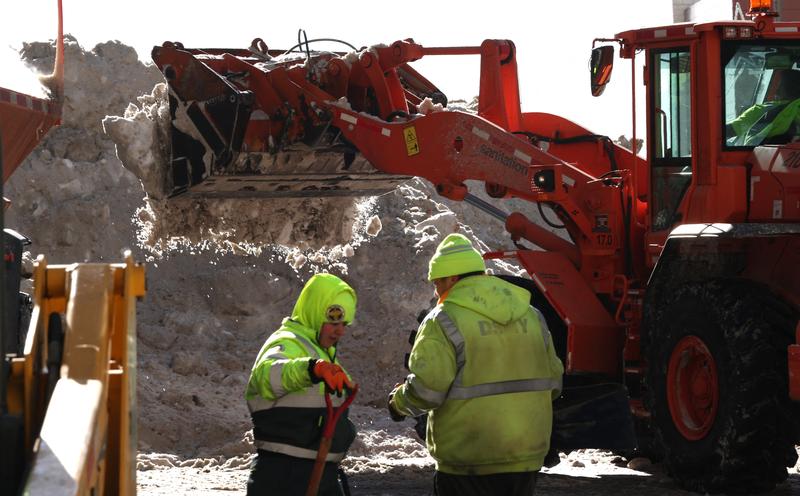
( Timothy A. Clary/AFP / Getty Images )
Brian Lehrer: Brian Lehrer on WNYC. We're about two weeks on now from that winter storm that dumped around a foot of snow across our area and blanketed streets, sidewalks, and public and private spaces alike. We're well into a cold snap that has turned much of that snow to ice. The agency charged with clearing all of it in New York City, as if I had to tell you, that means thousands of miles across New York City streets, is the Department of Sanitation.
That's on top of its day-to-day responsibility of collecting trash, recycling and composting, and more routine cleaning of the streets. Let's just say not everyone is happy about how they've managed to keep up. Now comes the inevitable melting with its own problems to boot. With us now is Javier Lojan, the acting commissioner of the New York City Sanitation Department. Commissioner Lojan has been leading DSNY since late 2024. Commissioner, thanks for coming on. Welcome to WNYC.
Commissioner Javier Lojan: Good morning. Thank you for having me today.
Brian Lehrer: Listeners, our lines are open. What do you want to ask or say to the sanitation commissioner? 212-433-WNYC. Complaints are okay. Compliments are okay. An observation about what the city needs still after this storm or anything else going forward, 212-433-WNYC, or help us still report the story of the post-storm period and tell us how things are on your block.
I know one person who lives in Queens and has a garage with a driveway, says the plows keep coming through and re-snowing her in because the snow from the street gets plowed to block her driveway, and then she has to shovel again. Whatever your story is, 212-433-9692. Commissioner, take us through some of this. How many miles of streets is DSNY responsible for clearing after a storm like this, and what does the operation look like, especially in the first 24 to 48 hours?
Commissioner Javier Lojan: Sure, so we're responsible to clear a little over 6,400 miles of roadway, when you look at it, lane miles, because each roadway might have multiple lanes, about 19,000 lane-miles. It's quite the massive undertaking. In parallel to that, we're also clearing close to 250 miles of protected bike lane infrastructure across the city. Going into a storm, the biggest thing is making sure we have all our adequate resources ready to go, depending on the forecast.
A storm of the magnitude that we had at the end of January was a 12 to 15-inch storm, which, a lot of times, forecasts can be a little tricky. In that case, it was pretty spot-on. We pretty much go into full-snow mode. We plow up all our trucks. We load up all our salt spreaders. We have over 700 salt spreaders, 2,200 plows. The plows, I want to remind everybody, which I'm sure a lot of the listeners may know, is that they're your traditional garbage trucks that you used to seeing going week to week, picking up your refuse and recyclables.
We convert those into plows, and then we work with some of our agency partners as well, who supplement some of our work. Department of Transportation, Department of Parks, Department of Environmental Protection. It's a really coordinated effort. Obviously, the mayor's office is very engaged and nice of them as well, so it's a whole all-hands-on-deck for this kind of storm. Then we split our workforce into 12-hour shifts. We have a morning shift, and that runs into the afternoon, and then we have a night shift that comes in right after that. We continue that throughout, depending on the storm.
We'll start salting and then plowing, and then that's pretty much how the first 24 hours go. We track everything through our internal tool, which we call Blade Runner. We have our snow command center here at headquarters. We track our assets across the city and ensure that everybody's getting the service that they should be receiving. Then we're tracking that, depending on the snowfall, the rates of snowfall, and the timing and everything, then we're making some operational adjustments at a high level. That's basically how the first 24 hours go.
Brian Lehrer: Because this storm was hours of snow followed by hours of sleet, and then the deep freeze locking that ice into place, how harder did this become than whatever snowfalls in the past you want to compare it to?
Commissioner Javier Lojan: I've been fortunate enough to be with this agency for 27 years. I've seen a lot of snowstorms. I want to say this is in the top five. Obviously, the amount of snow that fell wouldn't fall into that category, but the cold weather that followed was just something intense that I don't see much of. You look back at a storm. The Boxing Day Blizzard of 2010. The city got buried. It was a lot of issues with that storm.
Jonas in 2016. Those were two big noticeable storms that, while they were a lot higher in snowfall amounts, I think the temperatures were not anything close compared to what we got in this storm. I think on average, the temperatures after those storms were above 30 degrees. We're here. We're lucky if we saw 20 degrees during the day. At night, that just froze even more and more, made everything like rock. Definitely one of the most challenging storms we've had to face as far as post-storm, because I think during the first 24 hours of the storm, I think the agency did a great job clearing all the roads and the bike lanes, as I mentioned.
One of the things to also take into account for the listeners is that rock salt, typical rock salt, starts losing effectiveness when you start going below 20 degrees, even greater below 15 degrees. This storm, the first day, we were at 12, 13 degrees. We supplement that with calcium chloride, which lowers the effectiveness, but it's just one of these storms that was very, very challenging because of the cold temperatures.
Brian Lehrer: I think I'm channeling most, if not all, of our New York City listeners by giving props to all the sanitation workers who have worked so incredibly hard over the last few weeks. Someone told me yesterday that they saw a half-dozen sanitation workers hacking away at a single frozen mound with shovels the other day. What tools do you have for the kind of ice still in small hills on New York City streets right now?
Commissioner Javier Lojan: Right, so we have a multi-pronged approach when it comes to snow removal, particularly around pedestrian infrastructure. We have, as you mentioned, ice choppers and shovels. Typically, that would be sufficient enough, obviously, depending on the temperatures. We also have mechanized equipment, which, in this storm, we leveraged a lot more. We have what we call smaller skid steers. Those are very nimble pieces of equipment. They're smaller. We have front-end loaders. People would know them as payloaders because of the smaller sizes we have, and we use those to clear out some of those areas, and then we hire emergency snow shovelers.
We have people that are willing to come in and brave the cold and do some manual labor for a little extra money. We've employed hundreds of them. A multi-pronged approach, as I mentioned. I think in this storm, we expanded the reach, and we hired emergency contractors that have this kind of equipment that they use throughout the year for landscapers, construction companies that have this kind of equipment. We expanded our reach, so we had every resources out there available to get at and clear out a lot of these areas.
Brian Lehrer: I'm going to take a phone call for you from Louise in Brooklyn, who's going to articulate probably the most common complaint that we've gotten from listeners over these couple of weeks. Louise, you're on WNYC. Hello.
Louise: Hi, Brian. Good morning. Good morning, Commissioner. Thank you for taking my call.
Commissioner Javier Lojan: Good morning.
Louise: Yes, I want to repeat that we do appreciate that the streets were cleared. We were able to move our cars, if we could get these spaces around us cleared, which is certainly not the responsibility of the sanitation. The biggest complaint is that we get our pickup of garbage on Saturdays and Wednesdays. The Saturday before the storm, we did not get a garbage pickup. There were six pickups missed during the course of this weather event.
The first time we got a pickup was last week. I think it was either Thursday or Friday. We finally got a pickup. The garbage was horrendous in the neighborhood. I'm in Midwood. The other complaint was that crosswalks and bus stops were not cleared. Of course, that added to the danger of people or pedestrians, and drivers alike. I appreciate that I could voice this. I'm sure you've heard these complaints before, but thank you that you took my call. Thank you.
Commissioner Javier Lojan: No, and Louise, I'm very sorry to hear that you were missed. As far as our operation goes, the Saturday before the storm, we have reports. We had reported that everything was completed, obviously. Look, there might have been a missed collection unintentionally, obviously. I apologize from the top down. That should not be the case. Going into the storm, obviously, that's a separate challenge that I'll get into a little bit.
Obviously, during the storm and post-storm, we don't accept 311 complaints for missed collections because we're in parallel efforts there. If you got missed Saturday, you're able to call 311. We have reactivated 311 complaints for missed collections as of yesterday. Obviously, if that becomes a challenge going forward, please I encourage you to call 311. It's one of those things that we are looking at. Nobody should have to experience that. Again, I apologize. That's something that we know we have to get better at.
As far as the crosswalks and the bus stops, that is one of the things that we did recognize that was a challenge for the city. I just want to paint the picture here that we normally go into these operations after we clear the streets and the bike lanes. I think one of the things that made it so challenging is that a typical crosswalk may take our workers who are shoveling this manually during a storm of this magnitude, anywhere from 5 to 15 minutes.
You're clearing a passenger wide enough on both curb cuts, and then you move on to another one, right? This one, we had some reports of some of our workers having to take close to an hour in each one. That's why when we supplemented with our mechanized equipment, we focused on that more because the manual labor, which is very time-consuming, it just slowed us down a little more. It's one of those things that we're looking at to get better at, maybe be more efficient on how we throw different things at it, depending on the severity of the storm.
It is one of those things that we are closely evaluating, not only with internally DSNY's concern, but other agencies. We have agency partners that were great and helped us out with giving us supplemental work, and they were aiding these efforts. I think just looking at that holistically and saying, "How can we do this better from the onset," is, obviously, one of the things that we want to make sure we get out of this post-storm review as far as DSNY is concerned.
Brian Lehrer: Well, once the snow and ice came, did trash collection have to fall behind as much as it did?
Commissioner Javier Lojan: Yes, so one of the things to keep in mind is that the same workers, and I mentioned the trucks that are plowing the streets and clearing some of these areas, are the same ones that are collecting the trash. A few days after the storm, we did initiate collections on Tuesday frequency and going forward. We had to prioritize, so there's a few material streams. We have the refuse, the compost, and then you have your recyclables, which are metal, glass, plastics, and paper, because we had to make sure we still prioritize some of these areas of snow removal.
As you mentioned, the crosswalks and the bus stops and other areas that we had to continue to readdress. We had to prioritize the refuse and the compost collections for the first week of the storm. We knew we were intentionally backlogging ourselves on recyclables. What we did find after the storm is that when we went through some of these frequency areas, some people didn't put out. The following week, when they were using full-collection operations, it was double of everything.
The other thing I also want to remind the listeners are, typically, during a normal day of DSNY operations, the way our workforce is structured is the day begins at midnight for the majority of the workforce. You have a midnight shift. They work till 8:00 in the morning, and then you have a day shift. It usually starts about six o'clock in the morning. The bulk of our collections are done on the midnight, and then the 6:00 AM shift. We have done that to ensure that people get service early, and you don't have bags of trash on the street in the afternoon. People are used to not seeing a lot of that material day-to-day in the morning maybe. By the time they get to work, it's already gone, right?
Brian Lehrer: Yes.
Commissioner Javier Lojan: Because we had to split our operation, so we had everybody on mandatory 12-hour shift operations. We had a 6:00 AM shift, and then we had a 6:00 PM shift. Now, what that meant was we couldn't go after the entire material stream across the city on one shift. We had to split it up. A lot of people were getting picked up at 6:00 AM, and then a lot of them were being picked up at 6:00 PM. That went into the overnight.
Because we were backlogged, some of that material went into the following morning. Obviously, the focus was on the trash collection. It just got intensified even more. I think just the way our staffing had to be structured because of the split shift operation, a lot of people saw that material out more and more throughout the day, rather than a typical day, which starts at midnight. I mentioned, it goes into the early afternoon, not into the evening.
Brian Lehrer: So many people are calling and texting with questions, so let's go to Barbara on Staten Island next. Barbara, you're on WNYC. Hello.
Barbara: Oh, hello, and thank you. Commissioner, I went online and looked. The concept is out there about these hot tub trucks, I'm wondering, in combination with salt, I know that has to be used. I'm bringing it up because I'm on a side street. I did shovel and had myself dug out. The other side of the street, because of the plow, always goes to that side. They cannot really shovel very easily because the salted ice has turned brick-hard. I'm wondering if, in the mix, if this steam trucks or steam idea can be used a little more liberally to open up. Because even though I can get out, I know if I pull out, I will not have a spot when I come back. Then what will I do?
Brian Lehrer: Commissioner?
Commissioner Javier Lojan: I think one of the things with snow melters is what we call, which you're referring to, the hot tubs. We have 13 of those across the city. There's actually three in Staten Island. The way those work, just to clarify for everybody, it's not those melters are not melting the snow at that location where they're being used. The way the operation works, and you may have seen this across the city, is we have a lot of this mechanized equipment that will go up and clear streets across different parts of the city.
They will create these small mounds of snow, and then we'll put them in these dump trucks. The dump trucks then go to the snow melter site, and then they create humongous piles and dump them there. Then our payloaders or front-end loaders will then take those mounds and dump them into the snow melter. That's how we melt it. It's not at the location of where those melters are.
We're creating piles. We're clearing out as much as we can from various parts of the city, and then we're bringing them to these locations to melt it there. That's just one thing to clarify for the listeners about the snow melters. Again, we have 13 across the city, so that is something that we are finding effective. I think we're close to almost 200,000 tons of snow melted today, and we're going to probably exceed that because that effort is continuing on.
Brian Lehrer: Interesting. We talked about clearing the streets and the corners and the bus stops. Here's a question from a listener who writes, "Who's in charge of clearing sidewalks around and in playgrounds and basketball court surfaces inside of New York City parks?" Listener writes, "None have been cleared. Our middle school uses a New York City park for recess and have not been able to go outdoors for play for weeks." Somebody else writes a related question who has that question for schoolyards themselves. What's the answer to the parks and the schoolyards?
Commissioner Javier Lojan: Each agency partner is responsible for their property and the surrounding area. In the case of the parks, parks department would be responsible for that. Then, as far as the schoolyard, the Department of Education would be responsible for the removal of the snow on those properties.
Brian Lehrer: Sharon in Manhattan, you're on WNYC with the sanitation commissioner, Javier Lojan. Sharon, hi.
Sharon: Hi. Thank you very much for taking the call. This is a question about a rule that I heard that everybody's responsible for shoveling the snow from the sidewalks, but they're not supposed to put it into the street. It's really a very difficult thing to walk down. I've seen lots of people who cannot get out anywhere. If you have to take a car like Accessorides or something, where you have to have transportation where you can't get on a public bus or something like that, it's virtually impossible to get out to the street. What is that rule about not being able to put the snow in the street so you can't really shovel paths to get out to the street? It seems like an almost impossible rule.
Brian Lehrer: Hah, sounds like a catch-22. You got to clear the sidewalk in front of your building or house, but you're not supposed to put it in the street. Where is it supposed to go? Commissioner?
Commissioner Javier Lojan: Right, so I understand the challenge there. The reason why the rule is in place about not throwing in the street is, a lot of times, when we clear the roadways during a storm and immediately after a storm, we get people clearing out their sidewalks and things like that, and we will put that back into the street. That becomes a hazard for a lot of motorists because it's still cold. The roadway seems like it's not untreated. We put that rule in place so people aren't just throwing the snow back into the street, and then it just requires us to go back and replow it.
That understanding is a challenge. Each borough and each location is unique and, obviously, understanding that geography-- Real estate is not always easy to find in certain areas. It's one of those things where we just try to ask people to try to figure out what works best for their property. If it means making small piles and having a small opening, that might be a solution. Yes, that rule is in place, so people aren't just throwing snow back on the street and then recreating hazards for the roadway.
Brian Lehrer: Here's maybe a related question. I mentioned this in the intro with someone I know in Queens. Looks like Margarita in the Bronx has the same issue. Margarita, hello.
Margarita: Yes, good morning. Good morning, Commissioner.
Commissioner Javier Lojan: Good morning.
Margarita: Thanks for taking my call. Believe me, I was a city employee for a lot of years, so I know it's rough to satisfy everybody. The public, the higher restaurant, the whole nine yards. However, I live on a residential street, and all the neighbors came out. We all helped each other get our cars out of our driveways. There was a sanitation worker. He was so nice explaining everything to us.
My question to him was, and to you also, "Doesn't sanitation have an app to tell the drivers that that one street has been cleaned already so they don't have to come and redo it?" The worker said to me, "Well, my shift's not going to come back, but the next shift is." I said, "You can't communicate to the next shift saying, 'Blah, blah, blah, street has been done already, so skip that. Go to the next street.'"
Brian Lehrer: Is part of your question that when the plows come through again, they plow you in, meaning your driveway?
Margarita: My driveway, and I'm chopping ice again. Three times in a row, I went out there. I have that thing everybody else has. I have a herniated disc, yada, yada. Like I said, the day and age that there's an app for every damn thing. You mean to tell me there's not an app for sanitation people to say what blocks have been cleared and what blocks still need attention?
Brian Lehrer: Margarita, thank you. Commissioner?
Commissioner Javier Lojan: Margarita, first, thank you for that. I appreciate the statement of support there for city employees. As far as an app, so we actually have-- and it's one of these things that, obviously, depending on the block, we could look into that. We actually have navigation devices in all of our trucks. We have route-specific software in each truck. It's pretty sophisticated, where an operator is assigned a specific route at the beginning of his or her tour.
They get in that route. That navigation device will give them turn-by-turn directions to the route, and then they're on the route, going on to the next segment. As they're completing the route or if they don't complete the route, and then it has to be finished off on the subsequent shift, we have the ability to continue that route exactly where they left off. We don't have the issues, as you mentioned, where operators are informing each other of where they left off and what has to be done because, obviously, that's not an efficient way to operate.
All of our trucks have navigation devices. It's a pretty sophisticated system. If they somehow have to deviate off the route, we have a return-to-route feature that will bring them back, whether it's for an obstruction. There could be a fuel truck on the block, save a vehicle, whatever it may be, and then they can come back and make sure that that block is not missed. Again, it could look at that specific scenario.
Then as far as plowing back the driveways, that is one of the things that we are always stressing to our operators. During a snowstorm, it's a little difficult because they have to plow as they're going everywhere. Post-storm, that is one of the things that we are instilling in our operators that they have to be very mindful of not plowing anybody back in because that is frustrating. I understand why you would feel that way.
Brian Lehrer: Before you go, where does personal or community responsibility come in? Someone in Manhattan sent me some images of a scene in Riverside Park after people had gone sledding with lots of cardboard makeshift sleds and stuff. Those and other litter were just left behind. It actually reminded me of the images we've seen recently of litter piling up in Yosemite National Park after President Trump defunded a lot of national park staffing.
In that case, the staffing was a problem, but also, people going to Yosemite are leaving behind that much litter? In this case, in Riverside Park. I imagine it's happening elsewhere in the city, too. Have your sanitation workers been encountering scenes like that, or do you have any message or request for the general public in situations like this post-snow period?
Commissioner Javier Lojan: Yes, and we have encountered different-- obviously, unfortunately, people do litter and sometimes are not considerate. We have encountered that. We have been able to, the last week, shift back into making sure that those areas are addressed. Inside a park would be the responsibility of the parks department. Obviously, 311 is one of the best tools that I suggest everybody use because that's where exactly we would be going to and sending our resources to.
As far as the message for the public, I think using litter baskets, that's the best resources available because those will continue to service around the clock. Try to be mindful of where you put your waste. Unfortunately, a lot of these conditions could be avoided if people actually dispose of their waste appropriately. Obviously, we understand it's a city of 8.5 million people. Not everybody gets the same message, but we'll continue to try to refine our operation as much as we can and provide everybody the level of service that they deserve.
Brian Lehrer: Let me throw one other thing, and then we're out of time. You know the old quote? Maybe you know it better than I do. I'm going to paraphrase it. I think it's Mayor Fiorello La Guardia from 100 years ago, saying, "There's no Democratic or Republican way to pick up the garbage." Now that you've served under Mayor Adams and a little bit under Mayor Mamdani, is there a centrist and a DSA way to pick up the garbage?
Commissioner Javier Lojan: No, it's all the same. I think that's one of the things that I've personally enjoyed working for this agency for, as I mentioned, 27 years now, is that regardless of who's been in office, when it comes to snow removal and waste removal, the objective is to provide everybody the level of service that they deserve, regardless of political affiliations or anything. That's always one of the things that I've enjoyed the most. I think it'll continue on that way.
Brian Lehrer: Do you want Mayor Mamdani to keep you on?
Commissioner Javier Lojan: I think right now, I'm focused on making sure everybody gets the level of service they deserve and, obviously, rectifying any of the issues and the after-action and seeing what we could do better one day at a time. That's the way I've taken every day, so I'll just continue to do that.
Brian Lehrer: Good attitude toward life, not just work, right?
Commissioner Javier Lojan: Exactly.
Brian Lehrer: Javier Lojan, the acting commissioner of the New York City Sanitation Department, thank you so much for giving us this time today and engaging with so many listeners. We all really appreciate it.
Commissioner Javier Lojan: Thank you for having me. It was a pleasure to be on.
Copyright © 2026 New York Public Radio. All rights reserved. Visit our website terms of use at www.wnyc.org for further information.
New York Public Radio transcripts are created on a rush deadline, often by contractors. This text may not be in its final form and may be updated or revised in the future. Accuracy and availability may vary. The authoritative record of New York Public Radio’s programming is the audio record.
