
Will the US or Iran Blink First?
[music]
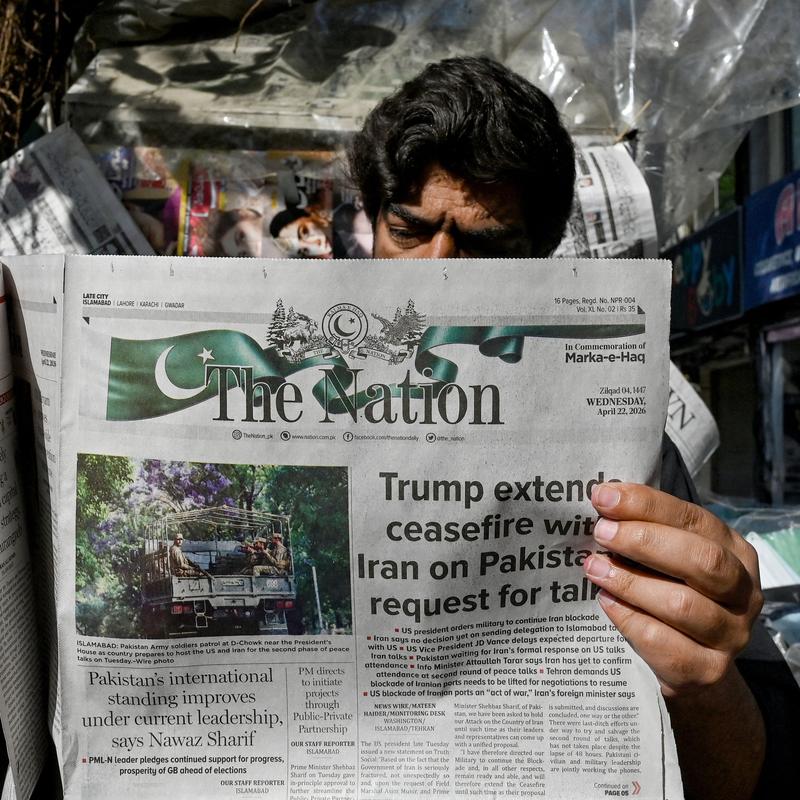
Brian Lehrer: It's The Brian Lehrer Show on WNYC. Good morning again, everyone. About the war with Iran, if you're not confused, you're not paying attention. President Trump last night announced an indefinite extension of what they're calling a ceasefire. At the same time, he's continuing an act of war, and so is Iran.
As NBC reported it a few hours ago, Iran attacked three ships in the Strait of Hormuz this morning, saying its Revolutionary Guards seized two of them and further inflaming tensions over the key waterway. It says it comes after US forces seized an Iranian ship and boarded a tanker linked to Tehran's oil trade. That from NBC News.
Listeners, you can decide for yourself if that sounds like a ceasefire to you. It doesn't really sound like one to me. Maybe a partial ceasefire in which there's at least no bombing by the US and no missiles being flung around the Middle East by Iran.
Most of the coverage in recent days has been about the negotiations over the war from the standpoint of the US, Iran, Israel, and Hezbollah. We'll talk a little bit about that in this segment, but we'll focus mostly now on the military state of the war. Who has won and lost what, and what each side's military could do if the ceasefire collapses.
Why the military aspects? Well, the prospect for military victories and defeats and the death and destruction that come with them, of course, drive what each side's military is willing to agree to in peace talks.
With me for this assessment is Fred Kaplan. He writes the column War Stories for Slate and is author of books including The Bomb: Presidents, Generals, and the Secret History of Nuclear War. Fred, always good to have you. Welcome back to WNYC.
Fred Kaplan: Thanks. Always good to be here.
Brian: One thing we know, and that is probably a reason for Trump's plummeting poll numbers. He's down to an astonishing 33% approval in the new AP poll out today. One reason for that, I suspect, is that he keeps declaring victory in a war that we're still fighting. This is from a month ago. This is one quick example.
President Trump: This war has been won. The only one that likes to keep it going is the fake news.
Brian: Trump a month ago. Here's Defense Secretary or War Secretary Pete Hegseth about two weeks ago, also declaring victory in the war that's still going on.
Pete Hegseth: Operation Epic Fury was a historic and overwhelming victory on the battlefield.
Brian: Pete Hegseth earlier this month. Fred, let's start with a basic reality check. The war isn't over, is it, or did I miss something?
Fred: Hello?
Brian: Fred, do we have you?
Fred: Hello?
Brian: Fred, let's start with a basic reality check. I think we had a little disconnection problem.
Fred: Sorry about that.
Brian: The war isn't over, is it, or did I miss something?
Fred: It's not over, but who knows what's going on. I mean, one problem we have is that we have a president who started this war having no idea where he wanted it to go, or actually having one big idea, which was that this would be easy just like Venezuela was, even though all of his advisors, or at least those advisors who know anything and aren't afraid to tell him something, told him otherwise.
Now, he's stuck in this situation. People talk about-- he keeps boasting that we destroyed their navy, we destroyed their air force, they've got nothing left. Well, people talk about, there's this phrase, asymmetric war. Now, what does this mean? It doesn't mean that one side is lopsidedly more powerful than the other. It means that the two sides are basically fighting different wars with different capabilities.
We've got all this armed might, these missiles and bombs that can do all kinds of things. Iran has-- even if all they had were a handful of speedboats with drones that could plow through the Strait of Hormuz, and that they control the land on the banks of the Strait of Hormuz, and as a result, no international shipper company wants to go through there risking their boats, then they're winning the war that they're fighting.
We don't have much in the way of countervailing firepower that can deal with that, unless you want to get into a really deep intervention, which I really do think Trump wants to avoid. I don't think he wants to send ground troops to occupy Iranian soil for the next decade.
What do we do about this? I think what Trump would like to do, and that's why he's declared this indefinite ceasefire, he'd like to forget about the whole thing and just go about his business and pretend that there's no problem. Hey, we've got oil. We don't need oil from the Strait of Hormuz.
The problem is that the global oil market is a global oil market. Even if we're not so dependent on oil from that part of the world, it affects the prices that we pay for gas and others.
Brian: I want to drill down and get into the weeds on some of the military aspects that you just cited. You mentioned what Hegseth boasts about. I'm going to play another clip of him from that same briefing a couple of weeks ago detailing a more specific list of military accomplishments than just saying, we won capital V for victory. Here he is.
Pete Hegseth: Iran's navy is at the bottom of the sea. Whether it's the Soleimani class, their frigate class, their prized drone aircraft carriers, submarines, minelayers sunk.
Iran's air force has been wiped out. Iran no longer has an air defense, any sort of a comprehensive air defense system. We own their skies. Their missile program is functionally destroyed. Launchers, production facilities, and existing stockpiles depleted and decimated.
Brian: Hegseth two weeks ago. Fred, can we at least say the things he listed there are real and Iran is military much weaker than it was before the war?
Fred: Well, some of them are real. I would say, if this is true and if it's meaningful, what's the problem? Why is anything still going on? Why is Iran still threatening oil tankers? How are they able to get away with it? Even if everything he said were true, it makes anybody wonder, well, geez, is he talking about the relevant factors here? They don't have much of a navy. They still have small speedboats that can fire drones at tankers.
They might not have a comprehensive air defense system anymore, in fact, that had been wiped out about a year ago, but they do have some shoulder fired surface air rockets that can knock down low flying airplanes such as what happened to an A10 a couple weeks ago. They still have enough stuff.
By the way, missiles, I read estimates that they still have about one third of their surface-to-surface missiles. These aren't like ICBMs. These are small. They're portable. They're movable. They can be hidden places. They are still able to fire missiles at other countries and US bases. We're not asking the right questions.
Brian: It doesn't mean two-thirds are gone. Let me ask you a follow up, a hypothetical about what you just described that they have left. If the US just wanted to occupy the country, which I know that's not the goal, but if the US wanted to go that far, could Iran resist? How much can Iran still attack Israel or the Gulf States with the weapons they have?
Fred: By occupy, you mean actually sending in ground troops and setting up bases?
Brian: Yes.
Fred: Yes, they could resist. The Revolutionary Guard has a couple hundred thousand troops and there's still a conventional army. Think back on the 2003 Iraq war. We occupied that pretty well, went in and rolled through and occupied Baghdad and sent Saddam Hussein fleeing within a matter of a couple weeks. Then we were there for the next nine years fighting an insurgency war.
In Iran, which, by the way, is three times the size of Iraq and has a very literate population, which, while they hate their regime, have a long history of hating foreign occupation even more. There are air bases that we could just go occupy in Iraq. There's no such thing as Iran. We haven't had any structure there, any military gear or anything since 1979.
You'd have to go in there with a few hundred thousand troops to take the place. Then you'd have to have more troops to protect those troops. You'd have to set up air bases so that you can fly in material. I had a professor once who talked about the fallacy of small-scale maps. In other words, you look at a world map and you say, "Well, that looks pretty small."
Brian: On your bedroom wall or somewhere.
Fred: "We could take that." It's a big, big, big place. Even if it were a small place, actually occupying something and protecting it and protecting the protectors, this is a major, major operation.
Look, I have to think that Trump has been briefed on this. I think he does not like to get involved in wars where the other side can shoot back. Look, Trump and things that he's done and what other people haven't done, it's like a continuing, stunning operation.
I would be more than stunned if he actually started sending-- I think something that he might be tempted by is to send a relatively small group of troops to occupy the banks around the Strait of Hormuz. Even that becomes a nightmare. You'd still have to go set up a base there, and then you'd have to have troops protecting those troops.
They have to eat and get ammunition. You'd have to have an air base to fly in stuff. It's an elaborate, elaborate operation. Too many people who comment about these things played Risk in their childhood and think that it's not much more complicated than that.
Brian: Played Risk or you say the fallacy of small maps. I never thought of that concept before, but it makes sense. I actually had a map of the world over my bed in my bedroom when I was a little kid. My brother and I shared a room and my parents put a map of the world over my bed, maybe because I was the older brother, and a map of the United States over my brother's bed. That's how we grew up. I think that's one of the reasons that I wound up becoming a journalist.
What really changed the shape of the war was Iran closing the Strait of Hormuz to most shipping, as you mentioned earlier, pushing up the price of oil and, by extension, so many other products around the world. What would it take, since this is a military segment, what would it take for the US or anyone else to militarily reopen the Strait of Hormuz and keep it open over Iran's objections?
Fred: As I say, you would have to go in and occupy the area right around the Strait, which looks small but isn't, and it's connected to the great Iranian land mass. You're isolated halfway around the world, which is why that's what you don't want to do.
The way that most wars have ended in history is not through unconditional surrender or destroying their civilization. It's through some kind of negotiated settlement that has something to do with the political objectives for which the war was started to begin with, rightly or wrongly.
One problem we have here is that Trump has mentioned so many rationales or rationalizations for this war that we don't know, the Iranians don't know. What's the crucial thing? One day he'll say, "We're here because we want to prevent Iran from ever getting a nuclear weapon." Then the next day he'll say, "Oh, I'm not worried about their uranium. It's buried so far underground, they couldn't ever get to it."
Well then, what is he worried about? What would it take for him to say, "Okay, good enough. Let's sit down and deal about what we do for the next 20 years." Even if you are a well-intentioned Iranian, and I'm not claiming that there are very many of those, you wouldn't know what to do, you wouldn't know what to say, you wouldn't know what to offer.
Besides, he's scuttled so many promises over the years, why would you believe anything that he said he was going to do? This works both ways. The other day you're saying, "Okay, well, the ceasefire is about to run out. We're going to probably have to start bombing again." Then the ceasefire runs out, and he goes, "Well, it's okay. We'll just extend it for a while."
If you're an Iranian, if you're a hawk, and there are a lot of Iranian hawks, A, you think that you're on the winning side of this thing. You have forced the most powerful country in the world to stop fighting and not getting anything for it. Second, you've got a president who makes all these threats, and then circles back on them because he doesn't want to carry them out.
Why believe any threat? On the other side, why believe any promise that this guy makes? It's a catastrophic situation.
Brian: Fred Kaplan, War Stories, columnist from Slate, articulating right there the theme from his latest article, which is called, Trump: madman theorist without a theory.
Listeners, Fred can answer a few of your questions about the military aspects of the US-Israel war with Iran and Hezbollah. 212-433-WNYC, call or text. Not so much on the diplomacy or the politics or morality for this segment, that we usually focus on, and rightly so I hope, but with this vague new ceasefire without a deadline or a specific new threat.
As the war actually continues in the Strait of Hormuz, we're taking stock of where the war stands militarily to better understand the options for all sides who, hopefully, will get to peace at some point, and a meaningful peace. Your questions about that, welcome here. 212-433-WNYC. 212-433-9692, call or text.
Fred, let's go on to the military issue that even though you just said these keep changing and we don't even know if it's this, but that I think we can say as the actual number one reason for the US involvement, Iran's nuclear program.
You've written two books about nuclear weapons. How would you assess the ability of Iran to make nuclear weapons compared to, let's say, before Trump's first term when he pulled out of the international Iran arms deal that was made during the Obama administration?
Fred: Well, I would say, as of last June, Iran was closer, at least potentially, to having enough highly-enriched uranium to make a nuclear bomb than they had ever been. It is true. After the midnight hammer bombing of June where 11 B-2 bombers, as Trump put it at the time, obliterated 3 enriched uranium sites, that set them back.
Now, we don't know, or at least I don't know, and I don't even know if anybody really knows how far it did set them back. There are reports that Iran took out a lot of the uranium before the bombs. Why wouldn't they since Trump was advertising that he was going to do that for weeks at a time?
Where is the uranium? I don't know. It probably is buried very, very deeply, which on the one hand, means we can't bomb it again very easily, but it also means that they can't extract it very easily without being seen by satellites or any number of other statements.
The Iran nuclear deal that was negotiated by Obama and five other leaders, which Trump keeps calling the worst deal ever negotiated. It's 159 pages. It took 20 months to write. It was actually a very successful deal. It did have some sunset clauses. Certain clauses of it were going to expire at certain dates.
The assumption at the time was that maybe there would be follow ons because we would have lifted our economic sanctions against some of Iran. Maybe they would have become more integrated into the world economy, maybe not. Obama's view was, look, maybe they'll join the world economy, the world system more, but if not, it's better that they do what they do without nuclear weapons than with nuclear weapons.
Trump said this is a terrible deal. He tore it up. He said, "I'll put in a better deal," which he never even tried to do. I think he thought the theory of maximum pressure would-- that the country would collapse. The sanctions would go back on, it would collapse. It didn't. They found workarounds, and then they started enriching uranium again.
Hey, why not? In fact, the big danger, let's say everything in the next few weeks or months has worked out, and let's say that the new leaders of Iran really are more reasonable. Trump goes back and forth between saying this is a much more reasonable bunch, and then still calling them crazy maniacs, so who knows?
Let's say it all works out. If I were an Iranian leader and if I were rational, even Western-leaning Iranian leader, I would say, "Okay, man. This time, we've really got to build some nuclear weapons. We have to build. We can't mess around with this anymore. We have to deter another crazy American president from coming along and bombing us to smithereens."
In order to get Iran not to think that way, we have to start offering them certain kinds of incentives. I don't know what those are, but they have a rational interest. In fact, a lot of countries, looking at what's going on with this and seeing how suddenly, the United States could just start attacking, they have a rational interest in building their own nuclear deterrent.
Brian: You said earlier that Iran has reason not to trust anything Trump says, or by extension, any deal that he makes because he so often changes and goes back on his word. Iran does that too, right?
Fred: Sure.
Brian: Like, while Obama was still president, after that deal was made, it was 2016, the German government documented instances of Iran trying to cheat. I have this quote from Angela Merkel, who was chancellor then, saying Iran continued unabated to develop its rocket program in conflict with the relevant provisions of the UN Security Council. If we can't trust each other-- it sounds like you want to push back on that. Go ahead.
Fred: It's rocket-- it is true there were some signs back then that they were continuing with some missiles. These were not covered by the Iran nuclear deal. They were covered by certain UN Security Council resolutions, which they were violating.
I've looked into this pretty closely. There were some ambiguities, but there was no indication other than that they were abiding by the Iran nuclear deal pretty faithfully. Trump's first secretary of Defense, retired General Jim Mattis, said that the verification provisions in the Iran nuclear deal, which he said he read three times, probably compared with Trump who I doubt read it at all, were as airtight as any that he had seen in any arms control treaty.
Again, how did that work? Well, it took 20 months. It's 159 pages. You can't send over Jared Kushner and an old real estate buddy with no staff to go along there, and come up with a deal that really locks this stuff down. It's complicated.
Brian: Well, we keep hearing, on the complexity, that Iran still has 1,000 pounds of enriched uranium. Not bomb quality, but getting there, is what I keep seeing in the press. Some resolution of that has to be in however the war actually ends.
Let's say there never is a deal. What can the US do by force militarily to seize that uranium or further delay how Iran could make bombs with it? We know there were the attacks in June of last year because this is a military analysis.
Fred: Right. Well, I will say this, the Special Forces has plans to invade, occupy, and seize and export the nuclear materials or arsenals of every vaguely hostile country that has nuclear weapons. I once talked with a Navy officer who said, and I don't know if he was telling the truth or what and I don't know if it's still relevant, that he had worked on the 400-page plan to go in and seize the Pakistani nuclear arsenal.
Now, I'm sure there are plans like these. Whether anybody could attest about their feasibility or risk level is another matter. We could go in there. If we knew where the uranium was, you could go in there. Again, it's not like you send in The Dirty Dozen to go do this.
You have to send in forces who knew what they were doing. You would have to send in a protection unit to protect that force and to provide perimeter defense around the whole area where you're doing this. This is a 1,000 pounds. You have to fly this out somehow.
It would basically mean occupying a huge chunk of Iran. It's a small area or areas where they have this stuff, and then the areas around there to keep it secure. Look how hard it was a few weeks ago. It was a brave but also elaborate, extensive effort involving hundreds of personnel, Trump said, to rescue two airmen who had been shot down.
They could go hide in a mountain. They didn't have to be out in the open, blasting through tunnels to get into uranium and then going through the tunnels. It could be done, but the other way to do this-- look, right before this war started on Thursday, before the Saturday surprise attack, Iran put forth a proposal that, among other things, would restrict the amount of uranium they could enrich to a purity level of 1.5%. You need about 90% for weapons grade.
It could have been said, this is better than the Obama deal, which restricted them to 3.5%. Trump said, "Well, we'll think about it, and let's resume talks on Monday." He surprise-attacked them on Saturday. That was a pretty good deal. That was the basis for a truly good deal.
He ignored it because he had some notion that there needed to be clause for zero enrichment. Even though the Nuclear Non-Proliferation Treaty declares that countries that sign it have a right. This is where this language of having a right to enrich uranium comes from. It isn't declared by Iran. It's declared in the Nuclear Non-Proliferation Treaty, which all but a handful of countries in the world has signed.
Now, does that mean that we believe what Iran says? No. If they're thinking, why should we be the only country in the world that doesn't have nuclear weapons and isn't even allowed to do any enrichment for "peaceful purposes"? 1.5% enrichment, restricting it to that, there's nothing you can do with that. You can't do research. You can't even do medical research. That would have been a pretty good deal.
Now I understand that last week, Iran offered a deal to suspend all enrichment for five years. Trump said, "No, it has to be 20 years." What is going on here?
I'm told that some official briefer from the International Atomic Energy Agency, when Iran offered the 1.5% deal, briefed Kushner and Witkoff on the whole business of enrichment, and how 1.5% enrichment, that's a pretty good agreement because you can't do anything militarily with that, as long as you can come up with ways for them to dismantle the highly-enriched uranium they had.
They didn't care. They didn't pay any attention to it. Maybe because Trump had a standing order that it has to be zero enrichment. All I'm saying is there are ways that we could have dealt with this problem. In fact, there were ways that we did deal with this problem that did not involve going to war against a country three times the size of Iraq. Trump decided not to do it because he thought that he's such a brilliant negotiator that he can get people to do anything he wants them to do.
Brian: Let me get a few listener questions in here before we run out of time. Short answer, because I think you can probably fact-check these with almost one word. There are some memes going around online that have-- I've seen one of them. Listener writes, "Is it a fact that General Caine, chairman of the Joint Chiefs of Staff, stopped the president from pressing the nuclear button over the last weekend?" That meme is going around online.
Another one asks, "Can Fred confirm that a downed airman was actually rescued, as the US says, or it seems like these kinds of videos that they put out are part of the new style of war we have. It was cover for a failed special ops incursion near one of the uranium sites." Do you have any reason to believe either of those things might be true?
Fred: The first one, I can't imagine it's true, partly because the chairman of the Joint Chiefs of Staff is not in the chain of command on firing nuclear weapons.
Brian: Really?
Fred: Trump could have given the order to launch a nuclear weapon that would have gone straight to a one-star general in the National Military Command Center in the basement of the Pentagon, who would have forwarded it to people in the silos and the submarines and so forth.
Now, the procedures do call for a conference call with the president and the commander of Strategic Command and some other people. Even if Trump wanted to push the nuclear button, the chairman of the Joint Chiefs of Staff would have had no power to stop him from doing so. That story is just nonsense.
The one about that the rescue was just a cover story, I don't know. The moon landing was shot in a studio in Culver City. I don't know, but it seems to me that if that were true, I think we would have heard something about this by now. This isn't exactly the most leak-proof administration in history. 9/11 was an inside job. You can come up with all kinds of stuff. It doesn't sound very plausible.
By the way, it shouldn't raise any eyebrows that the names of the airmen or the air crew haven't been released. They generally aren't, so that they're not flooded with publicity threats or so forth.
Also, I think the Iranians, who look pretty foolish not being able to capture two airmen after downing them, I think they would have poked holes. They would have denied any reports about it. "We never shot down any plane. We never went looking for any--" It doesn't ring plausible.
Brian: So we end with Fred Kaplan. To say at the end what I said at the beginning, if you're not confused, you're not paying attention. President Trump last night announced an indefinite extension of what they're calling a ceasefire. At the same time, he's continuing his act of war in the Strait of Hormuz, and so is Iran continuing theirs.
Fred Kaplan writes the War Stories column for Slate. His latest article, Trump: madman theorist without a theory. Thanks for joining us, Fred.
Fred: Thank you.
Copyright © 2026 New York Public Radio. All rights reserved. Visit our website terms of use at www.wnyc.org for further information.
New York Public Radio transcripts are created on a rush deadline, often by contractors. This text may not be in its final form and may be updated or revised in the future. Accuracy and availability may vary. The authoritative record of New York Public Radio’s programming is the audio record.
