
Wild NYC: Springtime Water Migrations
Brian Lehrer: Brian Lehrer on WNYC. Once a month for a year, on The Brian Lehrer Show, we started last month. We're taking some time to pay attention to one of the most important, if often overlooked, parts of the city and surrounding areas, the parts that are not man-made, the plants and animals that sustain us. Last month, we talked about some of the changes going on in trees as spring gets underway. Today, we take a look at the changes spring means for animals with Part 1 of a two-part look at spring migrations this month and next month. Not only do birds migrate this time of year, but so do fish. What? Other water creatures, too.
That's where we focus today. We're joined for this by Chris Bowser, an estuary educator coordinator for the New York State Department of Environmental Conservation with Cornell's Water Resources Institute, and by our guest throughout this series, Marielle Anzelone, urban botanist and ecologist, and founder of New York City Wildflower Week. Welcome back to both of you.
Marielle Anzelone: Hey.
Chris Bowser: Hey, so great to be here. I am so happy that you are focusing on some of the incredible natural wonders of our beautiful city.
Brian Lehrer: We thank Marielle for the idea, and I welcome you back, Chris, because you were here a few years ago. Maybe a few of-
Chris Bowser: I was.
Brian Lehrer: -our listeners remember, to talk about a species that's very much part of this story today, eels. Last time, you even brought a jar of what are called glass eels with you. Can you tell us about American eels and their spring migration?
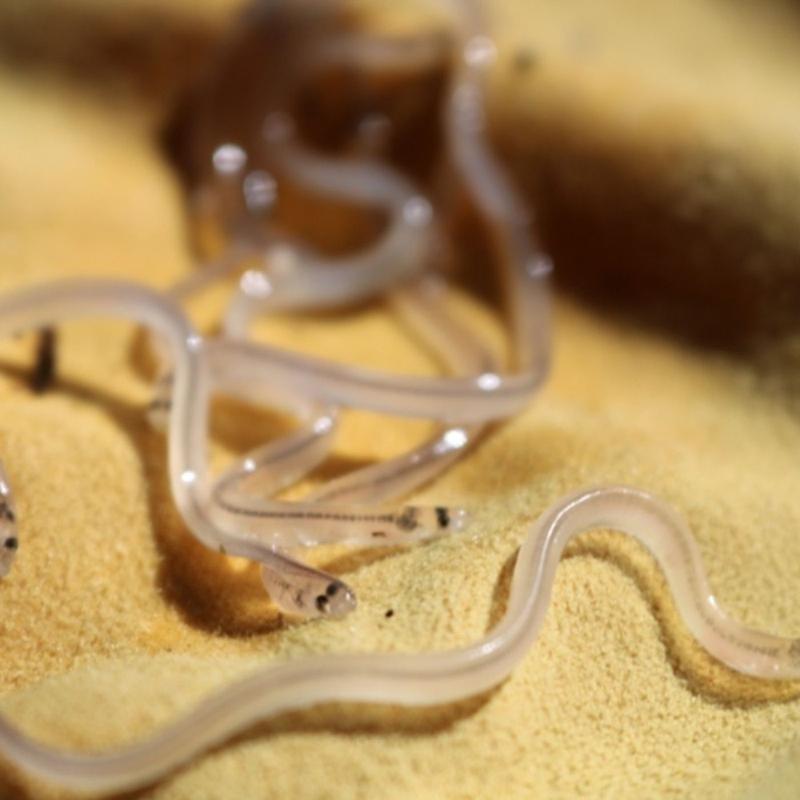
Chris Bowser: I absolutely can. Right now, as we speak, the migration is happening. There is a beautiful aquatic fish species, the American eel, Anguilla rostrata, that lives throughout the harbor, throughout the Hudson, and really throughout all of the waterways of the East Coast from the Caribbean to Canada. In the spring, at least in New York, the baby American eels, which are nicknamed glass eels, are on their migration from where they hatched in the Atlantic Ocean and the Sargasso Sea between Bermuda and Puerto Rico.
They're now a year old, and this is the time in their lives where they're transitioning from that saltwater ocean creature to this coastal fish that will become the eel that many of us are familiar with. If we've gone fishing or netting, or we've just seen eels, but right now is when that spring arrival of the baby glass eels is just coming in. They're arriving here by the thousands and thousands every single day.
Brian Lehrer: Listeners, any calls for our guests about spring migrations, the water edition? If you have firsthand experience with glass eels or other migratory fish or the horseshoe crabs that we're about to talk about, we're inviting your texts or calls. I don't know if anybody has anything on this particular sliver of New York life. 212-433-WNYC, 212-433-9692. Call or text. Like last month and throughout the series, we invite you to post your pictures of seasonal change, in this case, waterborne migration, to your Instagram stories. Post them to your Instagram stories and tag us @brianlehrershow. Use the hashtag #BLwild as you tag us @brianlehrershow on your Instagram stories. Marielle, horseshoe crabs.
Marielle Anzelone: Yes. We love a horseshoe crab. Before we get into horseshoe crabs, though, I just want to say Chris is so excited about the eels because I think we forget that New York City, at its core, is a city of islands. We're people. We're on land most of the time, but the Bronx is the only part of New York City that's actually part of the North American mainland. New York City has over 500 miles of coastline. We have a very intimate relationship with the water, and I think sometimes it's easy to forget that, so excited about talking about our waterways and the creatures who share the city with us, horseshoe crabs being one of them, of course.
It's not quite a migration, but we do see them each spring. Under the full moons of May and June, they return to the city shores in Brooklyn, Queens, and the Bronx to spawn. This follows the high tides that come ashore to mate. This is something that horseshoe crabs have been doing for a really long time before New York City even existed. They're considered to be about 350 million years old.
Then, interestingly, their eggs are also a really critical food source connecting us to next month's discussion around migrating shorebirds, the red knot birds. This, of course, links the city's coastal habitats to a vast ecological network. Then, interestingly, also in our summertime waterways, the city is also known to see a federally endangered sea turtle, Kemp's ridley sea turtle, swim in our waterways. What happens in New York City really affects larger ecological systems and migratory patterns.
Brian Lehrer: That's beautiful.
Chris Bowser: Marielle, I love that you've brought this up because all of these species that you've just mentioned are totally related to each other. You can do an absolute deep dive on the relationship between horseshoe crabs, eels, commercial fishing for eels, how we relate with horseshoe crabs and eels. I also love you point out that New York City is the city of islands, and I want to give a special shout-out to our colleagues with the Department of Environmental Protection who run one of our community-science eel project sites on Staten Island.
They're out there every day helping to monitor these baby glass eels using volunteer hours and local students. There's just such a great vibrancy about all of these animals and the reconnection of New York City's people residents with New York City's aquatic residents.
Brian Lehrer: We think it's a big deal, and it is, but we think it's a big deal that the United States is celebrating its 250th birthday this year, a little context, a little perspective on humans in the course of history, that Marielle said horseshoe crabs have been doing this thing for 350 million years. Let's see what a listener is contributing to this. Greg in Dover Plains, you're on WNYC. Hi, Greg.
Greg: Hi. How are you doing?
Brian Lehrer: What you got?
Greg: I got a couple of questions. First question is, what's the technical difference between an eel and a lamprey?
Chris Bowser: Oh, excellent question. It turns out that eels and lampreys, although at first glance they may look similar, scientifically they're actually pretty distantly related. Lampreys are a very, very old species of what we call fish. They don't have jaws. Their great-great-ancestors evolved and split from regular fish many, many millions of years ago. Then, eels are much more closely related to what we would call true fish or bony fish.
Everything from your guppy to your salmon to your trout, that's more of the eel family. Both look similar, but we often see that in nature, where different things will evolve to look similar because they're very good strategies to survive. That eel-like, snake-like shape works in a lot of different habitats.
Brian Lehrer: Chris, you'll be happy to know, Marielle, I'm sure you will too, that we have a full board of calls. All 10 of our lines are lit. It looks to me like every single one of them is calling with a question about eels. Whoever called-
Chris Bowser: Bring them on.
Brian Lehrer: -that it would come to this on The Brian Lehrer Show. Mandy in North Jersey has one of those questions. Hi, Mandy.
Mandy: Hi. Good morning. How are you?
Brian Lehrer: Good.
Mandy: I was just wondering, I'm a science teacher, and I'm dealing with oceanography right now. I was looking for specific things to tell my kids about: what physiological changes do the eels have to go through to adjust from their saltwater environment to this coastal, more freshwater environment?
Chris Bowser: Beautiful question. For you and all of the science teachers out there, we have got a full suite of eel-related lesson plans and classroom activities for you. If you go on to hrnerr.org, H-R-N-E-R-R.org, that's for our National Estuarine Research Reserve, you can actually look up in our curriculum and unit lesson plans different American eel lessons that are actually organized by grade, organized by topic.
I'll also give a special shout-out to our partners and colleagues in Pennsylvania that work on a program called Eels in the Classroom. You should check out their work as well. You'll get a lot of great stuff there, especially focused on these many cool changes through the eel life cycle. Those are really highlighted in those lesson plans.
Brian Lehrer: We've got some links on our website, The Brian Lehrer Show page at wnyc.org, to some of what Chris was just describing. Oh, Mark on Staten Island, you're on WNYC. You're into this, too, Mark, right?
Mark: I am very much into this. Thank you. Out here in Freshkills Park, the largest park in the city of New York, we are studying the horseshoes and the eels and everything else beautiful and wild for the New York City Department of Parks and the Freshkills Park Alliance. The 501(c)(3) not-for-profit provides programming all summer long for kids. We're going to be doing horseshoe monitoring in May and June, and that can all be seen on our webpage, freshkillspark.org. The wonderful work you guys are doing and the education that's going on is so important, and we at Freshkills can't thank you all enough for continuing to do that work privately.
Brian Lehrer: Cool. I'm going to leave it there. Freshkills Park Alliance. We have one from an educator at the Gowanus Canal Conservancy, where they say they get eels and horseshoe crabs. That's amazing. William in Westchester, I'm going to let you ask the last question because it's such a beautiful question. William, hi.
William: Hi. For those of the people out there who aren't going to delve into research on glass eels, could you describe the beauty of a glass eel?
Brian Lehrer: Don't you love that, Chris? You have about 15 seconds to do it.
Chris Bowser: Well, that's fantastic. First of all, I love glass eels because of the way the light refracts through them. They are nearly transparent. If they catch the light just right, they scintillate with little mini rainbows. The other thing that I find beautiful about them is that eels are a symbol of how all of our ecosystems are connected together. Those glass eels coming in from the ocean are a symbol of hope and connectivity across the entire world.
Brian Lehrer: Chris Bowser, estuary educator extraordinaire for the New York State Department of Environmental Conservation and Cornell's Water Resources Institute. Thanks again, urban botanist and ecologist Marielle Anzelone. We'll talk to you again next month with Part 2 of our look at spring migrations, when we look up to birds and other flying creatures. Thanks to both of you for coming on today.
Chris Bowser: Thanks, Brian.
Brian Lehrer: #BLwild Wild NYC. Listeners, remember, you can post your pictures of seasonal change, and they don't have to be about eels and horseshoe crabs. They can be about any springtime seasonal change to your Instagram stories. Just tag us @brianlehrershow using the hashtag #BLwild. Stay tuned for All Of It.
Copyright © 2026 New York Public Radio. All rights reserved. Visit our website terms of use at www.wnyc.org for further information.
New York Public Radio transcripts are created on a rush deadline, often by contractors. This text may not be in its final form and may be updated or revised in the future. Accuracy and availability may vary. The authoritative record of New York Public Radio’s programming is the audio record.