
Wild NYC - Spring is Coming
[music]
Brian Lehrer: Brian Lehrer on WNYC. Now, as promised, we debut a new year-long series on the show. We're going to take time each month to pay some attention to maybe the most important part of the city and surrounding areas, when you really think about it, the part that's not man made, the plants and animals that help sustain us. Some of you probably remember our 2022 series, BL Trees. Once again we'll be joined throughout the series to talk not just about trees, but other kinds of plants this time and wildlife. Marielle Anzelone, urban botanist and ecologist and the founder of New York City Wildflower Week, NYC Wildflower Week. Hey, Marielle, welcome back. Good to hear your voice again.
Marielle Anzelone: Hi, Brian. It's so great to be back on. I'm really excited to be here.
Brian Lehrer: Maybe before I introduce this month's topic and the expert you asked to join you, you could tell us a bit about why it's important in general in this city, with so much to hash out with a built environment, we need to spend some time looking at what's growing in the cracks in the sidewalks and the remaining green spaces and things.
Marielle Anzelone: Sure. I think it's something that people don't really consider, but the very existence of New York City is based on the fact that it has a really rich biodiversity. What I mean by that is it's the living part of the natural world, so it's the plants, it's the animals, it's the fungi, even the bacteria that live in our city. We have salt marshes and vernal pools, coastal dunes. There's a lot of really rich nature through the five boroughs, but we don't really think about them a lot. In some ways I think a little bit about it as how having a stable democracy helps people move on to doing other more creative things. This is the underlying infrastructure that we rely on but don't really think about, like the way flowers are pollinated or that forests store carbon and provide oxygen that we breathe. These ecological concerns directly support human health and our climate resilience and even our economic systems. They're really important to think about, but also it brings people a lot of joy just to observe plants and animals around us.
Brian Lehrer: Absolutely. We're going to do this together once a month for the next year. I see you've got some great topics lined up that our listeners will be able to participate in: birds, insects, wildflowers, migrations, green spaces, shorelines and more. For this month, to kick it off as March reliably came in like a lion, we're going to look ahead a couple of weeks to the first day of spring coming up later in March. We are in that roller coaster part of the year, snow and ice and freezing temperatures one day, 50 degrees the next. It's supposed to be 60s by the end of the weekend. That's one sign of spring.
This month's additional guest is going to give up some signs that the plants and animals around us are picking up and sending out and why we need to pay attention to that. Theresa Crimmins is the director for the USA National Phenology Network, associate professor in the School of Natural Resources and the Environment at the University of Arizona, and the author of the book Phrenology. Professor Crimmins, thanks for joining us for this happy almost spring. Welcome to WNYC.
Theresa Crimmins: Thank you so much for having me. I'm really excited to be here.
Brian Lehrer: I'm wondering, along with probably thousands of other people right now who just heard me introduce you, what's phenology?
Theresa Crimmins: It's such a fair question. I get this all the time. It's an old fashioned word that we really aren't that familiar with, but that I assure you, refers to content that we're all familiar with. It shares the same root as the word "phenomenon", and what it's referring to is when those seasonal events that define the start of spring or any of the other seasons happen and what the conditions are that are associated with them happening.
Phenology refers to when we will see those first blooms start to peek out through the snow or when we will see the first migratory birds return back from the South. It's just a really important facet of our lives that oftentimes we may not really talk about, but once you start thinking about it, you realize, "Oh, yes, that is actually threaded throughout my life and my daily round."
Brian Lehrer: I love that we're starting this series in the month when spring begins because spring just shouts beginnings and we can see the ice melting. What's going on, Professor Crimmins, that maybe isn't as visible?
Theresa Crimmins: That's a great question. Spring really is definitely the season that folks pay the most attention to. I think, because we're coming out of that cold, dark winter, we're so ready for seeing hope that it's going to feel warm and colorful and comfortable to be outside again without hats and all the rest. There's actually a lot going on. Like you hinted at, plants in particular have been paying attention to the conditions all through the winter months, trying to get a sense of when they should start showing off their signs of spring, when they should start to actually crack those leaf buds open and reveal their flower blooms.
They're paying attention to both things like how long the days are. They've got these cool cells called phytochromes that are sensing the length of the day and how many hours of sunlight they're being exposed to. They're also paying attention to the temperature, how warm and cold it's getting, and what the extremes between the warm and the cold from nighttime to daytime are.
Those two things definitely play a major role in influencing things like when the sap starts to move within the trees. If you're familiar with tapping sugar maples for syrup, that's exactly what you're taking advantage of, is the fact that the trees are starting to move the sap up and down again, and we can tap into that and drink it and enjoy it.
Some of the signs that those things are happening are if you look at the base of trees, if there's snow around them, you might notice a ring that's been melted right around the base of the tree. That's evidence that that tree is warming up, literally, and doing things. Even though we may not see the outward signs like the leaf buds breaking, yet, we can be assured that there is activity happening, that tree is alive and well, and spring is on the way.
Brian Lehrer: Now, listeners, we're going to invite you to participate in this series not as a call-in right now, but something you can do on Instagram. Those of you who use Instagram, post a picture to your Instagram story that's a sign of spring. Tag our account when you do, that's @brianlehrershow and use the hashtag #BLWild, which we're calling the series on Instagram, BLWild, and and we'll repost them to our Instagram stories as the month goes on. That's #BLWild. Make sure you tag us, @brianlehrershow, on your Instagram story. We are inviting your signs of spring and we'll talk about some of them on a future show.
Marielle, is there a particular sign of spring in addition to the interesting ones that Professor Crimmins just mentioned that you're on the lookout for, that our listeners in the area can be on the lookout for?
Marielle Anzelone: Yes. Really easy one that should be coming up pretty soon are red maples. That's a native tree that is really common in our woodlands, but it's also really common in our landscapes. It's planted as a street tree and it's something that people can see pretty easily. Maples are among some of the earliest trees to bloom, but the red maples are really pretty because they're bright red. They're really small, but again, given that we're starved for anything spring-like to see these little red flowers, they're just little [unintelligible 00:08:30] dots up on the tree, it's really beautiful. I would encourage people to look for that.
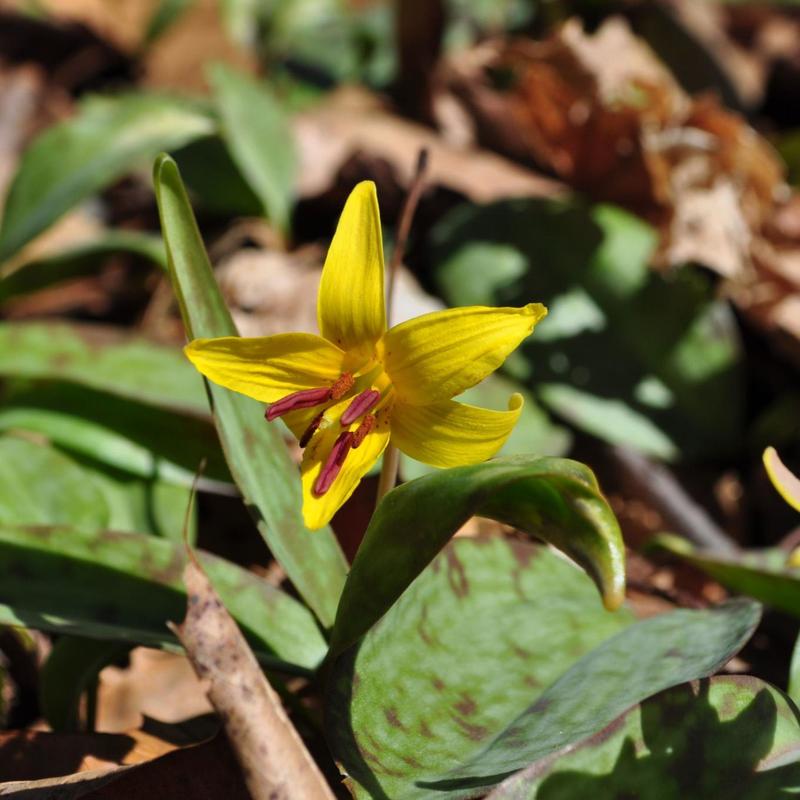
Another thing I'm excited about are trout lily. They'll be a little bit later in April, but they're so beautiful and you have to go to the woods to see them. They have a six-week life cycle where they pop above ground, photosynthesize, bloom and then disappear all before the leaves fully come out above them in the forest. They're really, really great.
Brian Lehrer: Neat. Professor Crimmins, before you go, I want to ask you about your work which contributes to the National Climate Assessment. A lot of our listeners know that that made news when all the volunteer authors for the next one were dismissed last summer under the Trump administration. The 2023 one, the last one, is still findable online, although it looks like they changed the web address. Have you been affected by the political struggle going on now in the scientific community?
Theresa Crimmins: Yes. One of the most direct ways we feel it is, the USA National Phenology Network was historically funded completely through federal funding. It was steady funding from when we were established in 2007 up until 2020 when the agency, the US Geological Survey, that had been supporting us had to scale back on support because of funding cuts that they were experiencing during that first Trump administration.
Since that time, we have been able to persist through mainly securing competitive grants, mostly from federal sources of support and a few other things, but it's gotten harder. We are very fortunate to have received a grant from the Moore Foundation most recently, and so we are continuing our work because it is really important for understanding what is happening all across the country in all the seasons and all the different species because it is such an important indicator of how plants and animals are responding to rapidly changing climate conditions.
Yes, the funding has been impacted, but we feel very strongly about the value of what we do. It feeds straight into the National Climate Assessment and so many other assessments and foundational research about how species and biodiversity is being impacted by climate change.
Brian Lehrer: To that point of documenting what's going on in nature, the climate and everything else, last question. Just as we're inviting listeners to post pictures of seasonal change to their Instagram stories and tag us, you have a bigger project I see, for budding citizen scientists, your Nature's Notebook, which I understand is getting an upgrade soon. Just in 30 seconds, if you can do it, tell us about it, what it entails, and how people can see it or participate.
Theresa Crimmins: Sure. Nature's Notebook is an opportunity for folks of all ages and background to document what they're seeing happening seasonally throughout the year in their yards or off the balconies of their apartment buildings or anything else. You can download the app Nature's Notebook, and yes, we will be releasing a wholly new version of it by the end of the month. You can go ahead and sign up now and then you'll be prompted to download the new app, which will be a lot more robust with a lot more features and invitations more appealing for younger audiences, for sure.
Brian Lehrer: Professor Theresa Crimmins, thank you so much for joining us today. This was great and really informative and inspiring, really, here at the beginning of March. Marielle Anzelone, urban botanist and ecologist, founder of New York City Wildflower Week, we'll talk to you in April.
Marielle Anzelone: That's great. Thanks, Brian. Thanks for supporting science and having us on today.
Theresa Crimmins: Thank you so much.
Brian Lehrer: You bet. Don't forget, listeners, we're inviting you to post your pictures of seasonal change happening right now to your Instagram stories and tag us at Brian Lehrer Show, @brianlehrershow, using the hashtag #BLWild. Brian Lehrer on WNYC. More to come.
Copyright © 2026 New York Public Radio. All rights reserved. Visit our website terms of use at www.wnyc.org for further information.
New York Public Radio transcripts are created on a rush deadline, often by contractors. This text may not be in its final form and may be updated or revised in the future. Accuracy and availability may vary. The authoritative record of New York Public Radio’s programming is the audio record.
