
Why the West-Park Church Wants to Sell Its Historic Building
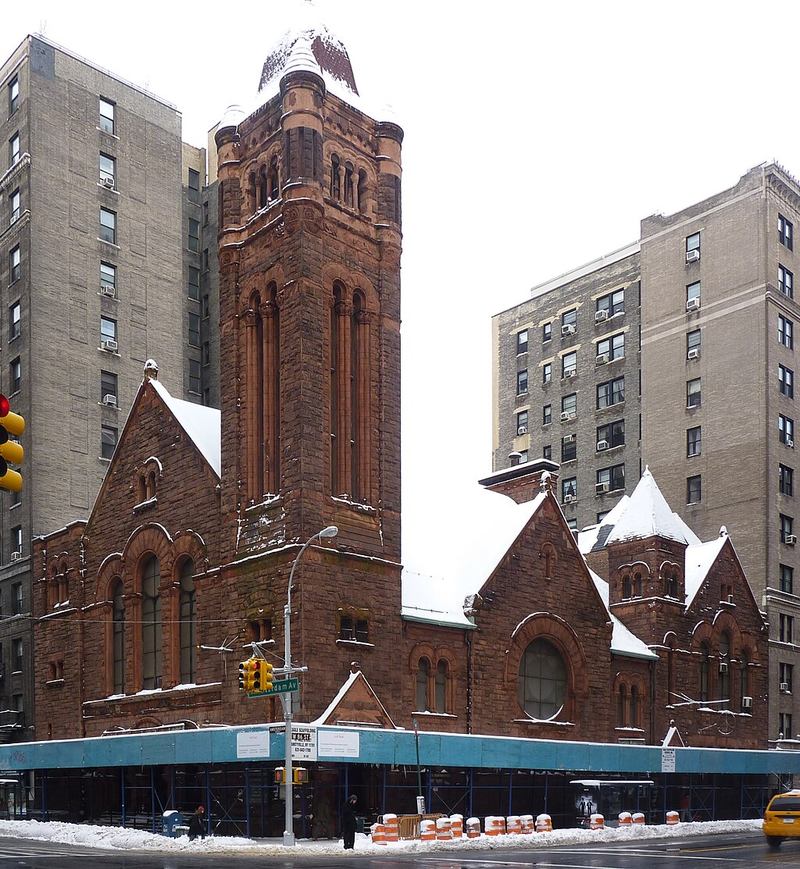
( James Russiello at English Wikipedia, CC BY-SA 3.0 <https://creativecommons.org/licenses/by-sa/3.0>, via / Wikimedia Commons )
Brian Lehrer: It's The Brian Lehrer Show on WNYC. Good morning again, everyone. We want to return to the big preservation fight that we covered the other day, playing out right now on the Upper West Side over a building that some New Yorkers see as a landmark worth saving and others see as a crumbling structure that's become impossible to sustain. It's the West-Park Presbyterian Church on 86th Street at Amsterdam. Preservation advocates and artists have been urging the city to protect it and restore it, but the church's stewards say the building has been deteriorating for years.
The repairs would cost millions, and the congregation simply doesn't have the money to keep it going. Well, now the church is asking the Landmarks Preservation Commission for something called a hardship approval, which would allow it to sell the property, likely leading to demolition and redevelopment. We talked about this on the show the other day with Peg Breen, president of the New York Landmarks Conservancy, and Mark Ruffalo, the actor, who are on one side of this. They've been part of the community effort to save the building. Here's a little bit of what Mark Ruffalo had to say here about the history of the space.
Mark Ruffalo: It's a worship space. It's a civil rights space. It has this incredible history. God's Love We Deliver started there. The anti-nukes movement in New York City started there. The first gay marriage was done there. Joseph Papp started basically the public theater out of there. It just had this incredible long line of social justice, worship, and performance. It's still serving all those those things.
Brian Lehrer: Mark Ruffalo on the show there. We also heard from callers about their connections to the church. Today, we'll get the case from the other side, and that is the church itself. Roger Leaf is chair of the West Park Administrative Commission. He argues that the Landmarks Preservation Commission should approve what's known as a hardship application, which would allow the church to sell the property and likely clear the way for demolition and redevelopment. He says it's the only path left for the church's survival and for what he describes as a broader social justice mission. Roger, thank you for joining us. Welcome to WNYC.
Roger Leaf: Brian, thanks for having me. It's good to be with you.
Brian Lehrer: Listeners, we can continue to take calls from those of you in the neighborhood or with another interest in what happens at West-Park Presbyterian on one side or the other. 212-433-WNYC, 212-433-9692. This is such a sad situation. There's no bad guys in this. There are people who want this space for some of the reasons that Mark Ruffalo laid out. There's the church, which wants to be able to survive in a different way. Lay out for our listeners what the church is asking the city to let it do.
Roger Leaf: Thanks for that. The church has, for many, many years, striving and struggling to maintain this building that was landmarked in 2010 over the objections of the congregation. It is now asking for a hardship so that it can enter into an agreement with a developer that would demolish the existing building and build in its place an apartment building that would include 10,000 of fully accessible space on two floors that would be retained by the church as a sanctuary and community space. That work has not yet been defined. We haven't even hired an architect, but that design work is ongoing. There's the possibility that it could be even larger than the 10,000 square feet.
The other important thing is that the proceeds from the sale of the building would go into a Social Justice Fund. That would be about $25 million or the bulk of the sale proceeds that would be gifted to the Presbytery of New York City to endow the Social Justice Fund to provide grants to Presbyterian churches across the city to fund programs like food banks, homeless shelters, immigrant services, such as ESL programs and the like, and supporting communities that are currently under siege at a time when such funding programs are under attack.
It is the case that the use of the church for arts programming is a fairly recent phenomenon that started when The Center at West Park obtained a five-year lease for the space that ended in 2022, although they refused to leave the building at that time until the courts ordered them to do so in 2025. It also should be clarified, I think, that in the prior session, the church was described as being owned by the Presbytery of New York City, and that it was the Presbytery that was seeking the hardship.
In fact, the Presbytery has no say in the sale of the building. The building is owned by the congregation as it has been for its entire time, and the decision about its sale can only be made by the congregants. The listener should also be forgiven for thinking that the hardship is about The Center at West Park and not the church, or that the hardship allocation is about its use as an art space. In fact, the Center is not a party to the application, has never owned the building, and has no say in how the space would be used. It has not been a tenant in the building since it relocated to new performance space last year.
I think the most controversial issue that has come up around this is what it would cost to restore the building. There have been a wide range of estimates about what it would cost, but I think this is principally because these different estimates are based on a different set of assumptions and a different scope of repairs. Peg Breen last week cited a number of $6 million to $9 million, which would just be to address the outstanding DOB violations on the facade for a period of about five years.
She failed to mention, however, that in 2011, her own organization, the Landmarks Conservancy, commissioned a study to determine what it would cost to repair the facade and concluded that, in 2011, it would cost about $11.4 million. That translates to a little over $20 million in 2025 dollars, which is even higher than the church's estimate of $17 million, but it's three times the estimate that Peg referenced in her numbers.
Brian Lehrer: Well, let me jump in for a second because I pulled that clip. Here's a little bit of what Peg Breen told us about what the church has to prove.
Peg Breen: There are four things that the church or the Presbytery has to prove to do hardship. Two of them, in a sense, give them. They have a contract to sell the building, presumably based on whether they get hardship. The developer's ready to move on a project, fine. They also have to show that to make improvements on the building that are necessary, they could never get a 6% rate of return on the investment. They're claiming $50 million to repair the building, but they're talking about inside, outside.
I'm not quite sure what else. You never do anything like that. It's an exaggerated amount. It's an exaggerated project. We deal with construction projects all the time. You phase them in. Every independent engineer that looked at this building says it's going to cost much less than they say it will to fix the exterior. The Landmarks Commission, a couple of years ago, hired an independent engineer who put the price tag to do what was necessary to cure the building violations and take the sidewalk bridge down at $6 million to $9 million.
Brian Lehrer: Peg Breen, president of the New York Landmarks Conservancy. What do you say to some of that? I know you were questioning some of the numbers before we played the clip. Is Peg wrong about the legal standard, wrong about what's actually required to make the building safe and usable? Give me a little more on that, then I'm going to take a call and play another Mark Ruffalo clip.
Roger Leaf: I think Peg Breen is absolutely correct. There are four criteria that are spelled out in the statute to meet a hardship. Two of them are non-confrontational, I think. They're just factual determinations. The two she cites, one is this reasonable return test. The other is the suitability test as to whether the church, given the cost of repairs and the burden of ownership that it places on the church, is suitable for the ongoing mission of the church. Those are the two central issues at hand.
She mentions the $50 million number. That is not relevant to the continued use of the church by the church as a church. The $50 million she references, the cost to address all of the code, life safety, ADA, and other requirements with the church, is currently grandfathered from, but would have to be met if the building were sold to a new owner. It doesn't relate to the continued use of the church, as I said. She also says that this work could be done in phases. In fact, all the work for ADA, life safety, fire safety, and the like would have to be done to obtain a CO that would be needed before anyone could actually occupy the building if it were in the hands of a new owner.
Brian Lehrer: Let's take a phone call. Michael on the Upper West Side, you're on WNYC. Hello.
Michael: Yes, hi. I think that the issue transcends money. Without things such as the church in New York City, what do we have left for the future? You're ripping apart the future for everyone by destroying these buildings or putting a 30-story apartment house on top of it. There's nothing left. What is the point of being here in New York City if there's nothing actually of superior quality to look at? I don't see this as a money issue that you can solve, but you can't replace that church. You're not going to. As we miss these things, we have nothing left. That's all.
Brian Lehrer: Michael, thank you very much. It's a preservation argument, Roger, quality-of-life argument, quality-of-neighborhood argument. What do you say to Michael from the Upper West Side?
Roger Leaf: Well, I would completely agree with him that landmarking and landmark buildings are important to the fabric and the culture of New York City, but so too are organizations like the West-Park Church, which is one of the oldest religious organizations on the Upper West Side. Everyone agrees that it has this long history of social justice and the like that Mark referred to in the clip you played earlier.
Where I disagree with the caller is whether or not it is about the money. Frankly, it is extremely expensive to maintain and restore a building of this sort. Even though there may be disagreements about what that number would cost, there's no disagreement that the building is in terrible shape and that the costs of repair and replacement, never mind bringing it up to landmark-worthy status, are considerable. Those funds are simply not available.
When the church was landmarked back in 2010, it was done so largely on the representation by Gale Brewer, who was the city council member for the area at the time, that she could raise millions of dollars to restore the building. That simply didn't happen. Those funds never appeared. It fell entirely on the church, which had a diminishing membership and growing problems with respect to maintaining the building, to take on the full burden of restoring and maintaining the structure.
It sold all of its other assets to do so. It had to let its senior pastor go. Frankly, in the last several years, it's gone deeply into debt just to keep this church going. It's an unsustainable situation for the congregation. Saving the church, which may or may not happen if the hardship is approved, there's no guarantee that this church will be sustainable in that case, but it almost certainly guarantees that the storied congregation will have to close the stores.
Brian Lehrer: To the caller's point about who is New York City for and what is the city if we can't save spaces like this rather than turn them over to developers in large part, here's how Mark Ruffalo on the show framed some of that same point.
Mark Ruffalo: What is landmarks for if it's not for saving these kinds of spaces? That's really what's at stake here. Who does New York City belong to? Does it belong to the people who will buy a $5 million and $10 million and $20 million apartments in a building and tear down what is essentially this incredibly thriving public space? Do we need another? Shouldn't we be saving these spaces instead of tearing it down when it can be viable?
Brian Lehrer: What's your response to that and to the kind of global argument about landmarking that he's making there that you're effectively asking the city to undo the very purpose of landmarking?
Roger Leaf: Well, I don't think that's entirely true. The hardship statute is a central piece of the landmark law and is central to, frankly, the legality of the statute and the whole concept of preservation. This is an important safety valve to ensure that there is an overreach by landmarking. The issue about who does the city belong to, I think, is a central issue about the whole concept of how we enforce the landmark law in this country.
Everybody benefits from these landmarks when they are retained and preserved, but it always falls upon the owner to pay the cost of maintaining that for everyone else's benefit. This is just a challenge that all landmarks face, but in particular, landmarks that are owned by nonprofits with limited resources and with little, if any, benefit from the actual landmarking itself.
There actually was a case that went to the Supreme Court that was brought by another church on the Upper West Side, challenging whether a landmarking of a church, in fact, enforced upon that church what its mission should be, because it deprives the church from using its resources in other ways. I think that's a valid argument, although the church lost at the Supreme Court. It's central to the idea of who pays the costs and who gets the benefit. In this case, the burden falls entirely upon the owner of the building. In this case, a struggling and storied congregation on the Upper West Side.
Brian Lehrer: Listener rights, "The church had 100 years of tax exemption. Effectively, a subsidy from the taxpayers. If they still couldn't survive, too bad. The city should take it over as part of our architectural heritage." Some other people are saying forms of, without bringing up the taxpayer subsidy, mismanaged. This is mismanaged. If the church couldn't manage its own space with all the advantages that it had over time with this beautiful property that it had, then too bad. Why should they be bailed out by the developer sector?
Roger Leaf: Well, you could also argue that The Center at West Park is a nonprofit that has a tax-exempt status as well. I think if the city were to take over the property of every nonprofit, the city would be, by far and away, the largest landholder in the city. I don't think that's really a legitimate argument that holds muster. It is the case that for most of its history, this church was a successful and thriving institution. It maintained this building for over 100 years.
In the late '90s and into the 2000s, the condition of the building began to deteriorate largely because of the materials it was originally constructed with that simply were not holding up to the climate and ravages of New York City weather. Frankly, the ongoing cost of maintaining the building has just gotten higher and higher and higher. That cost as a burden on the congregation has really driven congregants away from this church to other congregations on the Upper West Side that are closer to the mission that they support when they join the church in the first place.
Brian Lehrer: We've been taking mostly callers and texts who are on the other side of you on this. It's not a poll. Listeners shouldn't think, "Oh, everybody's on the other side, except him." We do this in all kinds of segments so that we have the dialogue going with people with different points of view. I will take one caller who's supportive of you, and I believe it's the pastor of another Presbyterian church, Broadway Presbyterian on 114th Street. Chris in Manhattan, you're on WNYC. Hello.
Pastor Chris Shelton: Yes, thanks for taking my call. West-Park Church has been a long part of my personal history. I'll start by saying I was a seminary student and was a field ED intern at West Park. Actually, my first day there was 9/11. That community is deeply writ upon my heart. That place is a very special place that will always be part of my story and part of the Upper West Side story. When we Presbyterians think about church, when we talk about what it means to preserve church, we're talking, first and foremost, about the people, about the legacy of the community, about the human story.
I'm very much in favor of preserving the human story, the human legacy, all of those wonderful social justice and arts ministries that have come to life in that place, but by honoring the people and their contribution. I think what's happening here is that the congregation has been so centered on trying to maintain this building and struggling that they have not been able to live out their legacy, to really let their social justice and their foundational being be what shines through.
I think what's happening in this can create an opportunity through the Social Justice Fund that Rogers talked about, to let that legacy really begin to flourish in some new ways and even spread across the Upper West Side into churches like mine where, right now, I believe the congregation I serve is the only house of worship in Manhattan that provides shelter, for example, for our homeless neighbors. We need resources so that we can do that and expand that kind of mission. I think that's the truer way of preserving the West Park legacy.
Brian Lehrer: Pastor, stay on for a second. I want to play one more Mark Ruffalo clip and get your response to this in the context of what you were just saying about the viability of the congregation and its worship and its missions. Here's Mark Ruffalo on the show the other day.
Mark Ruffalo: Last affordable space in New York City at $10 an hour for rehearsal space, when everywhere else in New York City is $100 an hour, it's really a significant thing. These spaces are gone. 25% of art organizations have lost their physical space during the pandemic. Nearly 50 theaters since 2020, spaces like this have closed down.
Brian Lehrer: Given the state of cultural institutions in the city, Pastor, do you see that as a mission, too, to be preserved?
Pastor Chris Shelton: Oh, very much so. I come into this work as a theater person myself and celebrate the artistic opportunities that happen in congregations around the city. That being said, as Mr. Ruffalo pointed out, $10 an hour. I can tell you in my own congregation, we couldn't maintain our spaces and do what we do by providing our spaces at $10 an hour. That's really not sustainable.
To find a model that would allow for that, that might support it in different ways, I think, is what The Center at West Park was created to do, but it never modeled itself successfully enough to meet the need of the building and all of its challenges. Yes, we need those spaces. We need to create opportunities for emerging artists, but we also have to do it in ways that are sustainable and responsible so that we can do the kind of upkeep that's necessary and create good spaces for people to be able to use.
Brian Lehrer: Chris, thank you for your call. Roger, let me throw a version of that same question to you. Is there anything that the church is offering with respect to an art space after whatever renovation and development you want to do, and what can you offer to the community that's concerned about that and the loss of that in the bargain of what you're attempting?
Roger Leaf: Well, I think it's important to reiterate what I said earlier, which is that when this new space is developed on the site, the church will maintain a minimum of 10,000 square feet of fully accessible space over the ground floor and the lower level for communities, as well as worship space for active engagement with the community. The church is committed to soliciting input from the community on the design of that space.
This is space that is fully accessible to people with disabilities and fully safe and secure to the point where there's no risk about code or other requirements that haven't been met. That's an enormous gift back to the community. I would repeat what Chris said about the Social Justice Fund. This is the largest gift that has ever been given to the Presbytery of New York City for any purpose over its entire history.
This is a consequential aspect of this entire transaction. Frankly, as somebody who's an unpaid volunteer who's been involved in this for over five years, there are really only two reasons why I've stuck it out for that period of time. The first is that I think the storied congregation deserves an opportunity to survive. The other is that the impact that this Social Justice Fund can have on communities with the greatest need in New York City is consequential on a level that's hard to describe.
It certainly doesn't solve all the problems in the city, but we live in a time, for example, when immigrants no longer rely upon government agencies for support and rely more and more on their houses of worship for the things that they need. This fund is targeted directly at providing the kinds of services that are essential for the citizens of this city who are most at need.
Brian Lehrer: If your hardship application is approved, the application, which would allow the church to sell the property and likely clear the way for demolition and redevelopment, will the church be in that same location?
Roger Leaf: Yes, absolutely.
Brian Lehrer: What would happen to the arts organizations that use it now?
Roger Leaf: Well, the arts organization that had been in the building until the middle of last year has been very successfully operating out of another church two blocks away. That space is comparable to the space that it had in West Park before it left, and seems to be doing very well there. The arts and community space that I mentioned in the new building is also something that we're happy to talk to all members of the community about how best to use that space to the benefit of all.
Brian Lehrer: If your hardship application is denied, what happens to your congregation as you argue it?
Roger Leaf: Well, the congregation voted in 2020 to sell the building because it saw no pathway forward for it to continue to maintain the property. I believe that if the hardship is turned down, the church will very likely try to find another buyer or negotiate a new arrangement with the buyer it's been in contract with for several years. If it does, under that situation, the almost inevitable outcome would be that the congregation would close. It would be the end of this very long and storied history of one of the Upper West Side's oldest religious organizations.
Brian Lehrer: Well, the controversy continues. We've done two segments now on two different shows with two different points of view for what should happen to the West-Park Presbyterian Church at 86th and Amsterdam. When will you know? When is the decision going to come?
Roger Leaf: That's really up in the air at this point. I think the earliest would be in three to six months. There is still one or two public meetings that the Landmarks Commission will have to hold on the matter. Based on the input and feedback from the community on those meetings, then they will hold a vote and decide whether or not to approve the hardship.
Brian Lehrer: Roger Leaf, chair of the West Park Administrative Commission, thanks so much for coming on and making your case today.
Roger Leaf: Thanks for having me.
Copyright © 2026 New York Public Radio. All rights reserved. Visit our website terms of use at www.wnyc.org for further information.
New York Public Radio transcripts are created on a rush deadline, often by contractors. This text may not be in its final form and may be updated or revised in the future. Accuracy and availability may vary. The authoritative record of New York Public Radio’s programming is the audio record.
