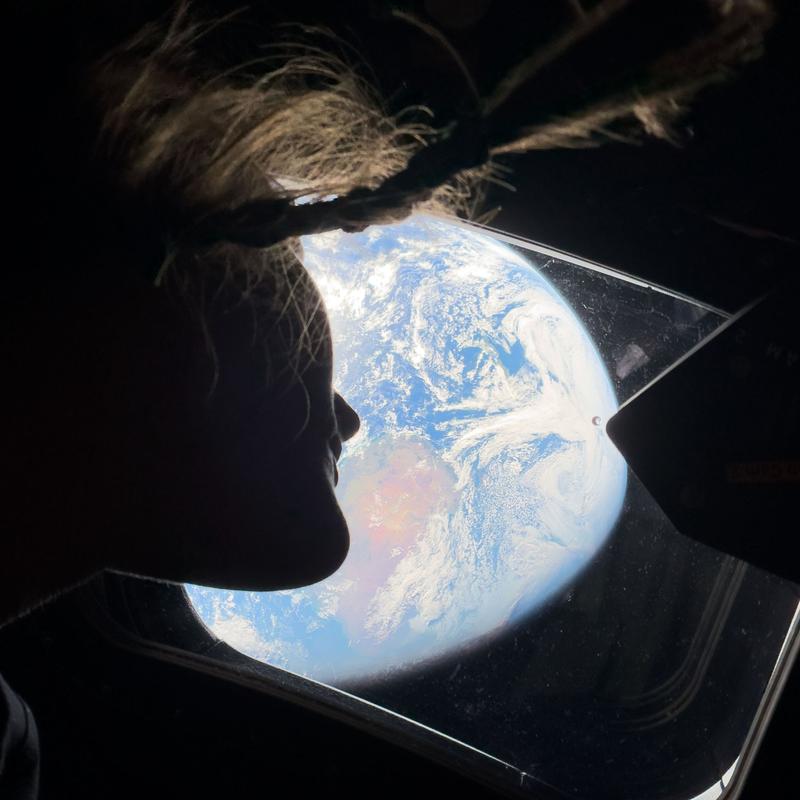
Brian Lehrer: Brian Lehrer on WNYC. Here's a clip from this show back in 2020, when our studio dialed up the actual International Space Station to allow me to interview some astronauts on board at the time. You're going to hear astronaut Victor Glover, who, among other things, was the first Black member of a space station crew. He is now a member of the Artemis crew, which, just as you've been hearing in the news, set the record for traveling the farthest from planet Earth. What he said in 2020, when I asked if he had any space travel fantasies for missions he hoped to go on beyond the space station, included this.
Victor Glover: Actually, landing safely from this mission is all the dream that I need. This mission right now, this very moment, we are living a dream. I'll be very happy to land safely, and then we'll go from there. You'll have to ask me after we land safely.
Brian Lehrer: All right. Very humble, astronaut Victor Glover from the International Space Station in 2020. Yesterday, six years and a few months after he did indeed safely return home, he beamed back this report from the neighborhood of Earth's moon over 220,000 miles farther than he was in 2020.
Victor Glover: There look to be islands out beyond the terminator because some of the things-- gosh, maybe even a [unintelligible 00:01:39] diameter into the terminator are catching sunlight on the peaks up to the north and to the south. It's very, very interesting to see.
Kelsey Young: Integrity science. Oh, my gosh, that was an amazing picture you just painted. I glanced over at the SER video, and I literally saw fist pumps in the air. Those types of observations are things that humans are uniquely able to contribute. You just really brought us along with you, so thanks for that.
Brian Lehrer: Victor Glover in Mission Control yesterday, from and to the Artemis II mission, achieving their main milestones yesterday of beating Apollo 13's record of the farthest a human crew has ever gone from Earth. Glover and three other astronauts have sailed past the Moon and spent 40 minutes in communication blackout, come out the other side, and are now on a four-day journey back to our home planet, where they will crash down into the Pacific Ocean safely, we hope, on Friday evening.
Now, the last time we sent people to that vicinity was 1972. The Cold War space race was still in full swing. Let's ask, more than 50 years later, what's changed in space travel, and what can we still learn from the Moon that's worth spending tax dollars on? Joining us now is Dr. Jackie Faherty, associate curator in the Department of Astrophysics at none other than the American Museum of Natural History. Dr. Faherty, welcome back to WNYC. Great of you to give our listeners the benefit of your expertise again at this historic moment.
Dr. Jackie Faherty: Yes, thanks, Brian. I'm happy to be back. I love coming on your show.
Brian Lehrer: Listeners, we can take one or two questions from you by call or text for Dr. Faherty, 212-433-WNYC, 212-433-9692. Why'd they go back now, and why did it take more than 50 years?
Dr. Jackie Faherty: That's the million-dollar, billion-dollar question right now. You could ask why we went in the first place. Why did the Apollo mission happen? Largely, there was a lot of competition at that time. There was a Cold War happening, and we were in a race with the Soviet Union. You could say that that dissipated in the late '60s and the '70s. 1972 with Apollo 17, we had won the space race, landed on the Moon, and we were doing missions.
We've had this pause, and competition is back. The US is in this race now with China. China is really interested in setting up a lunar base. They have had a number of milestone accomplishments over the past couple of years. They famously had a return mission to the far side of the Moon. They're really in it to win it to get people there, and so the US is back. NASA's back in it. That's the secret sauce right now as to why Artemis is propelled as much as it is. Competition is really a driver for space travel.
Brian Lehrer: What are we competing with China for? What do we get if we're first--
Dr. Jackie Faherty: Yes, what do we get? I think that there's advantages to having that location on the Moon. Look, I'm not the politician here. You can get people that talk about defense on here, but you do have a certain position when you're in space to have a permanent human presence there, can set you up strategically for certain things. That in itself is a competition. There's also a technology competition that's going on who's the best out there. That's not something to shy away from, at least as far as aeronautics is concerned. It has always driven us, NASA, to be the best that there is out there.
Brian Lehrer: People who are old enough to remember the old 1960s, 1970s missions might have the sense of astronaut food as powder in a packet. You have to somehow add a little water in your space capsule to make it edible at all, but take a listen to what was on the menu for yesterday's midday meal right before they entered communications blackout.
NASA Commentator: We have vegetarian chili, salmon croquettes, chicken with peanut sauce, sweet and savory kale, pickled beets, chocolate pudding, barbecued beef brisket, spaghetti and meat sauce, Italian vegetables, butternut squash, candy-coated chocolates, and maybe even a little bit of coffee.
Brian Lehrer: No wonder the toilet malfunctioned, but that's another topic. Is that an indication of something serious, like it's become more comfortable to be an astronaut, but it's also, therefore, become more complicated to get a mission off the ground?
Dr. Jackie Faherty: I think that it's definitely become more comfortable. You can just hear it. There's been an enormous presence in space since the '70s. It just hasn't gone the distance that Artemis just went. We've just been doing everything in low-Earth orbit. The other thing, Brian, which I think everybody should be paying attention to, is it's not just the space agencies that are involved now. There's private companies that want to be involved in this.
Jeff Bezos has a company, Blue Origin. Elon Musk famously has SpaceX. Richard Branson has Virgin Galactic. They've got their own desire to be a part of this. The level of comfort, the level of technology advancement is happening faster and faster, not just because of the political thing I just told you about, but also because of the private industry that's coming in here. I think this is a really good time to watch what's happening in the space race because so much is unfolding quickly with lots of players that are interested.
Brian Lehrer: Maeve in Brooklyn, you're on WNYC with Dr. Faherty from the Museum of Natural History. Hi, Maeve.
Maeve: Hi. Thank you so much. I'm a big fan of you both. I just have a question about the eclipse that the astronauts witnessed last night. Is that something that would happen every day from the far side of the Moon, or was this mission timed to catch that as well? Thanks.
Dr. Jackie Faherty: That's a great question. If you didn't see this, you should check it out. They came around the far side of the Moon. They got to see a really long solar eclipse. The length of the eclipse and how they had it set up, they got the length that they did, and they got the vantage point that they did because of the timing of when they launched. They did launch at the very, very, very start of the window on April 1st.
If they had launched at a different time, they would have been at a different vantage point. It would have been less of an eclipse. Once they're around that backside, the Moon is between them and the Earth. Oh, my gosh. Am I saying the right things in order? Yes. They're getting a full eclipse using the Moon the same way we would from Earth. I was insanely jealous of that, if I could for just a second. I think I've been jealous of every image, but that one was pretty spectacular.
Brian Lehrer: Yes, eclipses are amazing. I once built a vacation, knowing that an eclipse was going to be there, in Costa Rica. The time that I went to Costa Rica, I timed it for that. One other area of the Moon, the Orientale crater. Am I saying that right? For some reason, the astronauts and the ground scientists seemed excited to get a better look at. What's that, and what's its promise?
Dr. Jackie Faherty: Yes. Well, it's one of the mare on the Moon. That Mare Orientale, it's actually right at the terminator between what's called the near side and the far side of the Moon. We only see the near side, then there's a far side. The Moon is what's called tidally locked to the Earth. It only shows us its face. It never shows us its rear end. That's because it's going around us at the same rate that it's turning. The Mario Orientale is right at the edge.
From Earth at a full moon, you can see just a smidge of it. We've, of course, had images of it from lunar reconnaissance orbiters that have gone around. Human eyes have never seen it, because even when Apollo went around, the Moon was in a different phase. They wouldn't have seen that part of the Moon illuminated. It's a pretty awesome area on the Moon. It's a big crater. It's a couple of hundred miles large, and it looks like a bullseye. It probably happened when an asteroid hit the Moon and created that--
Brian Lehrer: That has to be the last word, unfortunately, because we're out of time. Dr. Jackie Faherty from the Museum of Natural History, thanks for explaining some of what they're doing on Artemis II.
Dr. Jackie Faherty: Happy to come back whenever you want astronomy.
Brian Lehrer: Stay tuned for Alison.
Copyright © 2026 New York Public Radio. All rights reserved. Visit our website terms of use at www.wnyc.org for further information.
New York Public Radio transcripts are created on a rush deadline, often by contractors. This text may not be in its final form and may be updated or revised in the future. Accuracy and availability may vary. The authoritative record of New York Public Radio’s programming is the audio record.