
Why New York City's Nurses are on Strike
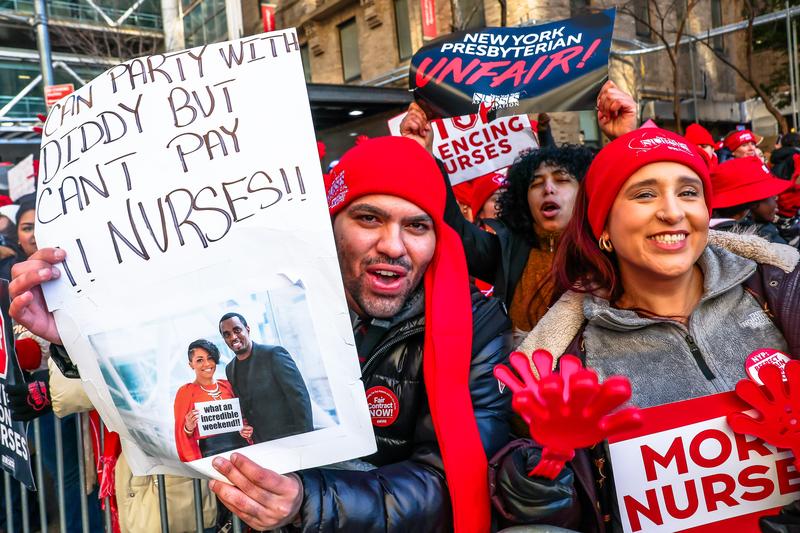
( Michael M. Santiago / Getty Images )
Brian: It's The Brian Lehrer Show on WNYC. Good morning, everyone. We'll talk a lot about health on the show today, including about the nurses who help keep people healthy and are now on strike at some New York hospitals. Also, we'll dig into the new RFK Jr. official US dietary guidelines. Sometimes we haven't had a chance yet to do that on this show, and we can do it in pretty extended form. We have a Harvard epidemiologist who will bring the science and answer your questions. We'll also bring some politics.
We'll have The New York Times reporter who wrote yesterday that the Trump EPA's new process for making air pollution rules will stop taking a certain thing into account. How many lives air pollution rules can save? Just that little thing. Apparently, only the cost to businesses will be officially calculated, the article says. We'll talk to the reporter on that story.
At the end of the show, we'll discuss the growing trend of online betting, not just on sports, but on anything, including world events like elections and economic indicators, even war and peace. We'll invite your calls on what non-sports betting you yourself may be doing, and we'll discuss the possible consequences in the world beyond the money that you might win or lose of people being able to bet on such consequential things. Let's start with the nurses' strike.
Some 15,000 nurses at major New York City hospitals are on strike, walking off a job in a dispute over staffing levels, pay, and safety, and forcing a high-stakes confrontation between frontline health care workers and some of the state's largest hospital systems. These include several of the city's most prominent hospitals, NewYork-Presbyterian/Columbia, Montefiore Medical Center, and Mount Sinai's main campus, as well as two other hospitals within the Mount Sinai system.
It's not every hospital in any of these systems that are being struck, but various ones. The nurses have drawn public support, as you may have heard, from elected officials, including New York Attorney General Letitia James, the new New York City Comptroller Mark Levine, and for the new mayor, Zohran Mamdani, it's an early example of how he's interested in supporting labor.
Mayor Mamdani: We know that during 9/11, it was nurses that tended to the wounded. We know that during the global pandemic, it was nurses that came into work even at the expense of their own health. They showed up even when we didn't have protective equipment for them. They showed up even as others were staying home. Bottom line, they showed up.
Brian: Mayor Mamdani speaking from one of the picket lines yesterday. The strike also comes as hospitals, from their point of view, warn about rising costs and looming federal health care cuts, while the nurses say the system has been stretched beyond what patients and staff can safely sustain. They also charge hospitals with breaking promises made after the last strike just a few years ago. Joining us now is Nancy Hagans, president of the New York State Nurses Association. We're going to talk to the president of the union.
She is also a working nurse at Maimonides Medical Center, the Brooklyn safety net hospital. Hagans was at the bargaining table during the last major contract fight there and joined us then about three years ago when nurses reached an agreement and avoided a strike. This week, she is actively participating in the current strike and has been out on the picket line as negotiations with hospitals continue. Nancy, thanks for joining us again. Welcome back to WNYC.
Nancy: Good morning. Thank you for having me.
Brian: Listeners, we can take your calls on this, too. If you are a nurse on strike or if you do another job at one of these hospitals, help us report this story. Hospital administrators can call in, too, and anyone supporting them. Nurses, what are you demanding? What are conditions like where you work right now? Again, any other hospital staff can call and describe this as well. How is the strike affecting patients and staff? 212-433-WNYC, for anyone related to this issue, 212-433-9692. You can call, or you can text, 212-433-9692.
Nancy, you've been out on the picket line. I happened to pass one of the picket lines yesterday, and it was an enthusiastic, noisy bunch. As of now, who exactly is on strike across New York City, and what specifically are nurses demanding at this moment?
Nancy: As of now, we have the nurses from NewYork-Presbyterian Hospitals, we have nurses from Mount Sinai Main and Morningside West, and as well as Montefiore Medical Center. Our asks are the three majors. Our patients come first. We are requesting safe staffing. Three years ago, we won a lot of staffing, languages, and protection. The hospitals have decided to roll back. As you know, there's increasing violence at the place. As you know, last week, there was an active shooter at one of the NYP New York Methodists in Brooklyn, and we are asking for management to have workplace violence protection.
Of course, we are asking to keep our medical coverage, and what management have decided to do, they want to take away our medical coverage. Nurses are the backbone of this healthcare system. If nurses are not healthy, if we don't have good medical coverage, we cannot get up and take care of patients. At the heart of the pandemic, everyone stayed home. We went to work. We saved New York without proper PPE, without vaccine. We were there. What we are asking is for us to have proper medical coverage.
Brian: Let me jump in and ask you to get specific about that one, because I'm sure a lot of listeners who are not familiar with the issues and the strike and the negotiations are thinking, "Wait, that's ironic. Nurses not being given good health coverage, medical coverage?" Give us some of the specifics of that. You say some of it's being taken away, or they want to take it away. What's the healthcare coverage now, and what's the change that they're proposing?
Nancy: First of all, as you know, being a nurse it's toxic physically and mentally, but we have coverage. We could go to the doctors. We don't need a referral to go to the doctors. Our coverage have also covered our spouse that don't have medical coverage and are dependents. They're pretty much telling us that our coverage is too expensive. They're not able to pay for our coverage. Those three main hospitals, especially NYP, NewYork-Presbyterian, and Mount Sinai, they are the one driving up the cost.
I work in a safety net hospital, a procedure that would cost $10,000 for a patient at the place where I work, NewYork-Presbyterian will charge triple of that. They are saying that they cannot afford us because our medical is too expensive, yet the CEO at NewYork-Presbyterian made $26 million last year, yet they are bragging how they spent over $200 million to hire replacement nurses. What we're asking, take the money, invest into our communities, invest into our patient staffing, invest into our medical coverage.
We are asking to keep the same coverage that we have in order for us to stay healthy, in order for us to seek proper medical attention when we need to. Right now, at the heart of the pandemic, we lost some of our nurses due to the pandemic because we've been exposed. We are exposed every time that we go to work. With the surge of the flu, our nurses are more likely to get sick. If I am sick, I cannot go to work. I cannot take care of the public if I'm not healthy.
Brian: On all the money that you say they're spending for replacement nurses, here's an example of that, according to The New York Times article on the strike. NewYork-Presbyterian had a spokesperson tell The Times that they spent $60 million preparing for the strike, hiring more than 1,700 contingency nurses. You brought up CEO pay. I'm going to play another clip of Mayor Mamdani on this particular issue, but also ask you how relevant it is. Here is the mayor again on the picket line yesterday.
Mayor Mamdani: The hospital executives who run these hospitals, the ones where these hardworking nurses are asking for what they deserve, these executives are not having difficulty making ends meet. The CEO and president of Montefiore made more than $16 million last year. The CEO of NewYork-Presby, where we are today, made $26 million last year.
Brian: My question for you about that is, we may have reason to be grossed out by high CEO pay, CEO pay that high, but is it too symbolic a thing to focus on? The pay increases you want for thousands of nurses can't be made up by reducing a few top manager salaries, right?
Nancy: What we are saying, nurses get up day in and day out to go to work. We put our lives up front. The patients come first. As you know, right now there's an inflation. What we are asking, we are asking for an increase in wages. Wages could always be negotiated. What we will not negotiate is cutting corners to care for our patients. Management have not proposed any type of increase. They are hypocrites because they're going out there and saying that the nurses want this money and that money.
What they are not saying, nurses want safe patient care. We want safe staffing. Nurses want to go to work and have protection in workplace violence. Nurses want to go to work where we could have good medical coverage and pension and fair wages. We will continue to negotiate in good faith, we will negotiate our wages, but we will not cut corners when it comes to take care of our patients, when it comes to take care of New Yorkers. Every patient deserves a real nurse at the bedside.
These are the richest hospitals that are trying to replace nurses with AI. Nurses, patients need human touch. Patients need a nurse at the bedside, and that we will not cut corners on. We will continue to stand up and fight for our patients. We will continue to go out there and send the message. Everybody's a VIP. Everybody needs to be taken care of, regardless of your zip code, regardless of your religion, regardless of your immigration status, regardless of your sexual orientation, regardless. All our patients. We need to tell those greedy CEOs, patients before profits.
Brian: Let's take a call from another nurse. Margaret in Manhattan, you're on WNYC. Hi there. Thank you so much for calling in.
Margaret: Hi, Brian. I've called you a bunch of times. I'm really disappointed with the spin in the media. I know they try to be balanced, but they are believing administration's lies that-- We're not asking for a 40% wage increase. I've been a nurse at Mount Sinai for 13 years, and I made $134,000 last year, so that would put me, really, at over $200,000? No, that's not what we're asking for. We want to keep our healthcare, as Nancy was saying, that we won last time, but they literally took our contract and handed it back to us with everything we won crossed out in red, and they say that they've been negotiating in good faith. This is a lie.
They have been sitting at meetings, at negotiations on their phones, not speaking, sometimes laughing when the union is proposing things, and leaving early, taking long lunch breaks, not coming back. They are not negotiating in good faith. They are so annoyed that we got such a good contract, and they've had to pay nurses millions of dollars when we work short, not on my floor. My floor is well-staffed, but units that are short-staffed, they've had to pay nurses the difference as if they were staffed properly, which has added up to millions of dollars. Of course, they don't want to do that anymore.
Brian: Because they have to pay overtime.
Margaret: Not overtime.
Nancy: No, it's not overtime. Sorry, Margaret.
Margaret: It's not overtime. No, no, it's okay. It's for if they had the correct amount of nurses, they've had to pay that difference to the nurses that are working. This is a mostly female-driven profession, and we're used to doing work of 10 people. They don't want to have to keep paying us and hiring enough nurses. It's very expensive. Now they're spending so much money to squeeze us because they know that most nurses live paycheck to paycheck. They're hoping that we give in and give our concessions back, and we're not going to. We're not going to give back-
Nancy: That's right.
Margaret: -these ratios that we won.
Nancy: We are not going back. Margaret, thank you.
Brian: Margaret, let me ask you one follow-up question, and Nancy, you can get back in after that. If you want to counter the 40% wage increase spin that the hospitals are putting on it, what would you tell our listeners that the actual wage demand is?
Margaret: I think that's more of a question for Nancy because I don't go to those negotiations, but I've heard that we asked for 10% and we backed off because that was too high. I think Mount Sinai would say, "Oh, but we're including their health care and their pension and their benefits, and that's why we come up with this outrageous number." Believe me, it does not add up to almost, what, $275,000, which is what I saw in The New York Times yesterday. I'd love to make that much money.
Brian: Margaret, thank you very much. Nancy, you want to-
Margaret: Thanks, Brian.
Brian: -expand on that?
Nancy: Yes. They are inflating the numbers. They are actually lying because, like Margaret said, I don't know where they got their numbers from. Somebody would have to ask them. Nobody ever asked for 40%, and the public realize that. Nurses, we come to work to care for our patients. We come to work. I'm an ICU nurse. I leave my house at 6:00 in the morning. Sometimes, if I don't have a cup of coffee before leaving my house or if I had a cup of coffee, that's my first and last meal for the day until I go home.
For the most time, we work without taking a break. We take care of our patients. We sit there. We don't want to leave our patients alone if they don't have a visitor. Like I said, during the height of the pandemic, the CEO that made $26 million said to us he couldn't come to the hospital because he was afraid of COVID. He was at his second home playing golf. We saved New York. We stayed here. What we are asking is safe nurse-to-patient ratios, which we one day want to take away.
What we are asking is to keep our medicals in order to take care of ourselves and our family. What we are asking is to go to work, and where we don't have an active shooter coming in and threatening to shoot the nurses and the patients. We need protection toward workplace violence. What we are asking is a fair wage so we also could take care of our families.
Brian: What new, if you're asking for new, workplace protections from violence are you asking? Certainly, a lot of the listeners heard about that-
Nancy: Metal detectors.
Brian: -awful active shooter incident at a city hospital the other day. Go ahead, tell us what you're asking for.
Nancy: Most of the hospital entrances have no weapon detectors. Anybody could walk in and out. Panic buttons so we could have on us that if somebody's coming in, we could press the button and somebody could walk in and take care of us. A de-escalation team that a team could walk in. Usually, when you have a certain emergency, if you have a fire, there's a number that you call. There's a number that we need to call when we have those situations. Especially, people are coming in and out, you don't know what weapon they have on them.
Look what happened at NYP New York Methodist. Patients help, staff hostage. The police intervened. Unfortunately, we lost a life. If we have weapon detector, then if somebody is walking into the institution, then the weapon could be picked up. There is no protection for us right now, and we need to protect our patients. We also need to protect ourselves in order for us to continue to deliver proper care. We are asking to go to work--
Brian: A listener is texting if the financial situation of nurses was exaggerated by the last caller when she said living paycheck to paycheck. If she is making $134,000, she said, I see the stat in The Times that at Montefiore, for example, pay for starting nurses is $119,000. Not to say that that can't be more, but in terms of how you spin what sort of social class the nurses are in, or the phrase "paycheck to paycheck" [crosstalk]
Nancy: I hear you, but you know what? Everybody is focusing on the paycheck, what they are saying. You live in New York. What is your rent right now? Your rent is very high, your electric bill is very high, your gas bill is very high, we pay the highest city taxes, and then you have to go to work. You have a family. Some of us are the head of household. I'm a widow. I give myself as an example. I have two daughters, so I'm the head of my family. Some of us, immigrant descent, we also have to take care of their loved ones back at home.
A nurse's salary, when we come to work, we have double of the assignment that we're supposed to have. We still get the same pay. The hospitals still make the profits. This is not about pay. This is about safety for our patients. This is about working in an environment where we could deliver high-quality care to all our patients. More nurses, better care. If you have more nurses, the patient is less likely to develop a bedsore. If you have proper nurses, the patient is less likely to develop pneumonia because you could get your patients out of bed.
When you're a patient in the hospital, you need your nurse at the bedside. When you walk into that emergency room, the first person you see is a nurse. When you're going to go home, the last person you see is a nurse. We are at the bedside providing care, but we need safe staffing in order to continue to do it. We need to have proper medical coverage in order to protect ourselves because if we are healthy, then we have a healthy New York. We could come to work and take care of our patients.
I know the greedy CEOs with their millions that they are making want to make this about salary, inflating numbers. I have no idea where they come up with the 40%. They would have to explain it to you because there is no type of math that makes sense.
Brian: The estimate of what you're asking for, according to you and according to the hospitals, is so different. Reading from The New York Times article, it says Mount Sinai said the union salary demands would increase the average pay to $275,000 over three years. The Nurses Association, which you lead, says Mount Sinai was only offering about $4,500 more per nurse. We won't resolve all of those numbers today, but I'm just laying out how different even the public statements of what's on the table are.
Nancy: Sorry. This is what they said to us. We're going to give you $4,500 a year. You take it. It's either you use it toward your medical coverage, or you use it toward your pension, or you use it toward your pay increase. How could you use $4,500 for the year toward your medical coverage? Anybody try to go to the open market right now to buy your own medical coverage, it doesn't even cost $4,500. That's all they put on the table.
Brian: I happen to be biased right now because I've been supporting a relative in and out of the hospital in recent weeks, and I won't name the hospital, but every single nurse I have come into contact with has been an absolute saint and has taken the time to explain things, to be cheerful even if they were under stressful conditions themselves. I just have so much respect for the profession, not that I didn't already, but with my recent contacts, just saying that I have encountered many nurses just in recent weeks who are absolute saints, one after another after another. Whatever training they do, whatever the ethics of your profession are, I just want to say it's working in my experience. Here is another-
Nancy: Thank you.
Brian: -nurse calling in. Michael in Brooklyn, you're on WNYC. This is on the staffing. Michael, you're on WNYC. Hello.
Michael: Hi. How are you?
Brian: Good. What you got?
Michael: I just wanted to bring up this point. It really isn't about the money, and I think Nancy is doing a good job of bringing this up. In all honesty, I would give up part of my salary for more staff, more aides, more nurses. Someone brought up earlier, one of the previous callers brought up that if we're short, the salary for that nurse that's missing is split between the rest of us. I don't even want that money. I just want the nurse. I just want more help.
Nancy: Amen.
Michael: In addition to that, we need more safety here. There really isn't metal detectors in most of the hospitals, and things happen. Security sometimes gets overwhelmed. They can't screen everyone. We've had instances where a drug dealer comes to the floor to meet a patient who is an addict, and the nurses are expected to deal with it because we're the first ones to see that happen. In addition to that, we have lots of patients who swing at staff, not necessarily because they're angry, but maybe because they are delirious, and we need more staff to help calm them down and take care of them better. It just makes for a better overall patient experience for everyone. That's all I wanted to say.
Brian: Michael, thank you very much. Let me ask you a Mamdani question, Nancy. Do you think it matters that this mayor is as pro-labor as he is and showed up on the picket line yesterday? Is that different from Mayor de Blasio, who's certainly pro-labor in his general orientation? Do you see anything unique about Mayor Mamdani so far, and could that affect the outcome of this strike?
Nancy: Mayor Mamdani did what he promised when he ran, that he is pro-labor, he is with the working people, he is with justice for working people, he believe in equitable. What he did yesterday is exactly what he promised to do for New Yorkers, for all New Yorkers, when he ran for office. We appreciate him coming to the picket line. We appreciate him keeping his promise when he ran for office. He ran on the working people and supporting labor, and that's exactly what he did yesterday.
Brian: One of the things that he campaigned on, and I don't know if he's going to be serious about trying to make this a reality, but I wonder if you would be for it or against it, is getting the not-for-profit status of some of these hospitals, which are technically not-for-profit, even though there's, obviously, a lot of money flow in and out, and the CEOs get paid what they get paid, ending the not-for-profit status of some of the major hospitals. Would that be helpful to the nurses, harmful to the nurses, or neither?
I believe this is a question that you have to go straight to the mayor. All I know that when he ran through his campaign, he made a promise to stand with the working people in this city, to stand with labor, and that's exactly what he did yesterday, and we want him to continue to stand with us.
Brian: The union doesn't have a position on that now.
Nancy: Our position-
Brian: Yes, go ahead.
Nancy: -is that patients before profits. We're telling all these greedy CEOs, because Mount Sinai, Montefiore, NewYork-Presbyterian are the richest hospitals in New York City. All eight safety nets hospitals, including the one where I work, managed to reach a tentative agreement with over 5,000 nurses and promised to keep our current medical, promised to protect us from workplace violence, promised safe staffing. These are all tentative agreements that we achieved to all the poorest hospitals in New York City. My message to those three rich hospitals, what is your excuse? You have no excuse not to come to the table and negotiate a fair contract like we did at all the safety net hospitals.
Brian: To be clear for our listeners, the safety net hospitals are public hospitals. Those are government institutions. The hospitals that you're striking are private hospitals, these private non-profits, Montefiore, Mount Sinai, and NewYork-Presbyterian. Just for accuracy's sake, so I don't overstate the mayor's position, The Times article quoted him saying during the campaign that the city "needs to reconsider its relationship to wealthy private hospitals."
He questioned whether such hospitals deserve to keep their tax exemptions. Maybe he didn't quite propose that they lose them, but he was raising it as an issue. Here's Tom in Manhattan calling, if I see this right, as a patient at a NewYork-Presbyterian Hospital and with a report from the front on the nurse's strike in progress. Tom, you're on WNYC. Hello. Where are you?
Tom: Hello. I'm at Columbia-Presbyterian in the main hospital. I'm on a floor that is the standard of care because of the specialty of the floor is among the highest that anybody ever sees. It's an extraordinary place. The nurses, as you've described them, they're magnificent. We now have two days, I'll be polite, of traveling nurses who are brought in. Confusion is fairly general. I've already had my medication messed up twice, and I'm now watching over it myself as opposed to trusting my nurses to be in charge of it.
Generally, it's just a scandal, that's all. The general care at Columbia-Presbyterian is so high, and so much of that has to do with the nurses and their extraordinary care and good-naturedness and ability to extend themselves, and all of that is not around. We're just lucky that the people who are just subsidiary to the nurses, the techs and people like that, are still here. There is a certain kind of quality, but the fact that we're seeing the standard of care just go down.
Brian: I'm glad you are saying out loud the experience that you've had with the on-staff nurses. I'm sure there are bad nurses in the world, but with the number that I've encountered, and every single one has been a saint, you get a sense, and your story backs it up of what the--
Tom: A saint with a good sense of humor.
Brian: [laughs] That's true in my experience, too. Tom, thank you for saying all of that. I hope whatever you're in for resolves successfully. Let me take one more call here. KA in Manhattan, you're on WNYC, an ER nurse calling in. I won't say your hospital in case you don't want to say it. Hi, KA.
KA: Hi, Brian. Thanks for having me on. My name is KA. They, them pronouns. I'm an ED nurse at Mount Sinai Hospital, and I am on strike. I wanted to say that one of the major things that we're asking for and that NYSNA and Nancy have also put in the pillars of the strike is to keep ICE out of hospitals unless they are required to be let in because they have a valid judicial warrant so that ICE doesn't come in if they have another kind of warrant that is up to the hospital's discretion like an administrative warrant or simply even an investigation.
We've seen ICE in the hospitals, in the EDs, in New York City. Patients are afraid. They are concerned that they'll be deported when they see anyone in uniform. Nurses and staff are concerned with being confronted by ICE, being vulnerable. We know ICE is not just looking at people's immigration status, but simply looking at the color of their skin and the language that they're speaking. People are in danger that we're taking care of and that we're working with and relying on.
A big part of safe staffing and ending workplace violence is keeping ICE out of the hospital. We have a major proposal for this on the table at Mount Sinai Hospital and at other hospitals in the city. The executives, lawyers have had this proposal since July. We've been working on this since March. They've barely come to the table, and they've crossed everything out. They don't want to agree that keeping ICE out of the hospital is a workplace issue, and it's definitely related to workplace violence and safe staffing and keeping patients safe. I wanted to share that with listeners that that's another reason we're out there striking.
Brian: I appreciate you calling in KA and raising that as part of this segment. Nancy, you want to end on that? Do you want to talk about anything ICE-related, specifically in the negotiations?
Nancy: I would like to say thank you. As nurses, we want to take care of patients regardless of their immigration status, regardless of their financial status, regardless of their sexual orientation, regardless of their religions, regardless. All our patients are VIPs, and we need to be able to take care of our patients, and we need our patients to come to the hospital where they feel safe. Thank you.
Brian: Nancy Hagans, president of the New York State Nurses Association. Thank you for joining us.
Nancy: Thank you.
Copyright © 2026 New York Public Radio. All rights reserved. Visit our website terms of use at www.wnyc.org for further information.
New York Public Radio transcripts are created on a rush deadline, often by contractors. This text may not be in its final form and may be updated or revised in the future. Accuracy and availability may vary. The authoritative record of New York Public Radio’s programming is the audio record
