
Why Masking ICE Agents Matters
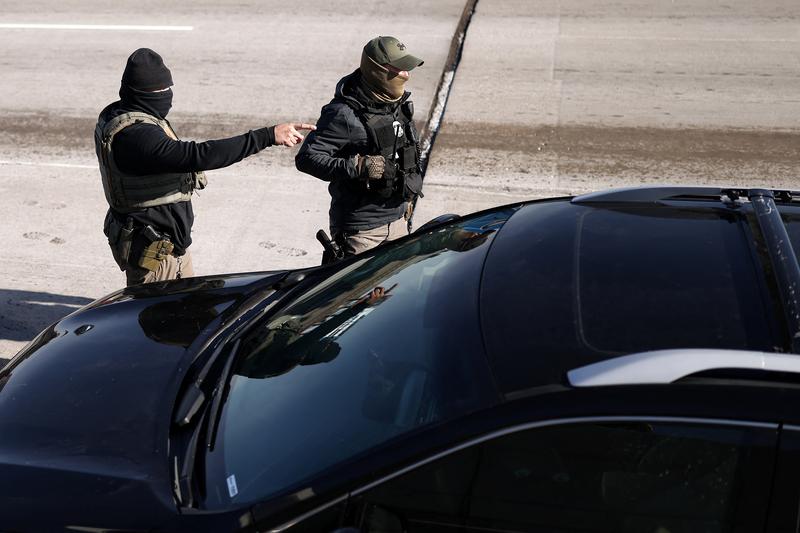
( Charly TRIBALLEAU / AFP via / Getty Images )
Title: Why Masking ICE Agents Matters
[MUSIC]
Brian: It's The Brian Lehrer Show on WNYC. Good morning, everyone. Thanks to Amina Srna, Kousha Navidar, and Brigid Bergin for filling in the last few shows. I continue to need to do parental care, which will continue to make my attendance here inconsistent for a period of time, I'm sorry to say. Thank you all for understanding, and I hope you appreciate the work of my very excellent colleagues.
Now, the short government shutdown has ended, with Democrats winning this concession. The Department of Homeland Security is only being funded until next Friday, while Congress and the White House try to negotiate possible changes to the rules of engagement for ICE. As New York Magazine reports it, Senate Democrats have a list of substantive demands that include a requirement for judicial warrants before ICE or Border Patrol arrests, coordination with local law enforcement and deference to their use of force rules, and an end to masking. Let's talk about that last one. Here's Senate Minority Leader Chuck Schumer yesterday.
Chuck Schumer: Defending ICE agents wearing masks and giving them special treatment, especially when they're so brutal and thuggy, is totally against the views of most Americans who want basic accountability. Anyone defending ICE agents keeping their masks on is not seriously trying to solve this huge problem of chaos we have seen in Minneapolis and so many of our other cities when ICE is sent in there.
Brian: Senator Schumer yesterday. Atlantic magazine staff writer, Adam Serwer, has a new article called The Real Reason ICE Agents Wear Masks. He's also author of the book The Cruelty Is the Point: Why Trump's America Endures. That, by the way, was published back in 2022. Thank you for joining us, Adam. Welcome back to WNYC.
Adam: Thank you so much for having me.
Brian: You make your opinion clear from the start of the article, so you might as well do that here, that there is no justification for federal agents to hide their identity from the public that pays for their weapons. Would you like to first expand on why you think that?
Adam: Yes. The law enforcement authorities are granted the ability by the public to use force, including lethal force. That is a weighty responsibility. It demands high standards of conduct, and it can and should be revoked when abused. Hiding people's identity and telling them that they have absolute immunity in the conduct of their duties is basically begging them to abuse those powers, because that's what that means. When you have anonymity and absolute immunity with regard to the use of force, you are more likely to behave in an unconstitutional manner.
These are agencies, Customs and Border Protection, Border Patrol, ICE, that already have checkered records when it comes to the use of force, especially CBP, when it comes to criminality. These are the agencies that are probably culturally least suited to that kind of power, not that it should exist anyway.
I think the end result is what you're seeing, which is uses of force that cannot be justified, that have caused a tremendous backlash in the public, because functionally the administration has told these guys, you could basically get away with murder. So far, they've made it clear that they're not even interested in investigating-- Actually, until recently, they made it clear that they weren't even interested in investigating even lethal uses of force when committed by federal agents.
Brian: I was a little surprised that high up in your article, you quote Republican Senator Thom Tillis of North Carolina, who's in the news mostly these days for being one of the few Republican critics of the President on some related things, enough so that he's not running for re-election, I guess because he thinks he would be successfully primaried from the right. You say Thom Tillis didn't have a problem with federal agents wearing masks. Considering everything you just said, why not?
Adam: He says, "I've seen people dox me, I've seen people take pictures and identify law enforcement officers, and then put their families at risk." Look, if people do things like that, you could charge people for committing crimes, for threatening people. The fact is that judges get threatened all the time, and we would not expect them to wear masks in the courtroom. The foundation of democracy and of American government is the idea that there is no power without accountability. When you give someone a gun and a mask and you say you can do whatever you want, you fundamentally break the process of democratic feedback that creates the basic ability of the public to determine their own fate.
Brian: You argue that the concern over doxing is not legitimate in the case of public employees empowered to use force, like police officers and ICE agents. I guess Thom Tillis might ask, why not if they face the risk during these high-conflict times of having their home addresses posted on social media and their families exposed to potential harassment?
Adam: Every single person who has a public-facing job, and even people who don't face that risk. In the aftermath of the assassination of Charlie Kirk, there were people who were critical of him who had their jobs and personal information doxed, but we don't spend taxpayer money to hide those people's identities. The reality is that when you are given the responsibility of life and death by the public, you are accountable for the use of that power. That's true whether you're a politician, whether you're a judge, and whether you're a police officer.
If you are a public-facing employee, it is not doxing for the public to know who you are, especially when you're involved in an incident that takes somebody's life. You see, these agencies, I could be wrong about this, but I don't think there's ever been a single incident in which an undocumented immigrant has killed an ICE officer. It's actually much more dangerous for police officers on the street, and we don't expect them to wear masks or hide their badge numbers because they are members of the public who are public servants. They are not meant to be above the law. This idea of putting masks on these guys is a way to allow them to do things that people who are unmasked, whose identities are known, would not be willing to do.
Brian: In fact, you make two interesting comparisons in the article you just cited. One, regular police officers who do not wear masks in their jobs except under certain extraordinary circumstances. The other one that you bring up in the article is politicians who don't wear masks, despite the risk and reality of political violence against them these days. That's really interesting.
I do want to open the phone. Some people are calling and texting already. Listeners, your questions and comments and personal experiences, if you have any, welcome for Atlantic staff writer, Adam Serwer, on his article, The Real Reason ICE Agents Wear Masks. 212-433-WNYC, call or text, 212-433-9692. Let's go right to the title of the article. Maybe you really addressed this in your first answer, but The Real Reason ICE Agents Wear Masks. I'll bite.
Adam: Sorry, you're asking me?
Brian: Yes, I'm asking you. What is the real reason?
Adam: I think the real reason that they wear masks is because the administration is asking them to behave in a lawless and unconstitutional fashion. It's easier for someone to behave that way if they think that their identity will not be known. It's the same reason anybody who wants to commit a crime wears a mask, because they don't want to get caught.
Brian: Pretty straightforward when you put it that way, incredibly simple, right?
Adam: I think it's incredibly simple. We're sitting here, and the administration is telling these guys that they can walk into a house without a warrant. This country was founded on the idea that you cannot break into someone's domicile without a warrant, and the Trump administration is just saying, "Oh, yes, you don't need a warrant. You can just give yourself permission." That's outrageous.
You see the way that these people are racially profiling in violation of the 14th Amendment, and that's outrageous. You see the use of force, pulling their weapons on unarmed civilians in order to intimidate them out of observing their operations. That's outrageous. It's a First Amendment violation. It's not really surprising to me that they're putting masks on these guys because they're asking them to do things that police really are not supposed to do.
Brian: Let's take a phone call. Here is Janet in Crown Heights. You're on WNYC, Janet. Hello.
Janet: Yes. Good morning. I'm a senior citizen, so I'm not really aware of doxing. I guess that's being able to look at someone's face. I want some kind of identifying, like a badge number, in large numerals. How am I supposed to know who these people are? Just mass people coming to get you. That makes no sense. I want to be able to know how I can identify the person that just attacked me. It sounds like there is no way that you can know who this person is or be able to make them be accountable for what they did.
Brian: Adam?
Janet: Thank you.
Brian: Thank you, Janet.
Adam: Look, I think she brings up a good point. This is something I don't really address in the article, but the absence of identifying information makes it very easy to impersonate a law enforcement officer. In fact, there were killings in Minnesota of state senators last year that were committed by someone who was impersonating a law enforcement officer. Now we're throwing masks on them and saying that we don't have to identify them. It's asking for criminals to take advantage.
It's all being done in service to what is a fundamentally unconstitutional project and a kind of war against the American people. You have these federal agents deploying to Minneapolis, a place that does not have a particularly high percentage of undocumented immigrants, simply to harass the population of people there who happen to not be white and are therefore "under suspicion" of being undocumented. It's outrageous.
Brian: The caller said she didn't know about doxing. Maybe for other people who may not actually know the term at this point, it's worth describing for just a second what doxing is and why that's used as a reason or an excuse for the masks.
Adam: Doxing is the public exposure of someone's personal information, so your name, your address, it can also include other things, maybe medical information. The point is, it's personal information that the public isn't necessarily supposed to know. The reason that doxing doesn't apply here is that you're supposed to know who the police are, you're supposed to know their names, you're supposed to know their badge numbers. These people are supposed to be identifiable because we give them a tremendous amount of authority in order to serve and protect the public. Fundamentally, you could see what happens when you take those things away. They're no longer serving the public. They're harassing, abusing it.
Brian: You have a principle of power and accountability in your article that I want to give you a chance to articulate, and that I kind of take as the real bottom line, having read through your article. You already said you think the real reason that ICE agents wear masks is so they can violate the Constitution without accountability.
To the principle behind that, you write, "When violating the Constitution on a daily basis, a mask helps because people who are assured that they won't face consequences for abusing power almost inevitably do so." I'm going to repeat that line: "People who are assured that they won't face consequences for abusing power almost inevitably do so." That goes for much of what has changed in the last year, that line you wrote, not just with ICE, right?
Adam: Yes. Look, I think, again, this goes back to the very first principles of this country. Madison said, "If men were angels, no government would be necessary." Democracy is necessary because sometimes the people with power abuse that power, and the public has to take that power away from them. If you hide people's identities, if you prevent that kind of democratic process from occurring, then you have stripped the people of their self-determination. That is why it is just fundamentally antithetical to the basic principles of democratic self-determination to have masked men with guns "enforcing the law," which is, in my view, really not what these men are doing.
Brian: Maria in Clifton has a question for you. Maria, you're on WNYC with Adam Serwer from The Atlantic.
Maria: Thank you, Brian, and thank you, Adam. My question is in reference to ICE agents that may be former police or military. I see this theory circulating on social media that many of them have been disbarred or removed from service for misconduct. I don't know if there's any credibility to that, but if you can answer that. Also, if it would be illegal for people that have been removed from service for misconduct to serve in other law enforcement agencies like ICE.
Adam: I can't really say what the composition of the Border Patrol or Customs and Border Protection or ICE is. These agencies are far more likely than other federal law enforcement agencies, other than maybe the Bureau of Prisons, to have officials who get arrested for various reasons. Again, the culture of these agencies, these agencies are used to dealing with people, undocumented immigrants, who the system really does not consider human beings. As a result of that, they have a sort of culture of impunity that they are bringing to the streets of Minneapolis in a way that we can all see is extremely destructive.
Brian: Fred and Montclair, you're on WNYC. Hello, Fred.
Fred: Oh, good morning. I wanted to say that as someone who's had a long career in psychology, there's a small area of the brain, the fusiform area, which has evolved for face processing, face recognition, the ability to distinguish between loved ones and enemies, et cetera. With masking, that function of the brain is taken away, and it's therefore the case that what we're faced with is people who don't appear to be human. They are truly faceless, and that makes them even more intimidating.
Brian: Thank you. That's a really interesting point. In fact, there's another story out there in the last day or two. I don't have it in front of me, so I don't want to misquote it, but I'll look it up, that the government wants to use facial recognition techniques software, I guess, on protesters at the same time that ICE agents are being allowed to wear masks. What do you say to Fred and Montclair, who brought up facial recognition?
Adam: Look, I think that this administration has made it very clear that it does not believe in free speech. It believes in intimidating anybody who expresses political views that they disagree with, whether you're a comedian, whether you're a university, whether you're an actor or a performer, whether you're a protester. What this administration wants to do is to intimidate anybody who might be a political opponent out of speaking out against the things that they are doing. They are using the power of the state to do so, which is a violation of our most sacred constitutional principles as a country.
It is unfortunately supported by a number of people who think that the right to free speech is when they can say what they want and when you can say what they want. Unfortunately, this attitude has infected the government, and it means that they are searching for any means possible in order to suppress their political opposition. You can hear the President the other day, he was speculating about "nationalizing" elections in violation of the Constitution. This is simply a person that does not believe his political opposition should be allowed to exist, and he has weaponized the state against the American people for that purpose.
Brian: Here's one of those articles about using facial recognition on protesters. This is in Forbes a few days ago. It's about a few people who got arrested, I guess, in the Minneapolis protests. They're writing about one guy, and they wrote, "The FBI sent the images they'd acquired of the man to its facial recognition services unit, which identified him. His social media profiles appear to show the same man discussing immigration issues, per the complaint. He was charged with destruction of government property. He has not issued a plea, and his lawyers didn't respond to a request for comment."
It goes on, "The case is one of three examples found by Forbes where facial recognition played a key role in the FBI charging people at Minneapolis ICE protests with crimes like vandalism and destruction of government property. In another case, an anonymous source sent the FBI a video they recorded at protests sparked by an ICE officer shooting a man in the leg. The agency then used facial recognition to identify two people from the video. They were later charged with theft of property from an agency vehicle, according to a criminal complaint."
That in Forbes, I wonder if you have a reaction to that. If the charges against each of those individuals is true, if they committed vandalism or other crimes, do you object on civil liberties or other grounds to law enforcement or the FBI or ICE, for that matter, using facial recognition, and how would you put that in the context of your objection to ICE agents wearing masks?
Adam: I would say two things. One is that I think there is a larger structural problem here, which is that we have now created for ourself a corporate structure of surveillance with our phones, with the data economy that makes it very easy for the government to turn private infrastructure into a panopticon. That said, there are certain instances where you do not have an expectation of privacy in a public place when you're vandalizing something. I understand people's concern about facial recognition in that context.
On the other hand, anonymity when it comes to speech, not when it comes to law enforcement, anonymity when it comes to speech goes to the very heart of our tradition. The original founding fathers were writing plenty of political tracks anonymously behind aliases. The idea that you should be able to speak anonymously because you fear retaliation from the government is a right people should and can exercise. It is not the same as an armed agent of the state empowered to use lethal force, hiding their identity. Those people need to be accountable to the public because they are public employees, they are public servants, and as a result, they need to be accountable to the people of the United States of America.
When it comes to speech, however, I do believe that people have a right to anonymity. People have a right to hide their identity when they're speaking out, as long as their speech, it's not defamatory. Obviously, we have legal exceptions to free speech. What happens with facial recognition is that it has a chilling effect. If you're afraid that the government is going to take a picture of your face and put it in a database, you might not show up for a protest protesting the government. That, in my view, is a genuine problem as opposed to, say, you break a window and you get caught on camera.
Brian: That isn't in your article, but just the opposite of ICE agents wearing masks. Some places are banning protesters from wearing masks. Sometimes it's ostensibly to protect against acts of antisemitism without the consequence of being identified and publicly shamed for that. Some of the proposals, I think, are more general than that in their intent. What do you think about protester mask bans? Are they ever justified in your opinion?
Adam: No, in my view, they are not. Again, anonymity when engaging in political speech is a right that goes back to the founding of the country. It is a right that the public has. The government does not have the same rights as people. If you are an agent of the state, you do not have the same rights of speech in your capacity as a government agent that a member of the public does. If you're a protester--
Brian: What about when the protester crossed the line to hate speech, which again is ostensibly the reason for some of these proposed bans?
Adam: There's no such thing as hate speech under the First Amendment. There's no distinction between speech and hate speech, and that's a good thing because it means that the government can't determine that you have engaged in illegal speech and prosecute you for it. It's fine if people find what some protesters say offensive. They think it's reprehensible. They want to denounce those people. That's also speech. The fact is that whatever side of a particular political dispute that you are on, as long as you are engaging in actual speech, you have a right to anonymity, and I don't see anything wrong with that. It is not the same as an armed agent of the state with power over life and death hiding their identity.
Brian: We'll continue in a minute with Atlantic magazine staff writer, Adam Serwer. His new article is called The Real Reason ICE Agents Wear Masks, and very relevant now as a policy question, which we will get to because with the end of this government shutdown, as I said in the intro, what they have left on the table as part of the deal to end it is that by next Friday, they have to decide on new rules of engagement if they will pass new rules of engagement for ICE agents in order to continue to fund the Department of Homeland Security past next week. We'll talk about the politics of that. I see we have some other interesting calls and texts coming in for Adam. Stay with us as we continue on WNYC.
[MUSIC]
Brian: Brian Lehrer on WNYC, as we continue with Atlantic magazine staff writer, Adam Serwer, mostly on his new article called The Real Reason ICE Agents Wear Masks. Jay in Brooklyn, you're on WNYC with Adam. Hello.
Jay: Hi, Brian.
Adam: Hi. How are you doing?
Jay: Hi. My comment is, I think what needs to be said here is that it's blatant white supremacy. I was thinking about it last night, and I was thinking of actually Martin Luther King and a quote of his, but anyway, I'll get to that. You know what, it reminds me of Ku Klux Klan wearing masks and abducting and terrorizing people with no accountability. I don't know, maybe some of them were agents of the state in their private lives. I don't know. The quote is it's about injustice, and it's "injustice anywhere is a threat to justice everywhere," something like that.
Brian: The Martin Luther King quote.
Jay: Yes, his letter from Birmingham jail. I think what's so shocking for us is that the two worlds have collided in America, and I think white people have realized the meaning of this quote. They have realized what a legalized lawlessness does for everybody. It's a chilling time for us, and it's a motivating time. The fourth branch of government, we the people, we have to stand up and say this is unacceptable because that's what it will take to stop it.
Brian: Jay, thank you for your call. I know he's not talking about all white people. He's talking about a portion of the population. Adam, your reaction to that caller?
Adam: Look, we have a really bizarre situation here, which is you have the two people in Minnesota who were killed defending their neighbors of color were white. At least in one of those incidents, the two agents who have been identified in the shooting of Alex Pretti were Hispanic. This is one of the bizarre things about America, because it's unquestionable that the architect of this policy of mass deportation, Stephen Miller, has made it very clear that his issue is with non-white immigrants.
He keeps talking about it in euphemism, but it's not really hard to understand what he's saying when he says things like third-world migrants bring with them the qualities of their broken societies. Number one, that isn't true. Number two, it makes it clear who he's targeting and why. This is a man who thinks that the country was ruined in 1965, when the United States repealed racist immigration restrictions that prevented people from Africa and Asia from coming here, regardless of how they could contribute to American society.
He is now trying to reimpose those restrictions, essentially, by executive order, and he has deployed armed mass federal agents in order to harass people so that they leave. The sort of bizarre, weird racial dynamics of the Border Patrol and of ICE, in general, don't change the ultimate goal here, which is a massive social engineering project that is meant to make America whiter than it is now, because this is an administration whose primary ideologues think that whiteness is fundamental to being American.
Brian: I was going to read out the lines from your article that go to what you said at the beginning of that answer. I'm going to do it anyway and invite you to expound a little more on that, despite what you just said about who wants to preserve the whiteness of America and the actuality of that. You wrote, "On Sunday, ProPublica revealed the names of the two agents involved in the Pretti shooting, Border Patrol officer Jesus Ochoa and Customs and Border Protection officer Raymundo Gutierrez."
Suffice it to say, you wrote that two Hispanic Americans killing a white person trying to prevent them from harassing or deporting other Hispanic people on the orders of Stephen Miller, a Jewish American whose ancestors fled pogroms in Eastern Europe, is a uniquely grotesque expression of the American melting pot in action. Give us some more thought about that.
Adam: Look, I think that the reality is that we have, again, an administration that is focused on the idea that the presence of immigrants from Africa and Asia, regardless of how much they contribute to American society, should not be here because this is a white European country. They have mobilized government agencies that are demographically significantly Hispanic, I think maybe half in the case of the Border Patrol and maybe like a third with ICE, in pursuit of this project.
I couldn't tell you what these men are thinking and how they are rationalizing it, but I don't think there's any question that that is what the project is. The irony, of course, is that the fact that this is possible really illustrates the extent to which the concerns about assimilation are false. The idea that non-white people are naturally liberal or that they will replace white people and conservatism won't be viable if the country is less white is just not true. The idea that these immigrants are not assimilating is not true. It is a dark fantasy that is motivating, I think, events that could become one of the darkest chapters in this country's history.
Brian: Mark in Mahopac, you're on WNYC. Hello.
Mark: Good morning. Like most Americans, I'm both appalled and frightened by what I see coming out of Minneapolis. Last night, I happened to have a conversation with an old friend that really stopped to give me pause to make me think, because she said that her sister is a longtime Customs Enforcement officer in New Jersey, I believe, and she's been receiving death threats and threats of physical harm.
I wonder if we are unable to discern between what we're seeing on the streets of cities like Minneapolis, but having to remember that Customs Enforcement and Immigration work, it's a large bureaucracy with a lot of decent people doing their jobs and doing what they think is right. Can we add a bit of nuance to the discussion? We don't want everybody tarred with the same rush that we are looking at in Minneapolis.
Brian: Thank you, Mark. Adam?
Adam: Look, this is why I'm focused on the rules of conduct with regards to this. What I want is not to condemn anybody, although I think anybody who's committed any crimes in pursuit of this mission should be prosecuted. What I want is for law enforcement officers to follow the law, whether that's not hiding behind a mask, whether that's respecting the constitutional rights of American citizens and people in the country, regardless of what their racial background is. I'm not interested in condemning whole classes of people. What I want is a society where Americans' constitutional rights are respected regardless of who they are.
Brian: You published the book in 2022, The Cruelty Is the Point: Why Trump's America Endures. Forgive me, I haven't read the book, but I guess you were arguing, considering when it came out, that Trump's America was enduring even into the Biden administration, and I guess that got proven by the 2024 presidential election. Even having written that book, has the extent of the actions of the Trump administration in the last year, especially with respect to the kind of thing we're talking about today, but more broadly authoritarianism and the rule of law, surprised you?
Adam: I think the speed with which American democracy has deteriorated in the face of the Trump administration is somewhat surprising, particularly at the elite level. What we've seen is that the elites that were put in charge of major American institutions really did not have the courage of their convictions. Now, on the other hand, we have seen ordinary people standing up to this administration at the risk of their own lives, particularly in Minneapolis, showing a kind of courage and steel that we did not see from many academics, white-shoe law firms, or even leadership of the Democratic Party.
As far as cruelty is concerned, I think the reactions to the killings of Alex Pretti and Renee Good speak for themselves. You immediately saw people justifying those killings based on the political views that they had and mocking them. There was a lot of commentary about how Renee Good was a liberal white woman who had gone crazy, and therefore it was okay to kill her, or that Alex Pretti was some sort of left-wing ideologue and therefore he deserved to die. What you can see there is the politics of cruelty in action and what it does and what it justifies.
Brian: Now we have this post-shutdown moment, and this is the news hook today for all of this, where there is only between now and a week from Friday to negotiate some kind of changes to ICE's rules of engagement before Congress has to vote again to fund the Homeland Security Department and a ban on ICE wearing masks and other rules of engagement changes or what the Democrats have put on the table and that's what they won, the little bit that they won, to just fund Homeland Security through next week while they debate this issue.
I will say that this is reminding me of the deal to reopen the government last time, when all the Democrats won, was a deal to debate continuing the extended Obamacare subsidies, and spoiler alert, the subsidies were not renewed. Do you have any reason to think that they'll have the votes to ban masking for ICE agents or anything else that might be on the table after the Renee Good and Alex Pretti killings?
Adam: I can't game out what the votes are, but I will say this. All of the Democrats' asks here are very modest. They're actually only asking for the federal government to follow the law and the Constitution. As such, the vote in my view should be unanimous. There shouldn't be any problem with any of the things the Democrats are asking for because these are all more or less things that the Constitution and the law demand. There should be no masks on law enforcement officers except in extremely limited circumstances, and deploying to wage war on a city because it didn't support Donald Trump for president is not a reason to do that.
Brian: Raul in Queens, you're on WNYC with Adam Serwer. Hello, Raul.
Raul: Good morning. Can you guys hear me?
Brian: We can hear you.
Raul: Good morning, Adam. Thank you so much, Brian. Love your show. Pretty much just everybody has said a lot, and just we need to call our senators. I call Senator Schumer. We need to verbalize and let them know that this is not correct. Adam, thank you so much for writing that article. Brian, thank you so much for the time.
Adam: Thank you.
Brian: Thank you very much. He says call your senator. You're a journalist, not an activist, but we get lots of calls and texts. We're getting a bunch today. I let Raul sort of speak for the group. He was saying what he was doing, which is calling your senator, but a lot of the people are just asking, "What can we do?" How would you, as a reporter, respond to anything that people are doing that could be effective, or how do you cover the response?
Adam: I don't want to tell anybody what to do in this situation. I think if you want to look at what people are doing that's effective, you can look at what people are doing on the ground in Minneapolis. You can look at how people are organizing politically against this kind of conduct by federal agents in other cities. You have to let it be known, whoever your political representatives are, if you do not support this, that you do not support this, because ultimately, they're going to act based on what they think is in their political interests.
Brian: Before you go, let me read off some headlines from other recent articles that you wrote for The Atlantic. Minnesota Proved MAGA Wrong, Trump Can Prosecute Anyone Now, Why Doesn't Trump Pay a Political Price for His Racism? And Conservatives Want the Antebellum Constitution Back. Can we take that last one for a minute? What do you mean by conservatives want the antebellum constitution back?
Adam: I think if you look at the jurisprudence of the Roberts Court and how this intersects with the ICE and Border Patrol stuff is pretty simple. I guess a few months ago now, in a case involving racial profiling, Justice Brett Kavanaugh wrote a concurrence that he later tried to walk back, where he said that it was common sense to rely on the racial background or language of a person in order to determine whether or not they were in the United States legally. That is fundamentally a violation of the 14th Amendment's guarantee of equal protection under the law.
I think in general, the conservatives have come to venerate the founding Constitution that did not have the Reconstruction Amendments' guarantees of equal protection for the right to vote. Because of that, you've seen them undermine not only the Civil War Amendments, but every single law that's been passed in order to enforce those amendments by saying there's too much government overreach. In a sense, they are, much as the Supreme Court did in the aftermath of Reconstruction, writing the Reconstruction Amendments out of the Constitution because they find them inconvenient or they're ideologically opposed to the guarantees that are contained within those amendments.
Brian: Kavanaugh walked back that comment that racial profiling is common sense?
Adam: He didn't exactly walk that back. What he said was, to reiterate the previous consensus, that you cannot use race alone as a reason to stop people. Of course, ICE and the Border Patrol have been doing that this whole time, and in fact, there are quotes to that effect from Bovino. They haven't been hiding it. They've been very public about it. Donald Trump sent federal agents to Minneapolis after saying that Somali immigrants were garbage and he didn't want them there. That's what that earlier piece about Trump's racism was about, by the way. The way that Donald Trump talks about African immigrants makes it very clear--
Brian: Let me just restate the title, because that was going to be my next question. Your article called, Why Doesn't Trump Pay a Price for His Racism? You have a theory?
Adam: Yes. Unfortunately, my theory is that people do not take it seriously until it affects them. Trump trashing African immigrants, there are a lot of people in the United States who are different to that because they don't think it hurts them. As we can see from what's happening in Minneapolis, that kind of racism leads to the erosion of other people's constitutional rights as well.
Brian: We'll talk about this with another guest later. Do we miss the point, based on your last answer, if we focus too much on individuals like Trump or Bovino or Stephen Miller, as hateful individuals for people who see them that way, rather than, this is who we are as a nation, at least enough so that Trump and company have been put into power twice now in the last 10 years, with everybody knowing what they're about, or at least what they said they're about?
Adam: Here's the thing about democracy. It is an ongoing process. It doesn't end. Every generation has to preserve American democracy. In this generation, we have a threat to American democracy that is substantially motivated by a racist ideology that believes that people of color do not contribute to American society and therefore do not belong here. That ideology affects everybody, including white people, in a negative way. The question of who we are is one that is constantly being litigated.
We can be one thing at one time, and we can become another thing if we wish to. The America that ended Reconstruction in 1875 is not the same America that passed civil rights legislation in 1964 and 1965. We could choose to be different, whatever we were in 2024 or 2020 or 2016. There isn't one constant American spirit that is unchanging.
The whole point of our government is that we, the people, decide who we want to be. If people are looking at what's happening on the streets of Minneapolis, streets of Chicago, streets of LA, masked men pointing guns at unarmed people who are trying to protect their neighbors, if they do not believe that's what America should be, then they should work towards an America where that cannot happen.
Brian: Atlantic magazine writer Adam Serwer. His new article is called The Real Reason ICE Agents Wear Masks. Adam, thank you very much for joining us.
Copyright © 2026 New York Public Radio. All rights reserved. Visit our website terms of use at www.wnyc.org for further information.
New York Public Radio transcripts are created on a rush deadline, often by contractors. This text may not be in its final form and may be updated or revised in the future. Accuracy and availability may vary. The authoritative record of New York Public Radio’s programming is the audio record.
