
Why Fewer Immigrants Doesn't Mean More Jobs
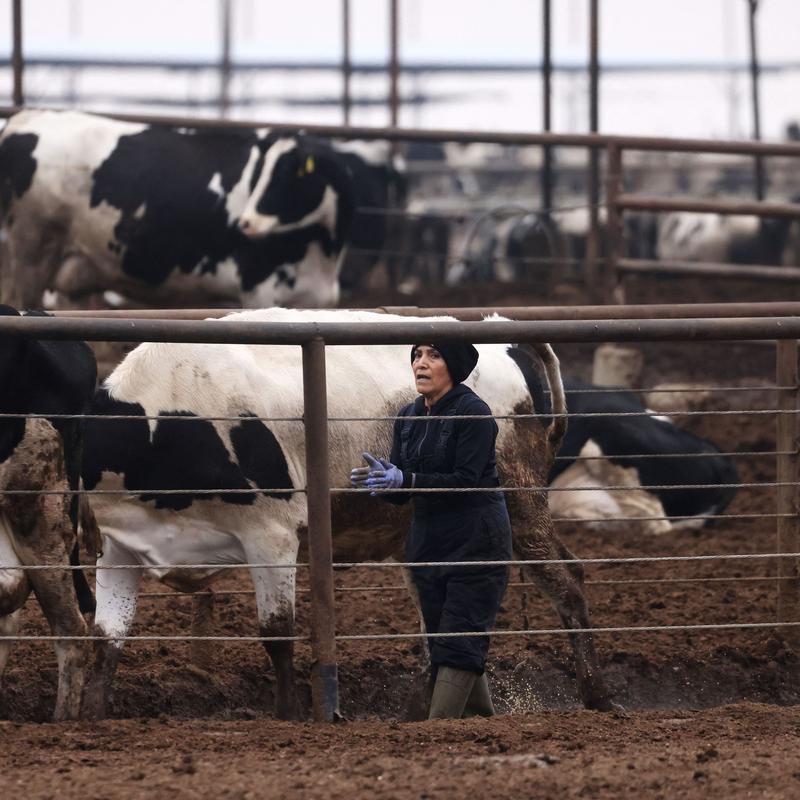
Kousha: It's The Brian Lehrer Show on WNYC. Welcome back, everybody. I'm Kousha Navidar, filling in for Brian today. We'll talk now about what happens when immigrant labor disappears and why the replacement often isn't American workers, but machines. Most American dairy cows are milked by immigrants, but on one farm in upstate New York, the cows are milked by robots. Yes, these cows walk up to a machine that cleans the udder, attaches the cups, draws the milk, and then dispenses a treat.
It's a glimpse of what's already happening in parts of American agriculture, and it raises a bigger question about the political promise that if you cut immigration, Americans will fill those jobs. Because what if the replacement isn't an American worker at all, but a robot? My guest now is Binyamin Appelbaum, lead writer on economics and business for The New York Times editorial board and the author of The Economists' Hour. His latest opinion piece is what replaces deported immigrant workers, not Americans, and we'll talk about it now.
Binyamin, welcome back to WNYC.
Binyamin: Thank you for having me.
Kousha: It's a pleasure to have you here. Listeners, we're talking about immigration, automation, and the future of work, especially in farming and other industries that have long relied on immigrant labor. If your industry has tried to replace workers with machines, or if you've worked alongside automation, what did it actually change? Especially if you've worked in agriculture, food production, or food service, do you think Americans would take these jobs if wages were higher?
Give us a call or send us a text. We're at 212-433-WNYC, that's 212-433-9692. You can call us at that number. You can also text us. Binya, you open with this line in your article: "Most American dairy cows are milked by immigrants. On Dale Hemminger's farm in upstate New York, the cows are milked by robots." Beyond the novelty of that, what else is being automated on farms right now, and what's next?
Binyamin: It's important to understand that automation in agriculture isn't anything new. The amount of human labor required to produce our food has dwindled hugely over the last 100 years. It used to be that most Americans worked in agriculture, and that was necessary to feed the country. Now less than 1% of Americans work in agriculture, and we still produce a huge surplus of food. Mechanization isn't new, but we're seeing it taken to new lengths, to the point where, on some of these farms, there really are hardly any humans around during significant portions of the process.
On a dairy farm like Mr. Hemminger's dairy farm, there are still some human workers, but you've got the cows walking into booths, giving their milk without any human interaction. He's building a new barn where you're going to have robots roaming around, picking up the manure off the floor, robots deciding which cows need to see a veterinarian. Just tasks that once it would have seemed inconceivable to automate are very quickly moving from man to machine.
Kousha: Another line that really stood out to me in what you wrote is the following: "There is a big hole in the seductively simple argument that Mr. Trump's policy will push employers to hire Americans. For many jobs, the cheaper and more likely replacement is a robot." I think this is an important thread to go down. What do you think people misunderstand when they assume that if immigrant workers are pushed out, American-born workers will simply step into the job?
Binyamin: I think that people understand that immigrant labor is often cheaper than hiring American workers. That's obviously the huge reason that many employers rely on immigrant labor. What they don't understand is that, in between the cost of immigrant labor and the cost of American labor, is in many cases the cost of automation.
If you are deprived of access to immigrant laborers, if you're an employer who can no longer hire those workers, they're no longer available, you're going to figure out what is the next least expensive option. In many cases, it turns out that the least expensive alternative is not going out into the market and paying whatever it would take to attract American workers. The least expensive alternative is to stop using workers and instead spend some money installing machines.
Kousha: Let's go to Scott in SoHo, who has some thoughts on immigration labor leaving. Scott, hi. Welcome to the show.
Scott: Hi. First of all, when tractors were invented, we had to stop plowing fields by hand, which made a big difference. Of course, once a farmer could afford a tractor, they would do that and then become more productive. I just want to say that your guess is right that, yes, people will move to machines to take care of things because automation is more efficient, probably less headaches, but there's a time before you can do that. Not every farmer is going to go out and buy mechanized milking machines for their cows until hopefully they can afford it, I guess.
In the regular industries, if you're a McDonald's employee or you're, I guess, maybe a chicken butcher in a big factory, if you get rid of, I would say, whatever migrant labor or people that are willing to work for a lot less than than Americans to do the same job, if those people are no longer here, the wages go up for the poor people. It obviously costs more for the big companies until they have to get to a point where they have to mechanize or go out of business.
Kousha: Scott, thank you so much for that call. I appreciate it. I want to break that down a little bit because you talk about two salient things that I want to point out. One, you start off with the tractor analogy of saying tractors came, couldn't do it by hand anymore. Eventually, people adopted it. Then also you're saying wages will go up. Binyamin, how do you respond to both of those threads there?
Binyamin: The first one is where I started. You can go back before the tractor to the plow, which is the original labor-saving innovation. This has been going on for a long time. That's absolutely true, although we're seeing it push into new territory. We haven't even touched on AI, but there are some really remarkable things happening with AI in agriculture as well. I write in the article about a machine, the LaserWeeder G2, that uses Nvidia chips, the state-of-the-art software to point laser guns at weeds in fields and zap them. It does the work of 75 people all by itself. There is continued progress in automation.
I think the caller is pointing out something really important, which is that you can't just flick a switch and automate. Even a farmer who has the capital available because he's borrowed it or saved it or what have you to invest in, say, an automated milking machine. If every farm in the country tried to do that tomorrow, there just aren't enough machines, and there are things that can't be automated immediately. It is absolutely true that if you removed every immigrant farm worker from the country tomorrow, you could not immediately replace them with machines, and if you're a farmer, you're going to face a choice, but it's important to recognize that there is a choice.
The choice is between hiring American workers at higher wages, assuming you can find them, which is not always clear, and going out of business. People who are assuming that the companies will have to hire American workers are ignoring the possibility that there will be companies that find that the wage they would need to pay an American worker is too high to remain profitable, or that even at that wage, they still can't find enough workers. There's not a lot of excess labor in this country right now.
There are examples of farms already saying, "Listen, if we can't continue to employ immigrant labor, we're just going to go out of business." Mr. Hemminger, who grows cabbage on the other part of his farm, has a nice way of thinking about this. He said, "Americans basically need to choose between importing the labor to grow these crops or importing the fruits of that labor from other countries."
Kousha: You cite Pew Research that shows more than 750,000 immigrants left the US labor force in the first half of 2025, and that immigrants make up more than half of dairy farm labor. When that kind of labor supply dries up, if you'll excuse the pun, what does it actually trigger in the economy?
Binyamin: We don't know, but it is probably not-- There's two directional answers to that question. One is that I think we're seeing that it is triggering a wave of capital investment in automation, that the loss of access to cheap labor is forcing companies, in some cases, to hire American workers. I want to acknowledge that that does happen in some instances, and in some instances, they do so at higher wages. It is also prompting them to invest heavily in automation to find ways of reducing their labor needs, and that's not just happening in agriculture.
We've seen Amazon, which is the nation's second-largest private employer, announce this massive push into automation in its warehouses that is expected to eliminate the need for tens of thousands of workers in the coming years. We've seen fast food restaurants investing in robots that make French fries or robots that form patties or robots that perform other tasks that once you would have needed a low-wage worker to perform. This is happening across the economy. The third thing that I think we will see is that some kinds of work will simply no longer be economical to perform in the United States.
Kousha: Listeners, this is The Brian Lehrer Show on WNYC. My guest is Binyamin Appelbaum, lead writer on economics and business for The New York Times editorial board and author of The Economists' Hour. Listeners, what do you want to ask our guest about the economics of immigration and the politics around it? Give us a call or send us a text. We're at 212-433-WNYC, that's 212-433-9692. Call or text us. Binya, I appreciate how you say that this is happening throughout the industry, which many of us are seeing, many of us are also feeling. Looking at it as something as so not simple, but everyday experiences that we have as dairy, I think, is really telling.
We have a text here from a cow vet that I would love to read. It says, "Cow vet here. It's worth noting that there is a certain magic to working with cattle, particularly dairy cattle. Good husbandry technique, gentle handling, et cetera, directly affects milk production. In my experience, Central American dairy workers somehow have old school mass for techniques in handling cattle, which cow respond very positively to. The job of an effective and productive dairy worker, especially the milkmaid, cannot just be replaced by any untrained worker."
Now, you also write, Binya, that before automation, Hemminger's farm produced about 800,000 pounds of milk per worker per year, and now it produces 2.5 million pounds. You also note that his remaining workers earn more, they have less punishing work, and they don't have to be in the barn at 5:00 AM on a freezing February morning. I'm looking at this text, and I'm looking at this almost more humane sense of automation. Is that a fair way to think about it, that these improvements actually do help out more than they hurt?
Binyamin: I think if you ask Mr. Hemminger about this, he will tell you that not only is he happier, not only are his workers happier, but in his view, his cows are happier. The reason is that automating some of these tasks allows his remaining workers to focus more on the welfare of the cows, to devote more of their time to looking out for problems, troubleshooting. They're taken off of the assembly line of milking and allowed to engage more broadly with some of the other issues that can arise on a farm.
This is not the total elimination of the need for labor. You still need workers, for example, to assist cows with births. On a farm, the scale of Mr. Hemminger's, he estimates about five cows born every day, which I just find remarkable, and workers need to be there to help with that. There's a version of this in which you continue to employ a smaller number of workers, and one might recognize that those workers have predominantly been immigrants and say basically we're going to keep on needing them.
Over time, you could have a government policy of encouraging automation, which is in our economic interest. It makes our economy more productive, it frees people up to do other things, and instead of an abrupt transition, you would manage a gentle transition. There's a good version of all of this, in other words, or there could be. What we're doing instead is this abrupt discontinuation of one supply of labor, forcing farmers to make these transitions more difficult than they otherwise need to be.
Kousha: Let's go to Joan in Manhattan. Hey, Joan, welcome to the show.
Joan: Oh, hi. On this issue of whether if you lose your immigrant, your cheap immigrant labor, you will necessarily hire native born Americans at higher wages. I remember a story, it was about 10, 15 years ago. There was a factory in the Midwest, Minnesota, Michigan, somewhere around there in the north, and they lost many of their workers. I don't know if it was an immigrant raid or whatever it was. Did they hire local people at higher wages? No, they went to the local prison, and they hired prisoners. The prison owners acted like a temp agency, and they hired out the prisoners. The prisoners got, I don't know, $0.25 an hour, and the prison company got, I don't know, $3 an hour or something, so they got cheap labor.
Kousha: Joan, thank you so much for that call. Let's talk about the bottom line from Hemminger, Binya. You write, "If American farms cannot import labor from other countries, Americans will have to import the fruit of that labor instead." Translate that into everyday terms. Are we talking about higher food prices, more imports, or American farm shrinking altogether?
Binyamin: I think all of the above. Imports are going to be more expensive, but it also means that the jobs aren't here. If Mr. Hemminger grows cabbage on his farm in upstate New York, as he does, that crop is produced in the United States. While much of the labor comes from foreign workers who are here on seasonal visas, it is still the case that the farm is owned by an American family, that the trucks that pick up the goods may have American workers, that the economic activity is happening in the United States.
If those workers can't enter the country, Mr. Hemminger says bluntly that he'll go out of business as a cabbage producer. America's need for cabbage will have to be met by importing it from other countries, where labor remains cheaper and less of the economic advantage accrues to the United States, and it's probably also the case that the cabbage becomes more expensive.
Kousha: How about the moral dimension? Because you argue immigration is a huge economic engine. You've called it America's rocket fuel. A lot of folks would agree with that. Is there compassion in an argument for immigration that basically boils down to we need people to do back-breaking, low-wage work Americans don't want?
Binyamin: I think that if, one, were forcing people to do that work, then there would be a moral question about putting them in that situation, but many of the people who are employed on these farms regard it as an enormous opportunity. It is a quality of work and of compensation that is not available to them in the countries that they come from. They come here to the United States to do this work voluntarily and are often quite eager to take advantage of these opportunities. In that sense, there's a win-win situation where workers are gaining an economic advantage and America is benefiting from their labor.
Now, whether they should be paid more is an open question. It's one actually that the Biden administration pushed to increase wages for agricultural workers on seasonal visas. The Trump administration came out this fall with a policy that would slash those wages and basically take advantage of the fact that there are a lot of desperate people who are eager to work on American farms. You can argue about the exact calibration of this relationship, and there's a moral dimension to that. The basic idea that there are people in other parts of the world who are willing to do work that Americans are not, I think, is pretty well founded.
Kousha: I'm thinking back to Scott from SoHo calling and talking about how there is not this immediate need, or at least that's something that you took up in saying that farmers had a choice in how quickly they adopt the new technology. You also talked about the gap. In fact, you wrote, "Mr. Trump, however, is trying to chase the existing farm labor force out of the United States much faster than automated alternatives can conceivably be introduced." When you remove labor faster than technology can replace it, what happens to that gap? Do you see any evidence of that on the farm that you wrote about?
Binyamin: On this particular farm, he was an early mover. He's already got his machines, and so he's less exposed to this. In general, two things can happen. You can either pay up and pay whatever premium is necessary to find replacement workers. We can talk a little bit about the evidence about whether Americans are willing to take these jobs and whether there's a wage at which they would be willing to do so. The other alternative is you can suspend production. You don't need to make whatever you are making if you no longer have the workers available to make it.
Kousha: Let's talk about the wage at which that might be possible, that citizens, and not low-wage workers, would take this. You cite the farm wage at $18.12 an hour in 2024, about 60% of the average non-farm wage. You ask, "Even if it were, let's just say, $30 an hour, would Americans do it?" What do you think? What would your answer be?
Binyamin: I think that that is a question that a lot of people wonder about because it's clear that farm labor does not pay especially well, and so the question is, if a farm job paid just as well as a job in town, would more Americans be willing to take it? At the margin, the answer is probably yes. There are probably some Americans, this is basic economic logic, who will do the work at $30, but would not do it at $18. What there is no evidence for is the idea that there is anywhere near enough Americans who would be willing to do that.
You can still make $30 an hour doing something a lot less difficult, a lot less dirty, a lot less dangerous. You would assume that getting people onto the farm would require a premium above the wages that are now paid in town. Listen, one defining story of America in its 250th year is that it's been 250 years of people leaving the farm to go live in the city. That is the great story, not just of our civilization, but of modern civilization. People choose not to be on farms basically whenever they have that opportunity.
The idea that we're going to have some type of back-to-the-farm movement seems to me incredibly implausible. One piece of evidence for that, which I find just fascinating, is that many states require workers who are unemployed to apply for jobs. They need to show that they're looking for work. An economist studied workers in North Carolina, 250,000 of them, who were required to do this. What he found is that just a couple dozen applied for farm jobs.
There are lots of farm jobs available, but almost no one applied for them. The workers who did apply were almost all offered jobs. Farms are eager for labor, but what they found was that relatively few of the workers who were offered jobs took them. Relatively few of the workers who took jobs bothered showing up, and almost none of those finished out the harvest season. Even when Americans are choosing between no job and a farm job, they still overwhelmingly prefer no job.
Kousha: There's one more text that I want to bring up with a final question about an aging population. The text is, "Who will take care of the elderly baby boomers? Trump doesn't think of the logical future the US needs for the US," I'm assuming that text wanted to say. While we're not exactly talking about an aging population here, I think it does tie into the importance of immigration more broadly. Binya, when you think about that, how does an aging population, and I would say a declining birth rate change as well, how does that change the stakes for immigration policy and the labor market?
Binyamin: I've written in other pieces about our need for more workers. One of the most important arguments for finding a way to create a rational, legal immigration policy is that America needs more people. We talk a lot about the things we no longer make in America. One of those things is babies. We simply don't produce them in sufficient numbers to meet our labor needs. If we stop bringing people to this country from other countries, we are simply going to run out of workers.
One place where you can see that that's going to happen, to bring this full circle back to the dairy farm, is that while a little more than half of the workers on American dairy farms are immigrants. As that implies, the other half are Americans. They work disproportionately on smaller family farms, smaller dairy operations, often in the upper Midwest and in the Northeast, and those farmers are overwhelmingly older. The average age has just been going up, up, up.
What we're seeing is that that native labor force that does still milk cows in this country is an aging labor force, and there is no obvious replacement in a new generation of Americans. You can find examples of young people moving to farms and opening dairy farms, and it's such an unusual development that the local papers in those communities often write about it.
Kousha: Write about it, yes.
Binyamin: Future stories, like, isn't it interesting that a young couple would want to be dairy farmers? If we don't find a new source of labor, if we don't continue to bring people to this country who want to do that kind of work, then the aging of our population is simply going to end that line of work or vastly reduce it.
Kousha: We'll have to leave it there for now with Binyamin Appelbaum, lead writer on economics and business for The New York Times editorial board, and author of The Economists' Hour. His latest opinion piece is "What replaces deported immigrant workers, not Americans." Binyamin, thank you for some of your time today.
Binyamin: Great to talk to you.
Copyright © 2026 New York Public Radio. All rights reserved. Visit our website terms of use at www.wnyc.org for further information.
