
Who is María Corina Machado, Nobel Peace Price Winner?
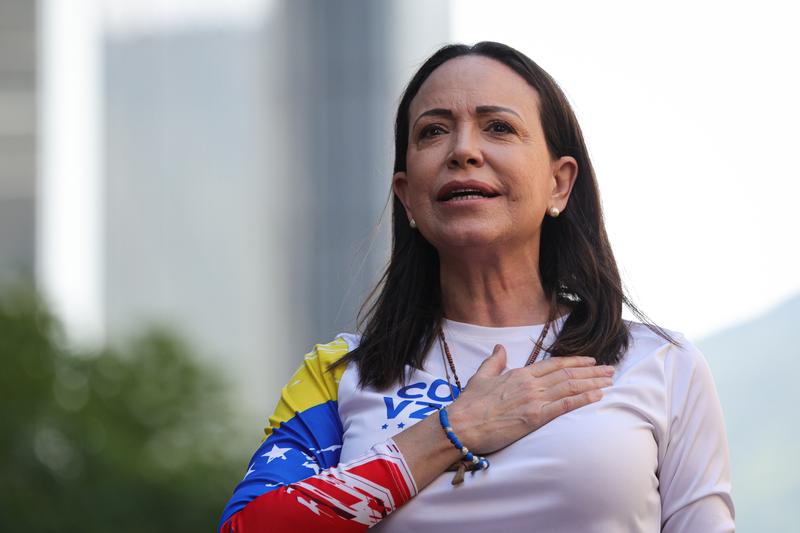
( Jesus Vargas / Getty Images )
[music]
Brian Lehrer: It's the Brian Lehrer Show on WNYC. Good morning again, everyone. This year's Nobel Peace Prize was announced this morning, and it goes to Maria Corina Machado, the Venezuelan opposition leader who has spent years challenging Nicolas Maduro's authoritarian rule, often at personal cost. She's been banned from running for office, accused of treason, and forced to campaign underground. The Nobel Committee is recognizing her for "her tireless work promoting democratic rights for the people of Venezuela and for her struggle to achieve a just and peaceful transition from dictatorship to democracy." Here is part of the official announcement.
Jorgen Watne Frydnes: Ms. Machado has been a key unifying figure in a political opposition that was once deeply divided, an opposition that found common ground in the demand for free election and representative government. This is precisely what lies at the heart of democracy, our shared willingness to defend the principles of popular rule even though we disagree. At a time when democracy is under threat, it is more important than ever to defend this common ground.
Brian Lehrer: That was the chair of the Norwegian Nobel Committee, Jorgen Watne Frydnes. I'm sure I'm mispronouncing that name, this morning. Here's the winner, Maria Corina Machado, in her own words. This is from a short phone interview with the Nobel Institute just after the announcement.
Maria Corina Machado: I accept this as a recognition to our people, to the millions of Venezuelans that are anonymous and that they're risking everything they have for freedom, justice, and peace. I'm sure that absolutely convinced that we will achieve it.
Brian Lehrer: What does it mean for the committee to choose her at this moment and from that country, Venezuela, which, separate from what she's being recognized, has this complicated relationship with the United States right now. Such a flood of asylum seekers from Venezuela in recent years, the Trump crackdown on them, singling out Venezuelan gangs as somehow representing the immigrants from Venezuela, and also the recent attack by the US military on two alleged drug boats from there?
What message is the committee sending the world by elevating this cause at this moment? We will also talk about the Middle East peace process now with our guest Gideon Rose, adjunct senior fellow at the Council on Foreign Relations, former editor of Foreign Affairs magazine, and the author certainly relevant to the Middle East situation at this moment, of the book How Wars End. We'll ask him if what's going on now fits into any pattern of how wars end that he documented in his book. Gideon, always good to have you on the show. Welcome back to WNYC.
Gideon Rose: Thanks, Brian. Always great to be here.
Brian Lehrer: Listeners, we're going to open up the phones first for anyone, just in case anyone is listening who has ties to Venezuela and maybe knows the work of Maria Corina Machado or wants to say anything about this particular Nobel Peace Prize award at this particular moment. 212-433-WNYC, 212-433-9692. For now, if you have ties to Venezuela, then we'll open it up more broadly later. Call or text 212-433-9692. Gideon, there was a little thumbnail in the intro, but tell us more. Who is Maria Corina Machado?
Gideon Rose: She's an inspirational figure who is the Venezuelan opposition leader and trying to stand for the principles of democracy and liberalism in a very difficult political situation in her country. I think it's a solid choice. The Nobel Peace Prize tends to fall into one of three categories. There are ideological prizes that essentially represent the hobby horses of the committee and are not really a serious intellectual or practical effort. There are inspirational prizes in which they're giving prizes to causes that deserve public boost and things that are related to peace. It's, in effect, an inspiration to all who want to keep the struggle going.
Then there are practical prizes that are given for actual accomplishments, often not particularly somewhat cynical, practical compromises, the real world of peacemaking. It's interesting, because let's say, for example, that the Gaza Prize comes next year. Let's say that the ceasefire in Gaza holds and emerges into something somewhat durable, maybe even the start of some peace process, and next year, Trump and Netanyahu and the Guterres and somebody from Gaza gets the prize. That would represent a sequence from last year's prize, which was essentially ideological, to the bomb survivors.
This year's prize, which is essentially inspirational, to next year's prize, which could be essentially practical. That's the way to think about this. There are multiple categories of the prizes. This year's prize is to a good person doing good things, struggling for a good cause that they wanted to recognize and give a public boost to.
Brian Lehrer: It is interesting to spotlight Venezuela right at this moment because of the relationship with the US, or maybe only people in the US would think about it this way, or people paying attention to the news in the US would think about it this way. You know, I said it in the intro. We've had the flood of asylum seekers from Venezuela the last few years. We've had the Trump administration's focus on Venezuelan gang members as a reason for the mass deportation program now underway.
Now the US launching military attacks that have killed people on alleged drug boats. Not the way the US has tried to apprehend and arrest people on drug boats in the past. Widely considered a violation of both US and international law. All of that is going on at the same time. Does this have something to do with that or nothing to do with any of that?
Gideon Rose: It's an interesting question. We don't know about the specific politics of it, but by highlighting neither the immigration, not the crime, and not the drug boat interdictions and the potential state of war there, but rather the relatively uncontroversial and sensible quest for political democracy and freedom inside Venezuela, I think the committee has done an unusually sensible job in focusing attention where it deserves to be, rather than on either highly ideological or personal or somewhat inappropriate controversial sides of things.
I think that this is actually a way of reframing the discussion and saying that what's really most important about what's going on in Venezuela is not the gang stuff and it's not the drug stuff, but it's actually the basic fight for political rights and freedom, which Machado represents.
Brian Lehrer: It does make the point, though, doesn't it? Which supports the political left and supports the political right, that on the one hand, Maduro is a really bad guy. If we take that as a premise, of course, the conservatives in the United States are the more outspoken, I think it's fair to say, against Maduro as a leftist authoritarian leader of Venezuela. It also makes the case for the more liberal people with respect to borders to say, yes, that flood of asylum seekers that was coming more from Venezuela than anywhere else during the Biden administration had a reason to be escaping.
Gideon Rose: Yes. One of the most interesting-- Another time we can discuss essentially migration in Latin America, which has multiple causes and has also been stopped more than many thoughts by the Trump administration-- thought it would be by the Trump administration's policies, but it's not-- The relation of migration to peace is tricky. You can make arguments, but certainly, if you had a stable, legitimate, economically successful government in a country, there would be much less migration from it. If Machado could actually take power, if Venezuela could actually manage its affairs better, then a whole bunch of positive goals would be served, including the stopping or the lessening of some of the migration issues, including crime, including peace.
Brian Lehrer: It also seems to me that the Nobel Peace Prize goes to basically two different categories of people. Tell me if you agree or disagree with this. People who actually are involved in negotiating peace. You could think of many examples over the years. People in a conflict situation who negotiated peace either as a participant or as a mediator, or people who are activists for human rights, as in this case, not necessarily a peacemaker per se in a war situation, but somebody who's advocating for human rights, including this year's winner. Would you say those are two basic categories of who gets the Nobel Peace Prize, and the second one doesn't necessarily address peace per se?
Gideon Rose: I agree, but I think there's also a division in the second category between people who are activists in causes related to practical political and peace and security issues, and people who are not really. The last year's prize, which was given to the survivors of the atomic bombings, and it was an attempt to raise the profile of the anti-nuclear movement in some respects and presumably to warn against the potential future use of nuclear weapons, it was utterly disconnected from reality.
The threat for nuclear weapons was being raised by a Russian aggressor, and the bombs were used in an attempt to defeat an aggressor. There was no structural parallel. Besides, to the extent that nuclear weapons have affected peace rather than rights, they've probably helped provide for stable peace during the Cold War and the long peace rather than undermined it. You could have made a case, however controversial, that the bomb deserved the prize last year more than the victims of the bomb.
This year's prize, Machado is actually an activist, and you can make a cause, not just an activist, an outside civil society activist, but a political actor in her country's politics, trying to bring about a democratic system, which we know does relate to peace, is related to a positive set of political outcomes. You can make the case that this is not just an inspirational or aspirational prize, but one that is connected solidly by both theory and practice to some outcome that is plausibly related to the prize itself.
Brian Lehrer: I'm going to ask you more about Machado herself and her background, but I want to acknowledge that we're getting either texts or calls from, let's see, one, two, three, four, five, six, seven, eight different phone numbers with people saying versions of the same thing. I think you could guess what it is. I'll read one that doesn't include a curse word. It says, "It's a direct slap on the face to Trump." Your reaction?
Gideon Rose: You could see it as a slap in the face to Trump for two reasons. Either because not giving it to him for Gaza when he was obviously lobbying for it, is a downside, but it could also be because of some relation to what he's doing in Venezuela. I don't think this is a direct slap in the face to Trump in one sense, because the official rules of the game say you shouldn't be nominated for stuff this year, the previous year, and the Gaza stuff, it's just way too early. If the Gaza stuff had happened in the spring and you had had actually a real process that built on that, there could be a legitimate case for giving Trump the prize.
If the Gaza settlement actually starts a process that is built on, you could make a solid case for next year. If what Trump has done in Gaza, belatedly applying pressure to both sides, is carried out with regard to Ukraine, in which pressure on Russia is combined with pressure on Ukraine to lead to some ceasefire or settlement there, you could make an even better case that that would be a legitimate peace prize next year. I don't think this is a slap in the face at Trump. It's sort of a not yet. In fact, by holding out the possibility of giving a prize in the future for developments, if they continue and solidify, that's a legitimate incentive structure going forward.
Brian Lehrer: I know you're going to want to hear some of these listeners. Another text says, "It's a big middle finger to Trump." Another one uses these initials and says, "It's a big F-U to Trump." Another one says, "I guess Trump didn't present sufficient evidence to the UN General Assembly that global warming is a hoax." You get where a bunch of our callers are going. Gideon, about Machado, she comes from a prominent Venezuelan family. I see. Her father was an industrialist and founder of a large steel company. She studied industrial engineering at a university in Venezuela and later at Yale.
She co-founded an election monitoring group, served briefly in the Venezuelan national assembly, and has long been one of the most recognizable figures to Venezuelans in the opposition. How do those parts of her bio help explain her prominence and how she's perceived by supporters and, for that matter, by critics?
Gideon Rose: This is, I think, an absolutely legitimate prize because this is somebody who has chosen to put her privilege and her principles together to work at the slow boring of hard boards, as Weber talked about, for political change in her country in a positive direction. This is something that the committee, in a rare bit of sense, one might say, has decided to recognize, because this is how political change happens. Positive, constructive political change happens when political entrepreneurs enter into activism in a structural context that might actually make it work.
If you're just fighting an impossible structure, it's never going to work. History doesn't happen just by inevitable forces. There's no invisible hand that forces possible good things to emerge. It happens through individual efforts of people like Machado. Somebody who has done, in effect, all the right things, checked off the right boxes, kept her principles while being pragmatic and effective and trying to generate changes, this is what the prize can and should be done.
Frankly, it would be an appropriate prize next year. If the Gaza deal holds up and becomes the foundation for something better and a restarting of the peace process, it would be appropriate to give it even to people involved, like Netanyahu and Trump, and people from Hamas. If they have dirty hands that have had bad things happen-- I was talking to somebody the other day who said it was a shame that Arafat got the prize. It discredited the prize to give it to a terrorist. He got the prize along with Clinton and Rabin for the start of the Oslo process. That was a legitimate movement towards peace. It didn't ultimately work.
Perhaps, there should be a mechanism for revoking a prize later. In the real world, peace happens not just through activism and not just through the Keebler elves and positive astrology and the stars aligning, but through practical people making choices that lead to a better outcome. This is a legitimate start from that, because people like Machado do it. What's happening in the Middle East is how things look when things actually move forward. It's never perfect, it's never great. The people involved are never true saints, because saints don't actually appear much in practical politics. It's a step forward to make the world better. That's what the prize should be about.
Brian Lehrer: We do have a caller who wants to push back on this as a good person to give the Nobel Peace Prize to, and I think on the legitimacy of the Nobel Committee and their process generally, not because of the history of awarding it to Arafat in that case, but from a different political perspective. Dominic in the Bronx, you're on WNYC with Gideon Rose from the Council on Foreign Relations. Hi, Dominic.
Dominic: Good morning, Brian. Good morning, Mr. Gideon Rose. Yes, I think the Nobel Peace Prize lost its legitimacy when it awarded it to Henry Kissinger. In that way, there's an irony, because in a way, Trump is ideal because he's maybe fomented a little bit of peace in the Middle East and he's starting war with his own people in the United States. Maybe he's actually a legitimate recipient of the Nobel so-called Peace Prize. Machado is part of this right-wing cabal sponsored by the United States to overthrow a government, which United States always does. Don't get me wrong, this is very American, like apple pie and the Yankees.
I'm in a little bit of a conundrum trying to figure out how to understand and appreciate the prize. We can give it to someone who's sponsored by United States to overthrow a democratically elected government. If we're going to start doing that, we have got a lot of governments to overthrow. If Trump gets it, well, it just further points out what the Nobel Peace Prize really stands for. That's my two cents. I don't know who to give it to. I would imagine giving it to maybe someone who's tried to work toward peace, and it's hard to figure out who that would be. Sorry.
Brian Lehrer: Do you think Machado has been a good head of state? Are you saying that? Not Machado. Maduro.
Dominic: Brian, to be fair, I'm a libertarian socialist. I don't think there are very many good heads of state. I think the state is a dangerous concept that divides us. I know I sound like pie in the sky, and I'm going to stay in the sky. I think Maduro's problematic, but I also think Trump's problematic, I think Putin's problematic, I think Netanyahu's problematic. Maybe we should just dispel the nonsense of awarding, basically, for the most part, people who are war criminals or potential war criminals.
Brian Lehrer: Dominic, thank you for your call. Gideon, I will say that there are a few other people chiming in related things. One points out that Machado was a guest on Donald Trump Jr.'s podcast earlier this year. We have another text indicating that she had asked Benjamin Netanyahu to intervene in a certain way in Venezuela. It's not clear to me exactly what that was, but the listener is obviously suspicious of her because of that. Your reaction to any of those things, or confirm the facts if you know them.
Gideon Rose: Okay, so first of all, I appreciate Dominic's consistency, given his position. I don't entirely disagree with his notion that all political leaders have some form of dirty hands and that political power is a nasty thing, but it can also be better or worse. I also agree that this is not a great year for peace prizes in the sense that I was trying to think who I would want to give it to myself. It was very hard to come up, this year, with good candidates because there hasn't been a whole lot of work towards practical peace this year. The world is going in a bad direction rather than a good direction. Maybe things are turning around a little bit. We will see.
Brian Lehrer: Let me just throw in one more here. Text that just came in. "This Nobel is bizarre. Machado wasn't in favor of democracy when she worked to overthrow the democratically elected Chávez government. Chávez was corrupt, so is Trump. Nobody here is working to non democratically overthrow our elected Trump government."
Gideon Rose: The political development in Latin America in the contemporary era is a very interesting and complex subject. There are people who have been supporters of Chávez and Maduro, and they originally started out with some perhaps democratic legitimacy, but they've run the country into the ground, and the opposition, I think, has a stronger case. I don't buy the grounds that Machado is some right-wing tool or puppet. She seems to be somebody who sincerely wants a better political future for her country. I think it would benefit not just her country, but the region and the world. I think that's a legitimate thing.
The question about whether it was a bad idea to give [crosstalk] Kissinger the prize is an interesting question because that's the same thing as the Arafat thing in reverse. Kissinger got the prize for helping to broker a deal to end the Vietnam War. Now, many people felt that was an inappropriate thing. Tom Lehrer said, "I'm going to give up comedy because there's no room for comedy in a world in which Henry Kissinger gets the peace prize." I can't compete with that.
Brian Lehrer: By the way, no relation, Tom Lehrer, except extreme admiration from this radio host. Go ahead.
Gideon Rose: No, I agree. Look, again, if you're giving things to people who are nice because you want to, like Dominic, you want to believe that the world can be better than the one we have and you're going to give it to, in effect, practical saints, you want to give it to Paul Farmer or Jane Goodall or people who are true secular saints, but then there are practical people who actually make individual situations better.
If we get a deal in Gaza that actually stops the killing and moves towards a peace process, or we get a deal in Ukraine that stops the killing and moves towards security in the region, and if we get a deal in Venezuela that actually moves towards popular government that isn't oppressive, that isn't violating the rights of people and destabilizing the region, that would be a good thing. I don't have as many expectations of the millennium coming soon. I think there's a role for giving the prize to people who are trying to bring about practical change in a positive way. I think that's useful and valuable.
Brian Lehrer: Let's take a phone call from Jesus, who says he's a Venezuelan New Yorker. Jesus, thank you for calling in. Hello.
Jesus: Hi. Hi, Brian. My name is Jesus. I'm from Venezuela. I've been in New York most of my life, and I just was listening to somebody just a few minutes ago saying that--
Brian Lehrer: Whoops, did we lose Jesus' line? Looks like we still have you. Try it again. All right, let's see. Gideon, can you hear me?
Gideon Rose: Yes, I can. Let me just say one more thing about Machado while you're getting the phones on. Being realistic, I don't think this prize will change much about what happens in Venezuela, but I think it will protect Machado's life by making her a Nobel laureate. This raises her visibility, and it increases the costs of attempts to suppress and destroy her. By, in effect, putting the sanction of international benevolent opinion on her efforts, it may protect her life. That's a good thing that deserves to have been done, even if it doesn't actually produce a lot of change in Venezuela in the near or even midterm.
Brian Lehrer: Yes. Something you just referred to is something I think is important for our listeners who don't know Machado to know, which is that, reportedly, she has been in hiding since the government cracked down on her opposition campaign earlier this year. You're saying it may not bring change, this Nobel Peace Prize structurally in Venezuela, but it may at least save her life. That's an actual risk.
Gideon Rose: Exactly. I think that's actually a positive thing because it basically says there are going to be costs for suppressing democracy movements, and you're going to suffer international public opprobrium if you kill a good guy, or in this case, a good woman trying to make the world better and trying to make their country better. That's a legitimate minor benefit of the prize.
Brian Lehrer: Do you think that her getting the prize might wind up legitimizing or giving Trump a talking point for legitimizing US Military intervention with these Venezuelan boats, or even to remove Maduro? The New York Times recently noted some Venezuelans belief that any action might be justified to defend last year's disputed election, which Maduro apparently lost, but he's still in office. That she, Machado, has voiced support for possible US military intervention to remove Maduro. Is that your understanding?
Gideon Rose: I don't think the Trump administration is eager to get involved in any regime change in Venezuela or trying hard to actually militarily intervene. What they're doing on the drug stuff, in terms of the boats and the crime, it's somewhat performative, it's somewhat violent. It's not the prelude to a giant major new war in the region. I think they don't like getting involved in that. I don't think this is actually-- They don't need the Nobel committee's backing to come up with a rationale. This administration does whatever it wants to do for its own reasons.
Brian Lehrer: I think we have Jesus back now. Let's see if his line is connected any better this time. Jesus, you're on WNYC again. You're there?
Jesus: Hi, Brian. Hi. Yes, I'm not sure what happened.
Brian Lehrer: It's all right. Give it another shot.
Jesus: Can you hear me?
Brian Lehrer: Yes.
Jesus: Yes. I was listening to this person saying that Maria Corina is a right-wing puppet, which is absolutely not true. People don't understand what's happening in Venezuela. Venezuela is being kidnapped by this regime, the Maduro regime. What she did, like nobody else have done in the war, is that she proved that the elections back in July 2024 were rigged by showing copies of the voting ballot. Because it's automatic with the machines, the copies of it, she was able to collect it and show it, and she proved that they won and that the person that won is the person that runs supported by her by 70% of the vote.
She's the only opposition leader that remain in Venezuela and that requires courage. Also, it's confusing what's happening with this "support" from Donald Trump to Venezuela. I think, I believe the whole bombarding boats in the coast of Venezuela, it is definitely performative. We don't know what the endgame is. When I look at the news this morning, I am concerned how Donald Trump is reacting that Maria Corina Machado wants the Nobel Peace Prize when that's something that he wanted so badly. We're going to see now if this "support" that the Donald Trump administration is giving to Venezuela is actually going to continue.
Brian Lehrer: Jesus, I'm going to leave it there for time. Great point.
Gideon Rose: That's actually a good point. Let me build on that, Brian. That's actually a good point, because you could think of this in two ways. You could think-- three ways about the relation of the prize to Trump. One is what your first caller said, which is, oh my God, this might actually lead Trump to get more involved, to upstage this by finally doing a strike on land or even invading. I don't think that's plausible given the Trump administration. You can do what-- or it could happen what your caller just said, Jesus just said, which is this could make Trump annoyed and less interested in helping out the opposition because he didn't win, and he's resentful of her prominence.
I think either of those outcomes is less likely, and I think it more just not really related to Trump. This is actually orthogonal to a Trump-related prize. It's neither a giant middle finger nor is it sucking up to him. It's, in effect, it's buying time to see what the Trump administration will actually do in its supposed peacemaking efforts and the big game issues, which right now are both Gaza and Ukraine.
Brian Lehrer: As we segue after a break to talking about Trump and the Gaza peace process, Gaza and Israel peace process. I'll just read two headlines as a footnote to the last caller and what you were just saying. One, there are a lot of headlines like this. Here's USA Today. It says White House complains about Trump's perceived Nobel Peace Prize snub." Another one, Times of Israel says, "Netanyahu posts AI image of Trump winning the Nobel Peace Prize."
We will continue in a minute with Gideon Rose from the Council on Foreign Relations and author of the book How Wars End, among other books, and talk about whether this war is ending between Israel and Hamas. Stay with us.
[music]
Brian Lehrer: Brian Lehrer on WNYC. Few more minutes with Gideon Rose from the Council on Foreign Relations, former editor of Foreign Affairs magazine. Gideon, you wrote the book How Wars End. Is this war really ending, apparently, in Gaza? Does it fit into any historical pattern that you documented in your book, at least to the extent that these negotiations have gotten so far?
Gideon Rose: Big questions. The short answer is maybe, but we will see how this play out. We should remember that we had a ceasefire at the beginning of the year which Netanyahu ultimately violated and the Israelis violated. We now are back to one after a lot more killing, but also a lot more destruction of Israel's foes in various places. This one might stick. From a Clausewitzian perspective, from a international relations perspective, wars involve the use of violence for political ends by states, and they end when those ends are achieved and you've beaten your enemy, or both sides or all sides realize they can't actually get what they want from fighting, and so they choose to stop fighting and do something else. Talk and so forth.
What you're seeing in Gaza and what you also might become to be seeing next year or so, perhaps in Ukraine, is the exhaustion of the belligerence, realizing that there is no significant major purpose to be accomplished by further fighting because they're not going to get much, which creates a space, an opening, a possibility for the kinds of negotiations and political entrepreneurship inside and outside that would recreate a settlement that could lead to peace. First to a ceasefire, then to some peace, and then some settlement.
I don't think this, what's happening in the Middle East, in Gaza right now is peace. There are a lot of big questions, from the control of Gaza to the status of Hamas, to the ultimate fate of the two-state solution, that are all still up in the air and need to be negotiated. Having the killing stop and having people talk is a better move. As Churchill famously once said, "Jaw, jaw is better than war, war." The fact that the parties have agreed to stop the immediate killing.
If it can be maintained and nurtured, and the parties who are responsible for this, which is not just Israel and Hamas, but the US putting pressure on both sides, the Europeans and the Arabs coming together and the Gulf states who are in many respects one of the big winners of this, showing their role as mediators and key players in the situation. This is definitely a positive sign, but hold the champagne. It's a lot of hard work to come, but if it could be built on, then it would be a legitimate case for a peace prize next year.
Brian Lehrer: I don't know if you can answer this in our remaining 30 seconds, but to the model you just laid out of stopping the fighting when one side or both are exhausted, why wouldn't Hamas have reached that point earlier? We have 60,000 plus Palestinians dead there. They presumably knew for a long time they couldn't win the war. They were overmatched by the Israeli military. 20 seconds. Why didn't they reach that point earlier?
Gideon Rose: Because they are very ideologically committed to very big goals, and the people who were bearing the brunt were often innocent Gazans and Palestinians. In effect, there was a cynical ploy to hope that the more Israel did to hurt Palestinians, the more other people would pressure the Israelis to stop.
Brian Lehrer: That is it with Gideon Rose, counsel on foreign relations, author of books including How Wars End. Thank you for talking about this and the Nobel Peace Prize with us. We really appreciate it.
Gideon Rose: Thank you.
Brian Lehrer: That's the Brian Lehrer Show for today. Stay tuned for Alison, and have a good weekend, everyone.
Copyright © 2025 New York Public Radio. All rights reserved. Visit our website terms of use at www.wnyc.org for further information.
New York Public Radio transcripts are created on a rush deadline, often by contractors. This text may not be in its final form and may be updated or revised in the future. Accuracy and availability may vary. The authoritative record of New York Public Radio’s programming is the audio record.
