
White-Collar Workers Unite!
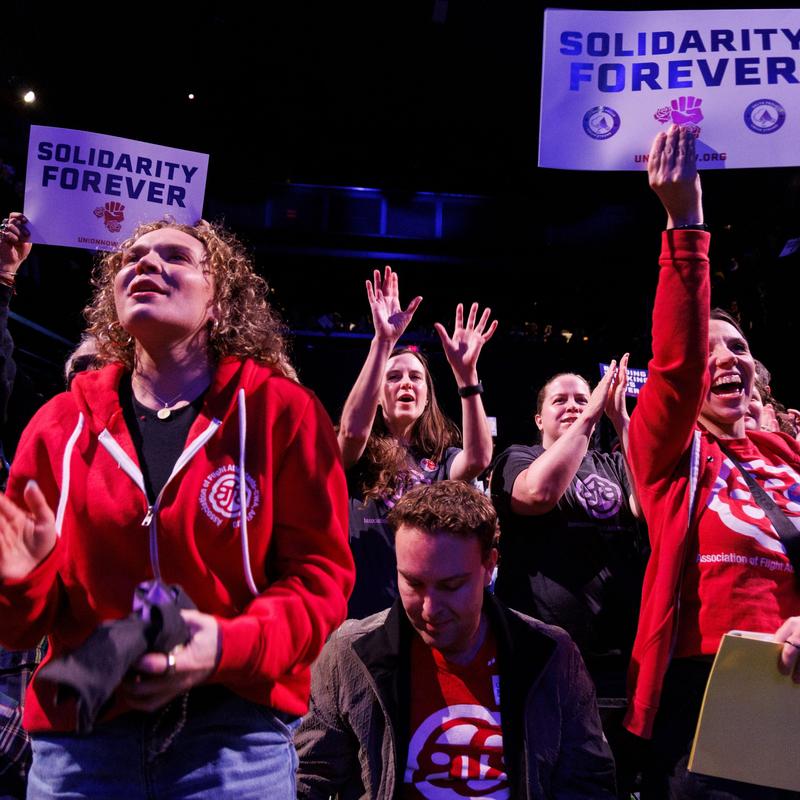
Brian Lehrer: It's The Brian Lehrer Show on WNYC. Good morning again, everyone. Are you in a union? Ten years ago, that question was mostly for auto workers, teachers, electricians, some others, but something has shifted. It's not just where people are organizing, it's who. When we think of union members, maybe you picture workers on a factory line, or longshoremen at a shipping port, but nowadays union members wear Apple store T-shirts and white doctors' lab coats. Yes, even some doctors are unionizing. Baristas, video game designers, Hollywood writers, and even resident doctors. Yes, have decided to unionize.
Noam Scheiber is a labor reporter at The New York Times, and his new book, Mutiny: The Rise and Revolt of the College-Educated Working Class is about the generation of college graduates who were promised a certain life, or so they thought, didn't get it, and decided to do something about it at work. Noam, it's been a minute. Welcome back to WNYC.
Noam Scheiber: Yes, thanks for having me. Great to be here.
Brian Lehrer: There are many places we could enter, but let me enter here. You described the first half of 2022 as the most significant moment in US labor history in the last 40 years. Why the first half of 2022?
Noam Scheiber: Yes. Well, we just had this explosion of union organizing among people who didn't typically try to organize a union, and at companies that were not unionized. This starts in the fall of '21, actually, with a few Starbucks stores in Buffalo, and two of these three stores win, and then that union campaign just spreads like wildfire across country. First a half a dozen in January of '22, then a dozen, and then by March, it's literally dozens, and by the end of the year, hundreds are trying to unionize.
We have workers at Apple store, as you mentioned. The first Amazon warehouse in the country was unionized in April of '22. We have workers at Trader Joe's and REI, so we just had this explosion of union activity, again, among people that had not traditionally done this, and so as this was happening in real time, I tried to reach out to people, and understand why they were doing this, and who they were.
It turned out that a very large number of the people who were doing this were young college grads. They typically had a lot of debt. They were not on the trajectory that they thought that they would be on when they graduated from college, and the pandemic for them was just the breaking point. It was just the last straw after years of frustrations with their post college trajectory, so that was really what caught my attention, and then stepping back to think about why this happened ultimately led to the book.
Brian Lehrer: Yes, and to use another historical marker, you used David Brooks concept of the Bobo. I remember his book Bobos in Paradise. He was on for that at the time. Bobo, the bourgeois bohemian as a before picture, and you say this new generation looks similar on the surface, but you write that they have the bank accounts and the politics of the proletariat. First, remind us what the bourgeois bohemian is supposed to mean.
Noam Scheiber: Yes, so David Brooks wrote this terrific book in 2000 about the bourgeois bohemians, and these were people who were often knowledge workers. They were lawyers and software engineers and management consultants, and even tenured professors, and so they had these very intellectually demanding jobs. They were very creative often, but they were not liberals.
They were moderate third way people, and their politics was very much in the vein of the late Clinton era. They favored things like trade agreements and globalization and lower taxes and lower regulations, but they also had this bohemian aesthetic. They liked reclaimed wood furniture, and Brooks talks about how they liked nubby fabrics, and so they had this bohemian aesthetic even though they had the politics of the bourgeois--
Brian Lehrer: Well, alternative in their aesthetics, upper middle class in their political interests.
Noam Scheiber: Exactly. I talk about how this younger generation of college grads superficially looks like they have some of the tastes and habits of the bourgeois. They have all these fancy devices. They have powerful smartphones. They watch prestige television on demand, but their politics are very, very different from the Bobos. They tend to have pretty far left politics. If you look at pulling the portion of college grads who approve of socialism, it doubles in the 2010s from about 20% to over 40% by the end of the last decade, and so very, very different politics, even though superficially, they look not too different from the Bobos that Brooks was writing about.
Brian Lehrer: Tell us, tell our listeners the story, in brief, of one of your two main characters. You have Teddy, a Grinnell grad who ended up organizing a Starbucks in Chicago, and Chaya. Am I saying her name right?
Noam Scheiber: Yes, Chaya. Chaya Barrett. Yes, Chaya Barrett is a fascinating person. She grew up in Baltimore county, and her parents had gone to college, but not graduated from college, but college was very, very important to them. They really emphasized the importance of going to college to their children, including Chaya. Chaya went to a predominantly Black high school in Baltimore County, but again, college was extremely important.
Chaya talks about how every year the seniors were told to put their acceptance letters, to tape them to the office window of her high school, because they wanted to celebrate all the students who were going to college. Chaya ends up going to Towson University in Maryland, a pretty good state school in Maryland. She studies communications in college.
She works part time at an Apple store, and she loves Apple. She's been-- She's a self described Apple nerd who's been super into Apple gadgets since she was a little girl, so she loves this job as a college job, but she thinks that she is going to get a job, a grown up job in her mind, so she applies to dozens of jobs in marketing, communications, professional development. Doesn't get any of those jobs, so finally when she graduates in 2018, she ends up just taking her college job as a full time job.
That is a bit disappointing, but Apple had been a place that had traditionally been like a pretty good resting spot for college grads who did not end up in a job that required a degree, so Chaya actually got a job called a creative, and these are the people at Apple stores who teach classes. They may help you edit a video that you made on your computer, or help you edit a podcast, and so this was a sought after job.
The problem was, in addition to these broader forces that I'm writing about higher unemployment among college grads, rising debt, Apple itself was degrading this creative job, and so it used to be this high status job within Apple, but by the time Chaya got there, it was already losing some of its luster, and then over the next few years, Apple actually starts rolling back some of these classes that the creatives taught, and just pulling them onto the sales floor to sell iPhones and Macs.
Chaya is just getting extremely frustrated thinking like, "Okay, it was already a compromise that I ended up taking my college job as a grown up job, but now I'm not even doing the job that was described. It was supposed to be this elevated, something that wasn't just ordinary retail, but now, increasingly, I'm just selling iPhones like everybody else in the store," and that was really frustrating for her.
Brian Lehrer: Listeners, does this sound like you and your workplace? Do you want to tell us a story? Are you in a traditionally unorganized sector that's been unionizing in recent years? Maybe you and your colleagues are considering a union. Help us report this story. Call or text 212-433-WNYC, 212-433-9692. For New York Times labor reporter Noam Scheiber, who's got this new book, Mutiny: The Rise and Revolt of the College-Educated Working Class.
Here's a text that's come in already, Noam. It says, "I'm waiting for freelancers to actually unionize, because the massive rise in gig workers, at least in creative industries, and has been a complete detriment, because once a freelancer's rate is set, it's almost impossible to increase it, despite years of increased inflation." Do you write about freelancers in the book?
Noam Scheiber: I don't write a ton about freelancers. I have written about them in the past, but I do think this dovetails with actually a broader trend that we see at these companies, which is the rise of contractors, temps, contingent workers. 20 years ago or 25 years ago when Steve Jobs created the Apple store, he was very adamant that we had to have employees. We had to extensively train them.
We wanted to give them good benefits, because we knew that if they were happy, and they felt good about their relationship to Apple, then they would in turn make customers feel really good about the product and the company, and so that was the founding principle of the Apple store. Over the past 15 years or so, under Tim Cook, the company has gradually relied more and more on this contingent labor force.
They hire a lot of temps, especially in the fall and through the holidays when they release new iPhones, and obviously, there's a lot of business around the holidays, and so now you get this labor force that waxes and wanes as needed, and these are temps. They don't get the same benefits, they don't get the same training, and it really is like hiring freelancers. The company doesn't feel the same responsibility and relationship that they do to their permanent employees.
What the person who wrote the text is describing, I think, is actually very true of freelancers, but it's something we've broadly seen in corporate America, where we've gone to more of a freelance contingent gig working workforce, and that's one of the things that I think has really increased the level of frustration. It's created this sense of precariousness that workers feel like they just never know if they're going to get enough hours to pay their bills. They don't know if they're going to have health care, and so that's very central to the story that I tell in the book.
Brian Lehrer: Here's Daniel in Manhattan calling in who I think identified very much with the story of the woman, Chaya, from your book, whose story you were telling before. Daniel, you're on WNYC. Hello.
Daniel: Hi. I wanted to say your Chaya-- I can't believe Chaya's story, because I had the same experience graduating college, working as a family room specialist at Apple, which was also supposed to be an elevated role, but in 2009 during the housing crisis when I graduated college, but I want to say it gets better. I leveraged that job into a support role at a big tech company, and then moved into a product job at that same tech company, and then had a a pretty serious career after that, so it gets a little bit easier.
Brian Lehrer: Daniel, thank you. Noam. Did he get the point?
Noam Scheiber: Yes, so I think one interesting development of the past 20, 25 years or so that I flickered in the book, is there used to be a class of jobs that you might call them like good non-college jobs, so people would graduate from college, maybe they didn't end up with the job that they really wanted that they-- In the field that they majored in, but they got a job that was pretty good.
It was relatively interesting, pretty good paying. These are jobs like insurance agents, or real estate brokers, or a lot of people in HR, or office managers. The jobs didn't require a degree, but a lot of college graduates did them, and they paid them pretty well. What we see from data from the Federal Reserve bank of New York is that right around 2003, those good paying non degree jobs start to go away, and then they really collapse in the recession in 2008, '09, and then they just never come back.
This thing that had been a safety valve, good non-college jobs. You can think of certain jobs at the Apple store as these jobs. They had really been a way for people who, again, didn't get their first choice job, but to make a good enough living, and have a good enough job that kept them engaged. This over the past 20 years we've really seen these erode and disappear, and that's left people in some cases in the situation that the first person who wrote the text was in, more in a freelancing job, or a gig job, or just taking more traditional retail, or customer service, or hospitality restaurant industry job, and so I think that's been one of the underappreciated stories of the past 25 years that has reinforced the frustration among these graduates.
Brian Lehrer: Well, here's a pushback text reacting to your Chaya story. Listener writes, "Can you suggest, or can you explain how a union could help someone like Chaya and her predicament? I'm losing the practical element," person writes, "of why someone would want to unionize, and what the union could actually accomplish, particularly for a company who has the right to restructure and reorganize?" Interesting, right?
Noam Scheiber: Yes, so I think it's a very fair point, and very important to point out some of the pluses and minuses. The union that Chaya and her coworkers organized at the Apple store in Towson, it took them a long time, over a year, almost a year and a half to negotiate a contract. They finally did. They got raises that amounted to about 10% for the typical worker over three years.
To your caller's point, this is nothing special at Apple. Apple can then turn around, and just give every employee at every retail store who's not in a union, the same 10% raise, so in a way, you could argue that these folks are just running to standstill. They're just running in place. They put a lot of effort into this union, and they got basically what Apple could turn around and give every other Apple employee.
There are a few wrinkles, I think, that actually make it a little more complicated of a story, and maybe demonstrate that there is some value to unionizing. One specific vision of the contract at Towson was that the store could never have more temps than 25% of the full time employees, so if there are 100 full time, or 100 permanent employees at the store, they could have no more than 25 temps at any given time.
This was really important, because, as I said, over the past 10 years or so, Apple has relied on more and more temporary and seasonal workers, and fewer permanent workers, and so I think the workers at that store really felt like this shift to temps was eroding, and moving in on the jobs that they had traditionally had, and so even though they didn't necessarily get a bigger wage bump, or a bigger bump in benefits, they got certain protections like that cap on temps that really made them feel better about the stability and reliability of their jobs. There are a few other provisions like that in the contract that I think don't get the same headlines as a big wage increase, but really do give workers peace of mind that they didn't have before.
Brian Lehrer: Really interesting. By the way, reacting to the freelancer who wrote in, some other people are writing in with advice, I guess, or examples of things that do exist. One says, "There's been an Artists Guild in New York City for years. I was a member as an illustrator in Manhattan." Another just says, "Please let your listeners know about freelancersunion.org." We've had guests from there in the past, freelancersunion.org, so that's a thing that the listener who wrote in, or others could contact and see if what they do specifically is relevant to your work.
A few more minutes with Noam Scheiber, labor reporter for The New York Times, with his new book, Mutiny: The Rise and Revolt of the College-Educated Working Class. One of the chapters in your book is dedicated to a union tactic called salting. The main salt in your story is somebody named Jaz Brisack, if I'm saying that right, a Rhodes scholar who went straight from that at Oxford, to a Starbucks in Buffalo, so what is salting? What did that look like in Jaz's case at Starbucks in Buffalo?
Noam Scheiber: Yes, so salting is a tradition, a labor organizing tradition that dates back more than a hundred years. The idea is to go undercover as an organizer, so you had people, usually with left-wing politics, who decided that they wanted to go and help organize workers, so they would get hired as a truck driver, or a factory worker. The key to salting is to be a really good worker.
You come in, [chuckles] you roll up your sleeves, you work really hard, you establish yourself as a good worker, and then you very discreetly start talking to your co-workers after earning their trust about the potential of unionizing, so this was a tradition again that dates back to the early 20th century. It had gone out of fashion, or just been a lost art for many decades, but it starts to come back a bit in the '90s.
Then, in the last decade or so, I think there's been a renewed push for it. I think in line with some of these trends that I alluded to. Just a growing interest among college grads in socialism and left-wing politics since the Great Recession. Jaz was someone who did incredibly well in school. They graduated from the University of Mississippi. They won a Rhodes scholarship. They went to study intellectual history at Oxford, but their real passion was organizing, so they came back to Buffalo.
They were involved in organizing a local coffee chain that they succeeded in doing, and then they set their sights on this on the whale of the industry, [chuckles] which was Starbucks. Yes, Jaz gets hired in, let's see, it would have been December of 2020, and goes essentially undercover at Starbucks, while working with a union in the area called Workers United. Goes about it the way that salts had been doing for decades, works really hard, establishes themselves as a good employee, starts making connections with other workers, and ultimately persuades them to join in this unionization effort.
I want to say that I think this salting effort was very important to getting the union campaign at Starbucks off the ground in Buffalo. After that, what was interesting, is that it spread extremely organically. There were not salts at all these other locations around the country. It was just people in their stores in Chicago, in Boston, in Phoenix, looking at what happened at the stores in Buffalo, and deciding that they wanted to do it on their own, so they would just jump on a Zoom with the people in Buffalo.
People in Buffalo would send them a little instruction manual and checklist, and they would be off to the races, so while this thing was set in motion by a very dedicated salting effort, it actually spreads incredibly organically, and that's actually what led me to write the book. As this was happening in '22, I was wondering, like, "Okay, how is this thing spreading so quickly to dozens and then hundreds of stores?" It turned out that it was these downwardly mobile college grads who just had a real hunger to do this once they saw it. Kind of proof of concept in Buffalo.
Brian Lehrer: By the way, a little more pushback on that Apple anecdote that you gave. Listener writes, "Isn't that Apple store one of the ones that Apple is closing because it is unionizing?"
Noam Scheiber: Yes, so it is illegal to close a store because it unionized. That's directly a violation of the National Labor Relations Act, but it is, I would say the timing is suspect. Apple closes very, very few stores. It's only closed a small handful over the years, and it did announce recently that it closed the Towson store. I think the union, they're unsure of how they're going to respond, but it is entirely possible that this will get litigated as a violation of the law, if Apple can't demonstrate that there-
Brian Lehrer: Interesting.
Noam Scheiber: -were other reasons-for closing the store. This is like very actively contested, [chuckles] or being looked into at the moment.
Brian Lehrer: Listener writes, "For decades, the architectural industry has been really harsh on their workers. Long hours, low pay. Considering what another profession can make within the same amount of hours. Have any architectural unions popped up?" Do you happen to know about that? Professional class and unions?
Noam Scheiber: Absolutely, yes. Very glad you asked. I've written about union campaigns among architects, and the writer is exactly right. For decades, this was very much a non-unionized workforce. These are folks who go to school for a very long time. They come out with a ton of debt, they're incredibly skilled, but they work very long hours for low pay, and you get often 60, 70 hours a week, but no overtime.
Yes, beginning in '22, I think, there began to be some organizing campaigns at some very prominent architecture firms in New York City, and there's actually one that succeeded. It was called Bernheimer and Associates. It's a smaller architecture firm, but that was the first one, first private sector architecture firm that we know of, and at least I think there were some, maybe in the '30s that were unionized, but in many, many decades, Bernheimer was the first private sector firm that unionized.
There have been a few others. I wrote a piece a couple months ago about a firm called Snoheta, which is a very prominent, highly respected firm. There was an organizing campaign there. The union lost by just a couple of votes, and then there was actually a group of people involved in the campaign who Snoheta fired, or sorry, laid off. Snoheta said it had nothing to do with the union, but the union filed what's known as a charge with the National Labor Relations Board, and the board then issued a complaint saying that these people were basically retaliated against for trying to unionize, so that's still being litigated.
Yes, this is a very active area of organization, and our architects are really in some ways very much fit the profile of the person I'm writing about. Very skilled, a lot of debt, and very tough working conditions. I think in the last 5, 10 years, architects have really been radicalized.
Brian Lehrer: One more, doctors. You write in the book about doctors forming unions. I think a lot of people listening will still think, "Really? Doctors in a union?"
Noam Scheiber: Yes. No, doctors is a fascinating case. I actually first wrote about a group of doctors unionizing in Oregon at a medical system there called PeaceHealth in 2015, and this was, so far as I could tell, the first group of private sector doctors to organize in the country for at least decades and possibly forever. Certainly, we've had doctors who work for cities, hospitals, and state hospitals in the public sector unionized, but this, I think, was the first group in the private sector in 2015.
Then, yes, in the last few years we've seen a huge increase. There was a big union campaign at a health system in Minnesota called Allina, where about first, in early '23, about 100 hospital doctors, known as hospitalists, unionized, and then in the fall, 400 primary care doctors unionized, which was the biggest private sector unit of doctors we've ever seen. What's really interesting about doctors is, as you say, we think of doctors as these highly skilled, highly trained professionals.
Typically, they would own their own practice, they would be the boss, but in the past 15, 20 years, we've just seen this huge consolidation in the healthcare industry, and so doctors who for generations had been their own boss, maybe they had a relationship with a hospital and they had privileges, but they basically called the shots. Over the past 15, 20 years, they've become the employees.
I think what you've seen is a lot of frustration, them thinking that the MBAs and the bean counters who run these health systems are suddenly telling them what to do, how long they can spend with their patients, what they have to ask them, how long they can keep them in the hospital, and so there's just been this huge backlash to that, which I think has driven a lot of the organizing among doctors.
Brian Lehrer: By the way, and you'll have to keep this really short. Is there any implications from this for national politics? If the former college educated bourgeoisie is now increasingly the college educated working class, it's already college educated people who are the core of the Democratic party's voters, so does this change national politics in any respect? When we think about midterm Congressional Elections, 2028 Presidential, do you think, real quick?
Noam Scheiber: I do, yes. I actually talk about this in the final chapter in the epilogue of my book. You're absolutely right. It used to be in the '80s and '90s that college grads were to the right of working class people on economics, but since about 2004, we've seen them drift left, and really favor higher taxes, more regulation, more of a government role, and I do think that there is this potential coalition of college grads and non-college folks who could come together, and form a of super majority on economic issues.
The one example I would point to, perhaps, not surprisingly, is the mayor, Zohran Mamdani, who really did talk very extensively about economic issues and affordability. If you look at the way the college educated folks voted for in this election, 84% of college grads under 30 voted for Mamdani, even though he's a self-described Democratic socialist. A generation earlier, you would have never seen college grads do that, so I think it is really striking to see the potential coalition that someone like Mamdani flicked at in his campaign.
Brian Lehrer: Noam Scheiber, New York Times labor reporter focusing on white collar workers, and now the author Mutiny: The Rise and Revolt of the College-Educated Working Class. Folks, if you want to continue the discussion in person, Noam will be discussing the book with New York Times columnist Jessica Grose at Greenlight Bookstore tomorrow night. Greenlight Bookstore in Fort Greene tomorrow night, April 16th at 7:30 PM. You can register for the event on Greenlight's website. Thanks for an interesting conversation, Noam. Thank you.
Noam Scheiber: Really enjoyed it. Thanks for having me.
Copyright © 2026 New York Public Radio. All rights reserved. Visit our website terms of use at www.wnyc.org for further information.
New York Public Radio transcripts are created on a rush deadline, often by contractors. This text may not be in its final form and may be updated or revised in the future. Accuracy and availability may vary. The authoritative record of New York Public Radio’s programming is the audio record.