
White House Correspondents' Dinner Chaos
Title: White House Correspondents' Dinner Chaos [music]
Brian Lehrer: It's The Brian Lehrer Show on WNYC. Good morning, everyone. Here's a take on the shooting at the White House Correspondents' Dinner Saturday night that you may not have heard. It comes from CNN chief media correspondent Brian Stelter, who was among those in the ballroom at the Washington Hilton when the gunman, apparently bent on killing multiple members of the Trump administration, tried to shoot his way in. Brian Stelter's take, "Thousands of media and political elites have now experienced what countless millions of other Americans have gone through in their schools, offices, malls, churches."
Brian Stelter joins me now for a few minutes with some thoughts on that and other aspects. Brian, thank you for giving us a few minutes after the emotional experience you all went through this weekend. Welcome back to WNYC.
Brian Stelter: Thank you, Brian.
Brian Lehrer: Let's go right to that quote of you that I cited. Most people are talking about this specifically in the context of political violence, which, of course, you acknowledge as well. Why did you also put it in that larger context of mass shootings or mass shooting attempts in this country of all kinds?
Brian Stelter: Because I don't want people to think that the journalists and the politicians in the room on Saturday were special. We are not special. We are now just like millions of other people who have been through this before. There was a mall in Louisiana where there was a shooting the other day. A teen girl was killed. Others were injured. People were fleeing, running for their lives. There was that horrible mass murder in Shreveport last week, most of a family taken out. These kinds of acts of violence, they destroy communities, they create grievous wounds in towns and communities, whether it's a school, or a mall, or a church, or a synagogue.
This time it just happens to be a bunch of media elites in a ballroom with the president. I get it it was extraordinary for one reason. It was extraordinary because the president and half the cabinet were all in the same room, but it was actually all too ordinary. You know what I mean? This is an ordinary event in America, and that's what makes it so terrible.
Brian Lehrer: Those other ones that you just cited barely made the news. Right?
Brian Stelter: That's a part of my concern as well. I understand why this is getting extensive coverage. This was another apparent assassination attempt. This was a gunman who apparently wanted to target the president as well as his inner circle. He was going through the journalists in the room in order to get there. He seemed to have a very specific intent. This is a huge news story. We also have a lot of eyewitnesses who have access to cameras and access to microphones. I just want to make sure that we recognize as the people who are in the ballroom are now dealing with their stress, their trauma. That's very real.
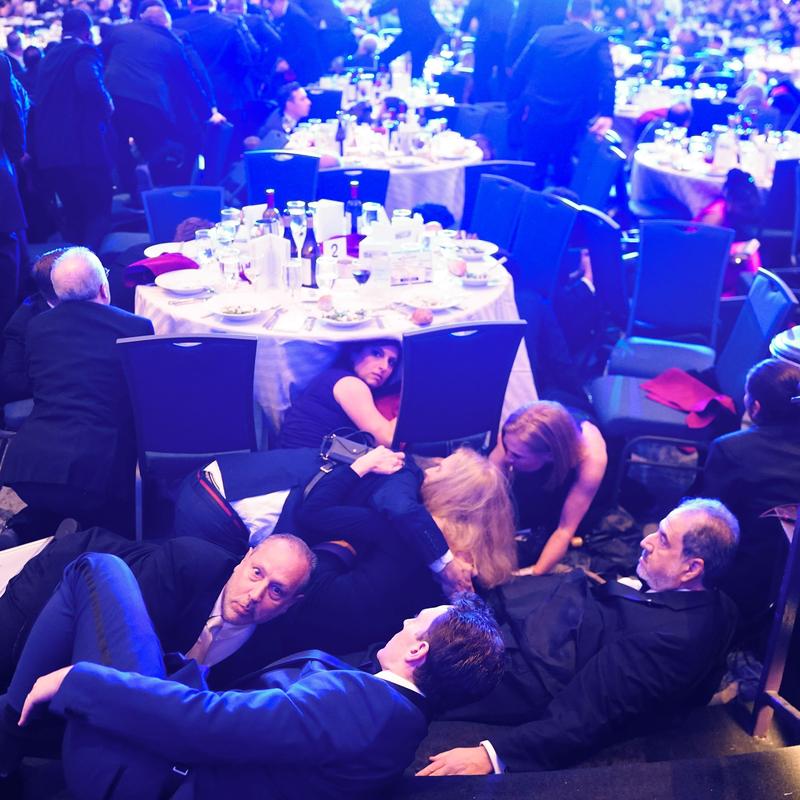
I'll tell you, Brian, I'm having memories come back to me that I blacked out in the moment. As the hours go on, it's starting to come back to me in my mind. I recognize, and I'm trying to be self-aware about that traumatic stress, but I also want to be self-aware that there are kids in schools who've gone through this and had much worse ordeals. There are people who get locked down every day in this country, either because there's an active shooter or more often because there's a fear of an active shooter. That's really what happened in DC. It was a fear of an active shooter, fear of something terrible about to happen.
Thankfully, this man was disarmed before he was able to enact a mass murder. I think us in the press, we need to make sure we're clear-eyed that this kind of thing is all too common in communities all across our country.
Brian Lehrer: Yes, it's a great perspective to have. Yet there are additional implications, which I know you acknowledge of attempts to assassinate the president or judges or other public officials. Because in addition to the danger, in addition to the PTSD that you cited, in addition to the possible underlying issues of all kinds in mass shootings, mental illness, epidemic bullying, epidemic unavailability, everything, an assassination attempt is an assault against democracy, and that's its own very important aspect, right?
Brian Stelter: Yes. There's something that stands out about this versus the other attempts on Trump, and that is that J.D. vance and Pete Hegseth and Marco Rubio, and all these other figures were also in the room. In fact, I was shaking hands with House Speaker Mike Johnson. It must have been two, maybe three minutes before this all happened. He's number two in the line of succession. Chuck Grassley was not there. He's the next in line. If the worst had happened inside that ballroom, then you actually were thinking about line of succession issues because of this particular event and because of the way it was all gathered in the ballroom.
Brian, as it comes back to me, I've had multiple memories of what it was like in those about-- It was about two minutes, maybe three minutes when everybody was on the floor and Trump officials were being escorted out of the room. One of the memories is that you had security officials jumping, leaping over the chairs, trying to get to Trump administration officials. That created this own kind of fear of being trampled, of a stampede, of an overreaction. You also had Secret Service officials armed with heavy weapons, pointing those weapons out to the crowd, looking for a threat, looking for any assailants.
There's a dozen different ways where this could have gone horribly wrong, where there's a dozen different ways this could have become a huge tragedy. I think that's why it's still so top of mind this morning, on top of, as I said, those succession issues. Can I add one more detail? For about half an hour, the White House press pool did not know if the President was okay. He very well could have been hurt while he was being evacuated from the room. There's just all of those what-ifs that are still top of mind this morning.
Brian Lehrer: I heard a report or an allegation that after the incident, either the White House or somebody coordinated a MAGA social media response. Then there were all these social media posts that say, "See, this is why we need an East Room ballroom in the White House," defending that action of Trump that's been pretty unpopular. Have you reported on that at all as anything coordinated?
Brian Stelter: It certainly looked like a coordinated effort on social media. When I say coordinated, I don't want to overstate it. I think it's very possible and quite common that you have political operatives working together in a chat room, whether it's a text chain or a Twitter DM group chat, where they're all talking about something, all having the same idea, all wanting to share the same opinion. When we say coordinated, it may be coordinated in that kind of loose way where everybody's in the same chat room having the same thought, wanting to spread the same message. That definitely happens. It looked like it happened on Saturday night, and we saw certainly on Sunday, the White House and the DOJ did push aggressively. Renew that push. Promoting Trump's ballroom.
Trump's ballroom is not really relevant to this conversation, though, because the White House Correspondents' Association would never choose to hold an event like this at the White House.
Brian Lehrer: Why not?
Brian Stelter: The point of the dinner is that Trump or whoever's the president is the guest of honor. The idea is never to have it at the White House. The thing Trump is trying to build is much smaller than the ballroom that would be needed to hold this press dinner. It's not just journalists in the room on Saturday night. It's college students, it's advertisers, it's corporate lobbyists, it's politicians. You can love it, you can hate it, but it's a very big event that would not fit inside Trump's ballroom. Yes, I think there has been an effort to promote Trump's ballroom as a result, but it's not really relevant.
Brian, there are also all sorts of unfortunate conspiracy theories that are spreading on social media. People on the far left imagine that this was staged to help Trump. I just want to tell you, as someone who's been to a lot of these dinners, there's no way that could have happened. There's no way that would happen. This was not staged.
Brian Lehrer: CNN chief media correspondent Brian Stelter is with us for another few minutes. He was among those in the ballroom at the Washington Hilton when a gunman, apparently bent on killing multiple members of the Trump administration, tried to shoot his way in at the White House Correspondent's Dinner on Saturday night, transitioning to the event itself. Here's Trump on 60 Minutes last night after the incident, referring to his attendance at all at a White House Correspondents' Dinner for the first time as president after skipping it previously in both his terms.
President Trump: This time I went, and I felt really good being there. There was a great camaraderie. I wasn't sure what the response-- It was a lot of press, a lot of media. When I walked in, I got a very nice applause. I wasn't sure. I told my wife, I said, "I may walk in and they may give me a hard time or I may walk in-- Let's see what happens." I walked in and got very nice-- I think they were happy to see me there, actually."
Brian Lehrer: Trump on 60 Minutes. Brian, how would you describe, from the press corps point of view and as someone who covers the media as your beat, how this came about and how the correspondents felt about mingling socially with him like that, when I think it's accurate to say most of them think he's trying to destroy or weaken freedom of the press?
Brian Stelter: There were very, very mixed feelings. You had people ahead of time saying they were practicing their resting face because they didn't want to be seen on camera either laughing or frown during the president's speech. There was an expectation that, yes, he was going to lay in on the press and wage his verbal attacks. Karoline Leavitt told me in advance, that's basically exactly what the president was planning. There was a point of view, especially expressed by Weijia Jiang, this year's president of the association, that it was worth trying to repair the strained relations between the president and the press.
At least from the press corps leadership perspective, let's try to repair relations. Jiang has said maybe that was naive of her, but she wanted to try. I understand why she wanted to try. I think the reality, Brian, is that nothing's going to change the dynamic because the president wants attention, but he does not want accountability. The press is going to continue to try to hold him accountable. A few days ago, Paramount, the parent company of CBS, which is trying to buy CNN and the rest of Warner Brothers Discovery, Paramount, held a fancy special secret dinner for President Trump.
It was a private dinner. The president spoke at the dinner, and it was viewed as controversial because Paramount right now is lobbying the Trump administration to get approval to buy CNN. That dinner happened on Thursday. Then on Sunday, Paramount, CBS had that interview with President Trump that you just aired. Norah O'Donnell asked him tough questions, and he bristled at the questions. He didn't like being questioned. He called her all sorts of names. What did he say? He said, "You're a disgrace." To me, that basically sums up the dynamic.
The parent companies can try to schmooze the president, journalists can try to repair the relationship, but he's always going to bristle when he's asked hard questions. He's never going to want to be held accountable. The relationship is always going to be this way. The push and pull is always going to be this way because we're going to have to keep asking him questions and keep reporting on what he's doing.
Brian Lehrer: You feel safe saying that with the prospect of Paramount buying your company?
Brian Stelter: I do. I do. I absolutely do. I think the fact that CBS aired that interview shows that they are doing their jobs just as the folks at CNN are doing our jobs. At the end of the day, Brian, despite all these pressures on the American press, there are journalists in so many other countries that wish they lived here, that wished they lived with the First Amendment, that wish they had the protections that we have today. I am blessed that I was able to be there in Washington, cover this crazy event, report on it, and understand. I know the dinner is controversial.
I know a lot of folks think journalists shouldn't be there in the first place. That's a fair opinion and worth having the debate. We're lucky we're able to be there. We're lucky to be able to report on this president freely, without fear, and lucky that we have those First Amendment protections.
Brian Lehrer: What was the event supposed to be like Saturday night? I see this dinner wasn't going to have a comedian, as it usually does, but rather an entertainer called a mentalist. People were anticipating a speech from Trump denouncing the White House press corps. Why even do this from the correspondent's point of view? What was this supposed to go like?
Brian Stelter: I think from the association's point of view, this is a tradition that dates back 100 years. The president's always showed up until Trump. Trump is the only one that's ever boycotted. This was an attempt to get back to normal. I mentioned Weijia Jiang. She was attempting a sense of normalcy and a repair of the relationship. Not booking a comedian was controversial. They booked a different kind of entertainer, probably trying to appeal to the president. Look, that's more about Trump than about us. Trump is thin-skinned. I think almost everybody would agree with that. He doesn't want to be roasted by a comedian. That speaks more about him than about anybody else.
Ultimately, I think people were actually interested in seeing what was going to go down. Journalists are using their First Amendment rights every day to comment on Trump. Trump is certainly allowed and entitled to comment on us, and so he does that all the time. Like I said, he's back to form now. He was quite respectful of the press corps on Saturday night, but by Sunday, he was back to insulting Norah O'Donnell. We know that. That's not new or novel at this point. We know who the president is. We know what he does. We also know that most Americans see through it.
I don't know if you've noticed the polls lately, Brian. I know you have. The president is trending down toward record low approval once again. I think what that tells me is that the American people are reading, and watching, and listening to the news. They're still understanding what's going on despite the president's attempts to lie and smear about the press.
Brian Lehrer: It's being rescheduled now for a later date, this dinner, right? A makeup. You'll all try again?
Brian Stelter: Well, that's what they say. Well, that's what the president says. The president says he wants to have a redo. He wants this to go on again in the next 30 days. I'll tell you, Brian, I think there's a lot of skepticism about that. There's a lot of doubts in the press corps that that could happen or that should happen. There's a lot of people who, frankly, don't want to show up for another one. I think the traumatic stress of this event is real. I think it's taking time for it to sink in among people who were there. I think, again, in that way, these media elites and lobbyists and advertisers, they're not so different from all the other people who have lived through one of these emergency settings.
By the way, if there's any silver lining, maybe it's that corporate CEOs who were there, Trump administration officials who were there, news anchormen who were there, maybe they now know a little bit of what it's like for those school children, and for those synagogue attendees, and for those mall shoppers who suddenly hear an alarm, or hear a siren, or hear a loud noise and have to evacuate and have to fear for their lives. I know that for me as a journalist, I'm going to take away that experience and that feeling, and I'm going to bring that inside me and try to remember what that felt like when I'm covering the next mass shooting in America.
Brian Lehrer: Nice way to bring it back to your original point. I want to ask you one last question. Trump, with Norah O'Donnell last night, blamed this to some degree on what he calls hate speech from Democrats and the press. He himself has a long history of adding to this environment, which certainly goes both ways. There's been political violence from the right. There's been political violence from the left in recent years. He tried to, when we think about some examples, pin the blame for the murder of Rob Reiner on Rob Reiner himself, because he criticized Trump a lot. He said he was glad Robert Mueller was dead. He called the January 6 riot a day of love and pardon the perpetrators.
We can go back to his 2016 campaign when he said this. Here's a clip about Hillary Clinton, if she was elected, appointing judges who the voters don't get to elect and who gun rights advocates oppose.
President Trump: If she gets to pick her judges, nothing you can do, folks, although the Second Amendment people, maybe there is. I don't know.
Brian Lehrer: There's been all that for 10 years. I could go on to other examples. Should he be getting asked about that in the context of this incident, even though he was a target?
Brian Stelter: Yes, I think that's fair. I think that we're going to go through another First Amendment stress test in this country in the next few days because folks on the far right are blaming the press for inciting violence, blaming the press for causing this suspect to show up in DC. I mentioned far-left conspiracy theories about this as well. I view this as another one of those stress tests that we've been through in the past year and three months since Trump returned to power.
Thankfully, in all of these tests so far, free speech has prevailed. Trump has threatened protesters, he's attacked the No Kings movement ahead of time. He's done all of those things that have put pressure, that have tested our free speech rights. Yet every time, the First Amendment has prevailed. What's that old saying, Brian? It's the First Amendment for a reason. It comes first for a reason?
Brian Lehrer: Yes. Brian Stelter, CNN chief media correspondent, thank you for some time today. We appreciate it a lot, especially as you described, you're still experiencing some emotional fallout from Saturday night. Thank you very much.
Brian Stelter: Thank you.
Copyright © 2026 New York Public Radio. All rights reserved. Visit our website terms of use at www.wnyc.org for further information.
New York Public Radio transcripts are created on a rush deadline, often by contractors. This text may not be in its final form and may be updated or revised in the future. Accuracy and availability may vary. The authoritative record of New York Public Radio’s programming is the audio record.
