
When Politicians Curse
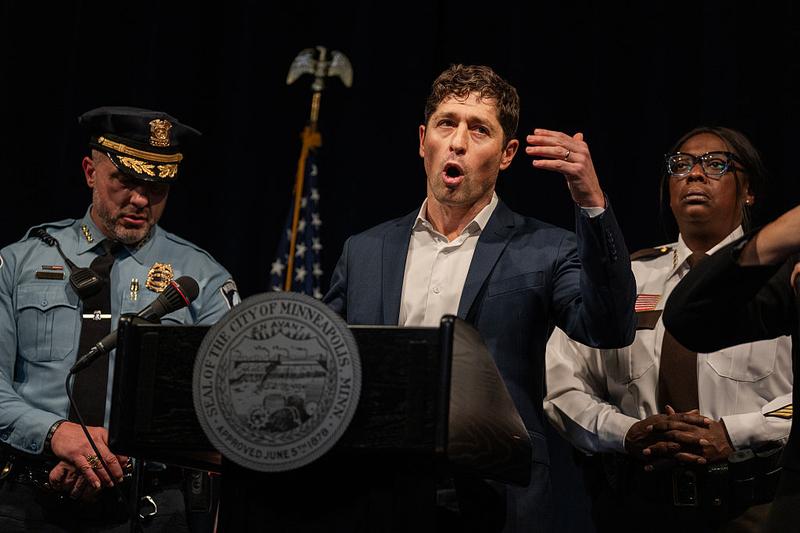
( Richard Tsong-Taatarii/The Minnesota Star Tribune via Getty Images / Getty Images )
Brigid Bergin: It's The Brian Lehrer Show on WNYC. I'm Brigid Bergin, filling in for Brian today. To end the show today, we turn to profanity, specifically profanity in politics. Back in January of 2018, President Donald Trump, while discussing immigration protections for people from Haiti, El Salvador, and African nations with a bipartisan group of senators in the Oval Office, referred to those nations as asshole countries.
It seems as though there's been an increasing use of swear words among politicians on both sides of the aisle ever since. Back in October, The Atlantic's Tom Nichols wrote about the recent use of curse words coming from Senator Chuck Schumer and Representative Marjorie Taylor Greene over the fight for health care, but there are many more recent examples of politicians using profanity. On Wednesday, President Trump raised his middle finger and appeared to direct profanity toward a Michigan auto plant worker who criticized him. Last week, in response to the fatal shooting of Renee Good by an ICE officer, the Minneapolis mayor, Jacob Frey, had this to say.
Jacob Frey: To ICE, get the f*** out of Minneapolis.
Brigid Bergin: Tom Nichols is a staff writer at The Atlantic and a contributor to the Atlantic Daily Newsletter, professor emeritus of national Security affairs at the US Naval War College, and an instructor at the Harvard Extension School. In an article in October, he wrote, "Elected officials cursing is a spreading epidemic, and it has to stop." He joins us now to discuss. Tom, welcome back to WNYC.
Tom Nichols: Great to be back. Thanks for having me.
Brigid Bergin: Listeners, when do you think it's appropriate for politicians to use profanity, if ever, in your opinion? Maybe you feel some situations call for a show of force, and a well-chosen expletive is appropriate. Maybe it depends on who the profanity is directed at. Other government officials, maybe governmental agencies is fine, but so called punching down is not so fine. Maybe like Tom Nichols in his piece wrote, "You think politicians just don't quite do it right. It's a little too awkward."
We'll invite you to weigh in now, but with one really big caveat. WNYC is regulated by the FCC, and as such, we definitely cannot use these words on air. Let's talk about the idea of profanity without using profanity. Thank you. The number 212-433-WNYC. That's 212-433-9692. You can also text that number. Tom, so you write presidents historically have shown more decorum than the common folk in Congress, but not Trump. The president is the most effortlessly vulgar of the bunch when he swears. Someone who has covered politics for a while, just how different is President Trump's use of profanity compared to past presidents?
Tom Nichols: Oh, he's in a class by himself because I think, in part, sometimes he does it on purpose. I just want to say, by the way, to your listeners, in my personal life, I swear like a sailor. This is not because I am a prude. I grew up in a working-class family in a factory town, and I've really had to try to learn not to swear as I got older. This isn't that it offends my delicacy. I just think it's bad for the country. I think it's bad for our public discourse.
I think when I talked about how it's done so poorly, I think a lot of politicians who do this do it because they're trying to sound authentic or they're trying to sound like the common folk, and it just comes across as crass and awkward. Presidents in general hold themselves to a higher standard than just about anybody else in public life, and Donald Trump doesn't. He holds himself to no standard in public life on anything, whether it's accepting gifts, or criticizing other people, or saying terrible things. Swearing is just one of the many places where he does that.
It doesn't mean that the rest of the country has to follow suit about this because it's going to sound like, I'm going to say, won't someone think of the children? Politicians can still be role models, and maybe we ought to just be swearing less in public life in general, and politicians can be the place to start.
Brigid Bergin: I think some people, in fact, Tom, are thinking of the children. I'm going to go to Janet in Crown Heights, who I think wants to make that very point. Janet, you're on WNYC.
Janet: Good morning. I grew up in a working-class family from the 1950s Black family, and my mother always raised me not to curse because you make your point. Whatever people are saying, they're not making their point. What is your point? Again, I'm concerned about children, too. I want people, as we say, to five-year-olds, use your words, and tell me what is your ideas and how you're going to make it better. I don't want to go down Trump's road in any kind of way. Thank you.
Brigid Bergin: Janet, thanks for your call and your perspective. Tom, some pushback just in the idea of the acceptance, I think, of profanity writ large, but certainly profanity from the president seems unacceptable to Janet. Part of what-- Go ahead.
Tom Nichols: I just want to say that it loses its impact. Look, everybody knows the cathartic and relief of hauling off a really good swear when you're upset, but if you do it all day, then you're not swearing. That's just how you talk. You mentioned the mayor of Minneapolis the other moment. That was one case where I thought that was appropriate. I got it. He was upset. He was in that moment, and he was really enraged.
I think if people were swearing less in public life, his use of the F-bomb probably would have had even more impact because we don't hear it every day, and we would have been shocked by it, and we would have said, "What? What is going on there that has led a public official and the mayor of a great American city to actually talk this way?" I totally agree with your caller, it's not just teaching people to use their words, but that in those rare moments where maybe you should swear, that's losing its impact because everybody swears now.
Brigid Bergin: Let's talk about that for a little bit, Tom. In an article, you cited a 2015 study that suggested swearing may actually be a sign of intelligence. What political scenarios do you think swearing might make someone sound smarter? Does it depend on who's delivering whatever the letter bomb it is in that moment?
Tom Nichols: [chuckles] I love the idea that swearing is a sign of intelligence because then apparently I'm a genius. I think the talent is to know when not to swear. I don't think there's ever a time in public life where swearing makes you sound smarter. I think the point of the article was that intelligent people sometimes cycle through curses when they're upset or stub their toe or whatever, a little more often than other folks. I think the most effective thing in public life is not to swear.
One example I always think of was years ago, an American soldier was killed in Berlin by the Soviets, and Ronald Reagan was doing a press conference. He was clearly livid, and he caught himself. They said, "What are you thinking, Mr. President?" He stopped himself. He said, "You don't want to know what I'm thinking." I thought that was a lot better than calling the Soviets a B-word or an F-word or whatever went through his head. It may be that intelligent people swear more, but politically adept people swear less.
Brigid Bergin: Let's try Rachel in Nyack. Rachel, you're on WNYC.
Rachel: Hi. Thank you for taking my call. My thing is, I personally feel like the conversation is a couple of things. One is most people are not comfortable with adults cursing in front of kids, in front of children. Politicians are supposed to be upstanding adults for children to look up to. I believe that once Trump started with the asshole countries and being so demeaning about people, not just even with swear words, but the way that he would talk and use condescending terms like the R-word and things like that, and people say, "Oh, but he's just being a regular guy. That's what makes him so great. He's one of us."
Then it comes down to, "Okay. Is it okay for all of us adults to be like that in front of children? Do we now say that we all talk like that and that's how we are examples for kids, that way it's okay?" That's my thing.
Brigid Bergin: Rachel, thank you for that call and that point. Tom, I want to give you a chance to respond, but I want to sneak one more caller in before we do. Let me go to Eve in Manhattan. Eve, you're on WNYC.
Eve: Hi there. I just wanted to say that Donald Trump has opened the floodgates on so many inappropriate things. When he does it, when he drops the F-bomb or when he gives somebody the finger, it's crass. There's no question about that because of where it's coming from. When somebody like the mayor of Minneapolis does it, it has legitimacy, and I agree that this is where we have to make a distinction on who the cursor is rather than just the curse itself.
Brigid Bergin: Eve, thanks for that. Tom, any response to those differing takes on it?
Tom Nichols: Yes. I totally agree with your last caller. Look, if someone has just been shot by federal troops in your city for being at a protest and you explode with anger, that's a lot different than, say, Chuck Schumer saying, "This bill is BS," or "Their arguments are BS." If you're a leader in the Senate, you can come up with a better criticism of Bill than BS. With your previous caller, I think, made a great point about, "Well, he's one of us." Here's the thing. I don't want the president to be one of us. I want the president to be better than us. I want the president to be a model of behavior for the rest of us.
Every president is a very flawed person. They did terrible things in their personal life. I would not want anybody to raise their children, their sons, to be like Jack Kennedy. On the other hand, President Kennedy, President Nixon, who swore-- Nixon was a Navy man, swore like crazy. They understood that in their public life that they had to carry themselves with a certain kind of deportment that was just important.
It's a small thing, and I'm sure there are people listening, saying, "With all the trouble in the world, we're going to worry about this." Maybe just worry about one small thing while we're working on the big things to say maybe presidents shouldn't take their personal life and act out whether it's how they feel about women or whether they swear or whether they drink too much or whatever it is that maybe they ought to encourage us to be better than we usually are because they lead a country of 350 million people.
Brigid Bergin: Tom, I intro this segment with a warning to our listeners that we have to comply with FCC regulations on profanity. Even that clip we played, we had to bleep the full content. Most outlets, you don't tend to edit the president's words, otherwise it can be seen as cherry picking or taking them out of context. Just with your journalist hat on, how do you balance reporting on profanity?
Tom Nichols: I have always said that because I think that Donald Trump has gotten a pass too often from everyone in the media who tries to report on him as if he is a normal person. He is many things, but he is not a normal person. He's certainly not a normal president. I would never bleep him. I think when the president goes to a rally or gives a rambling press conference that networks ought to put it on live, unedited, uncensored, and let people get the full Donald Trump experience, because I think in a way, he has been protected from some of the consequences of the way he talks by careful editing and selective quoting.
He goes to a rally and goes off about sharks and electricity and swearing and drowning, and the headlines is, you find the one thing where he says, "I'm not going to put a tax on tips." That's true, but there was an hour and a half of really awful stuff before that. I don't think you should edit him.
Brigid Bergin: We're going to leave it for there today. My guest has been Tom Nichols, a staff writer at the Atlantic, contributor at Atlantic Daily Newsletter, professor emeritus of national security affairs at the US Naval War College, and an instructor at the Harvard Extension School. His article, back in October, is titled Politicians Aren't Cool Enough to Curse This Much seems just as relevant now. Thanks so much for coming on, Tom.
Tom Nichols: Thank you for having me.
Brigid Bergin: I'm Brigid Bergin. That's it for The Brian Lehrer Show today. Stay tuned for All Of It. Happy Friday.
Copyright © 2026 New York Public Radio. All rights reserved. Visit our website terms of use at www.wnyc.org for further information.
New York Public Radio transcripts are created on a rush deadline, often by contractors. This text may not be in its final form and may be updated or revised in the future. Accuracy and availability may vary. The authoritative record of New York Public Radio’s programming is the audio record.
