What We Want From Our Pro Athletes
( Alessandro Bremec/NurPhoto via Getty Images / Getty Images )
Title: What We Want From Our Pro Athletes
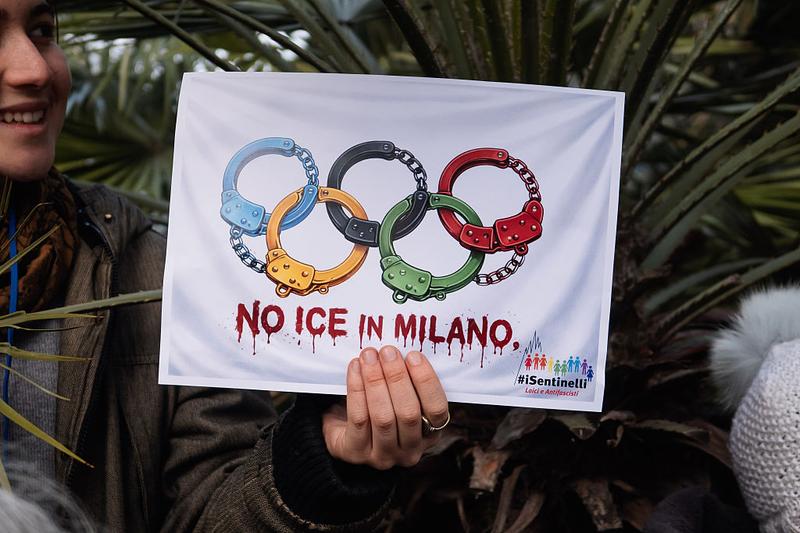
Brigid Bergin: It's The Brian Lehrer Show on WNYC. I'm Brigid Bergin, filling in for Brian today. It's a big weekend for sports fans with Super Bowl Sunday and the Winter Olympics officially beginning today in Milan, but the vibes in this country and around the world are a bit off this year. The headline in POLITICO yesterday sums it up pretty well: Trump's geopolitical tensions spill into the Winter Olympics. Beating the Americans will feel even sweeter for the US's top allies. In the not-too-distant past, athletes were some of the loudest voices in politics.
Take LeBron James calling Donald Trump a bum in a 2017 tweet, or Colin Kaepernick's bent knee in the 2016 NFL season. It seems like athletes are more cautious this time around, for better or worse. Maybe it's for the best. Let our athletes focus on their own job and allow fans to tune out of politics for a bit when sitting down to watch the game. Maybe tuning out of politics is dangerous at this moment in our country's history. What do we expect of our athletes to say now? That's the question staff writer Louisa Thomas poses in her latest column of The Sporting Scene for The New Yorker. She joins us now to talk about it. Hey Louisa, welcome to WNYC.
Louisa: Thanks for having me.
Brigid Bergin: Listeners, I'll pose the question to you right away. What do you want athletes to say during this political moment in our nation's history? Do you want them to say nothing at all? Were you ever impacted by the activism of an athlete? Do you see sports as political or as an escape from reality? You can call or text us at 212-433-WNYC, that's 212-433-9692.
Louisa, your piece starts with a look at last Sunday's basketball game between the Minnesota Timberwolves and the Golden State Warriors. The Timberwolves had just lost 111 to 85, and the team's young star, Anthony Edwards, spoke to the press about the bad vibes. Take us to that press conference. What caused the team to be off their game, and what did Edwards say?
Louisa: He was sitting in the locker room talking to the press, as is customary, after games. It had been pretty apparent that something was off with the team, and everyone really knew what it was because the game had actually been delayed. This is two weeks ago. This is the same day that Alex Pretti was killed in Minneapolis. There had been a game scheduled that night, and the NBA moved it to Sunday. That Sunday, the Timberwolves played terribly, and Edwards dismissed the idea that they were tired. He was given the opportunity to offer a message to the people of Minneapolis, and what he said was, "I love Minneapolis, basically. I'm behind whatever they with," is the way he put it.
He said, "I don't really have social media, and I'm not in tune with everything. I've heard about the stuff going on," and that he and his family were praying for everyone. That was taken a number of different ways. Some people saw that as a really kind of heartwarming statement of support, and some people saw that as a kind of abdication of his duty to denounce the killings as murder, which some other athletes and some other people in the sports world had.
What struck me was that it was really not considered very newsworthy because, for much of my time writing about sports, we had taken it for granted that sports are inherently political, and there had been a pendulum shift after 2020, in which sports have retreated into a more apolitical space. I'm now struck as there is so much tension roiling this country where athletes stand now. I wanted to investigate that question a little bit.
Brigid Bergin: We have a caller who has one perspective. Jesse, in Staten Island, you're on WNYC.
Jesse: Hi. I just want the athletes to play, not to voice their political opinion. People come to see their skills, not their point of view.
Brigid Bergin: Jesse, thanks for that perspective. Louisa, I think that kind of goes to what you were looking to investigate in your reporting. There was mixed feelings about Edwards' statement, and then a string of controversies that Edwards found himself in. You wrote, "He's not the person to look to for civic leadership or discussion of federal policies." Using Edwards as an example, why have fans across the political spectrum soured on the idea of athletes having an obligation to use their platform to talk about political and social issues?
Louisa: I think a lot of people feel inundated with bad news, to be honest. They've always seen sports as a kind of space for them to relax, for them to have trivial arguments that seem to matter immensely to them, but are insulated from the rest of the world. I've gone on my own journey about this, I have to say, and I understand that better than I used to, maybe. I understand the desire for an escape, the desire for a space that is free from the trials and the tribulations of the world and the strife.
Also, I'm aware that a lot of athletes live in the world, as we all do, and that politics have never been out of sports entirely. When people feel something or believe something passionately and they're asked about it, or even if they're not asked about it, some people feel a duty to speak out. In this case, a lot of people saw this as maybe not even a political issue. When someone is killed, it doesn't necessarily have to be a policy question.
Brigid Bergin: Let's go to Debbie in Huntington, who I think has a different point of view on the role of athletes and their perspectives. Debbie, you're on WNYC.
Debbie: Hi. Thank you for taking my call. My opinion is that everybody should speak out. I think we're in a very serious situation, and it doesn't matter to me who speaks out. I just think everybody needs to. That's it.
Brigid Bergin: Debbie, thanks for your call. Louisa, going back to what happened in Minneapolis, not everyone stayed silent about the killings there. There were athletes who spoke up. Can you talk about who spoke up, what they said, and what's significant about the people who did choose to speak versus those who didn't?
Louisa: I think it's significant that a lot of the athletes who spoke up are basketball players, but the NBA has generally been overall progressive, but also a little bit more outspoken, and that there are a number of factors for that, one being that it's a game more of individual stars than a sport like football, for instance. It tends to be because, for all sorts of reasons, including racial makeup, the league, a history of activism, there's a little bit more of a tradition of speaking out.
Players like Victor Wembanyama or Larry Nance Jr. or Steph Curry, Steve Kerr, there is a pretty solid list of athletes who spoke up, were an interesting moment. You mentioned the Winter Olympics and how athletes from other countries are going to take special pleasure perhaps in beating the United States because of the shifts in the geopolitics. Olympics have at several points in history been a platform for dissent among Americans, and a number of athletes are from Minnesota. In fact, I think it's the highest concentration of athletes among any states.
A number of them have spoken out about what's happening in Minnesota, but there is a balance for many of them between speaking out and talking about what they stand for and what this country should stand for and the more direct protests, let's say, on the medal stand. There are rules against that, and I think that a lot of athletes are wrestling with themselves about how to balance their desire to do the best they can, perform the best they can, which obviously means blocking out some of these distractions insofar as they're distractions.
For others, seeing them not as distractions, but as critically important things, as the last caller said, that are going on and can't be ignored. I think that different athletes are coming at this from different places, but that as the Olympics goes on, I'm going to be curious to see how much we are hearing about politics. Part of that will depend on what's happening here and how loud it gets.
Brigid Bergin: A listener texts, "Most of us regular people don't have a voice, so I think it's extremely important for anyone who has a voice to use it. However, Colin Kaepernick never recovered, so I 100% understand the hesitation they may feel. Is it worth their career?" Louisa, can you speak to that? That the risks for some of these athletes, certainly Colin Kaepernick is a prime example.
Louisa: There are different kinds of risks. Yes, Colin Kaepernick never did come back. For some of these athletes, it is a big risk. For some of these athletes, it's a, in some sense, even bigger risk because not everybody has the kind of financial earnings that Kaepernick had, which is not to say that what he did was risk-free or easy in any sense. For a winter Olympian, for instance, a lot of them are driving Uber and waiting tables or whatever, just to fund their dream, and so they're trying to make what money they can.
I think that there was a time where it was less risky. There was a time where you were getting statements about the protests and Black Lives Matter movements and everything from large corporations, and that gave probably athletes a certain kind of permission to speak out, maybe even a compulsion. That doesn't really exist anymore. I think every athlete is weighing their appetite for risk. Also, every athlete is speaking to different audiences, and it's coming from a different place. There's a lot of diversity viewpoint, a lot of athletes are not progressives, and maybe are not as troubled as the votes are.
Brigid Bergin: You do note that the women's basketball players tend to wade more directly into political matters. A listener texted, "This is why I love women's basketball. You don't see Natasha Cloud or Breanna Stewart shrinking away from politics. They're much more vulnerable considering their meager pay and LGBTQ identities." Why do you think the gender divide exists? Do you think there's a gender divide when it comes to these issues?
Louisa: When I mentioned the tradition of activism in the NBA, it's so much stronger in the WNBA. It's almost part and parcel with the league's identity. This is a league that organized to oust an owner, the Atlanta Dreams Kelly Loeffler, who is a Trump supporter. I think that there is partly a tradition of activism because I've had one WNBA player tell me that to be a female professional athlete, especially a queer female professional athlete, is to be inherently an activist. You have to be.
Your existence in some ways is a kind of a repose to the dominant social order. I think that there's a little bit of that, an understanding that you have to fight for what you believe, the rights you have, and the rights you should have. With that might come a more generous view of fighting for other people's rights as well. It doesn't always work that way, but I do think that part of the league's sense of itself, and importantly, a large part of the league's audience, there's a great understanding and willingness and support for that kind of activism.
Brigid Bergin: We're going to leave it there for today. My guest is Louisa Thomas, staff writer at The New Yorker, who writes the weekly column, The Sporting Scene. Louisa, you have a lot of sporting scenes to consume this coming weekend.
Louisa: It's a busy time.
Brigid Bergin: Thanks so much for joining us and making some time for us. The Brian Lehrer Show's producers are Lisa Allison, Mary Croke, Amina Srna, Carl Boisrond, Esperanza Rosenbaum. Our interim producer is Sasha Linden Cohen. Megan Ryan is the head of live radio. Shayna Sengstock and Milton Ruiz are at the studio controls. I'm Brigid Bergin. That's it for The Brian Lehrer Show today. Happy Friday. Stay tuned for All Of It.
Copyright © 2026 New York Public Radio. All rights reserved. Visit our website terms of use at www.wnyc.org for further information.
New York Public Radio transcripts are created on a rush deadline, often by contractors. This text may not be in its final form and may be updated or revised in the future. Accuracy and availability may vary. The authoritative record of New York Public Radio’s programming is the audio record.