
What to Know About TrumpRx
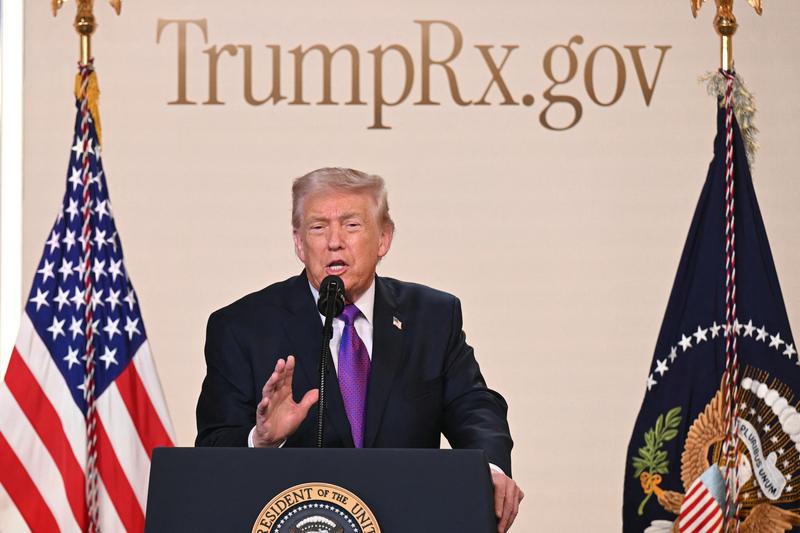
( SAUL LOEB / AFP / Getty Images )
[music]
Brian Lehrer: It's The Brian Lehrer Show on WNYC. Good morning, everyone. On today's show, we'll welcome New York City's acting Sanitation Commissioner Javier Lojan. So many New Yorkers have complained about garbage piling up on the streets since the big snow and ice storm, and in some cases complained about how the snow was cleared as well, and maybe even about how some of your neighbors are not doing their part to keep things as cleaned-out as possible. We'll hear the commissioner's explanation and discuss what comes next as the big melt inevitably begins. Also, the new mayor of Jersey City, James Solomon, today, after the outgoing mayor, Steve Fulop, yesterday.
All Of It, producer Jordan Lauf introduces the new Get Lit with All Of It newsletter. It's a newsletter for book lovers. That'll be a fun segment. This will include a reveal of the upcoming Get Lit with All Of It group reads that you'll be able to join in on.
We start here. One of the biggest issues for the midterm elections will be the affordability of healthcare. You'll remember that the government shutdown late last year was largely over the Democrats wanting to continue those extended subsidies for Affordable Care Act or Obamacare insurance policies, while the Republicans wanted the subsidies to end. The Republicans won that issue, remember, meaning the disputed subsidies expired. Now, government data released in late January indicates the number of Americans insured through Obamacare has dropped by more than a million people.
Wth healthcare costs looming as a midterms issue that seems to favor Democrats, President Trump last week announced a new program aimed at helping some people pay less for prescription drugs. The program is called—what else?—TrumpRx. It's for people who do not have insurance.
President Trump: This is a very big deal. People are going to save a lot of money and be healthy.
Brian Lehrer: Well, how true is that claim? Let's take a look at TrumpRx with a leading healthcare reporter who will explain and answer your questions about who can save money through the program and who can't. We welcome Chelsea Cirruzzo, Washington reporter at the health news website, STAT. She previously wrote POLITICO's daily health policy newsletter. Maybe we'll touch on some other health policy news as well, like Trump appointee Dr. Mehmet Oz now saying everyone should get the measles vaccine as outbreaks increase around the country, but the head of their vaccine advisory committee, questioning even the polio vaccine now.
Chelsea, thanks for coming on. Welcome back to WNYC.
Chelsea Cirruzzo: Thank you so much for having me.
Brian Lehrer: Can we start with how big a problem prescription drugs' affordability is? I saw Dr. Oz on CNN the other day, say a third of Americans, or 3 out of 10 Americans—almost a third—decline to buy medications they've been prescribed when they get to the counter and see the cost. That comes from a Kaiser Family Foundation survey, so that's a mainstream number. Do you have demographics on that? Like, who's foregoing their prescriptions because of cost? Only people who are uninsured? Do they concentrate geographically, by race, gender, or anything else?
Chelsea Cirruzzo: That's a great question. I don't have numbers in front of me, but I can say it is certainly true that everybody is subject to the high cost of drugs, even if you have insurance. Certainly, it's a problem that, like you said, anybody, any voter could empathize with and understand that high drug prices certainly impact their lives.
Brian Lehrer: Right. Dr. Oz said in that CNN interview that Americans pay three times as much for the same prescription drugs as people in Europe do. I see that number comes from a RAND Corporation study, so again, it's a mainstream number. TrumpRx sets prices for 43 specific medications. The president singled out some for emphasis in his rollout announcement.
President Trump: For example, you will see dramatic reductions in the cost of popular weight loss drugs known as GLP-1s.
Brian Lehrer: They're setting the prices based on what patients in other countries currently pay compared to Americans here.
President Trump: Under the Most Favored Nation agreements, my administration has negotiated the United States will pay the lowest price paid by any other country. We're taking the lowest price paid for drugs. We will pay equal to the lowest price anywhere in the world. That's the price that you're going to be paying.
Brian Lehrer: Chelsea, help us understand what that means. Build on those two clips. I see you've compared what GLP drugs like Wegovy and others cost now for cash-paying customers—customers not using insurance—and what the TrumpRx price will be. Can you share some of that comparison?
Chelsea Cirruzzo: Yes, of course. My colleagues and I compared the prices on TrumpRx to other websites like GoodRx and Mark Cuban's Cost Plus, which offer similar coupons or discounts on drugs. It's worth noting that none of these websites directly sell drugs; they just direct you towards a coupon or a way of getting the drug cheaper if you pay through cash, which means not paying through insurance.
Now, of course, it does include these GLP-1-s like Zepbound and Wegovy. Like that clip just noted, that's notable because President Trump has promised to lower the costs on these drugs. Those makers, Novo Nordisk and Eli Lilly, are actually already selling those drugs at a discount. Now, when we did look at this analysis, it didn't necessarily lower prices as much as the president was saying. Like I said, you can find lower prices on GoodRx or Mark Cuban's website because you could be looking at generics. It's separate from the brand-name drug. It's sort of the same drug, but it can be cheaper.
An example here, Chantix by Pfizer, which treats smoking cessation, you can get it on TrumpRx for a little under $95, but the generic on GoodRx was around $37, and on Cost Plus, it was around $15. We found about 22 drugs on the TrumpRx website do have a generic available that you can get for cheaper.
Brian Lehrer: The most extreme example I see on your site is for the heart arrhythmia drug, Tikosyn, $672 on TrumpRx, $9 for the generic version on the website, Cost Plus. Why does TrumpRx only help pay for name-brand drugs if the generics are so commonly used and cost less?
Chelsea Cirruzzo: This was all part of a deal that the White House struck with 16 pharmaceutical companies. We know that President Trump loves to make a deal. He made these agreements with these pharmaceutical companies to list their brand drug prices on the website. GoodRx, Cost Plus, they have different models, and they can offer the generics. That isn't to say, of course, they aren't involved. I will note that GoodRx told us that they are partnered with the Trump administration to help bring their price integration over onto TrumpRx. Still, they do offer lower prices on their own website.
Brian Lehrer: There's a critique on The Atlantic magazine website by one of the writers today that says the big winners for TrumpRx are actually the pharmaceutical companies, largely because they get a lot of good press for engaging in this deal with Trump to lower some of the prices. I don't know if you, as a reporter, can critique that critique, but does that ring true to you, if you can say?
Chelsea Cirruzzo: Here's what I can say. Earlier, there was a clip where President Trump talked about Most Favored Nation, which is his plan to make drug costs lower in the US than they are abroad, because they are lower abroad already. To do that, he's brought in a lot of pharmaceutical companies into the White House. They've struck deals. In exchange, those companies have gotten tariff reductions, or they've been immune from certain things. They've gotten a lot of attention. They're standing in the Oval Office with the president, talking about their products. I can certainly say that that likely helps them. That probably feels pretty good. It's not a bad deal for the pharmaceutical companies.
Brian Lehrer: Listeners, do you have a question about TrumpRx or a question or comment on anything related to the economics or politics of healthcare affordability, more generally, for you personally or as a midterm elections issue? Remember, part of our frame here, in addition to just giving you the information about TrumpRx, if it happens to help you with your prescriptions, there is the political context of Trump and the Republicans generally trying to play some catch-up on healthcare as a policy issue for the midterms. 212-433-WNYC, 212-433-9692. You can call or you can text.
We're going to get to how this affects pharmacists in a minute, and pharmacies. There may be a reality that the Trump administration is actually laying some of this subsidy on your local drugstore. We're going to play a clip about that and get to that. Pharmacists, welcome to call in, 212-433-WNYC, in addition to anyone else. Questions, comments, stories: 212-433-9692 on TrumpRx and related issues with our guest from STAT. Is this only for people who are uninsured only?
Chelsea Cirruzzo: Yes. Well, these are all cash prices, so that means you're looking at the price that you will get if you're not using insurance. Of course, if you have insurance, you could use this site and just buy a drug using cash and not using your insurance, but it doesn't really show you how much the drug would cost you if you use your insurance, and also if you're on federal healthcare programs. Some of these drugs don't include people on Medicare, which is for people over the age of 65, and people on Medicaid, which is, people below a certain income threshold. It's really limited in who can accurately use this tool to figure out what a drug will cost them.
Brian Lehrer: People can't use TrumpRx to cover their copays or deductibles if they have insurance?
Chelsea Cirruzzo: No. Again, all of this is consumer-driven. We're going to talk about this more, of course, with the pharmacies. It's really about what you, as the consumer, are willing to pay. Your insurance is completely separate. If you want this drug and it costs a lot of money with your insurance, sure, you could go outside of your insurance and try to buy it just using cash. That is when you might use a site like TrumpRx or GoodRx.
Brian Lehrer: If you're insured, but you said if you're insured by Medicare or Medicaid, you can't, right?
Chelsea Cirruzzo: Yes, you cannot.
Brian Lehrer: Maybe that would never come up in real life anyway. If you have Medicare or Medicaid, would TrumpRx ever be cheaper?
Chelsea Cirruzzo: Something else we're watching here is Medicare drug price negotiations. That's a separate, actually a Biden-era law that was passed that makes drug companies negotiate down the prices of drugs for people on Medicare specifically. Now, I will say Republicans, including the Trump administration, have been quite critical of that plan. They've tried to overturn it. I will just say that the difference here compared to TrumpRx is Medicare negotiation is a law that, no matter the administration, they do have to follow it. Therefore, we will certainly see those Medicare drugs negotiated down. Whereas these deals President Trump is cutting are voluntary. It's really not clear what happens to the price of these drugs once he leaves office or if this no longer becomes a priority for him.
Brian Lehrer: I'll follow up. I'm interested in this topic. The ability of Medicare for the first time under Biden's Inflation Reduction Act, to be able to negotiate price. That's, of course, for so many millions of Americans, so that's a big group with a lot of negotiating power to negotiate price with the pharmaceutical companies. I read this morning on the Stanford University Medicine website, where it says, for the first 10 drugs selected for negotiation, Medicare is projected to save $6 billion in 2026 alone, a 22% reduction in spending across these 10 medications. Does that get passed on to the consumer?
Chelsea Cirruzzo: It depends. It's hard to say because this is so new. We'll have to wait and see where pharmaceutical companies move around their profits. Of course, we've seen this happen all the time when health policy moves to cut prices, companies or providers have to shift the way they're making money. They might hike up prices in other areas to make up the difference. It's still worth seeing. The one thing I will note, and you alluded to it here, is that the Medicare price negotiation law focuses specifically on the drugs that cost Medicare the most money. These are very, very expensive drugs, so it really does make a difference to negotiate them down. Whereas the drugs we're looking at on TrumpRx tend to be more focused on GLP-1s, fertility. That's not to say these aren't expensive drugs; they are, but the drug price negotiations are really focused on driving down those very high-cost drugs.
Brian Lehrer: As you said, Republicans have generally opposed Medicare being allowed to negotiate prices. I see that just last month, Democrats released a critique of what they deride as the Republicans' big, ugly bill. Trump calls it the big, beautiful bill from last year. The Democrats' critique says, "The bill created a loophole that allows manufacturers of some of the most expensive drugs in the world to avoid negotiating fair prices for seniors. Without this loophole, Keytruda and Opdivo, two costly cancer drugs, would have likely been on the list for negotiation this year." From the Democrats' critique. Why are Republicans trying to weaken that Medicare negotiating power?
Chelsea Cirruzzo: I had to ask my colleagues, Daniel and John, about this since they cover this a lot more closely. They told me that the GOP has always been critical of the IRA drug negotiations. I think at this point that they really largely stopped trying to overturn the provision that was very popular early on when the IRA passed. Instead, Trump is trying to convince Republicans to pass his plan on the Hill, which could end up actually creating stronger government control than the IRA did. Republicans are still pretty skeptical of that plan, so it's sort of a stalemate here, what the president wants versus how the Hill feels, given their feelings about Medicare drug price negotiation.
Brian Lehrer: Listener writes: "Medicaid will not cover GLP-1-s, so how can someone on Medicaid get the TrumpRx?" Listener writes: "This is important." [chuckles] I guess maybe it's important to them if they're on Medicaid. Is that correct, to your knowledge, that Medicaid does not cover GLP-1-s? But you said people on Medicaid cannot take advantage of TrumpRx.
Chelsea Cirruzzo: It depends on what the GLP-1 is being used for. State Medicaid plans do need to cover the FDA-approved GLP-1 drugs for type 2 diabetes, but they don't have to cover the weight loss drugs. That is certainly true, also depending on what state you live in. Yes, if you did want to use TrumpRx to purchase one of these drugs or to find a cheaper price, you wouldn't be looking through your Medicaid pricing. Of course, since Medicaid doesn't cover it for weight loss, you don't even have that option anyway. You would have to pay through cash, so you'd have to pay directly from your own savings and not from your insurance.
Brian Lehrer: Another listener writes: "Yes, you can be on a Medicare drug plan and get a lower price with GoodRx. With each prescription you fill, you can compare the price under your Medicare plan to the price using a coupon." I don't know if that includes TrumpRx, which has a relationship with GoodRx, but does that ring true to you?
Chelsea Cirruzzo: Yes, absolutely. Honestly, that's a better explanation than I had. That's true, yes. If you are on insurance, say you're on Medicare, you want to get a certain drug, you see how much the drug costs on Medicare, you can still go on GoodRx and TrumpRx and see how much the drug would cost if you did not use Medicare. Again, paying your own money, your own cash. That, in some cases, could be lower than using Medicare.
Brian Lehrer: One more like that. Listener writes: "I don't buy into Medicare Part D"—that's the prescription drug part of Medicare—"so if I don't buy into Medicare Part D, can I use TrumpRx?"
Chelsea Cirruzzo: Yes, certainly. Again, it's not as though if you have insurance, you can't go on the website, forget it; you can, but you just need to understand that whatever insurance you have does not apply to the prices you're seeing. Those prices are as if you are uninsured, or if you are uninsured, that's the reality. Just know that you cannot apply your insurance to the prices you're seeing.
Brian Lehrer: Here's Debbie in Lower Manhattan, who I think has an anecdote about the cost of something here compared to in Europe. Debbie, you're on WNYC. Thank you for calling in.
Debbie: Oh, hi. Thanks for having me. I just wanted to say that right before the holidays, I got a prescription for a face cream for an autoimmune skin condition, so not something banal. I went to pick it up, and they said, "Your insurance,"—which, by the way, I now pay twice as much for as I did before the holidays—"they're rejecting this. They're not permitting you to get it. You can just pay out of pocket," he said very calmly. I was disappointed, but I was like, "Okay, I just really need this stuff." $750. I just left, obviously, without it, and feeling really pushed around and bullied that I need this stuff and can't get it. Anyway, long story short, I went to Paris over the holidays and I was able to walk into a pharmacy and get it for $99 just willy-nilly like that.
Brian Lehrer: Well, if you can't get a good face cream in Paris, where can you get one? I'm kidding. $99 compared to $750, Chelsea, that's quite a comparison. Does that fit into a pattern that you're aware of? I've made a joke about face cream, but it's a prescription drug. Where does this fit into the US versus Europe pricing?
Chelsea Cirruzzo: Exactly. This is exactly why President Trump has pushed most favored nation, which is his policy to bring the drug prices down comparable or lower than European prices because that is just an experience across the board that Europe and other parts of the world are paying a lot less for these drugs than we are. The deals that President Trump is striking with the pharmaceutical companies is to get them to agree to lower their prices to be comparable to those in European countries or even lower. Of course, that remains to be seen. Some of these deals are still ongoing, we're still waiting to hear more details. That experience is exactly where I believe the president is coming from when he talks about most favored nations.
Brian Lehrer: Here's something that we just looked up with respect to what you can use when-- This is from-- Let's see. Is this the New York State Department of Health website? Yes. This is for people on Medicare and Medicaid in New York State. That's a particular population. If you're in that population, listen up. It says: "If enrollees do not participate in a Medicare prescription drug plan, they may lose all their Medicaid benefits. However, some people on Medicare and Medicaid may receive a letter from their employer or union stating if they enroll in Medicare Part D, they will lose the healthcare benefits provided by the union or employer. If an enrollee has received this letter, they may disenroll from the Medicare prescription drug program by calling 1-800-MEDICARE."
Now that I've thoroughly confused you even more than you were confused a minute ago, at least you know that there are some moving parts. If you're in any situation that sounds like it might be that, check with your employer, check with your union, check with your doctor. I want to bring up this issue for pharmacies that might potentially lead many not to participate in TrumpRx pricing. Here's a clip from a report on the FOX station in Huntsville, Alabama that I came across today, FOX54, Huntsville, Alabama, about a disconnect that could leave pharmacies paying for the subsidy rather than the government.
FOX54: While patients may pay as little as $199 for medications like Ozempic, pharmacies still have to purchase these drugs at their regular wholesale cost, which can be more than $1,000. Association representatives say pharmacies don't yet know where that difference will come from, leaving many hesitant to participate until more details emerge.
Brian Lehrer: Are you familiar, Chelsea, with that issue, or if the government is resolving it in any way? Because this is supposed to be a reduction in price not being borne by pharmacies?
Chelsea Cirruzzo: I can say a little bit about that. It comes back to what I said earlier, that the government is pushing towards consumer-driven healthcare. You are purchasing a drug through a direct-to-consumer model as opposed to going to your pharmacy. What that means is you go online, and you buy the drug, versus going to CVS or going wherever your local pharmacy is and working with the pharmacist to figure out how to get it. I can say that this is certainly something that HHS Secretary Robert F. Kennedy, Jr. is very interested in. I heard him speak yesterday at the Heritage Foundation. He talked a lot about making it more possible for consumers to decide for themselves which drug they want, if they want to do this certain service. It's really about shifting not just the costs, but also the information, the decision-making onto the consumer when it comes to their healthcare.
When it comes to pharmacists, of course, it still remains to be seen. Again, it just shifts the focus away from them and certainly creates this price competition for them that they are competing with these direct-to-consumer avenues as opposed to before.
Brian Lehrer: When we come back from a break, I want to pull back the lens and look at where TrumpRx fits into the larger picture of healthcare inflation in the United States and what each party beyond TrumpRx is proposing in this run-up to the midterm election, since healthcare looks like it's going to be a very salient issue. Listeners, you can call in on that as well with our guest from STAT News, Chelsea Cirruzzo. 212-433-WNYC, 212-433-9692. Chelsea, a Washington reporter at the health news website STAT, who previously wrote POLITICO's daily health policy newsletter, she's all over this health policy beat. We'll continue with her in a sec.
[music]
Brian Lehrer: Brian Lehrer on WNYC as we continue for a little bit more on TrumpRx, which was introduced last week for a better price for some people on some prescription drugs. Pulling back now to the larger question of healthcare as an issue in the midterm elections with Chelsea Cirruzzo, Washington reporter for the health news site STAT News. What are some of the big factors, if you can say, driving up healthcare costs overall, and how significant is pharmaceutical inflation as a factor in that?
Chelsea Cirruzzo: I can't say exactly percentages or what each one is contributing, but it is a lot of factors. Drug prices, of course, the ACA subsidies did end last year, and that means people's premiums went up, so people are just paying a lot more money for healthcare. On top of that, when we have more people who are uninsured—and you said this at the top of the hour—fewer people are signing up for health insurance, given higher premiums. When you have more people that are uninsured, the way hospitalizations, if there's an accident that happens, uninsured costs are very high on providers. You have somebody who comes in and can't necessarily pay for the care that they're receiving. Of course, hospitals do have to provide that care. It's a combination of factors: of the drug prices, the premiums, and the uninsured rate.
Brian Lehrer: The numbers I'm seeing for Obamacare enrollment after the extended subsidies expired are that it's down this year by 1.2 million people compared to last year. That's actually a lot less than the 10 million or more losing insurance that many people predicted. Have you reported on those numbers and what they reflect?
Chelsea Cirruzzo: Yes, just a little bit. We have noticed that it's far less than what was expected. Of course, advocates for the subsidies say this still matters, that people losing insurance drives up costs across the board. Again, those who said that these concerns were overblown certainly have pointed to those numbers to say, "Listen, it didn't drop as much as we were expecting."
Brian Lehrer: Since TrumpRx is for the uninsured, can we say that it's aimed politically at those Americans losing Obamacare because of the Republican defeat of the extended subsidies to mollify what might be their anger or alienation in the midterms?
Chelsea Cirruzzo: Certainly, it's all part of a political calculus by the president. He wants to say that he is driving down healthcare costs. Of course, his opponents will say that's incongruent with efforts that he's made to end the subsidies, efforts by GOP lawmakers to disenroll people from Medicaid or to restrict the number of people that can be on federal healthcare programs. For the president, saying I have TrumpRx, saying I've made these deals, again, comes back to that consumer-driven market that they're trying to promote here, that you, as the consumer, can find lower prices, you, as the consumer, will be able to pay less for your healthcare through the deals that we have made.
Whereas when you look at the insurance market, people are still paying very high premiums, high cost for drugs. Again, that's not to say that being uninsured is the move here. It's hard to say. Again, if you are uninsured, that does drive up health costs if you have to go to the hospital or you are in need of an emergency procedure.
Brian Lehrer: Here's one other question from a listener before we go to the kind of big-picture question of what the Democrats and Republicans are proposing in the run-up to the midterms. Karen in Manhattan has a question that probably applies to a lot of people about how she shopped for a better price for prescription drugs. Karen, you're on WNYC. Thanks for calling.
Karen: Yes, hi.
Brian Lehrer: Hi.
Karen: Can you hear me? Hi.
Brian Lehrer: Yes, we got you.
Karen: There are many expensive prescriptions that offer copays that aren't available to people who are on Medicare, Medicaid, or other government programs. They are cheaper on places like GoodRx, which I guess is the same thing as TrumpRx, but I found them to be even cheaper at Canadian pharmacies online. For example, I have a medication that costs over $600 at retail. I'm not eligible for any copays. It's $250 approximately if I use GoodRx, but I can get it for less than $125 if I use a Canadian pharmacy that's certified. Is that legal, and what do you think about that?
Brian Lehrer: Chelsea?
Chelsea Cirruzzo: I can't comment necessarily on if it's legal. If you're able to get it through legit means, I'm sure that's fine. It comes back to what I was saying earlier. Other countries are paying far less for drugs than we are. That is something that the Trump administration has really focused on with their Most Favored Nations policy, lowering those prices. That said, as you just demonstrated, has that panned out quite yet? No. As you were saying, the drug was far cheaper at a Canadian pharmacy than a US one. Their messaging is, "We're going to lower the prices down from these other countries," but in reality, it doesn't quite look like that.
Brian Lehrer: If prescription drugs and other healthcare costs, including health insurance, are going to be an issue in the midterms, can we say that the Trump administration or the Republicans, let's say as a party running in the midterms, or do Democrats have bigger-picture plans to rein in these costs?
Chelsea Cirruzzo: I think both parties would say that they have big plans to rein in the costs because we can say the blame game here is particularly strong. Each side is saying the other side is responsible for driving up prices. It is really an important messaging war as we approach the midterms, because there is a consensus that the government needs to step in and lower healthcare prices. Where they differ is in how they want to do that. GOP legislation has focused a lot on market solutions, targeting middlemen known as PBMs (Pharmacy Benefit Managers), which is a whole other complicated part of the healthcare system that we don't need to get into. They argue that they drive up drug prices, so they want to rein them in.
Whereas the Democrats want to focus on strengthening Medicare price negotiation, basically strengthening the government's power in driving down these prices versus putting controls on the market, if that makes any sense. I'm sure we've confused everybody here. Just know that it is a huge war between both sides.
Brian Lehrer: Here's a big-picture question from a listener. Several are writing in with versions of this. Very simple. "This is just another smokescreen"—writing about TrumpRx— "designed to pull the wool over Americans' eyes and avoid the real issue. We should have free universal healthcare." Even the Democrats are not running on that, right?
Chelsea Cirruzzo: That's true. Not at this time. That was certainly true for some people years ago when I first started covering healthcare, but not so much. One thing I will say, based on our analysis is, we found that the TrumpRx does not lower prices as much as the president says it does. We found that half of them are actually available as generics for far less. Knowing that, going into that with that knowledge, I think, is really crucial.
Brian Lehrer: Here's a physician calling in. Jane in Brooklyn, you're on WNYC. Hi, Jane.
Jane: Hi. Can you hear me?
Brian Lehrer: Yes, we hear you.
Jane: Hi. I work in a major academic medical center. I'm a physician. My son was recently diagnosed with a chronic medical condition that requires a specialty medication. We started on it in December, and then our insurance changed the pharmacy benefits from Express Scripts to Carillon, and Carillon refused to pay for the medications. We've been dealing with fighting and appealing and appealing. In the meantime, in order to avoid abrupt discontinuation of the medication, I've been looking into what the out-of-pocket costs would be for this medication. Even with manufacturer patient assistance program, it would be about $22,000 a year cash.
Brian Lehrer: Whoa.
Jane: The one [unintelligible 00:36:21] that the pharmacy paid for before they switched over was $13,000 that the pharmacy paid. With the patient assistance, it would be about $2,000 cash for me. I looked at GoodRx and all these other places to figure out what else I could do to get this medication for my child. It's thousands of dollars. It got to the point where I was able to get an emergency authorization to continue the medicine. The copay for the one month that I've so far filled was $3,817, just the copay.
It's actually cheaper to buy it cash with a patient assistance than to use the pharmacy copay benefit. Being a patient when I got one of the many denials from Carillon, and my patient actually is a retired police officer who cannot afford his specialty medication that I see him for his condition, buy from [unintelligible 00:37:35] Edia. I literally got this phone call, and I turned to him and said, "I may need your source to get my son's medication from [unintelligible 00:37:44] Edia."
Brian Lehrer: You're a doctor and you're having this kind of complicated problem getting coverage for your son's medication. Jane, let me ask you, as a physician, and having gone through this, or still going through it, I guess, do you have a structural solution to solve this? [silence] Jane, I'm asking you.
Jane: Do I? Oh, well, yes. Honestly, the answer is a single-payer system because at the end of the day, I have spent, I can't even tell you how many hours. Literally, almost every day on the phone for hours with various insurance people. It's a very obscure process. I'm a physician, I have health literacy. I do this for my patients, and I still am struggling. I haven't been able to resolve this problem on my own. I feel really bad. I've been reaching out to the physician who is prescribing this. It's very frustrating for them, too. We spend our time on the phone with all of these pharmacy people, all these insurance people. We don't get paid one red cent, and we still can't get the medications for our patients.
Honestly, what really needs to happen is to have a closed system where the cost of my time fighting with insurance is not borne by me as a physician. The patient isn't the one having to negotiate cost for medication directly, and the government, as the buyer of all the medications, has the ability to negotiate the cost on large scale. This is what other countries do, like many Latin American countries band together and negotiate for essential medications like [unintelligible 00:39:32], to come up with a cost for multiple countries that are buying in bulk.
Brian Lehrer: Dr. Jane, thank you very much for calling in and sharing your story and your views. That doctor is going to get almost the last word. Chelsea, I want to throw in one other thing off-topic because I know you cover vaccines a lot. Here is Dr. Oz from the Trump administration on CNN just the other day, surprising some people by saying everyone should be vaccinated against the measles.
Dr. Oz: Take the vaccine, please. We have a solution for a problem. Not all illnesses are equally dangerous, and not all people are equally susceptible to those illnesses, but measles is one you should get your vaccine.
Brian Lehrer: Chelsea, is this a change in position from what his boss, RFK Jr. has been saying? The setup to that, Dana Bash from CNN was talking about big outbreaks of measles in the country. I don't even think these are getting reported on so much. Maybe the media has become complacent about this, but because we heard about that outbreak in Texas a little while ago, she was citing an outbreak of more than 600 cases in South Carolina. I think hardly anybody knows. That was Dr. Oz's response to that. Is that a change in tune?
Chelsea Cirruzzo: I would say HHS probably would say no, but it does sound a lot different from what we've been hearing. Let me back up for a second. You alluded to it just now. Yes, the measles cases across the US have grown to alarming numbers. In fact, the US is in danger of losing its measles elimination status. A couple of weeks ago, my colleague Helen asked CDC if they were concerned about losing that status. The response was, "That is just the cost of doing business," and that they are not necessarily so concerned about it.
It is true, measles is on the rise in the US. I live in Washington, DC, there was just an alert that people in DC could have been exposed to measles because somebody who had it had recently traveled to the city, which is not something you expect to hear every day.
Now, Dr. Oz's comments, "You should take the vaccine," it comes after Secretary Kennedy has been wishy-washy on whether or not you should take the vaccine. He has said explicitly earlier last year, "Yes, take the vaccine. It is the best way to protect against measles." At the same time, he has cast doubt on the vaccine itself. He has referred to it as a leaky vaccine. He has caveated his statements by saying it's your choice. The reality is, vaccination, as Dr. Oz was saying, is the best tool to prevent measles. Kennedy has instead talked about unproven treatments like vitamin A to treat measles, at the same time as discussing the vaccine.
Brian Lehrer: All right. Our next debate show will have Dr. Oz on one side, his boss, RFK Jr. on the other.
Chelsea Cirruzzo: [chuckles]
Brian Lehrer: No, I don't think they'll come on for that. With that, we leave it with Chelsea Cirruzzo, Washington reporter at the health news website STAT. Thank you so much for all the information.
Chelsea Cirruzzo: Thank you so much.
Brian Lehrer: Brian Lehrer on WNYC. I know you want to talk to our next guest, New York City sanitation commissioner, on the cleanup and sometimes lack of garbage pickup since the snow. Stay with us.
Copyright © 2026 New York Public Radio. All rights reserved. Visit our website terms of use at www.wnyc.org for further information.
New York Public Radio transcripts are created on a rush deadline, often by contractors. This text may not be in its final form and may be updated or revised in the future. Accuracy and availability may vary. The authoritative record of New York Public Radio’s programming is the audio record.
