
What to Do About the Crumbling BQE
[MUSIC - Marden Hill: Hijack]
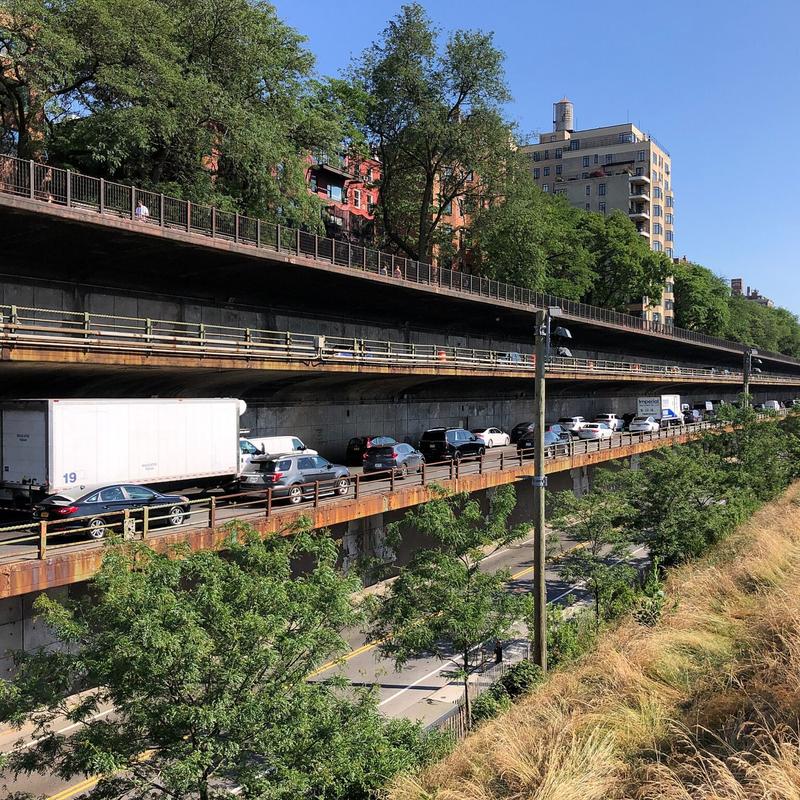
Brian Lehrer: Brian Lehrer on WNYC. All right, hold on to your steering wheels, folks. Now we're going to talk about the BQE. I think it's fair to say that for as long as anyone can remember, the Brooklyn-Queens Expressway has had problems, right? Major problems. Even non-drivers know this. It's loud, it's clogged, it carries far more traffic than it was built for, and parts of it are literally falling apart.
Despite decades of studies, emergency repairs, and big proposals from multiple mayoral administrations, there's been a kind of bureaucratic paralysis, you might call it. No matter who's in office, the city can't seem to land on or fund a permanent fix. What's the holdup? That's what we're going to spend the next few minutes talking about. For some context, the BQE was designed way back under Robert Moses, the infamous and controversial master builder of mid-20th-century New York, who designed practically every major city thoroughfare that you could think of and displaced a whole lot of people in the process.
Before that legacy was cemented, when the BQE was first unveiled, it was hailed as a feat of modern engineering in an increasingly car and truck-centric city. Here's a clip of then-Governor Thomas Dewey at the 1950 ribbon-cutting ceremony for the BQE.
Governor Thomas Dewey: Because this business is the business of making it possible for people who live in the city to move about in it without being choked to death by traffic. It's the difference between a chance to get food and vegetables and manufactured products in and out of the city fast, cheaply. In order to reduce the cost of living, these highways are essential. In order to make possible trips out of the city by the people who want to get away for weekends, these highways are essential. In order to make commuting traffic, which keeps the city growing and great, these highways are essential.
Brian Lehrer: How about that for a clip from the archives? Governor Thomas E. Dewey in 1950 at the ribbon-cutting ceremony for the BQE. Here we are a little over 75 years later, and there's no question that those highways are still essential, to use Governor Dewey's word, but they're also essentially on the brink of collapse, especially the triple cantilever section, as it's known of the BQE. Now, WNYC is hosting an event next Tuesday in The Greene Space. That'll be a conversation between Stephen Nessen, our great transportation reporter here at WNYC, and Gothamist and Ian Cross, the host of GBH's Peabody-winning podcast The Big Dig, which is about a big road project up in Boston.
They're going to be talking about the past, present, and future of the BQE with transportation expert Polly Trottenberg and community advocate Lara Birnback. Tickets are sold out already, but you can live-stream it when the time comes next Tuesday at wnyc.org/bqe. Bookmark that if you're interested in it, wnyc.org/bqe. Stephen and Ian join us now to preview the conversation. Stephen, hi. Always great to have you on the show. Ian, welcome to WNYC.
Stephen Nessen: Thanks for having me.
Ian Coss: Hey.
Brian Lehrer: Always great to partner with GBH folk. Stephen, first, you want to just tell the listeners why you're having a Greene Space public event about the BQE.
Stephen Nessen: Well, it might actually be more appropriate for Ian to discuss it because his amazing podcast, he can tell you about it. He's been taking it on the road. Ian, why don't you tell them about The Big Dig on the road?
Ian Coss: A couple of years ago, I did a podcast series about the notorious Boston highway project known as the Big Dig. As a follow-up to that, just over the years since, I continue to get emails from people about other highway projects in other cities, and I never knew how to respond to them. This year, we're doing a 10-city nationwide tour of live tapings that we call the Highway Teardown Tour, and basically taking this question on the road of what should American cities do with their old highways?
As you said at the top, this is a universal story. These highways through the middle of cities, they are aging out, they're crumbling, they're congested, they've all kinds of problem and the question is what to do with them. That's why I'm excited to be in New York talking about one of the granddaddy of those complicated highways, the BQE.
Brian Lehrer: I want to apologize and correct, I mispronounced your last name. I added an R. You are not Ian Cross, you are Ian Coss. C-O-S-S, right?
Ian Coss: Yes. As somebody wittily pointed out to me, that is my cross to bear.
Brian Lehrer: Your cross to bear. You're telling us, Ian, that as much as people in New York, especially in Brooklyn and Queens, think this is a particularly New York City thing, you're telling us it's not.
Ian Coss: Yes. There was this mid-century building spree in the '60s, '70s, when, just as that clip illustrated, there was this enthusiasm around urban highways as something that would connect the urban center to the suburbs, to the outlying areas. That would be an economic boom that would get rid of congestion. Virtually every American city built these big structures, often along the waterfront, often through underserved neighborhoods, often dividing neighborhoods from each other. That is the legacy that we're now reckoning with.
A lot of these structures, like I said, are aging out around the same time. They were built to last for 50 or 60 years, and now they're 60, 70 years old. Something has to be done. Doing nothing is not an option. You can see this in Detroit, you can see this in Seattle, you can see it in New Orleans, you can see it in Baltimore. It is everywhere.
Brian Lehrer: Stephen, you want to comment on that archive clip from the Governor Dewey ribbon-cutting? There it was 1950, and the way he's framing the advent of the BQE, I'm sure, made people almost drive off the road, if they were driving and listening right now, "Making it possible for people who live in the city to move about in it without being choked to death by traffic."
Stephen Nessen: From all accounts that I read, that didn't last very long. The traffic built up pretty quick. It really dovetails nicely with what Ian was saying, is Robert Moses, obviously, prior to the BQE, built his highways to Long Island. The BQE was really the final piece of his puzzle to connect those Long Island commuters so they could drive through Brooklyn to get to Manhattan. Like I was saying, almost immediately, traffic filled up, and it didn't work out quite as Dewey had envisioned.
Like Ian was saying, we really are stuck with this design today that, as you know, is constantly clogged with traffic, is well beyond its useful life, and now, just like those other cities, but maybe even more so because New York City is just so built up. It's just such a bedeviling problem for planners for New York City, but also for the state DOT, because they own part of it, the federal government owns a part of it. It's just such a complicated roadway. Like you were saying in the intro, it's like, what should we do with this? A lot of ideas have been floated, and there's some on the table right now that could be advanced. I think really the next two years are going to be quite crucial for making a decision on that.
Brian Lehrer: Listeners, you can weigh in on that question. What should we do with it? What should we do with the BQE? If you drive it, if you live in Brooklyn Heights or elsewhere along the route, what do you think the potential plan should be? How do you feel about potential plans that have been floated that you may have been aware of as part of the community of drivers or nearby residents? 212-433-WNYC, 212-433-9692, call or text. Do you think the city should restore what already exists or rethink the highway entirely?
You can also ask questions to our guests about what plans may be in the works and how those plans might affect residents. 212-433-WNYC. How does the BQE and how do the BQE's problems affect your life today? Tell everybody else. 212-433-WNYC, 433-9692. Stephen, under former Mayor de Blasio, the transportation department for the city warned, this is back in 2018, that without major intervention, the cantilever section of the BQE would collapse by 2026. It's 2026.
Stephen Nessen: Here we are.
Brian Lehrer: On a day-to-day basis, how risky is it?
Stephen Nessen: The DOT say of course, safety is paramount. They've got all kinds of sensors, they're monitoring it, and they've done a lot of work since then to shore up the roadway to make it safe. Any driver that tries to drive in the evening knows they're constantly doing work to repair different pieces, replace certain parts of the decking, and the steel. I think the biggest thing they did, which took a long time, actually, to implement, was these weight-in-motion sensors that basically ticket overweight trucks that are not supposed to be on that roadway.
That's gone a long way to preserving the roadway. They have also, folks know they reduced the lanes of traffic from three to two. Another method so that they're not putting too much weight on the triple cantilever section, which really is only 0.4 miles of this very long roadway, but it's the most sensitive. It's the one that they said was going to collapse by 2026 if we didn't do something. The DOT took us underneath the BQE at that point and showed us holes in the roadway, holes in the steel. They were really quite alarmed and wanted to push through a plan pretty quickly, and obviously, that fizzled under de Blasio.
Brian Lehrer: Talk about that, and then we're going to bring Ian in on this because he's got all this history from here and around the Country. Why did the plan fizzle? It seems like there is bureaucratic paralysis.
Stephen Nessen: I guess the problem was the DOT, led by Polly Trottenberg at that time, they basically put out two proposals. One was to put a temporary elevated roadway at the level of the promenade and then destroy the BQE beneath it and rebuild it, but folks in Brooklyn Heights-- hackles were raised. Of course, they don't want a highway at street level, where they live, all the pollution and everything that comes with that. That plan was completely destroyed.
The other suggestion was to close it down on weekends. A full lane closure 24 weekends over eight years. They believe that could have been done in that amount of time for $4 billion. Folks just found that would be too disruptive, so they went back to the drawing board. They came up with this panel. They came up with recommendations to extend the life of the BQE while they came up with a permanent plan. Under Adams, they put out this huge list of options. I think you may recall. We've spoken about it before. There's the cookie-cutter-- Excuse me, not cookie. The cake design, a wedding cake with all these different layers.
A bunch of those were floated, and that's where we are right now. Folks are still-- The city is preparing an environmental review for all those proposals. They're not going to say which one they want. Some of them would put the BQE even underground, Big Dig style, although I'm told that's not very popular or practical. There's a lot of considerations right now because now there's the Brooklyn Bridge park, which wasn't there when Robert Moses built the BQE. There's ball fields, and the MTA has a fan plant that really makes it difficult to work on the roadway because that needs to be preserved. It's a challenging situation over there.
Brian Lehrer: John in New Canaan, Connecticut, who used to live in Brooklyn Heights. Hi, John. You're on WNYC.
John: Hi, Brian. I apologize. I have a brain injury, so I stutter every once in a while.
Brian Lehrer: That's all right.
John: My comment was I agree that the BQE needs to be replaced. It needs to be replaced for 25 or 30 years. The metropolitan area is three times the size it was when it was built, and so the amount of traffic using it is-- I won't say, exponentially higher, but it's much, much greater than the planned maximum usage. The other thing is, we as Americans, and you can see this throughoutNew York City, you can see it throughout Connecticut, where I live now, is once we build things, infrastructure projects, we don't fund them, we don't fund their upkeep. We've built them, we've paid for it. That was historically the problem with BQE, with the Brooklyn Bridge, until they redid that. Things like that. We don't fund the upkeep, the maintenance that we really need to do.
Brian Lehrer: John, I'm going to leave it there for time, but thank you very much. I'll just say I'm really glad that, despite your stutter, you called up to talk on the radio. Keep it up. Alan in Brooklyn, you're on WNYC. Hello.
Alan: Good morning, Brian. Thank you. Before I was a lawyer, [inaudible 00:14:22] architecture. Although you learn the strength of materials at their peak, it's a little bit arrogant to think that we should be testing every material to the maximum stress capacity it has when it's new, knowing that the only reason we see Roman architecture surviving 2,000 years is that they never did this sort of thing. They didn't test materials that are meant to be in compression by putting them in tension and relying on the reinforcing bars and concrete to last more than a few decades.
Brian Lehrer: Alan, thank you very much. Combining those two callers, Ian, there's this historical tension that's probably important to talk about. Robert Moses could move fast because he centralized power and often sidelined community input. The result of that approach was often massive displacement and long-term harm. Today, there are environmental reviews, community boards, lawsuits, elected officials weighing in. As we've seen, with the population three times the size of what it was in 1950, according to the first caller, it's been really hard to get everyone on the same page and get a plan in motion.
Reporting on these kinds of things from around the country, how do you see that trade-off, and how do you weigh the importance of community buy-in and control when it's also contributing to a paralysis?
Ian Coss: Something I found really interesting in studying these highway removal debates in different cities is that you can see there are these coalitions that come together and then fracture around these issues where for example, there will be a camp of people who are really neighborhood focused, who are focused on the impact of the noise of the traffic on the people who live right next to it, but then there will also be more regional transit activists who are thinking more about how do we reduce the carbon impact, the climate impact of these roads, how do we shift the city towards a different kind of regional transit system.
On some issues, those two groups might align, and then on some issues they might divide. There are some business interests that will organize around supporting removing a highway, some that would oppose it. You get this very complicated shifting ground around these projects that can often lead, exactly as you said, to paralysis. In studying up on the history of the BQE, I was just reading a statement that Polly Trottenberg, who will be one of our guests next Tuesday, she put out at the time at one of these community events, saying, "Look, there is no solution that everyone's going to be happy with. There is no perfect solution to this. People will be unhappy."
That is the point that the decision-making process has to get to where somebody has the political will and political capital to say, "We have heard the various interests and desires around this, and I'm willing to push through with this decision knowing that there will be people unhappy with this, and I will take that heat." Obviously, that moment has not arrived yet, but I think it's good to be clear-eyed with these projects that there is no perfect solution that pleases everyone.
Brian Lehrer: Stephen, a few of the texts coming in. Listener writes, "For me, the BQE is like a large snake. I find it fascinating from a distance, but avoid any close contact at all costs." Another person asks why they built Brooklyn Bridge Park, before they resolve the problems with the cantilever. Do you have an answer to that question?
Stephen Nessen: I do not have an answer other than development continues and proceeds, whether the cantilever problem is solved or not. I think they just made it a little more complicated. The Brooklyn waterfront, I forgot exactly when, probably under Bloomberg, you could help me out there, was rezoned, and all those massive luxury buildings went up down there. It's really nice, and I think just not doing that park improvement, waiting for a BQE solution, folks weren't going to wait around for that.
Brian Lehrer: That is where we will leave it for today. My guests have been Stephen Nessen, our transportation reporter here at WNYC and Gothamist, and Ian Coss, a reporter for GBH who hosts the Peabody-winning podcast The Big Dig. They're going to be speaking about the BQE again next Tuesday. Again, if you want to immerse yourself in this and hear more, it's going to be at The Greene Space, WNYC's theater, with transportation expert and really relevant newsmaker to this story, Polly Trottenberg, because she was the transportation commissioner under Mayor de Blasio when some of the restructuring plans that have not been implemented were formed, and also community advocate Lara Birnback.
Tickets are sold out, but you'll be able to livestream it at wnyc.org/bqe. Is that seven o'clock, and do I have the right time next Tuesday?
Ian Coss: Yes, that's right.
Brian Lehrer: 7:00 PM at wnyc.org /bqe. Stephen, thanks. Ian, thanks for coming on the show.
Stephen Nessen: Thank you.
Ian Coss: Thanks, Brian.
Copyright © 2026 New York Public Radio. All rights reserved. Visit our website terms of use at www.wnyc.org for further information.
New York Public Radio transcripts are created on a rush deadline, often by contractors. This text may not be in its final form and may be updated or revised in the future. Accuracy and availability may vary. The authoritative record of New York Public Radio’s programming is the audio record.