
What Saks' Bankruptcy Filing Means for Shopping
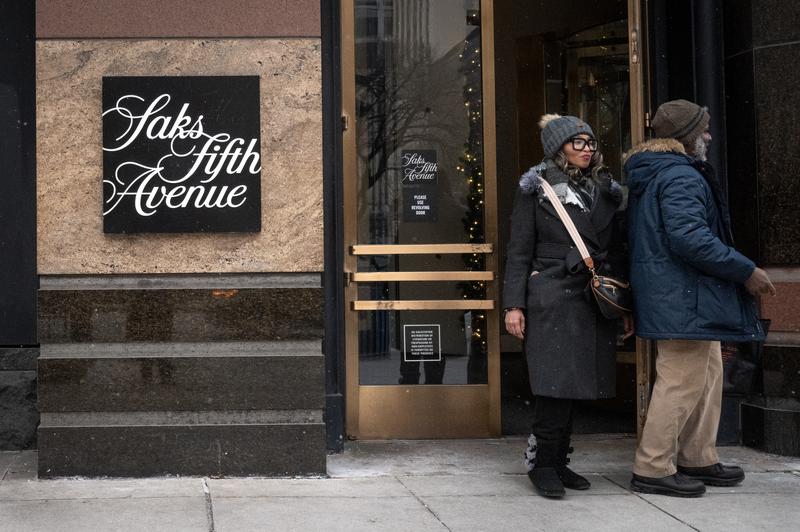
( Scott Olson / Getty Images )
[music]
David Furst: It's The Brian Lehrer Show on WNYC. Good morning, I'm David Furst, WNYC Weekend Edition host, filling in for Brian today. Another American retail icon has hit rock bottom. Last week, Saks Global, the parent company of Saks Fifth Avenue, Neiman Marcus, and Bergdorf Goodman, filed for Chapter 11 bankruptcy protection. This feels familiar, right?
In the last 10 years, New York City has lost so many of its department stores: Barneys, Lord & Taylor, Henri Bendel, Century 21, J.C. Penney, and, most recently, the Macy's in Downtown Brooklyn. Neiman Marcus also filed for Chapter 11 bankruptcy before it was acquired by Saks. With us now is Vanessa Friedman, fashion director and chief fashion critic of The New York Times, to explain why Saks is filing for bankruptcy, what it means for shoppers, and why so many department stores are crumbling in this new retail landscape. Vanessa, welcome back to WNYC.
Vanessa Friedman: Hi. David, nice to be with you.
David Furst: Before we ask about how Saks got to this point, is there going to be huge sales going on at Saks Fifth Avenue and Bergdorf Goodman?
Vanessa Friedman: [laughs]
David Furst: Are they liquidating assets and closing stores? What's happening?
Vanessa Friedman: Well, this is not a going-out-of-business sale; this is not a Barneys situation. It is most likely a shrinking of the Saks Neiman's footprint situation. There may be some stores that are going to have going-out-of-business sales, most likely a Saks Off Fifth. For anyone who was in New York over the holidays, they might recall The Saks off Fifth on, I believe, 57th Street closed, and there were big 85% off sales there. Depending on where you live in the country, you might get treated to bargains, but not everywhere.
David Furst: You said this is not a Barneys situation. Can you explain the difference between Chapter 11 bankruptcy and Chapter 7, which is what Barneys went through, right?
Vanessa Friedman: Right, Barneys went through Chapter 7. Chapter 11 allows a company to restructure its financial situation, its debt obligations under the protection of a court-approved process. In that situation, which is what we're talking about with Saks and Neiman's, there is a potential for, if we're talking about a retail group, them to get out of certain rental obligations, certain lease obligations that maybe weren't high-performing stores, without incurring a penalty.
They can renegotiate terms with the brands they owe money to. Right now, Saks and Neiman's owes a lot of money to a number of brands, many, many brands, because they've been very slow on their payments. Those brands may not recoup everything that's owed, but they will get different percentages of it. It's a way for the company to stay in business and get ready for better business, hopefully.
David Furst: Saks missed payments to the brands that they carry. With some of those really big-name luxury brands, I imagine they'll be okay dealing with that, but what about some of the smaller contemporary brands? Are they in a more precarious situation?
Vanessa Friedman: Absolutely. It's the smaller independent brands that are very dependent on department stores like Neiman Marcus, like Bergdorf Goodman, like Saks Fifth Avenue to serve as windows to the consumer, and discovery channels for the consumer; they're really in trouble. Saks currently, according to their bankruptcy filing, owes $136 million to Chanel, that sounds like a crazy big number, but Chanel is a multibillion-dollar business.
David Furst: That does sound like a crazy big number, though.
Vanessa Friedman: It's number one on the list of brands that will be called, I believe, critical brands. They will get paid at least probably 80% of that number back. They frankly can handle it. They're not the ones to be worried about. You have a tiny brand, and maybe they're only owed $50,000 or maybe at most $200,000, but that amount of money could be absolutely crucial for them being able to make their next collection, being able to finance their own business. They're way, way down the list of brands that are going to get repaid in the bankruptcy filing. For them, this could really be the end.
David Furst: Will shoppers still be able to find their favorite brands at Saks?
Vanessa Friedman: Depends on what their favorite brand is, really. If shoppers were going to Saks to find names they'd never heard of, tiny New York fashion brands that were springing up, or if they were going to Saks to discover new napkin makers, because they all have homeware sections, those brands may disappear, but the truth is probably fewer and fewer shoppers were in fact going to department stores for that kind of discovery experience.
David Furst: Trying to get all the names straight in my mind here. Didn't Saks just acquire Neiman Marcus in 2024?
Vanessa Friedman: They did.
David Furst: What was the idea behind that acquisition? Did that turn out to be a big mistake?
Vanessa Friedman: It did. Then the man behind this, a businessman who started life as a real estate developer named Richard Baker, had this idea, which he'd had for decades; he'd been trying. He bought Saks in, I believe, 2014, and he'd been trying to buy Neiman pretty much ever since. He had the idea that in this changed retail landscape, the only way for what is called multi-brand third-party retail to survive would be to combine all the high end department stores into one kind of behemoth group which would then be able to, rather than compete with each other, leverage their critical mass to make great deals with brands to get exclusives, to be the place, really the only place that consumers could go to, that customers could go to to buy the whole variety of brands they were interested in. It makes sense, right? It's a logical strategy. It didn't work this time for a variety of reasons.
David Furst: What are some of those reasons?
Vanessa Friedman: The chief reason I think really is the completely changed shopping habits of the American consumer. Between 2014 and now, if you think about it, e-tail really emerged as a strong force in people's lives. People started buying online. This was completely sent into hyperdrive during the pandemic when everyone was at home. Really, shopping behavior changed dramatically. You combine that with the fact that most luxury brands—because these are primarily high-end luxury department stores—most luxury brands now have their own stores pretty much all over across the country, which they did not use to have.
Used to be, certainly for European brands, the thinking was the department stores were the gateways to the American consumer because the country is so broad that it was hard to have a presence in every major city. That's no longer true. Right now, those brands all have direct relationships with their consumers either via their own retail presence or via online stores. Now they're competing with the stores that used to be their only means of access. Now they're shopping on social, right now they're social media shopping. There are all these different ways for people to encounter clothes, stuff. They're just a tiny little player in that now.
David Furst: I like how when you're talking about the emergence and taking over all of this online shopping, you call it not retail, but e-tail.
Vanessa Friedman: E-tail. [chuckles] There's Amazon, right? Amazon is the prime place for purely transactional shopping. If you just want to go in and buy something and make it as easy as possible, most people are getting that stuff off Amazon. That also puts further pressure on physical stores to give you something else, to be the place that you want to go because you want to feel stuff, and you want to experience it, and you want to have this kind of imaginative, immersive shopping moment. A lot of them weren't doing that; they were just warehouses for garments.
David Furst: This is The Brian Lehrer Show here on WNYC. If you're just joining us, we're talking about the Saks Group bankruptcy with Vanessa Friedman, fashion director and chief fashion critic of The New York Times. Listeners, if you'd like to join this discussion, give us your reactions to this news. Do you have any Saks memories? Do we have any Saks shoppers listening, maybe window shoppers listening in, or maybe Saks employees who want to share what the bankruptcy looks like from inside the house? Any brand owners waiting on a check from Saks? If you're a longtime patron of the department store, of any department store, what memories do you have associated with those stores? Give us a call, 212-433-9692. That's 212-433-WNYC. As we're talking about the changing nature of shopping, Vanessa, are people just shopping less in general?
Vanessa Friedman: I don't think they're shopping less; they're just shopping differently, and they're shopping in different places. I think they want different things out of a department store. In Europe, it's interesting, the department stores that are left have really become almost like tourist sites. Like urban monuments. They're in these incredible landmark buildings, but they really exist on their own, and they become destinations to go to to ogle the whole thing, as much as to actually buy something. Bergdorf Goodman does play that role a bit in New York. Saks Fifth Avenue, the flagship store, plays that role a bit in New York. Neiman Marcus in Dallas plays that role.
During the early part of this century, end of last century, these department store changes exploded across the country. They were in every mall. Often, a mall would have both a Saks and a Neiman's. They started to just seem very, very cookie-cutter. They kind of lost the point of view, which is one of the reasons you go to a store, right? They all buy slightly differently. You want to see like Barneys, what was super cool, what was New York cool like Bergdorf's, what was uptown society like? Once you lose that identity, there's less of a reason to go shop there.
David Furst: Well, you're starting to take us back in time to the golden age of department stores. I'm going to take your calls in just a moment. First, what role did these department stores play in making New York City a fashion capital of the world?
Vanessa Friedman: I think they sold the idea of New York, of New York sophistication, of New York chic to the world. They were the place you went to, to become that person that you dreamed of, that person that was in movies, the person that was in novels. It's not really an accident that Émile Zola wrote an entire book called The Ladies' Paradise, about the role of the department store, the purpose of the department store. Each one offered a slightly different version of who you might want to be. If you went to Neiman's in Dallas, you were going there to become this fabulous Texan society woman. If you were going to Saks New York, you were going to the New York version of that. It was a magical experience.
David Furst: Well, let's take some of your calls right now. If you'd like to join this conversation with Vanessa Friedman, fashion director, chief fashion critic of The New York Times, the number: 212-433-9692. Joe in Scarsdale, welcome to The Brian Lehrer Show.
Joe: Hi, David. Thank you very much. Vanessa, you're terrific. I am a bankruptcy lawyer. I represent vendors in Saks. There are some 2,500-plus vendors. The impact of this bankruptcy is monumental.
David Furst: Did you want to say any more about that? Or, Vanessa, maybe just respond to that notion that this is monumental?
Vanessa Friedman: I'd actually love to hear, Joe, if you have clients who are affected by this, what it means for them and where they're sitting on that list of money owed.
Joe: Sure. Yes, I have clients involved in this, as little as a couple hundred thousand to 10 million. The reality is the largest vendors here, the top 30 creditors on the Saks list who will likely be on the creditors committee, those are billion-dollar, what I call bohemths. I've posted extensively on LinkedIn about this. They're not going to be affected. They're going to stay in business. Yes, this is not good, it's not good for Chanel and others, but the reality is the little guys, some of them will be driven out of business.
The proposal right now is to provide some 300 million to take care of what they call critical vendors. The little guys are having a very difficult time getting on that list. It's absolutely abhorrent, it's disgusting. They aren't the ones that caused this. One of the things that Vanessa said that's so meaningful, I have so many clients who provide unique goods, and that's what makes Saks and Neiman's an interesting place. You can get Chanel anywhere; Chanel has their own stores. You can get Burberry, you can get plenty of good Vince, but you can't get some of these smaller vendors anywhere from Paris, from Turkey. The fact of the matter is, it's extremely meaningful for them to get paid. I am advocating for them to be paid in full for their past due amount.
David Furst: Vanessa, I'd like to have you respond to some of what Joe was just saying there. It's really some of what you were touching on earlier, that some of the little guys will be driven out of business.
Vanessa Friedman: I think there's a real question here that Joe has raised, which is, if you're a young creative, someone who's making new stuff, how you get your stuff seen. Department stores used to be absolutely the way you did it. You went to the department store, if they're lucky, you got to be part of the homeware floor, you got to be part of the young designers floor. That was the window that was the gateway to this consumer.
Someone, when I was reporting my stories on Saks with my colleagues, compared department stores to magazines. I actually thought that was a really good and pertinent idea because, similarly to magazines, magazines once upon a time were the doorkeeper between brands and consumers. Brands would have fashion shows, magazine editors would go and watch them, and they would decide how to package those clothes and how to tell a story around them, put it in the magazine, people would read the magazine and that's how we understood what was going to be trending, what we should go buy, what we should go look for in a department store.
Department stores were similarly this kind of flexing point between brands. They would go around, see what designers were doing, decide what to buy, then consumers would come to the store and discover it. That's no longer true because of this changed landscape. For big brands, as Joe said, it doesn't make a big difference; they have their own stores. For small brands, the question becomes how do you get seen? How do you get yourself in front of a consumer when not everyone is going to a Saks to find out? The answer probably has to do with social media and the way we communicate now.
Now that's not to say that's easy. It's complicated to create your own e-tail business, to do direct-to-consumer communications on TikTok, Instagram, or whatever. We're talking about all these millions of different platforms that now exist. It's probably where this is all going to.
David Furst: We have a lot of calls coming through right now. Let's try to move through some of your phone calls. 212-433-9692. Pamela in West Orange, New Jersey. Welcome.
Pamela: Thank you. I'm glad to be with you all.
David Furst: Are you a Saks customer?
Pamela: I am. I absolutely am devastated by this news. I am in my 50s, and I hate online shopping. I love going into the store and trying them on. I am a lover of old-school movies. The '50s, the pencil skirts, the elegance of-- [unintelligible 00:19:05] [crosstalk]
David Furst: Do you picture yourself in one of those movies when you're shopping there?
Pamela: Yes, yes. That's what it is for me. The other piece of this is, I am a plus-size woman, and shopping online does not work for me. Going into the store and having that full experience, and I was able to find fashionable clothes because I am a fashionista, I didn't know I was until I started going to Saks, and I said, "Oh my God, they have clothes for me here. They have different sizes for me here." I like pencil skirts and the elegance of the '50s, and they had those things for me in my size, and now, I don't know where I'm shopping.
David Furst: Wow. Some great comments. Thank you so much for joining this discussion. What about that? Vanessa, I'm shopping challenged myself, but I can't imagine replacing going in and trying on clothes in a store.
Vanessa Friedman: I think one of the winners here are going to be the specialty stores, not the department stores. Not quite as big as department stores and often not part of a chain. There's usually just one in each city or one in different suburbs. Stores that are run by an actual person who has a very specific point of view on what he or she wants to stock in their stores, usually knows their customer, has a kind of personal relationship with their customer, and can help them figure out what to buy and what to wear. I think that is something you cannot replace online. It is very valuable. Particularly as we enter an ever more tech-heavy world with AI and platforms we have yet to discover, that kind of personal relationship, I think, is going to become very, very important because sometimes you want to go into a store and not just feel something, but actually have someone help you figure out what you want to wear.
David Furst: Yes. You mentioned a couple of those stores. Maybe a quick list?
Vanessa Friedman: There's Capitol in North Carolina, there's Ikram in Chicago. There's Kirna Zabete and Dover Street Market in New York. There are actually a bunch of Dover Streets around, two in this country and a couple around the world. There is A'maree's in California. In fact, The New York Times has a list of what we call the 50 Best Stores in America. Everyone should go find it. It is that. It's these one-off stores that really have very specific points of view and are not replicated anywhere.
David Furst: We have a lot of great calls coming in right now. Try to do a speed round right now to get to a few more of them. Let's see. Let's hear from Theo in Manhattan. Welcome to The Brian Lehrer Show.
Theo: Hi. Hi, Vanessa. I read you all the time. I just wanted to jump in here. I, in fact, worked for 15 years at Lord & Taylor as a buyer and five years at Bergdorf for a buyer, then I did product development, so I've seen this whole thing going on and how it happened. I'm just going to jump in here and say one thing. We had stores everywhere, and they ended up being 50 stores. I have to tell you something. It was in the day of when Stanley Marcus was alive at Neiman Marcus, et cetera, and Marvin Traub at Bloomie's, these guys, well, like PT Barnum, it's probably a long time before you. They created what was called, at least Marcus did, a fortnight. Did you ever hear of this? Every year, they took two weeks, and they did a spectacle of a certain country. Let's say it was India or Spain.
The buyers went and created products from all these people. They even had an elephant. There was a reason he'd lure these customers to see this, and then they bought in the store. There's no reason to go to a store anymore. The other thing I just want to mention is you were saying customer service at Lord & Taylor, I have to tell you, it could be a department store, not a specialty store. I would have a meeting every morning with my staff, who were professional salespeople. They knew what product came in, they knew who it was bought for, they knew who they were supposed to be selling it to. I think if we had more of that, even though we can't go against social media, et cetera, et cetera.
You're so right. I'm going to finish you here. I was at Bergdorf the first time that we brought in a European fashion designer to have his own boutique, and it was Armani. It's what you alluded to, Vanessa. There were no special Armani or Pradas or anything on Madison Avenue. People had to come, and they don't have to anymore. I'll finish it now. The downfall, really, were people like Richard Baker when he was at Hudson Bay. These guys are real estate people. They are not merchants. They do not know the first thing about how to buy, and clothing [crosstalk]
David Furst: We're going to have to leave that there. Thank you so much for your comments. I want to try to get to another call. Pat in Scarsdale. Welcome to The Brian Lehrer Show.
Pat: Hi. Thank you. I just wanted to say first, I agree with a lot of the things that the previous caller said, but also I really miss the department stores of my youth during the Christmas season, where you could walk the length of Fifth Avenue, and everyone had spectacular displays that got you really excited about the holiday and the opportunity to buy gifts and get gifts. It's down to basically Saks and then the boutiques now or the designer stores. It's only half as long as it used to be because it would run from 34th all the way up to [unintelligible 00:25:06] or 60th. It was a destination in itself. Also, I wanted to say that the department stores created a lot of good entry-level jobs and jobs for women that are now gone, including good union jobs.
Vanessa Friedman: That's a great point.
Pat: It's a real loss.
David Furst: Wow. What an interesting comment to finish on there. Vanessa, can you jump in on that?
Vanessa Friedman: I think it's true. Retail was/is one of the biggest employers in the United States. You talk to almost anyone, I think they have some sort of job in their immediate family or in their background, where you started on the shop floor. That's a summer job or a pay-your-way-through-school job. I think sometimes, because retail isn't as sexy or exciting as tech or Wall Street, we forget how important this industry is to employment in the country.
David Furst: I think it is bearing out how important this industry is and how many calls we have coming through right now. I wish I could get to all of them. Thank you so much, everyone, for calling in. We're going to have to leave it there right now, probably revisit this topic. Our guest was Vanessa Friedman, fashion director and chief fashion critic of The New York Times. Thank you so much for joining us.
Vanessa Friedman: Thanks for having me.
Copyright © 2026 New York Public Radio. All rights reserved. Visit our website terms of use at www.wnyc.org for further information.
New York Public Radio transcripts are created on a rush deadline, often by contractors. This text may not be in its final form and may be updated or revised in the future. Accuracy and availability may vary. The authoritative record of New York Public Radio’s programming is the audio record.
