
What is Zohran Mamdani's Political Ideology?
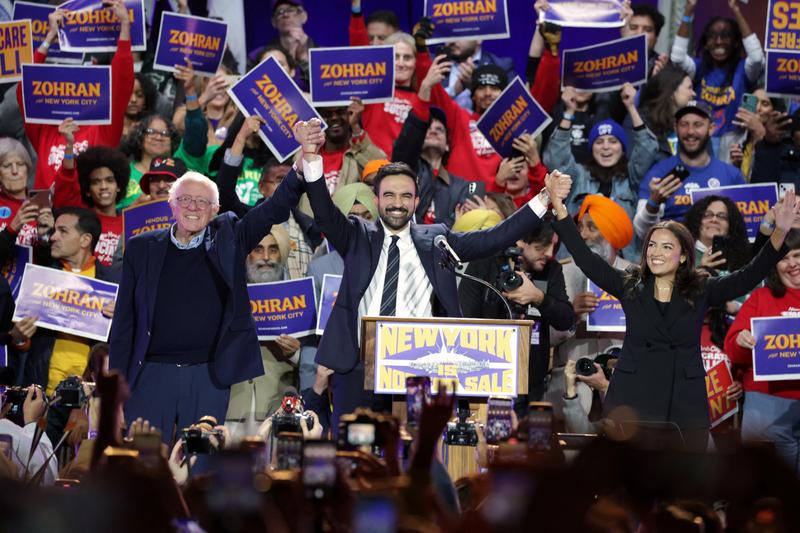
( ANGELA WEISS / AFP / Getty Images )
Title: What is Zohran Mamdani's Political Ideology?
[music]
Brian Lehrer: It's the Brian Lehrer Show on WNYC. Good morning again, everyone. Coming up later this hour, your 30-second eulogies for the penny on the week when the last ones were minted or make up a new phrase to replace ones that use the word penny. That's coming up, but first, New Yorkers and others are continuing to ask, what does it mean that Mayor Elect Zohran Mamdani calls himself a Democratic socialist? What will that mean in practice?
Now, we know from polls and from our callers that the word socialist is not as toxic in American politics as it was during the Cold War, when the main threat to democracy in the world was perceived to be the USSR, the Union of Soviet Socialist Republics. Younger Americans don't have that in their experience and are frequently down on capitalism, which I don't have to tell you, they experience as failing to provide them a path to financial stability as much as it did for their parents or grandparents, or maybe never did en masse for African Americans and other economically marginalized groups.
The word socialism was not a disqualifier, obviously, because Mamdani got elected, and arguably it was even a political plus. Maybe that's why antagonists of Mamdani have ascribed other labels to him and his politics. Jamie Dimon, we talked about this earlier in the week, CEO of JPMorganChase, described Mamdani as "more a Marxist than a socialist" back in July of this year.
I guess he thought socialist was becoming benign. He had to up the ante. Then there's President Donald Trump, who's repeatedly called Mamdani a communist. You've heard this probably, but here's 15 seconds of the president addressing the American Business Forum the day after the election.
Donald Trump: If you want to see what congressional Democrats wish to do to America, just look at the result of yesterday's election in New York, where their party installed a communist as the mayor of the largest city in the nation.
Brian Lehrer: Not a communist, as even Andrew Cuomo is quick to point out, but what do these words mean? Communist, Marxist, socialist, capitalist, democratic socialist versus social democrat. Social democrat is seen as a normal term, not a radical one, like democratic socialism strikes more people here, a normal term in Europe. Social democrat versus democrat socialist, there are actually differences, at least in theory.
For that matter, what's the difference in this country between a democratic socialist and a progressive? Where on this whole spectrum does the incoming mayor actually fall? How will he take his beliefs, whatever words you use, into leadership of New York City, the epicenter of capitalism after all, how does a socialist in office actually govern under capitalism?
We need a professor of political philosophy to sort this all out, don't you think? Luckily, we have one. It's Carlo Invernizzi-Accetti, professor of Political science and executive director of the Moynihan Center at City College, The City College of New York, part of CUNY, of course, and author of the book 20 Years of Rage: How Resentment Took the Place of Politics. Professor Accetti, we are now students in your class. Welcome back to WNYC.
Carlo Invernizzi-Accetti: Thank you. It's a pleasure to be here.
Brian Lehrer: Can we start with that Trump clip? Trump doesn't find it threatening enough to say democratic socialist, I guess, so he keeps calling Mamdani a communist. What's a communist?
Carlo Invernizzi-Accetti: All of these terms have different definitions that change over time. We could talk about what it means at different moments, but what Trump is doing in that clip and what the right in this country has been doing for a long time is using a classic red scare tactic, which is to try to conflate the differences between different kinds of socialism, communism, democratic socialism, reducing them to their worst possible version, which is a scarecrow, which is some conception of what the Soviet Union must have looked like itself, portrayed in the most negative possible light as a way of discrediting what they are attacking.
Brian Lehrer: The Jamie Dimon quote, CEO of JPMorganChase, he must also have thought socialist was not toxic enough because he said Mamdani is more of a Marxist than a socialist. What's a Marxist?
Carlo Invernizzi-Accetti: Again, a Marxist is somebody that follows the philosophy of Karl Marx or subscribes to it in various possible ways. All of these terms have multiple definitions. I think what it meant to be a socialist or a Marxist in the 19th century when Marx was writing, is different what it is today. I think one way to begin getting our heads around these questions is to say what is distinctive about Mamdani's mayor, Mamdani's own brand of socialism, and in what ways does it fit into a broader history of both American and international socialism.
I think on that count, there's at least two senses in which when Mamdani himself is asked, what does it mean that you're a socialist? He always refers to this concept of dignity, of human dignity that he subscribes to and wants to advance. I think in that there are two core principles that we can get to that define what Mamdani's brand of socialism is and then perhaps distinguish it from other types of socialism.
I think on one hand, there is an overcoming of what went for a long time, as by the name of neoliberalism. Even large parts of the left in this country subscribe to a form of neoliberalism, understood as the idea that the market is the best mechanism for distributing social goods. That was an idea that even parts of the Democratic Party subscribed to in the '90s and early 2000s. That's the Mamdani strand of socialism wants to overcome and say, look, sometimes markets fail, sometimes markets are not the best way of distributing social goods.
For instance, we can decide that if a city like New York becomes too expensive, we can freeze the rent and not allow the market to do whatever it thinks is the best. That's one thing. An overcoming of neoliberalism. Another, more distinctive aspect of Mamdani's socialism, I think, relates to a more recent feature of the left in this country, of the Democratic Party, is a particular way of politicizing identity politics, of identity matters.
For at least the past 10 years or so, what went by the name of woke was a particular way of politicizing identity issues that had a certain number of features that I think proved in some ways unpalatable both for the left and the right. I think Mamdani's socialism represents a way of overcoming that, too, of repoliticizing identity, for instance, his Muslimness in another way that's more universalist, that's not victimizing or recriminative like woke was. He is post-neoliberal, post-woke, and that's what standing for dignity means.
Brian Lehrer: When Trump would call Mamdani a communist during the campaign endorsing Andrew Cuomo, Cuomo would reply that, "No, Mamdani isn't a communist, he's a socialist," but then criticized him for that. Here's Cuomo on election day.
Andrew Cuomo: Socialism has never worked anywhere on the globe. Not Venezuela, not Cuba. It's not going to work in New York City.
Brian Lehrer: We use Cuba and Venezuela as representative of socialism. Didn't say anything about Europe social democracies, for example. Where do Cuba and Venezuela actually fit in to any global definition of socialism? How much might they apply to Mamdani's definition of democratic socialism?
Carlo Invernizzi-Accetti: That's right, everything's in the label. I think not at all. The whole point of the US tradition of democratic socialism is to distinguish itself from the Soviet socialist tradition of the USSR and then from the Bolivarian Venezuelan tradition, the Cuban tradition. From the time of Eugene Debs in this country in 1912, who ran a socialist campaign in 1912, and got a million votes up to Students for a Democratic Society in the 1960s, and the whole socialist tradition in the United States has always attempted to work within the American framework of democracy.
There is an American tradition of socialism that I think Mamdani is self-consciously inscribing himself in and trying to move ahead that works within the American constitutional framework, accepts democratic principles and norms, and tries to advance the values of dignity, equality, universal values of freedom, equality, and fraternity, if we will, within an American framework.
That is very different. It's very important to distinguish, therefore, democratic socialism from other strands of socialism like the Cuban, the Venezuelan or the Soviet, or even the Chinese ones. That is another type of willful confusion that enemies of Mamdani are trying to foster in order to delegitimize him.
Brian Lehrer: Some people are calling in and texting already. We'll get to some of you. 212-433-WNYC so everybody has the number. Call or text 212-433-9692 with a comment or a question, since we are all now students in Professor Invernizzi-Accett's political science class at City College. 212-433-9692. Here's a clip of then candidates around Mamdani on CNN back in June before the primary. In this one, CNN's Erin Burnett asks about another ism, capitalism.
Erin Burnett: Do you like capitalism?
Zohran Mamdani: No. I have many critiques of capitalism. I think ultimately the definition for me of why I call myself a democratic socialist is the words of Dr. King. Decades ago, he said, "Call it democracy or call it democratic socialism, there must be a better distribution of wealth for all of God's children in this country." That's what I'm focused on, is dignity and taking on income inequality.
Brian Lehrer: Mamdani with Erin Burnett on CNN. Actually, that was after he won the Democratic primary on June 26th. Professor Mamdani often uses that Dr. King quote to define democratic socialism, "a better distribution of wealth for all of God's children." Was Martin Luther King a socialist?
Carlo Invernizzi-Accetti: I think that's another really interesting move by Mayor Mamdani, inscribing himself in this distinctively American tradition of socialism that is democratic, and of course, that Martin Luther King belonged to. Martin Luther King is another person whose legacy has been tried to be reinterpreted both by critics and by friends to sanitize it and simplify it.
One of those things that I think is particularly interesting of Mamdani's brand of socialism, I was saying, is that attempt to move past the woke approach to identity issues, and to reconfigure identity politics in a more universalist vein. In that sense, I think the recovery of a figure like Martin Luther King, who during the civil rights movement absolutely thought that to advance civil rights for African Americans was co-original and inextricably inseparable from class politics and advancing the conditions of workers in the United States, too.
This has been a long-standing debate even recently in the American left, whether identity or racial issues are prior to or separate from class or income distribution issues. Mamdani here by appealing to Martin Luther King is making a very valid point that they cannot be separate, they are co-original. If you want to solve class issues, you cannot abstract from racial issues. If you want to address identity racial issues, you cannot abstract them from class issues.
Brian Lehrer: Mel in Manhattan, you're on wnyc. Hi Mel.
Mel: Hi. I just wanted to say a couple of things about the word Marxism. The first is that every socialist organization since the 19th century, DSA included, and socialist organizations of a very different stripe, study the works of Karl Marx. I'm sure you could find it on DSA website. Secondly, what Marx meant in the 19th century is certainly-- Now people use it as well, you're a Marxist, that means you're a terrorist.
That means you're part of a guerrilla army that wants to attack Washington, DC, or something like that. It's far from what Karl Marx meant in the Communist Manifesto. The main reason that he wrote the manifesto, Ian Engels wrote the manifesto is to say that, "The liberation of the working class must be done by the working class itself." In other words, workers organizing themselves.
He used the word communism to distinguish it from socialism, which in those days socialism tended more to mean schemes by some thinker who I'm going to come up with some way to reorganize society. What Marx meant was simply no, there are already active people, working people trying to organize for their own liberation. That's what I want to use the word communism, because to me communism means that. That's a--
Brian Lehrer: As a student of Karl Marx, would he have been for electoral democracy?
Mel: Karl Marx was always for, and the socialist movement was always for socialists running as socialists in capitalist democracies. What he would not believe is that the elections in and of themselves would lead to socialism.
Brian Lehrer: Which means, professor, that if you agree with the caller, he would have advocated other means than democracy. I don't know if that implies violence, and of course, we're not saying these things about Mamdani. That's part of the point. People are trying to tar him like Jamie Dimon calling him a Marxist rather than a socialist, but is that a meaningful distinction that the caller makes?
Carlo Invernizzi-Accetti: I think Marx's own thought evolved over time. Initially, when he was younger, he was like your caller was saying, for some kind of radicalized version of electoral democracy and then later in his life did advocate for violent revolution and nationalization of the means of production, what he called the dictatorship of the proletariat.
Just like Marx himself evolved, there's many different strands of Marxism, some which do advocate violent overthrow of existing bourgeois institutions and others which don't. It seems to me pretty clear that to the extent that he refers to Marxist thought, Mayor Mamdani belongs to a democratic, nonviolent American tradition of interpretation of Marxist thought that other members of which we haven't mentioned, I mentioned Debs, we mentioned Martin Luther King.
Michael Harrington, the founder of the Democratic Democratic Socialists of America organization, was also always actually thought we should work within the Democratic Party ticket. He described the DSA as the left wing of the possible, advancing always an agenda of dignity, of equality, but within existing institutions.
There's many Marxisms, but to the extent that Mayor Mamdani is a Marxist, he's certainly not a extremists, revolutionist or violent or terrorist, other things that he has been called by lazy people who don't want to actually understand what tradition he belongs to.
Brian Lehrer: Here's another Mamdani clip. This is from a YDSA, Young Democratic Socialists of America, conference in 2021. This, as some of your listeners may know, went viral among conservatives over the summer, racking up at least 8 million views on X. You'll hear why. Let's take a listen.
Zohran Mamdani: There are also other issues that we firmly believe in, whether it's BDS, or whether it's the end goal of seizing the means of production, where we do not have the same level of support at this very moment. What I want to say is that it is critical that in the way that we organize, the way that we set up our work and our priorities, that we do not leave any one issue for the other.
Brian Lehrer: Mamdani in 2021. He was already in the state assembly at that time. I guess, professor, he likely wouldn't say that now in that way, but he did, offhandedly in that clip, say that seizing the means of production is an end goal that he "firmly believes in." What does that mean he's after as mayor or anything else?
Carlo Invernizzi-Accetti: I actually think it's important what you said that he wouldn't say that today because I said there's a history to Marxism, there's a history to socialism. What it means to be a socialist changes over time. I think Mamdani himself has evolved since 2021. I actually respect him and admire him for the fact that he has moved on from certain positions that he might have had three or four years ago, the campaign that he ran for mayor.
We all remember that in January of 2025, he was at 1%, and he won this election with over 50% of the votes. What did it take to get that extra 49%? It took a transformation, an evolution of his message, which I think it's a wrong thing to say, that what he actually represents is what he stood for four years ago, and that everything else is cosmetic. I think everything else is political. It's an evolution of his message.
All of the socialist, for instance, iconography has been taken out of his campaign. There's no use of the red or of the symbology, of the hammer and sickle. He's not run as a communist. He's run much more as an economic populist that wants to advance a message of affordability and has, on the way, picked up a lot of allies even amongst various constituencies, amongst Muslims, amongst especially younger Jewish voters, amongst upper and middle, and lower classes.
It's a much broader coalition than an exclusively Marxist or even just DSA constituency. I think that's more power to him for that, because that's how you do politics. You've got to make allies, you got to make compromises, and he's doing that. I don't think the truth of Mamdani is 2021. The truth of Mamdani is the Mamdani that won this election as a broad coalition.
Brian Lehrer: I think Jeremy in Queens wants to go back to that CNN clip where Erin Burnett asked him, "Do you like capitalism?" And Mamdani said, "No." Jeremy, you're on wnyc. Hello.
Jeremy: Hi. I definitely consider myself left of center, but I get frustrated. I've gone to a few DSA meetings, and when they throw around the term capitalism, I'm looking at their website, capitalism is a system designed by the owning class to exploit the rest of us for their own profit. We must replace it with democratic socialism.
To me, on the left, sometimes capitalism is used in this way. Sort of like the way on the right that they use socialism to discredit socialism. Capitalism, the reality is capitalism is very diverse. It exists in many different-- formed in many different countries. That's frustrating to me the way that capitalism is seen as the C word, kind of like cancer.
Brian Lehrer: Thank you very much. This brings us to the last clip that we're going to play. This is from a conversation I had here with Nobel laureate economist Joseph Stiglitz for our segment 100 Years of American Capitalism last year. You will hear what label this progressive economist uses for himself and how he distinguishes it from democratic socialism.
This starts with my question about his label for himself, which is progressive capitalist. How different after this whole 100-year arc of history, how different is your progressive capitalism, as you call it, from say, Bernie Sanders' Democratic socialism? Are they the same thing but using those competing words, or are they really different?
Jeremy: They're very, very similar. I sometimes say that if I had written the book in Europe, I would have subtitled my book Focusing on a Rejuvenated Social Democracy. Let me emphasize one thing that is in Bernie Sanders' language that is missing in my term, progressive capitalism, and that is the role of democracy.
If capitalism is going to work, it has to have systems of checks and balances, that there is a natural proclivity in an unfettered market economy for the agglomeration of power, both economic power and political power. The agglomeration of political power has a result. You get under regulation, you get pollution, you get domination of monopolies, you get inequality that can grow without bounds.
Brian Lehrer: Joseph Stiglitz here last year. I'll turn that question over to you, Professor. How different is Zohran Mamdani's democratic socialism from Joseph Stiglitz's progressive capitalism?
Carlo Invernizzi-Accetti: I think not very different, I 100% agree, both with Professor Stiglitz and with the previous caller, that there are varieties of capitalism. It's a mistake, a mistake, by the way, that in part, the left is itself responsible for for the reasons you pointed out because by symmetry, like the right wants to pinpoint communism as a bugbear, sometimes the left wants to pinpoint capitalism as a bugbear, and then often reduces it to an essence that it doesn't have.
The left is responsible for this idea that there's only one type of capitalism. The reality is that's false. In the 1920s in the United States, we had laissez-faire capitalism. Then we had the New Deal, and there was a lot of state intervention and regulation into Capitalism in order to make the system of private property sustainable, which involved a lot of compromises on capitalist principles.
Since then we've had the Great Society, Social Security, lots of things that temper a pure capitalist system. Amongst the various varieties of capitalism, many involve socialist elements. Amongst the different varieties of socialism, there are many that involve market mechanisms. There's certainly a possibility of overlap between the two that is the space of social democracy or of democratic socialism, and that's the space that Zohran Mamdani is in.
I think it's useful to sometimes call it progressive capitalism, sometimes call it social democracy, depending on context, depending on the point that you're trying to make, but it's especially important to make clear that this is not an un-American, anti-private property, terroristic, anti democratic set of values. It's much more normal and much more actually germane to the American tradition than people are making it out to be.
Brian Lehrer: Oh. The last thing I want to do is see if you think there's a distinction between social democracy, which is what they tend to say in Europe, and democratic socialism, which is what Mamdani and the DSA call it here. I'm going to set this up with David in Englewood, who I think is going to say they don't really practice socialism in Europe. David, you're on WNYC. Hello.
David: I'm sitting in my car. I had to pull over when I heard this conversation. Let me just mention two quick things. In terms of socialism, Sweden ditched socialism over two decades ago. Look it up. Don't take my word for it. It didn't work. They ran huge deficits, taxes were over 50% and the GNP collapsed. Europe right now has no economic growth almost at all. France, if they get 1% increase in their GDP, they're just like jumping for joy. You think Americans would stand for this [audio cut] point regarding New York City. New York state once had 47 congresspeople. It's down to, I think it's 26 or 29.
Brian Lehrer: People are moving away, but there's a big debate which we've been having. Is it the rich people because we're too socialist, or is it the working and middle class people because the private sector prices are making New York unaffordable? We'll get back to that one another day. David, thank you, we appreciate your call. Using that as setup, last question, what about Mamdani's democratic socialism compared to social democracy?
NPR did an explainer after the election and they said proponents say democratic socialism goes further than social democracy, which often involves a strong welfare state operating under capitalism, but the DSA says we believe that our vision pushes further, including owning some means of production that are essential, like utilities and healthcare. That's a big question, but is there still social democracy in Europe, as the caller is skeptical of? Are they really different things, social democracy and democratic socialism? The best you can do with this in under a minute?
Carlo Invernizzi-Accetti: All right. I think Europe, there is an evolution of socialism. There are socialist elements that persist and that have been transformed, just like Mamdani is an evolution of American democratic socialism. People get invested in distinguishing social democracy and democratic socialism. People in DSA do that because they want to hold out the possibility that social democracy might actually lead to something else.
They usually want to say, Bernie gives us social democracy, and that's a stepping stone to something more radical that might involve transformation in the balance of power between workers and employers at the workplace. Maybe social democracy is the stepping stone for something else that could be called democratic socialism.
It seems to me what won this election was pretty much something that in Europe goes by social democracy, here is called democratic socialism, could also be called the progressive capitalism. That's Mamdani. Mamdani, I think rightly so, is less interested in drawing this distinction and more in making friends and bringing people onto an agenda of greater dignity for New Yorkers.
Brian Lehrer: All this understanding that we were trying to do in this segment of all these political philosophies are beside the point, you're saying. [laughs]
Carlo Invernizzi-Accetti: They're intellectually interesting, but what won the election was the capacity to move past these distinctions. Lenin once said one of the infantile disorders of the left is its tendency towards fractionism. One of the interesting things of DSA is that as an organization, it was one of the few left-wing organizations that was not born out of a split, but out of a fusion. In that tradition, one of the things I think is interesting of Mamdani's socialism is its, if I dare say it's catholic components, its capacity to integrate, to bring together different strands, different coalitions rather than to split hairs.
Brian Lehrer: Ending with small c catholic, Carlo Invernizzi-Accetti, professor of Political science and Executive Director of the Moynihan Center at City College, and author of the book 20 Years of Rage: How Resentment Took the Place of Politics. Thank you so much for joining us.
Carlo Invernizzi-Accetti: Thank you.
Copyright © 2025 New York Public Radio. All rights reserved. Visit our website terms of use at www.wnyc.org for further information.
New York Public Radio transcripts are created on a rush deadline, often by contractors. This text may not be in its final form and may be updated or revised in the future. Accuracy and availability may vary. The authoritative record of New York Public Radio’s programming is the audio record.
