
What Comes Next for Israel and Gaza?
( Kenny Holston - Pool / Getty Images )
[MUSIC - The Brian Lehrer Show Intro]
Brian Lehrer: Brian Lehrer on WNYC. For our last 15 minutes, we get back to the big breaking news of the day. This has been a historic day in the Middle East with the release of the 20 remaining live Israeli hostages from captivity in Gaza by Hamas, and a release of about 2,000 Palestinian prisoners, many without charges filed against them by Israel. Israel has pulled back its military, and if promises are being kept, open Gaza much more widely to food and medicine, and other relief supplies coming in.
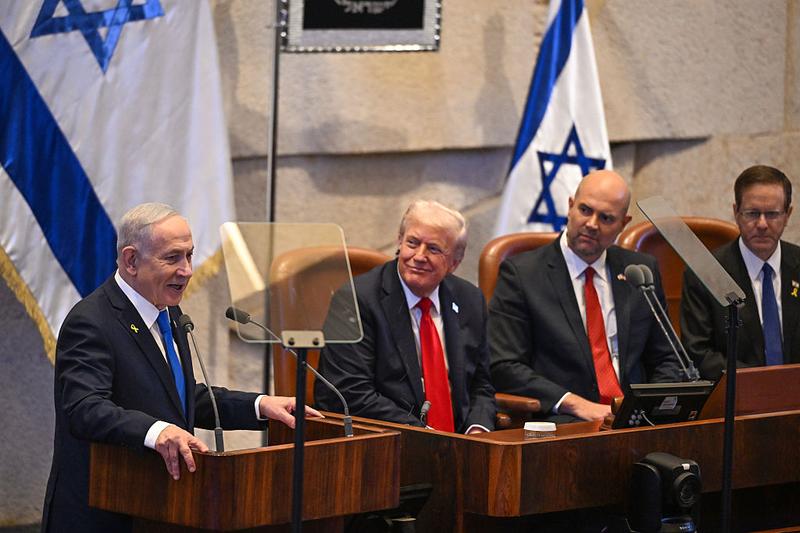
Of course, the hostages and families of those killed on October 7th, two years ago, will have a lot of healing and grieving still to do. The Palestinians have such a long road, and much they cannot undo, with more than 60,000 people dead and Gaza lying in ruins. We'll play a few clips from this morning, but also talk mostly about what comes next. President Trump is there, getting a lot of credit from everyone for getting this process this far. Maybe you've heard a few of the clips out there about how hostage-family crowds have cheered Trump but booed Netanyahu. Here is Prime Minister Netanyahu from a speech this morning on what could possibly come next.
Prime Minister Benjamin Netanyahu: A proposal that opens the door to an historic expansion of peace in our region and beyond our region. Mr. President, you are committed to this peace; I am committed to this peace, and, together, Mr. President, we will achieve this peace.
Brian: Netanyahu there. I also want to play a report from NPR's Aya Batrawy on the Palestinian situation now. Here is that 38-second report.
Aya Batrawy: The UN humanitarian agency, OCHA, says real progress is underway with cooking gas entering Gaza for the first time in months. People in Gaza have been burning plastic, clothes, wood, tires, and other items to bake bread and boil lentils and pasta. The UN says it was also able to bring in more tents for displaced families, frozen meat, fresh fruit, flour, and medicines on Sunday. It says aid groups distributed thousands of hot meals and bread bundles.
Israel is easing restrictions on aid into Gaza as part of the ceasefire deal. Aid groups had called Israel's restrictions "collective punishment," as cases of severe malnutrition and deaths from hunger spiked in recent months.
Brian: NPR's Aya Batrawy. That originally aired on Morning Edition today. One more clip. Former Israeli Prime Minister Ehud Olmert, who had been in the news for saying, "Yes, this is my country. I'm a Zionist, I'll always be a Zionist, but we're committing war crimes in Gaza," maybe you heard the news that he made, a few months ago, that way.
He was interviewed on Morning Edition today; he's a critic of Netanyahu from within, about what he thinks Netanyahu and others have to do now to make the rest of the peace plan a reality, not just promises on paper.
Former Israeli Prime Minister Ehud Olmert: The question is not what Netanyahu wants. We all know what he wants, and we also know what he doesn't want. He doesn't want to move forward, broadly speaking, towards a solution that requires the recognition of a Palestinian state and the withdrawal of Israel from more than 90% of the territories that are, now, occupied by the State of Israel. That includes Gaza and the West Bank. I had proposed a full plan for such peace in 2008, when I was Prime Minister, that included the creation of a Palestinian state.
Brian: "That included the creation of a Palestinian state," part of the ultimate goal of peace here. "Land for peace," as they've been saying for many decades. Former Prime Minister Ehud Olmert on Morning Edition. Fred Kaplan, who writes the War Stories column for Slate and has been a longtime observer of the region, joins us now. Fred, thanks for coming on. Welcome back to WNYC.
Fred M. Kaplan: Thanks. Anytime.
Brian: First, let's acknowledge the events of today. All the living hostages are home. Many Palestinian prisoners in Israel are being freed, at least that was scheduled to take place. I haven't been following it since the show began. You can confirm if that's actually happening. The Israeli military has apparently pulled back. More aid is supposed to start coming in or has started, and many Palestinians are returning to their homes, as you heard Aya Batrawy say. What would you like to say about this day and how they got here?
Fred: You're right, it's very significant. It does seem to be happening. The one hitch, and I think it's a minor one, is that Hamas has not yet returned all 28 of the dead bodies. I think it's only 4 or 5. This could just be a matter of logistics, of finding them all. Maybe they don't even exist anymore, I don't know. It's a very big thing, but it shouldn't be overstated. We have been here before. You might remember, one month into the war, Biden negotiated the release of 100 hostages, almost half of those that were there, and there was about a 7-day ceasefire that then collapsed.
The difference? There are several differences between that ceasefire and the current one. One, Hamas is very weakened. It can't even be called a coherent military power, much less having great political control over Gaza. Two, all of its suppliers in the region are decimated, if not destroyed. Assad in Syria is gone, Iran is very unconfrontational now, Hezbollah, decimated, so they don't have the strength they once did.
Third, you have a situation, it's the Trump factor, which is very interesting, more complicated than it seems. Trump finally came down, pressuring Netanyahu to get involved.
Brian: Can I jump in right here? How did he do that? What leverage did he have over Netanyahu?
Fred: He's always had leverage, and Netanyahu knows this. Netanyahu knows. Trump is practically his only friend in the whole world among leaders. When Trump came in, Netanyahu thought that Trump would be in his pocket. You remember you have Mike Huckabee, Trump's Ambassador to Israel, saying, "There's no such thing as occupied territories. It's all Greater Israel."
You had Trump himself urging Netanyahu to get this war finished quickly. He also presented this plan to get all of the Palestinians out of Gaza, to resettle them elsewhere, and to turn Gaza into a Riviera in the Middle East. These were not hopeful signs. [chuckles] What happened, and it's ironic, is that Netanyahu went too far. A couple of weeks ago, in an attempt to assassinate some Hamas negotiators who were in Qatar, he bombed Qatar territory, and that outraged Qatar. What he didn't realize, or maybe underestimated, the closeness between Trump and the United States and Qatar. The United States has the largest military base in the Middle East in Qatar.
Qatar, you'll recall, gave Trump a $400-million jet airliner, which he's converting into the next Air Force One. The United States is providing an air training center for the Qatari Air Force in the United States. I don't think we've done that for any other country. Netanyahu violates Qatar's territory, Trump realizes Netanyahu is not interested in peace, he's not ever going to get us there. I think Trump really does want peace. I'm not sure if he understands what that involves, but I think he generally wants it.
He called Netanyahu into the office, he made Netanyahu call the Qatari Prime Minister and apologize over the phone. I don't know if Netanyahu has ever done that to an Arab, then he made Netanyahu sign at least Phase 1 of this deal. Once that happened, he also then told the Arab powers, "I will never allow Israel to annex the West Bank. I'm dropping my insistence that Palestinians leave Gaza. They can stay, they can go, they can come back." That's when the Arab countries realized, "Okay, we can start pressuring Hamas because we see that Trump really is pressuring Netanyahu."
There's a very good book called Righteous Enemies: The Arab-Zionist Conflict, 1890 to 2001. It's been going on for a long time. One conclusion that you can derive from this book is that all the peace arrangements that have been made since 1948, the ending of all the wars, it's happened when outside powers apply pressure; the United States on Israel during the Cold War, the Soviet Union on the Arab countries, believe it or not, the United nations on all sides, when it had more legitimacy.
That always had to happen, and now, it is finally happening. Trump did initiate it. The 20-point plan did come out of his office, much of it written by his son-in-law, Jared Kushner, and Tony Blair, and some of it inherited from the position that Biden's people had tried to put forth, although he'll never admit that. That's what's different: the weakness of Hamas, the evaporation of Hamas's explicit support from around the region, and the fact that both sides are now receiving pressure from outside powers.
Brian: As usual, when we talk about this topic, our listener comments are polarized. Here's one. "Why do you refer to Israelis as 'hostages' and Palestinians being held in Israel with no charges as 'prisoners'? Both were used for bargaining, and neither were charged with anything." Another one, politically opposite, says, "Why aren't you also mentioning Hamas roaming the streets fully armed and already killing 30, I heard, last night, on BBC, 'those who might be able to provide leadership in the future'?"
Do you know if that's a confirmed fact? I know I heard a report on the BBC about a vacuum of leadership there because Hamas is not supposed to be, but there's nobody else, and about that language, "Palestinian prisoner" versus "Israeli hostage," if the Palestinians were not charged with anything?
Fred: That's the language of the documents, and some of the prisoners being released were charged and were, in fact, murderers. There was some negotiation over who should be released, but I am getting to the second point, which is the limitations.
The listener is absolutely right. This is just Phase 1 of a multi-phase agreement, which incorporates 3 or 4 of the 20 points in Trump's 20-point document, things that have not yet been agreed to. Hamas agreeing to disarm, Hamas agreeing to relinquish all positions in political leadership, a decision on who is going to run Gaza now. Who is controlling it? Where the money comes from, where the political leadership comes from. Who provides security? Will Israel withdraw completely, or can they stay, maintain a presence in a small sliver as a hedge?
There are still many, many-- The list of things that have yet to be agreed to, and the nature of which have never been agreed to in these kinds of deals, is much, much longer and much more strenuous to accomplish than what's been accomplished so far.
Brian: Looking ahead to some of that, the clip of former Prime Minister Olmert that we played, he said, "Two-state solution." Netanyahu, in his speech this morning, definitely did not say, "Two-state solution." I don't even think he said the word "Palestinian," or if he did, I didn't hear it, and the underlying issues haven't gone away. You were just referring to some of these. Israel wants, if there is a Palestinian state, disarmament and security authority not to be with that state. That goes against the Palestinians' demand for self-determination and autonomy. Those things are contradictory. How can they get there?
Fred: Yes, it's a good question. Netanyahu has, in fact, said several times, "I will never allow a Palestinian state." There was a time, a while back, when Saudi Arabia was going to agree to a grand solution to this if Netanyahu merely agreed to resume negotiations toward a Palestinian state. It didn't even have to be serious. Quite honestly, the leaders of the Sunni-Arab countries in the Middle East don't really care about the Palestinians. It's all been domestic politics for them, but they needed Israel to step up, even rhetorically, and he wouldn't even do that.
Part of it is the survival of his very tenuous political coalition, whose right-wing elements can't tolerate even the mentioning of such a thing, and part of it is his own views. [crosstalk]
Brian: In our last 30 seconds, Fred, how influential, to part of what you were just saying, is Saudi Arabia right now? Because I heard a report this morning that indicated Israel really wants recognition from Saudi Arabia as part of the so-called Abraham Accords, but now Saudi Arabia says, after all of this in Gaza, "No recognition without a Palestinian state." How much does Israel care? How influential could Saudi Arabia be in that respect? We have 20 seconds.
Fred: A deal between Israel and Saudi Arabia would be crucial for long-term Israeli security with the Arab and Muslim world, around the world. Saudi Arabia wants it, Israel wants it, but for political reasons, quite rightly, Saudi Arabia needs Israel at least to maintain even the pretense of commitment to a Palestinian state. As long as Israel is led by someone who will not even mention that, even pay it lip service, it can't happen. [crosstalk]
Brian: Fred Kaplan writes the War Stories Column for Slate. Thank you for joining us on this historic day.
Fred: Sure. Thank you.
[MUSIC - The Brian Lehrer Show Outro]
Copyright © 2025 New York Public Radio. All rights reserved. Visit our website terms of use at www.wnyc.org for further information.
New York Public Radio transcripts are created on a rush deadline, often by contractors. This text may not be in its final form and may be updated or revised in the future. Accuracy and availability may vary. The authoritative record of New York Public Radio’s programming is the audio record.
