
'We Hold These Truths...'
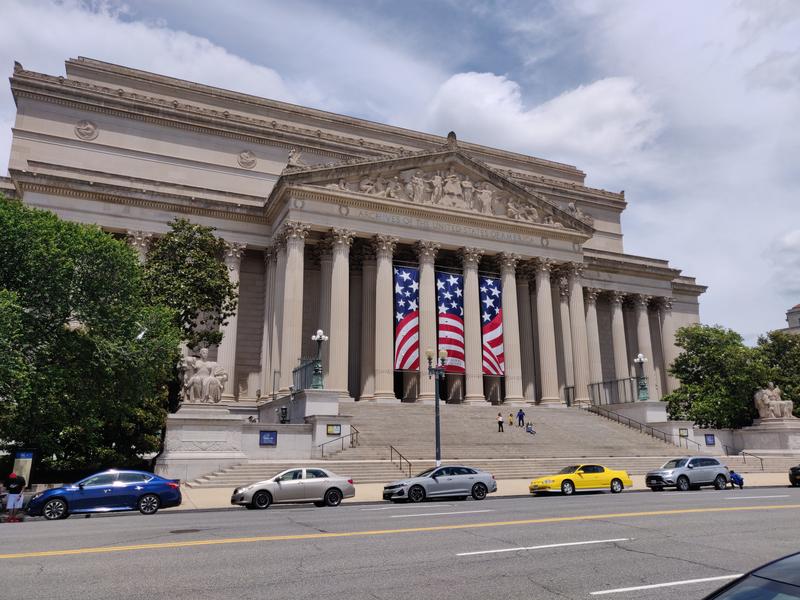
( Kurt Kaiser / Wikimedia Commons )
Title: 'We Hold These Truths...'
Tiffany Hansen: It's The Brian Lehrer Show. I'm Tiffany Hansen filling in for Brian today. Good morning again, everybody. All right. How well do you know this sentence from the Declaration of Independence? We hold these truths to be self evident, that all men are created equal, that they are endowed by their Creator with certain unalienable rights, and that among those are life, liberty, and the pursuit of happiness. Did you know that the first draft of that sentence, in that first draft, Thomas Jefferson actually wrote, we hold these truths to be sacred?
Benjamin Franklin, however, crossed that out and made the change that we know today. This single key sentence with its many edits is the subject of an entire new book by historian Walter Isaacson. He's a professor of history at Tulane and the author of several books, including his latest, The Greatest Sentence Ever Written. he joins us now. Hi, Walter. Welcome back.
Walter Isaacson: Hey. Thank you, Tiffany. It's good to be back on the air.
Tiffany Hansen: I will say I misspoke, say, saying it was the first sentence of the Declaration of Independence.
Walter Isaacson: That's all right.
Tiffany Hansen: It is not, everybody. It's TGIF. Stand down, all the historians in the audience. I know what I did. I apologize. The first sentence is, of course, I'm going to just editorialize and say it's a bit of a run-on sentence. This would have probably taken you a little more time to dissect. It begins with--
Walter Isaacson: They do talk about a decent respect for the opinions of mankind in the first sentence. It sets it up nicely. You're right, that second sentence went through wonderful edits.
Tiffany Hansen: Yes. All right. The big question here, why key in on that particular sentence?
Walter Isaacson: It's a mission statement we have as a nation, and it's a mission statement we haven't fulfilled, and certainly wasn't a description of the nation in 1776. As we are getting into our 250th birthday, and as we're a nation now, so divided and fractured, I think I wanted to do a short book reminding everybody of what we aspire to be. That's encapsulated in this sentence.
Tiffany Hansen: Listeners, Walter and I want to just bring you in this conversation right away. Do you have a question, an observation about the Declaration of Independence? Tell us what this sentence means to you, especially as Walter mentioned here. In this context of the 250th year celebrations coming up, does anything ring hollow for you? Do you have any other questions for Walter Isaacson? We know he's got a lot of fans out there, so you can give us a call. 212-433-9692. You can also text us at that number.
Walter, you lay this book out in chapters that zero in on words or particular phrases in the sentence. The very first word of that sentence is "we." It's worth remembering, I think, that that first word in the Constitution is also "we the people." You write that that first word is profound because of its simplicity, it points to the founders belief in social contract theory. Talk to us about what that social contract theory is and walk us how that "we" is illustrative of that.
Walter Isaacson: We were creating a new type of nation back then. Up until then, power either came from the divine right of kings or the sword of a conqueror. During that period, philosophers like John Locke in his second treatise or government or Hobbes or Rousseau all wrote about power should come from a social contract. In other words, it should derive from the people. Well, that was a new thing on earth. When Jefferson, Franklin, and Adams were writing this sentence, they were all reading those philosophers who talked about how voluntarily people come together to form a society and protect each other's rights. That's what was happening in July 1776 and why the sentence begins with "we."
Tiffany Hansen: Well, I'm going to say, Walter, that I'm not sure that we, when it was written, at the time it was written, meant me, for example. Women enjoyed very few rights at that point. It, certainly, [unintelligible 00:04:30].
Walter Isaacson: That's the theme of the book, of course, which is when you say all men and you say created equal, well, that just was not the case. The theme of the book is how do each of these words get expanded, and they don't expand themselves. We have to make it happen. Four score and seven years after that sentence was written is, of course, when Lincoln is standing at a cemetery at Gettysburg and saying we created a new type of nation conceived in liberty and dedicated the proposition that all men are created equal. Well, the thousand some odd people he was burying that day, they were part of that struggle to take a sentence that was not true and see if we could push it forward.
Tiffany Hansen: Did they view it as aspirational? In the moment, we can retroactively fit it and say that it is an aspirational we, but is that how it was viewed by the founders?
Walter Isaacson: Yes, that's a very good question, Tiffany. I worked on that a lot. the answer is I think yes, for the sum of the specific founders, certainly for Ben Franklin, but here's Jefferson. He's the most problematic, let us say. He drafted that sentence. He wrote all men are created equal. The earlier versions people have talked about they're created equal when they enter into a social contract, which was a way to exclude slaves.
Jefferson is in that room drafting it, and not only are Ben Franklin and John Adams there, there's a young man named Richard Hemings, who's there, who's the enslaved valet of Thomas Jefferson and whose younger sister will eventually, Sally Hemings, become the mistress of Jefferson, and yet Jefferson takes a sentence and makes it simpler and just says, "All men are created equal." He writes later in the document, an assault on slavery, and yet he's enslaved more than 400 people. You've got a very complicated thing to wrestle with, whether or not is all men are created equal or the pursuit of happiness. Jefferson thought of those as aspirational phrases, and he knew they were not true at the time.
Tiffany Hansen: One of the things that people often say about the Constitution is that it's a living document. I wonder if you would apply that same living-- Is the Declaration of Independence a living document?
Walter Isaacson: Yes.
Tiffany Hansen: They're meant to be given new meaning to those, as you're alluding to, new meaning to those words over time. If it is a living document-
Walter Isaacson: I think so.
Tiffany Hansen: -how is it living and breathing now?
Walter Isaacson: I think it's a living document because even the way John Locke, for example, has the concept of aspiration, it's life, liberty, and property. Jefferson changes that to pursuit of happiness, which is a very aspirational phrase, but also one that breathes. Each new generation can try to say, here's how I get most fulfilled. By happiness, they didn't mean let's go to a party and get happy. They meant, how can each generation feel fulfilled and useful as members of society?
I think for many generations, we were good at making that part of the American dream. By American dream, I mean the thought that each new generation could do better than the last. I think we've messed that up badly now. At the moment, you have less than a 50% chance of doing better than your parents, for the first time in history. In the decade when I was born, I hate to admit it is the 1950s, I've been around a while, you had more than 80% chance of being financially or just your life being better than your parents. That is where the pursuit of happiness is a breathing thing, but we've not fulfilled the promise.
Tiffany Hansen: What was happening historically that the phrase about property was changed to pursuit of happiness? What was happening in that moment that made that seem relevant to-- and revolutionary.
Walter Isaacson: Because at that time we had what was known as the commons. If you go to a Boston or Cambridge or Philadelphia, there's the Boston Common. I always thought, that's just a nice little park. I realized it was the land that nobody owned that was set aside for use in common. Anybody could graze their herds there. Anybody could bury their dead there or plant a garden there. America had this concept of things that we put into the commons.
The founders, like Jefferson and Franklin, decided certain services would be in the commons, including, say, education of young people. Both Jefferson and Franklin start schools. Likewise, they put police protection, fire corps, they even put health care in the commons. Ben Franklin creates the hospital, a public private partnership in Philadelphia. Its motto is to pour forth benefits for the common good is divine. Back then they were trying to say, "Yes, we'll have private property, but there will be things that we allow everybody to have in common." When we start shrinking the commons, that's where it makes it harder for each new generation to succeed, and that's where you get a backlash against the establishment.
Tiffany Hansen: Is there any truth? A listener texted us here, Walter, does the word happiness come from ancient Greek philosophy? I'm going to mispronounce this eudaimonia, meaning human flourishing, sometimes translated as happiness. The listener says, "I know the founders were classics nerds." Any truth to that?
Walter Isaacson: Yes, they definitely were, especially Jefferson. Yes, it's flourishing is what they're talking about, or fulfillment and flourishing. It comes from Plato trying to discover the good life.
Tiffany Hansen: We are talking, listeners, with Walter Isaacson, professor of history at Tulane, author of many books, including the latest, The Greatest Sentence Ever Written. We would love to take your questions about this sentence from the Declaration of Independence. Here it is again, just for the reminder. We hold these truths to be self evident, that all men are created equal, that they are endowed by their Creator with certain unalienable rights, that among these are life, liberty, and the pursuit of happiness. Questions? Comments? You can call us, you can text us. 212-433-9692. 212-433-WNYC.
One of the words here, Walter, that I want to zero in on is to-- Actually they're kind of related here, right? The change from is it self evident from sacred, and then also this mention of the Creator. More broadly, I'd like just your comment on this notion that in this sentence there's a difference made between the divine and the human element of this.
Walter Isaacson: Absolutely, Tiffany. What happens is the sentence that Jefferson crafts in the first version is, "We hold these truths to be sacred." Benjamin Franklin takes his dark black printer's pen, you can see it in the flyleaf of my book. I reprint the first edits of the sentence. He crosses it out, and he puts in self-evident. That was a not just meaning obvious. He had been staying with David Hume. I mean David Hume, the greatest philosopher of the time up in Scotland, would come up with notions of truth that are true simply by reason.
In other words, all bachelors are unmarried. You don't have to go asking a lot of bachelors, "Do you have a wife?" to know all bachelors are unmarried. He wanted to say our rights come from rationality, not from the dictates or dogma of a religion, but then Jefferson continues to write that they derive certain rights, and John Adams, who's more conventionally religious, writes, they're endowed by their Creator with rights. Even in the editing of that first half of the sentence, you see our founders balancing the role of enlightenment rationality in bringing our rights and divine providence in doing so. I think it's important that they don't base it on religion, but they do see a balance there. Sometimes we're not very good in our day and age of having a balance. We either say a Christian nationalist view of our nation or a totally secular view. That balance is what the founders were great at.
Tiffany Hansen: Walter, let's bring Roland in Washington, D.C. into the conversation. Good afternoon. No, it's still morning. Good morning, Roland.
Roland: It is still morning both in Washington, D.C. and in New York.
Tiffany Hansen: It is.
Roland: I grew up in Baltimore, the state that produced Roger Brooke Taney who wrote the majority decision or the decision of Plessy versus Ferguson. Growing up in Baltimore in a Black community, my father was able to buy a house because somebody broke a restricted covenant that allowed him to buy a house in a formerly all white neighborhood. The term we hold these truths to be self evident that all men are created equal was just, in my grandmother's words, poppycock.
All due respect to Locke, Jefferson, and most of the people at the convention in Philadelphia, own people that look like me. I'm Black and I am the great grandson of a 15-year old African slave who was raped by her 36-year old English slave owner. I don't think that they were talking about me when he said it was self-evident. My father joined the army at 18 years old, afforded the Battle of the Bulge, came back home with $5,000 in his pocket.
He was a pretty screwed guy in the Quartermaster Corps. Actually, it was $7,500. Walked up from the train station in Baltimore thinking he could get a taxi cab in a driving rainstorm in his Class A uniform with a combined infantry badge on his chest, and not one single cab driver would stop for, but still a Black GI. When he got on the Baltimore transit company bus, the bus driver thumbed him to the back of the bus. He got off and walked home seven miles in a driving rainstorm.
All men are created equal is not self evident to me. When I go into a prison, which I do from time to time, I see large numbers of Black and brown people who could not possibly have been treated equal. It was self-evident that there's a problem here. When I go to South Carolina or Arizona, I recently visit a Navajo reservation. I talk to elders, and they tell me stories. I lived in Canada for a while and I visited a Mohawk reservation. An elder told me one night after a long dinner, they have no real written history. It's all oral.
He said to me, "I was always curious as to what it was like." He said, "Well, when the first white people came," he said, "a Mohawk boy could have gone all the way to the North Pole. We knew the world was round because the other planets were round. That was not something we questioned. A Mohawk boy, 16 years old, could have gone all the way to the North Pole and not have encountered a single soul. When we saw these pale people, we thought they came to hunt and fish, and that they would leave." That's not what happened.
Tiffany Hansen: Roland, I'm so grateful for your comments and for the history that you bring to the conversation. I wonder, Walter, what you say when someone has that history and feels that so deeply. It's hard to buy into the fact that this is an aspirational statement.
Walter Isaacson: It's hard to. There are times in our nation where we make it aspirational. We march for civil rights, or we are women's rights. There are times we backslide as a nation, but the guiding star should be that more and more people are included in that sentence. It's happened in fits and starts. When we backslide, when we make it harder for people to have equal rights or to be treated equally, we know we're not living up to that promise. As the caller so aptly said, back then, more than half the people at the convention enslaved people. We're a nation that was born with this deep problem. We still have to struggle to make the sentence more true.
Tiffany Hansen: The founders, who were enslavers. You mentioned Sally Hemings. Many folks, including myself, thinking Jefferson's mistress is really not an accurate way to portray that she was enslaved. She was a young girl. That was not a mistress situation. It's worthwhile pointing that out, that a lot of people are mentioning that. The one thing I want to get to here before we let you go is this difference between unalienable and inalienable. You say it was sort of a typo. Let's talk about the meaning there and what the difference is.
Walter Isaacson: Those of us who are writers and copy readers, when Jefferson writes it, he writes inalienable truths, and then in the final version, it's unalienable. I must say, I spent weeks trying to figure out the difference. Then I basically discovered it was a transcription error. I think John Adams transcribed a third or fourth version. What's odd is on the Jefferson Memorial, it says they're endowed by the Creator with certain inalienable rights, but in the final document, it says unalienable.
I just think that if we study each word in the sentence, we all try to appreciate, and we all try to appreciate how we haven't lived up to that sentence in time, then maybe all sides in our poisonous political discourse these days can come together to say, well, at least that's what we're trying to be as a nation, or should try to be as a nation.
Tiffany Hansen: We have this 250th anniversary coming up. We are a divided country. If Americans are to come around around this sentence, as you're hoping in the book, and come away with one thing, what would it be?
Walter Isaacson: It would be that if most of us calm down on certain issues, like how much should we have in the commons, including how much health care, how much police protection, all these things that the founders said should be held in commons rather than the private sphere, we could probably come to more sensible agreements than making everything so politicized. We also have to know, if you look at the charges against the king for quartering troops and trying to stop immigration or whatever, these were our values, and we haven't lived up to them. Let's make it New Year's resolution for a birthday new year in 2026.
Tiffany Hansen: Walter, let's pretend you have an editor's pen in your hand. You going to change anything about that sentence at this point?
Walter Isaacson: That's a great question, Tiffany. [unintelligible 00:20:59] No. I think I would underline the words "created equal" and put them in italics because that's the one we haven't been able to fulfill. It would be a land of opportunity. I mean, that's it. Everybody deserves the exact same opportunity, whatever the race, whatever their background, that was the American dream they embodied in the sentence, and that's what we keep having to struggle with, just like they did 250 years ago.
Tiffany Hansen: Any chance you're going to unpack the first sentence of the Constitution? Which, by the way, I think talking about an editor's pen, really another run on sentence, but it does begin with we, we the people of the United States, in order to form a more perfect union. I mean, that right there, you could unpack more perfect. Any chance you're gonna be doing that?
Walter Isaacson: Well, that's 11 years later, so maybe you've given me a decade to do it, but, boy, you put your finger on the right thing. When I was growing up, I had a grammar teacher saying, "You're not supposed to say more perfect. Something either perfect or it ain't perfect." She wouldn't let me say ain't either. The founders got it right by saying, "We're going to try to be more perfect." We should never think that anything's perfected. We should never think that anything's binary, good or bad. We should just say it's in transition because we're going to try to make it better.
Tiffany Hansen: Walter, I know we have to let you go, but this text is just too good. Where are the drafts of the Constitution and the Declaration preserved so that we can see those edits?
Walter Isaacson: What a wonderful question.
Tiffany Hansen: I know.
Walter Isaacson: When I first did it about a decade ago, I was writing to Benjamin Franklin. The first draft, besides being the fly leaf of my very little short book, is in the basement of the Library of Congress, not on display. I had to go down and get them to show it to me. I'm leading a struggle, a fight with a lot of people to say for, our 250th, take it out of the basement, put it right next to the final version, and so people can see each of the versions. Maybe I'm kind of a writer geek because I like different versions, but I'm hoping that they'll take it, put it on display in the rotunda, the archives, next to the final version.
Tiffany Hansen: That is the voice of Walter Isaacson. He's a professor of history at Tulane and the author of several books, including his latest, The Greatest Sentence Ever Written. You can find Walter on Sunday, November 23rd from 5:00 to 6:00 PM Eastern Time at New York Historical. That event is sold out, but there will be a live stream link at nyhistory.org. Walter, thanks so much for coming on.
Walter Isaacson: Tiffany, great being with you.
Tiffany Hansen: Coming up next, what to do with all of that stuff that your parents are leaving you. Do you have some ideas, some plans? Well, your chance to chime in coming up. I'm Tiffany Hansen, in for Brian Lehrer, so don't go anywhere.
Copyright © 2025 New York Public Radio. All rights reserved. Visit our website terms of use at www.wnyc.org for further information.
New York Public Radio transcripts are created on a rush deadline, often by contractors. This text may not be in its final form and may be updated or revised in the future. Accuracy and availability may vary. The authoritative record of New York Public Radio’s programming is the audio record.
