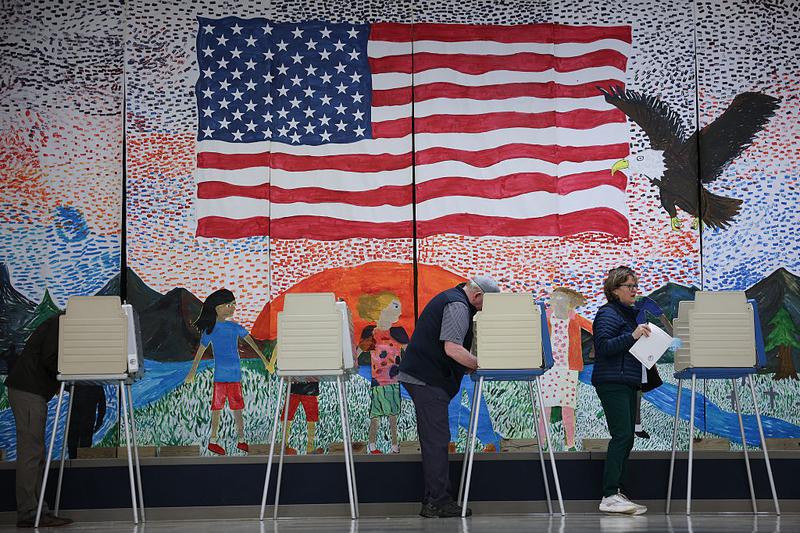
Brian: Brian Lehrer on WNYC. Virginia, where voters are choosing their governor and attorney general today, Democratic nominee and former congresswoman, Abigail Spanberger, has maintained a lead in the polls since very early in that race over Republican nominee Lieutenant Governor Winsome Earle-Sears. As in New Jersey, the governor's race has become somewhat of a referendum on President Trump's first year so far in his second presidential term, but it's also become a referendum on some bigger national topics like political violence, redistricting, and parental rights.
Voters' top concerns, though, we are told, are energy prices, housing affordability, and jobs. Joining us now to break down the latest on the races and the issues in Virginia on this election day is Markus Schmidt, senior Virginia politics reporter and deputy editor at the Virginia Mercury. Markus, thanks for some time. Welcome to WNYC.
Markus: Hey, thanks, Brian, for having me. Appreciate it.
Brian: Listeners, anybody in Virginia or with ties to Virginia, welcome to call in. We'll have time for a few, or text us. What are you hearing, seeing, or talking about with friends and family? 212-433-WNYC, 212-433-9692. How much is this a referendum on Donald Trump? I'm just going to go right there.
Markus: It's a pretty massive referendum on Donald Trump. Virginia, we have a history of usually when you have one party in the White House, the following year is the gubernatorial election, and usually the opposing party then wins. There was one exception when President Obama was elected to a second term, Republican Ken Cuccinelli lost against Terry McAuliffe in the governor's race. That was really the sole case when that happened in the last 30-plus years.
Brian: Both former President Obama, who you just mentioned, and President Trump have weighed in on the race in Virginia these past few days as the candidates make a final push, and they focus their message on affordability, from what I've seen. Here's a clip on Saturday, Obama touched on this issue. Let's take a listen.
President Obama: For ordinary families, costs haven't gone down. They've gone up. Partly thanks to this shambolic tariff policy. Young people trying to get a start in life are having a tougher time than ever finding a job. Entry-level hiring is down 16% from last year. Hundreds of thousands of federal employees, including a lot of people here in Virginia, have lost their jobs to pay for those billionaire tax cuts.
Brian: Obama in Norfolk, tying affordability for most people to tax cuts for billionaires and the so-called Big Beautiful Bill. Here's the Democratic candidate, Spanberger, focused on an economic message, and specifically tying her Republican opponent to Trump's policies. This is an ad that aired over the summer.
Abigail Spanberger: I'm Abigail Spanberger, candidate for governor, and I sponsored this ad. MAGA Republican Winsome Earle-Sears.
Winsome Earle-Sears: I am speaking.
Abigail Spanberger: What does she say about Trump's bad budget bill?
Winsome Earle-Sears: The bill, as you know now, does so many great things.
Abigail Spanberger: What? The Trump budget raises health care costs, raises mortgages, raises the price of electricity and gas. You pay more so billionaires can pay less.
Winsome Earle-Sears: I am speaking.
Abigail Spanberger: We've heard enough. Winsome Earle-Sears is so far right, she's wrong for Virginia.
Brian: We hear the unified message about tax cuts for billionaires being bad for you from Obama in support of Spanberger and Spanberger herself in that ad. Here's our next clip, and it is Trump at a tele-rally for Virginia's Republicans yesterday for all the Republicans on the ballot in the state. What's missing from this 18-second clip? Give it a listen.
President Trump: Vote Republican. If I just cover one subject, your energy prices will go way down as opposed to your energy prices going through the roof. Just that one subject alone is so big. Every Virginia patriot should get out and vote, and all Republican up and down the line. It's so important.
Brian: Markus, he said every Republican up and down the line, but he didn't mention the gubernatorial candidate's name. What's up with that?
Markus: That's the big question here. Obviously, Lieutenant Governor is a bit in a predicament because a couple of years ago, she already alienated herself from the former president, at the time, former president, when she told Republicans needed to move on from Donald Trump. We know what happens when elected officials distance themselves from Trump. We saw what happened with Ron DeSantis. We're in a similar situation here.
Number one, there's definitely a personal problem between the two of them. A few weeks ago, President Trump was in Virginia Beach, and at the time, the Lieutenant Governor was present at that-- I wouldn't call it a rally, but it was almost a campaign rally event. At the same time, he did not acknowledge her being there. What we heard last night was a similar thing. The president encourages Republicans to vote for the ticket, but he did not name any of the candidates on the statewide ticket, and that is a problem for Winsome Sears.
Brian: We heard a Spanberger ad. Here's a 30-second Earle-Sears ad, and very interested in how they're going after the Democrat in this one. I'll ask you about it on the other side.
Winsome Earle-Sears: How liberal is Abigail Spanberger? She voted to allow men in sports, bathrooms, and locker rooms. Spanberger believes this woman has a right to undress next to young girls.
Abigail Spanberger: Our LGBTQ neighbors have the same legal rights as anyone else.
Winsome Earle-Sears: If a child secretly identifies as transgender at school, she says the parents shouldn't be told. That's insane. Spanberger is for they them, not for us. Vote Winsome Earle-Sears for governor for common sense.
Brian: I gather that's a very recent ad. It's a closing argument ad, and we know that line was so effective for Trump in the presidential election last year and for other Republicans. The Democrats are for they them, not for us, going after trans rights of various kinds. Has that been a theme in this campaign?
Markus: Oh, absolutely. One could even argue that this is really the Lieutenant Governor's main platform. She has revealed very little on her positions. If you go visit her website, she has no issues pages on there. We don't know where she stands on particular issues. We know obviously she is Republican, she's conservative, but she hasn't really given much detail about what she would actually do as the governor.
The transgender issue is definitely one that she has seized on from day one, and she has continued to try it to Congresswoman Spanberger to this particular issue. In a way, it worked for Governor Youngkin four years ago when he ran for the first time. It wasn't about transgender so much, but parental rights in public schools. I think she's kind of doubling down on that and tries to replicate that type of campaign strategy.
Brian: Spanberger's record is what it says in that ad, or is it being misrepresented?
Markus: I think it's somewhat misrepresented. She has been not really clear on where she stands in transgender. She says, "We support transgender rights," et cetera, but even during the recent debate, she has said very little about that. While we can assume what she might do as a governor, if she's elected, we can't really say for sure which legislation she's going to sign or which protection she's going to put in place.
Brian: I want to touch on the attorney general race because a few weeks ago, as you know, National Review published a text message exchange involving the Democratic nominee for Attorney General in Virginia, Jay Jones. The messages revealed Jones describing hypothetical violence against a political opponent, a few years ago, then Republican State House Speaker, Todd Gilbert. How has this affected the race for governor in Virginia?
Markus: That was a fine line, again, for Congresswoman Spanberger to walk. She couldn't really disavow. She couldn't distance herself from Jay Jones over these remarks, but at the same time, she did not fully embrace him. She said he needs to apologize, but she never called for him to drop out. Obviously, with early voting in Virginia already underway by the time that scandal broke, there was very little she could do that would have made strategic sense other than maybe just try to distance yourself just enough to not be associated with him. Jay Jones did attend the Obama rally in Norfolk last weekend, and we assume that there's still unity on the ticket.
Brian: From what I read, he's still leading by a little bit in the polls. One other thing, real quick. Is there a redistricting ballot proposal, one of these ones like we're seeing in Texas, on the right, or they didn't need a ballot proposal, but we're seeing it in California among the Democrats today as well, to make it easier for Democrats to fight back against all this Republican gerrymandering and other states?
Markus: Right, and this turned really the final week before the election upside down here in Virginia, when Democrats in the Virginia General Assembly, they hold a majority in both chambers. Last week, they called them back into special session, the speaker did, and they're pushing a constitutional amendment that would allow mid-decade congressional map changes that would be approved by the House and the Senate, mostly on party-line votes.
Brian: It affects the gubernatorial because, if the Republican wins, she would veto it, or wouldn't she have that power?
Markus: No, she wouldn't because, as a governor, you don't have the power to veto or sign off on a constitutional amendment. That goes directly before the voters [crosstalk]
Brian: An interesting election day and consequential election day in Virginia. Markus Schmidt is senior Virginia politics reporter and deputy editor at the Virginia Mercury. Thank you very much for giving us some time today. We really appreciate it. I know you're busy.
Markus: Thanks, Brian. Appreciate it. Thanks for having me.
Copyright © 2025 New York Public Radio. All rights reserved. Visit our website terms of use at www.wnyc.org for further information.
New York Public Radio transcripts are created on a rush deadline, often by contractors. This text may not be in its final form and may be updated or revised in the future. Accuracy and availability may vary. The authoritative record of New York Public Radio’s programming is the audio record.