
Unpacking Trump's Voting Proposals from the State of the Union
[MUSIC - Marden Hill: Hijack]
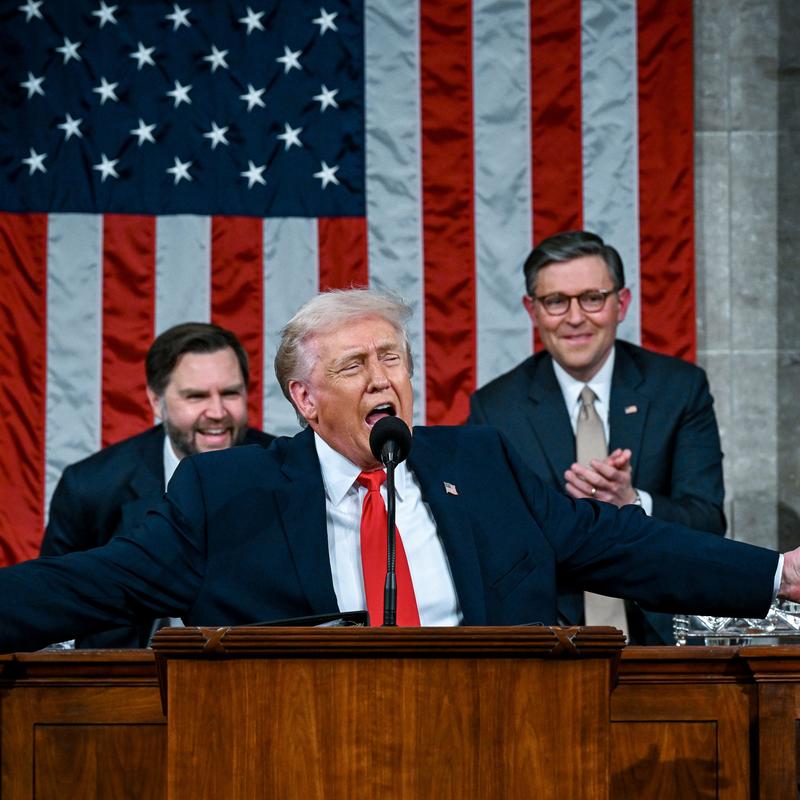
Brian Lehrer: It's The Brian Lehrer Show on WNYC. Good morning, everyone. We're going to start with a specific angle on the State of the Union address. I'll assume you either heard enough of it yourself or have heard enough coverage this morning of the speech in general. We're going to look at this as a big national campaign kickoff speech for the 2026 midterms and how it intersects with concerns that Trump will be doing everything he can to suppress Democratic votes.
Our central clip from the speech, funny enough, and we'll play it right now, is where he references Zohran Mamdani in a mostly positive way as Trump is urging Congress to pass the so-called SAVE act, which would require proof of citizenship documents to register to vote. That's not just for immigrants, by the way. Then government IDs when you show up to vote, and a nationwide ban on most mail-in ballots. Trump actually called this part of his hour-and-47-minute speech perhaps the most important part. Let's take him seriously and at his word. Here's that clip.
Trump: No more crooked mail-in ballots except for illness, disability, military, or travel. None.
[applause]
Trump: This should be an easy one. By the way, it's polling at 89%, including Democrats. 89%.
[applause]
Trump: Even the new communist mayor of New York City. I think he's a nice guy, actually. Speak to him a lot. Bad policy, but nice guy. Just said they want people to shovel snow. They got hit hard, want some to shovel snow. If you apply for that job, you need to show two original forms of ID and a Social Security card, yet they don't want identification for the greatest privilege of them all: voting in America. No, it's no good.
Brian Lehrer: All right, that from the State of the Union. With us now, Ari Berman, Mother Jones national voting rights correspondent. He's the author of the books Minority Rule: The Right-Wing Attack on the Will of the People–And the Fight to Resist It, and his classic from 2015, Give Us the Ballot: The Modern Struggle for Voting Rights in America. His latest Mother Jones article critiques the SAVE Act as a show us your papers bill. Ari, thanks for coming on. Welcome back to WNYC.
Ari Berman: Hey, Brian, great to talk to you again, and always appreciate the classic references.
Brian Lehrer: [chuckles] You heard that clip. What do you make of the comparison the president made between the ID you need to get hired as a snow shoveler in New York and to vote to determine who runs the country?
Ari Berman: I think it's an apples-to-oranges comparison, because voting is a constitutionally protected right. It's different than being hired as a snowman. It's different from needing ID to buy liquor or to get on a plane. There are higher bars you have to clear in terms of what's required for voting, because there's a history in this country of suppressing voting and putting barriers in front of people's ability to vote. Of course, the bill that Trump wants passed is much bigger than voter ID. It really is a show your papers law requiring a passport or birth certificate to register to vote. That is far more onerous than simply having to show, for example, a driver's license to cast a ballot.
Brian Lehrer: Trump referenced the proof of citizenship for registration and verification ID, when you actually vote, as having overwhelming public support. I looked it up, and he's right on those two things. For example, a Gallup poll just before the 2024 election found photo ID to vote at 84% approval and proof of citizenship when registering for the first time at 83%. Do you think this is a losing issue because it seems too much like common sense to people, and the fight for securing the right to vote should concentrate on other things?
Ari Berman: I think you should separate the voter ID provisions from the proof of citizenship provisions, because I don't think that most Americans are familiar with what proof of citizenship would mean. It makes sense that voter ID is popular because most people have a driver's license, but requiring a passport or a birth certificate to register to vote, those are things that Americans don't carry around with them on a regular basis. 21 million Americans don't have ready access to their citizenship documents, but that really understates the number because there could be a much higher percentage of people affected.
For example, 69 million married women who took their spouse's last name could have a hard time registering to vote because their birth certificate has a different last name than their current documents. That's a lot of people. By the way, that constituency leans more Republican than Democrat. Also, their requirement is that you have to show your citizenship documents in person at an elections office, which, if you live in a rural area, you could have to drive a long way to get to your elections office.
There are burdens associated with proof of citizenship that I think most Americans are not aware of. While it might poll well, I think that once something like this would go into effect, it would burden more people than I think the average American realizes. For example, when Kansas passed a law requiring proof of citizenship to register to vote, it blocked one in seven Kansans from being able to register to vote. If you blocked one in seven Americans from being able to register to vote, that would be millions of Americans who would be unable to register.
Brian Lehrer: People probably don't realize that this isn't just for immigrants who become naturalized citizens. Since, as you say, many people listening right now don't have their birth certificates handy, would have to send away for a replacement since driver's licenses don't count at registration time. People always bring up what you mentioned, married women whose birth certificates have their maiden names, but all the current IDs have their husbands' last names, so they wouldn't match. What about the attack on mail-in ballots? Who's that aimed at?
Ari Berman: I guarantee you that's not polling at 85%. It's not even something that I think would be popular among many Republicans, but because the fact is a lot of people use mail-in voting, it's heavily used in many Republican states, places like Florida, places like Utah. One of the reasons that Trump did better in 2024 was that his campaign and Republicans decided to use mail voting in higher numbers, and that's why the smart Republican strategists don't want Republicans to ban mail-in voting. That's why it's not actually in the Save America Act, because it would be counterproductive for them to be able to do so.
Trump is really fixated on this because of what happened in 2020, but the fact that people used mail-in ballots in larger numbers because of the pandemic, and Trump perceives that's why he lost. Now, I don't believe that is why he lost, but he's fixated on that. The fact is mail voting is secure, it's popular, it's used by a lot of Americans, and it's something that Americans rely on, whether they don't want to wait in a long line to vote, or they're elderly and they can't get to a polling place, or they live in rural areas where it's harder to access a polling place. There's any number of reasons why you'd want to vote by mail.
In lots of states, places like Utah, places like California, places like Oregon, Washington, elections are almost entirely by mail, and they run very smoothly.
Brian Lehrer: Why do you think, just again, to cite the president's own words from the speech, that this was perhaps the most important thing to him in the State of the Union address?
Ari Berman: I think the president is very worried that his party is going to lose the midterm election, and he's fixated with the mechanics of voting to be able to prevent that happening. The first thing he did was try to persuade all of these Republican controlled states to redraw their districts mid decade, which was really unprecedented. That has not turned out as well for him as he hoped because Democratic states like California fought back. Now he's trying to change the mechanisms of voting in other ways.
He's saying he wants to nationalize elections. He's saying that he wants to take over voting in at least 15 places. He's saying he wants to raid ballots. They've taken the ballots in Fulton County, Georgia, which is really a dramatic escalation of his administration's weaponization of law enforcement, and now, of course, he's fixated on this bill, the Save America Act, that's moving through the Congress. It's likely to fail in the Senate, and then he's promised an executive order to do many of the same things, which I have full confidence would be ruled unconstitutional, like his previous executive order.
I think that Trump is just fixated on needing to somehow change how Americans vote to prevent Republicans from losing in the midterms.
Brian Lehrer: Demographically, do Democrats vote that much more through mail-in ballots? The proof of citizenship, which would seem to apply across the board, like we said, not just to recently naturalized immigrants, but to any American, would that hurt Democrats in terms of eligibility more than Republicans for any reason? Either of those things, that or mail-in ballots.
Ari Berman: Democrats use mail voting more than Republicans now, but that's only because Trump demonized it so much in 2020 and afterwards. Before that, mail voting was more popular among Republicans. It was Republicans in places like Florida that really pioneered the use of mail voting. There really wasn't a stark partisan breakdown on mail voting in terms of-- until recently, when Trump started attacking it.
If you banned mail voting now, it would hurt Democrats more, but that's only because of how Trump has talked about this with his supporters. When it comes to proof of citizenship, if you look at the data, for example, the consistencies that have been most affected by proof of citizenship laws in other states have been people that registered for the first time. That's younger voters, people that may be lower on the socioeconomic aisle, voters of color, for example.
As I said, the way this, the Save America Act is written, it could actually hurt Republican constituencies more because married women who change their names, for example, they're more likely to be Republican women than Democratic women who took their partners names, rural voters that have to drive long distances to register to vote and elections office and show their documents there, they're going to be more likely to be Republican.
There's a lot of unintended consequences here, and I'm not sure that Republicans have completely thought this through in terms of trying to surgically target how Democrats are voting. The other angle here, Brian, is that when you put barriers in front of people to vote, it generally hurts those people that are less motivated to vote in the first place. This is going to be an election in which Democrats are more likely to be motivated to vote than Republicans.
If you put new barriers in front of people, Democrats may actually be more likely to jump through hoops to cast a ballot because they're motivated to vote in 2026, whereas Republicans who are on the fence already about voting in the midterms may just say, "I don't really want to bother." In a lot of ways, I think the bill could hurt Republicans more than Democrats.
Brian Lehrer: We're getting a few stories from listeners in texts. Listener writes, "Proof of citizenship also amounts to a poll tax. A copy of a birth certificate in New York City cost me $17 and change. A renewed expired passport cost $130." Another person writes, "I needed to request my certificate of birth abroad a while ago. It took the State Department four months to produce it." Just some of the impediments that that require that that requirement would impose.
Oh, I want to let people in on a little behind-the-scenes thing that's been going on during our conversation. My guest, if you're just joining us for another few minutes, is Ari Berman, voting rights correspondent for Mother Jones as we talk about the part of the State of the Union address that President Trump called perhaps the most important to him last night in the speech. Behind the scenes, Ari and I have been looking at SCOTUSblog because it was possible that a major voting rights decision was going to come down this morning. It did not. That'll be for another day. Ari, you want to tell people what this voting rights decision that we're waiting for from the Supreme Court is?
Ari Berman: Yes. We're waiting for a huge decision that could concern the constitutionality of the Voting Rights Act as it pertains to redistricting and particularly districts that are drawn to boost minority representation, which are known as majority-minority districts, districts in which Blacks, Hispanics, or other minority groups have a majority. That kind of district was drawn in Louisiana. A second majority-Black district was drawn there pretty recently, and Republicans in Louisiana are challenging the constitutionality of that.
This is a really important decision because if the Supreme Court were to strike down this part of the Voting Rights Act, it would allow Republicans in Southern states, and particularly possibly elsewhere too, to eliminate these majority-minority districts that are overwhelmingly held by Democrats. That's a real wild card in terms of the midterms, because this could allow Republicans to pick up a number of new seats, perhaps a dozen or more, depending on when the decision comes down. Also, the Supreme Court has repeatedly already weakened the voting rights. That's something that we've talked about at length on this show.
If they were to weaken it again, it would essentially make the Voting Rights Act of 1965, the most important civil rights law in the history of the country, a dead letter.
Brian Lehrer: Here's one more clip of the president from last night on the topic of voting. This one we just have to say is a lie. A lie that is historically intended to undermine faith in electoral democracy at all and enable authoritarian takeovers, but you'll recognize it. Listen.
Trump: The reason they don't want to do it, why would anybody not want voter ID, one reason, because they want to cheat. There's only one reason. They make up all excuses. They say it's racist. They come up with things. You almost say, "What imagination they have." They want to cheat. They have cheated, and their policy is so bad that the only way they can get elected is to cheat. We're going to stop it.
Brian Lehrer: Now we're back to the 2020 stolen election lie, Ari, but he's applying it to any election that a Democrat wins. Should we just shrug that off as Trump being Trump, or can it actually be destructive to American democracy?
Ari Berman: It can be very destructive to American democracy because it leads to more destructive outcomes. For example, seizing ballots in Georgia, threatening to take over elections, putting new barriers in front of Americans' ability to cast a ballot, building support for things like the insurrection. This is all premised on a lie. A lie that there is widespread fraud in American elections, which we know is not true. An even bigger lie, which is that noncitizens are voting in large numbers to sway American elections, which is even more untrue.
All the data shows that the cases of voter fraud in the country writ large are very small, and the cases of non-citizen voting is even smaller. That's why states are really resisting what President Trump wants to do, which is basically a federal takeover of elections in a number of different ways. Every state has some kind of security in terms of how you vote. I'll just take-- Since you mentioned New York, Brian, in New York, we just have to verify our signatures when we vote, but even that fraud would be very hard to pull off because if I wanted to vote in the name of Brian Lehrer, for example, I would have to know, Brian, where you live, what your address is, where your polling place is, what your signature looks like.
I would have to not be recognized that it wasn't you and all of that to change one vote. It doesn't actually make any rational sense why someone would try to do that. It makes no rational sense why someone who is here as a non-citizen, whether legally or illegally, would risk fine, prison, and possible deportation to cast a ballot. That's why every single study shows how rare this is.
Brian Lehrer: Just don't try it, buddy. Just don't try to vote as me or you're going to be in big trouble. Last thing, I guess the devil's advocate question on some of this. Republicans argue that these things, voter ID, proof of citizenship, mail-in restrictions, would restore faith in elections, even though they're the ones who've been tearing away at that faith. They argue this would restore faith in elections because those rules would end the controversy. 30 seconds, why not look at it that way?
Ari Berman: If someone wanted to propose some kind of grand bargain where you had ID but then you also had access to mail voting, access to early voting, something like that, then I think Democrats might be willing to entertain that. The fact is, people have lost faith in the system because Trump and his supporters keep lying about what's happening with voting. I think the quickest way to restore people's faith in the electoral process is to ensure people that the system is secure, that it's safe, and to stop demonizing your opponents and to stop spreading baseless lies about the electoral process. To me, that's the quickest way to restore people's faith and the integrity of elections.
Brian Lehrer: Ari Berman, Mother Jones national voting rights correspondent. He's the author of the books Minority Rule: The Right-Wing Attack on the Will of the People–And the Fight to Resist It, and his classic from 2015, Give Us the Ballot: The Modern Struggle for Voting Rights in America. Ari, thanks for coming on with us for what the president called perhaps the most important part of his State of the Union address on this morning after. Thank you.
Ari Berman: Always great to talk. Thank you, Brian.
Copyright © 2026 New York Public Radio. All rights reserved. Visit our website terms of use at www.wnyc.org for further information.
New York Public Radio transcripts are created on a rush deadline, often by contractors. This text may not be in its final form and may be updated or revised in the future. Accuracy and availability may vary. The authoritative record of New York Public Radio’s programming is the audio record.