
Tucker Carlson's World
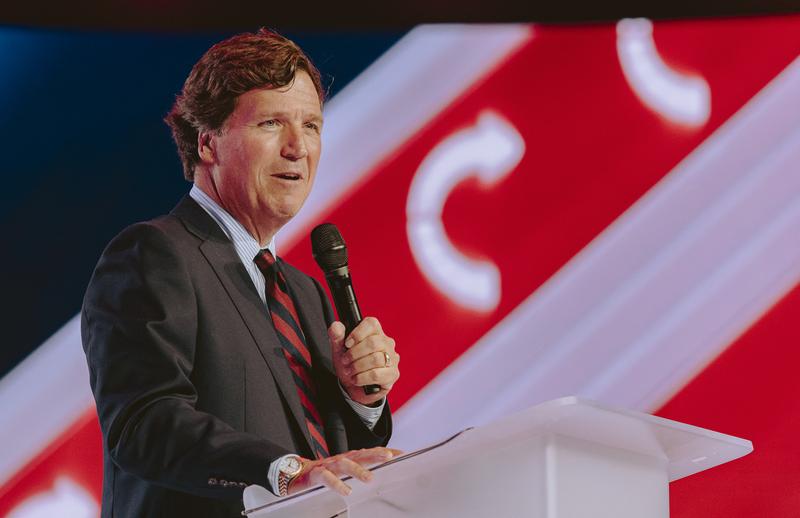
( Olivier Touron / AFP / Getty Images )
Title: Tucker Carlson's World [music]
Brian Lehrer: It's the Brian Lehrer Show on WNYC. Good morning again, everyone. We'll talk to New Yorker staff writer Jason Zengerle now about Tucker Carlson and Stephen Miller and what their rising power and apparently their popularity say about America today and how they became so influential. Jason has a new book called Hated by All the Right: Tucker Carlson and the Unraveling of the Conservative Mind. Some of what he reminds us is that Tucker Carlson was not always as conservative or far right as people think of him today. Jason, welcome to WNYC. Thank you for joining us today.
Jason Zengerle: It's good to be here. Thanks for having me on.
Brian Lehrer: I want to go right to what I think is the main takeaway from your book. Tell me if this is too reductionist. Tucker Carlson used to be a mainstream media conservative, but gradually went far right in pursuit of ratings and audiences, not so much out of true conviction. Is that the story you're telling?
Jason Zengerle: That's part of the story. Yes. I think certainly, he's responding to the incentive structure that exists in conservative media and conservative politics. I think, like anybody, they change their minds over time. I think his viewpoint has shifted a little bit and probably legitimate ways. There were significant events that occurred that had an impact on him, whether it was the war in Iraq or the 2016 election. You can't discount those, but yes, I think you've summed it up pretty well.
Brian Lehrer: To some degree, this is a story of market cynicism and opportunism more than genuine ideological radicalism as you see it, but why think this was for fame and power more than belief? What's the evidence?
Jason Zengerle: Like you said, Tucker started off in a very different place from where he's wound up today. He began his journalism career at the Weekly Standard magazine, which was the flagship publication of American conservatism. He was very much a mainstream Reagan conservative, both in terms of his economic views, his views on immigration, his views on American power in the world. He reflected mainstream conservative thought.
I think the Iraq war was a really significant moment in his ideological development. He, at the time, was the on the right host on Crossfire, the CNN debate show. It was his job to to give the Republican line on things. At that time, it was his job to to support George W. Bush's argument for going to war in Iraq. I think Tucker had some private doubts about it, but he pushed those aside and he became a public supporter of the war.
Then very, very soon after the war was started, he changed his mind and he recanted. He actually went to Iraq to write an article for Esquire magazine and saw things firsthand and saw what disaster it was. Nine months in, he was off the bandwagon on Iraq and really one of the first conservative pundits to do that. I think, to his credit, he really grappled with what led him to be wrong about Iraq and what led others, people he admired, whether it was John McCain or Bill Kristol, someone like that, what led them to be wrong about Iraq.
Conversely, he reassessed people who he had held in fairly low regard, people like Pat Buchanan, who had been right about Iraq. He wondered what else have these people been right about? I think that started leading him down the road towards a more restrictionist immigration policy, towards questioning free trade deals. I think that was legitimate. I don't think that was just pure cynicism on his part.
At the same time, I think he did see as he started going down these roads, that there was an audience out there for it. Especially, there was a real sense of energy among the conservative base for these views, for these opinions, for these ideas. He eventually launched a website where-- It was called The Daily Caller. He saw that in the traffic numbers. The kind of articles they ran, the ones that did the best traffic, the ones that had the most eyeballs, were articles that were harsh on immigration, that were about Black-on-white crime, things like that. He was able to see what conservative voters, what conservative base audience people, actually wanted.
Brian Lehrer: You say his Fox News show became the most watched show in cable news history. Who was watching demographically, geographically? Who was the audience and what made it so large?
Jason Zengerle: The audience was the typical Fox viewer, which is an older, oftentimes, usually white person. I think what made it more significant was there was one person in particular who was watching, and that was Donald Trump. Tucker was able to use his show to drive government policy. He knew that Trump was watching because Trump would oftentimes call him after a show to talk about it.
Tucker recognized that he could influence Trump's thinking and therefore influence government policy. He would craft his show with an eye towards that audience of one, he would write his monologues speaking directly to Trump. He would book guests who he knew they would say things that would influence Trump. He was really able to turn this hour-long TV show into a really kind of like vital force in American government.
Brian Lehrer: Part of your story is that most of Fox News was very skeptical of and critical of Donald Trump at first, including Tucker Carlson, but he then became the face of the network on the network of the pro-Trump movement. That was many years after he turned on the Iraq war under George W. Bush. Can you tell a little of the story of how that happened?
Jason Zengerle: Tucker had had a really checkered career in cable news. He'd worked at CNN, he worked at MSNBC. Then, by the time Trump came along in 2015 and announced his presidential campaign, Tucker was on Fox as the anchor for their weekend morning show, Fox & Friends, which is more aggressively stupid than the weekday Fox & Friends. Tucker's job was to ride go-karts around the set and do cooking demonstrations with Billy Ray Cyrus, and really just dumb stuff.
When Trump launched his candidacy, and I think people don't really remember this now, but Fox was really dismissive of him. Rupert Murdoch personally was dismissive and then the pundits on Fox didn't think Trump was a serious thing. They didn't think he was a real threat to win the Republican nomination, they thought he was a sideshow, they thought he was a distraction. Like some thought that he was actually a liberal plot to discredit Republicans.
At the same time, he was great ratings. Roger Ailes, who ran the network at the time, recognized that he wanted to talk about Trump on Fox's air because people tuned in. The problem that Fox was having was that just to produce basic television debate segment, they didn't really have anyone to take Trump's side. Tucker, because I think of his experience at the Daily Caller, because he saw the great gap between what the Republican establishment thought voters wanted and what conservative voters actually wanted, he was not dismissive of Trump.
He had some sort of personal qualms about Trump. I don't think he was a fan of Trump personally, but he recognized that there was going to be a lane in the Republican Party for a nativist candidate that ran on white grievance. He was willing to go on air and say that and that allowed him to rise up from this third-string pundit role on Fox as the Weekend Fox & Friends host, he started getting more airtime on better shows.
Eventually, look, everyone on Fox eventually got on board with Trump. The network threw in behind him, but at the end of that presidential campaign, after he got elected, Roger Ailes had been fired because of the sexual harassment scandal. Rupert Murdoch stepped in to take control of the network and the first thing he did was he made Tucker a primetime host. He rewarded Tucker's foresight.
Brian Lehrer: Since they were following the audience, this tells me that perhaps Tucker Carlson is not actually the story. Maybe the real story is the radicalism of a frighteningly large segment of white America. If it wasn't Tucker Carlson, if it wasn't Donald Trump, if it wasn't Stephen Miller, it would be somebody else to represent their grievances and their interests. Is that in a way the deeper story here than that of one celebrity podcaster and movement leader?
Jason Zengerle: Yes, [laughs] I think it is. The reason I wanted to write this book was I thought that Tucker's career and his trajectory told this larger story because he is responding to what the audience wants, and he's worth paying attention to for a couple reasons. One reason he's worth paying attention to is he has a really finely tuned professional and political radar, and we've seen that especially over the last 10 years. The fact that he is saying these things I think is a sign of where the conservative movement is headed. It's important to pay attention to him because he's a bit of a canary in the coal mine.
Brian Lehrer: My guest is Jason Zengerle, now with The New Yorker. You may have known him from some of his significant reporting in The New York Times previously. He's the author now of the book Hated by All the Right People: Tucker Carlson and the Unraveling of the Conservative Mind. We can take questions for him. I'm also going to ask him about one of his recent articles about Stephen Miller. 212-433-WNYC, 433-9692, call or text. Remind us, why did Fox dump Tucker Carlson?
Jason Zengerle: That's a great question, and I honestly don't have a satisfactory answer for you.
Brian Lehrer: Huh.
Jason Zengerle: I could not get to the bottom of that in the book. There are multiple theories, none of them I find completely satisfying. Tucker himself thinks that it was part of the settlement with Dominion Voting that after they sued Fox and Fox settled, Dominion wanted a billion dollars, Rupert Murdoch only wanted to go to 787 million, so he said we'll throw in Tucker scalp as part of it. I don't know if that's true.
Tucker had crossed a number of lines at Fox. He was, I think, viewed as a difficult but worthwhile employee. It's possible that he just went too far. There's a strange story about at the time, Rupert Murdoch's fiance was a huge Tucker Carlson fan. Thought he was a messenger from God. Rupert Murdoch invited Tucker out to his house in Los Angeles to have dinner or lunch, a meal, and the fiance was there and was so worshipful towards Tucker, it weirded Murdoch out.
He broke off his engagement with this woman the next day, and then a few weeks later, Tucker was fired. It's really hard to know what exactly happened there, but it was a shocking move when it happened because Tucker was the number one rated show on cable at the time.
Brian Lehrer: One thing that jumped out at me is that you wrote that by 2022, Carlson had developed "a populist nationalist ideology that was far more coherent than anything being offered by Trump himself." What's more coherent about it?
Jason Zengerle: He never flip-flops on immigration. He supports not only a border wall, but restrictions on H1B visas, and he just wants less immigration. Trump goes back and forth on that. He supports a crackdown on crime. Trump occasionally waffles on that. Similarly with foreign policy. Tucker is a real isolationist, a real America First person. He was against the attack on Iran. He was against the military operation in Venezuela. He since offered some qualified support for it, but I think he used these lines that Trump himself oftentimes muddies just because Trump is just inconsistent. He's not an ideologue. Tucker is an ideologue.
Brian Lehrer: I want to bring up the recent reason why Tucker Carlson has been in the news. This happened after you wrote your book, but on Nick Fuentes, an open anti Semite who Carlson interviewed on his podcast recently, again after your book was written. Carlson has been criticized on other parts of the right for giving Fuentes a soft interview. This is Nick Fuentes, who has praised Hitler. For people who don't know him, a congressional resolution condemning Fuentes quoted him saying, "Hitler was awesome, Hitler was right, and the Holocaust didn't happen."
The American Jewish Committee notes that he said on Carlson's podcast that the main obstacle within the conservative movement was "the Zionist Jews." After the podcast, he said things like, "We are done with the policing of antisemitism, the Holocaust, religion, and propaganda." Jason, it seems to go further than Carlson just giving Fuentes an easy interview, rather that Carlson himself got in on the act.
The Guardian reported on the podcast, for example, and wrote, Carlson called out Republicans, including Senator Ted Cruz, the former President George W. Bush, an ambassador to Israel, currently Mike Huckabee, for being "Christian Zionists" who have been "seized by this brain virus." This seems to be quoting Carlson, not Fuentes. Carlson said, "I dislike them," the Mike Huckabees, the Ted Cruz's, the Christian Zionists, "I dislike them more than anybody." Where do you see Tucker Carlson on the openly anti Semitic right wing spectrum?
Jason Zengerle: I think he's someone who is doing a lot to mainstream these anti-Semitic views and these voices. Fuentes and him, they have a lot of the same enemies. At the same time, in the run-up to that interview, they were engaged in this feud. Tucker had called Fuentes, he called him a weird little gay kid who lives in his parents' basement, and he suggested that Fuentes was actually a federal agent, that he was part of a government operation to discredit right-wing voices.
Fuentes return fire on his own show and called Tucker a hypocrite and opposer, and someone who wasn't a real populist. They were having this, this fight, and Tucker was actually losing the fight. Fuentes, his fans, the groipers, these young disaffected conservative men, they were siding with Fuentes, and they were attacking Tucker.
I think Tucker has come to the conclusion, and I don't think he's alone on this, that you can't be successful in conservative media or conservative politics these days without appealing to neo Nazis, to put it bluntly. He had Fuentes on his show as a peace gesture to Fuentes and to his fans to say, "I'm part of your team." That was the background for why he had him on. Then yes, he conducted this interview that was incredibly soft.
Look, I think, I think the question of platforming people is a little bit of a dumb debate, because he could have had Fuentes on and done a hard interview with him. Tucker is extremely capable of making someone look stupid. He did it to Ted Cruz just four or five months before that when he had him on his show, but he didn't do that. He asked Fuentes soft questions, and he laundered some of Fuentes's opinions.
I think that's something that Tucker is doing a lot where he's taking some pretty fringe, really far out there ideas and repackaging them and making them a little bit more palatable and presenting them to people who wouldn't have encountered them otherwise. If they had encountered those views in their rawest form, with Nick Fuentes praising Hitler and things like that, they would, I would hope, be repulsed by them. When Tucker presents them, they're not, and they become receptive to them.
Brian Lehrer: Do you have a larger take then on the right's incoherent relationship, we might call it, with anti-Semitism? On the one hand, they use it as a wedge against the left, like in that congressional hearing with the university presidents and many other things, and are ardent supporters of Netanyahu's politics. On the other hand, there are things like we've just been discussing. What do you make of it?
Jason Zengerle: There are different factions on the right. Tucker and Nick Fuentes are not ardent supporters of Netanyahu's politics. They're harsh Netanyahu critics, and they're harsh critics of Israel. In the run-up to the attack on Iran last summer, Tucker, who was quite vocal in opposing that, he gained fans on the left. There was this horseshoe thing going on where you had liberals who are opposed to Netanyahu and then some who are actually opposed to Israel itself, celebrating Tucker.
I think you're right, though, that there is some incoherence in terms of the way certainly, the Trump administration has used anti-Semitism as a cudgel against American universities and things like that. I think people like Tucker are scarily more consistent, if that makes sense. [laughs] There is no incoherence with him when it comes to Israel or anything like that. He is firmly anti-Israel, and he doesn't think anti-Semitism is a problem.
Brian Lehrer: Do you think those on the right and those on the left who are anti-Israel, as you just put it, are for different reasons?
Jason Zengerle: Some, but I think you see the agreement. Someone like Glenn Greenwald, who is a far-left figure, his criticism of Israel is very similar, if not identical, to Tucker Carlson's criticism of Israel. I think the thing that is significant about Tucker is that there are a lot of people after October 7th and after what's been happening in Gaza, both on the left and the right, but let's focus on the right, since we're talking about Tucker, especially young people who I think are troubled by what Israel is doing and are obviously troubled by Netanyahu, but it goes beyond that.
It goes to Israel itself, and I think have legitimate questions. Then someone like Tucker comes around, and they're able to capitalize on that legitimate sense of concern and question and turn it into something far more damaging, and just in some instances hateful towards Israel. I think a light bulb moment for me was when J.D. Vance went down to the University of Mississippi after Charlie Kirk was killed.
Charlie Kirk used to do these ask me anything events on college campuses. J.D. Vance was doing it at Ole Miss, and during the question and answer session, this young man, Ole Miss student, looked like an SEC frat boy, asked this question about Israel that could have come straight out of Nick Fuentes's mouth about Israel persecuting Christians and controlling American foreign policy. This was not seemingly some really politically active kid, probably conservative, mainstream kid. It had penetrated to that level. I think that comes from people like Tucker speaking to that audience and getting in their heads and leading them in directions that they wouldn't have gone in were it not for Tucker.
Brian Lehrer: Just as there's overlap between some factions of the left and the right on that, we have a couple of people who want to chime in on the overlap between the left and the right on opposition to the Iraq war, which is part of your book. Listeners, if you're just joining us, my guest is Jason Zengerle, New Yorker staff writer and the author now of Hated by All the Right People: Tucker Carlson and the Unraveling of the Conservative Mind.
One listener texts, curious that Tucker woke up one day and said the Iraq war is wrong. Yet rather than acknowledging and joining forces with those who'd been saying so all along, he continued to dismiss those on the left and co-opted his anti-war sentiment, pivoting to far-right and white far-right ideology. That's one listener. Brett in Queens is another. Brett, you're on WNYC. Hello.
Brett: Hi. Thank you for taking my call. I seem to remember on the eve of the second Iraq invasion, Tucker Carlson wrote an op ed in the New York Times that was one of the most eloquent and coherent arguments against the invasion. Yet he wasn't credited for changing his mind on Iraq much later. That seemed to be the case.
Brian Lehrer: All right, Brett. Thank you. Anything on that.
Jason Zengerle: I do not remember that op ed. I've read, I think everything Stucker's written in the last 30 years in the course of doing this book and read all the transcripts of his TV shows as well. I think he might be mistaking Tucker for someone else.
Brian Lehrer: Huh. What do you say to the texter who, again, I'll quote that part that says rather than acknowledging and joining forces with those who'd been saying the war is wrong all along, he continued to dismiss those on the left and pivoted to this, the way they wrote it, far white, far right ideology.
Jason Zengerle: He didn't become a member of Code Pink or anything like that. He certainly enjoyed punching left and attacking people on the left. He went in a paleocon direction. He made an alliance with the Buchanans of the world. He didn't align himself with lefties. That's certainly true.
Brian Lehrer: Before you go, I want to bring up Stephen Miller briefly, Trump's essential aide, especially on immigration. You had a-- it was a New York Times article right? In December called The Ruthless Ambition of Stephen Miller. He and Carlson would certainly be different on Israel, I assume, but how much part of the same movement on keeping the United States white or the so-called Great Replacement Theory, which is related to that or things like that.
Jason Zengerle: I think they're in complete lockstep. I think that Tucker, in the first Trump administration, he raved to people about Miller, and he started to get to know Miller better during that and told people that he was the single smartest political person he'd ever met. He recognized Miller as a kindred spirit back then. I think, yes, you're right, especially about immigration, especially about domestic policy.
I think they have an identical view about what they want this country to be, and that is a lot lighter than it is right now, and greater percentage of legacy Americans making up the population. It's a good question about Israel, actually. I don't know what Stephen Miller thinks about Israel, and that's actually something I would be really interested in exploring, but certainly when it comes to immigration, when it comes to things like ICE and the like, I think Tucker and Miller are very much on the same page.
Brian Lehrer: What set of beliefs or goals then motivates Stephen Miller ultimately? How would you compare them to Tucker Carlson?
Jason Zengerle: I think they're very similar. I think they have a very similar ideological project in mind. It's a return of the United States to the 1950s in terms of its demographics, in terms of its attitudes towards gender and sexual identity, and things like that. I think they have the same vision.
Brian Lehrer: Were you suggesting that Stephen Miller's position on Israel might be more complicated than I might have suggested?
Jason Zengerle: I honestly don't know. It was funny when I did that piece on Miller last year. It was being reported at the time that he was angling to become National Security Advisor. I was talking to a Trump advisor about that and asking what does Stephen Miller believe about foreign policy? What are his foreign policy views? This person said his foreign policy's views are whatever the President's foreign policy views are that day.
I don't know if Stephen Miller has really well thought out or deeply felt foreign policy convictions. It seems as if he might be someone who's willing to just go along with whatever Trump is thinking, which I think is not the case on domestic policy. I think he's the one who's driving Trump there, not vice versa.
Brian Lehrer: Last thing, do you report either in your Stephen Miller article or your Tucker Carlson book on efforts to weaken what so many people not in their movement see as hateful, racist agendas? Many of the calls and texts we get on topics like this ask essentially what can we do? Do you see, I realize you're a journalist, not an activist, but do you see effective and less effective means to counter these agendas by Democrats or others as a reporter?
Jason Zengerle: One of the reasons I wrote the book was I wanted to take Tucker Carlson seriously, and I wanted to consider him as less just an entertainer or a media figure and think of him more as a political operator and a movement leader. I think it's important that you pay attention to people like him, and you don't just ignore or dismiss them as irrelevant or not relevant to your lives. I guess that would be my suggestion is just--
Brian Lehrer: That's interesting because we have one caller who's saying, I don't want to understand Tucker Carlson, I want you to expose him.
Jason Zengerle: Tucker Carlson exposes himself every day. [laughs] I don't think you need me to expose him. I think you need to pay attention to him.
Brian Lehrer: I guess then we can leave it right there with Jason Zengerle, staff writer at The New Yorker now and author of Hated by All the Right People: Tucker Carlson and the Unraveling of the Conservative Mind. Thank you for sharing it with us.
Jason Zengerle: Thanks a lot for having me on. I appreciate it.
Copyright © 2026 New York Public Radio. All rights reserved. Visit our website terms of use at www.wnyc.org for further information.
New York Public Radio transcripts are created on a rush deadline, often by contractors. This text may not be in its final form and may be updated or revised in the future. Accuracy and availability may vary. The authoritative record of New York Public Radio’s programming is the audio record.
