
Trump's Threat to Take Cuba
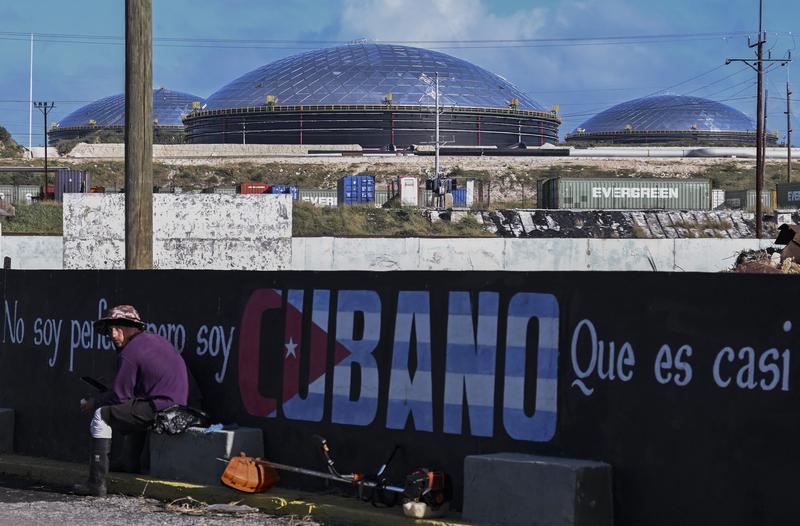
( YAMIL LAGE / AFP / Getty Images )
Brian Lehrer: It's The Brian Lehrer Show on WNYC. Good morning again, everyone. In the first hour of the show, we spoke with Senator Andy Kim about the US involvement in Iran after President Trump addressed the nation last night, but that's not the only military intervention with regime change sort of a goal, and not that we've seen recently. The US also seized Venezuelan President Nicolás Maduro, as you know, in January. Now we'll take the president at his word and ask, is Cuba next?
President Trump: Yes, Cuba is going to be next. Cuba's a mess. It's a failing country, and they're going to be next. Within a short period of time, it's going to fail, and we will be there to help it out. We'll be there to help our great Cuban Americans, who were thrown out of Cuba. In many cases, their family members were mutilated and killed by Castro. Cuba's going to be next, yes.
Brian Lehrer: President Trump speaking to reporters aboard Air Force One last week. What is next for Cuba? We're going to dig into that question in a minute with two guests, but a little context first. The capture of Maduro resulted in Cuba losing one of its major sources of fuel. Since then, the US has imposed an oil blockade on Cuba, plunging the island into an energy crisis. As of this week, there's been one small exception to that blockade. Maybe you saw it in the news. Trump personally allowed a sanctioned Russian oil tanker to dock in Cuba this week, the first oil shipment the island has received since January, according to the reports I've seen. Here is President Trump taking questions from the press aboard Air Force One on that.
President Trump: If a country wants to send some oil into Cuba right now, I have no problem with it.
Brian Lehrer: It's unclear what the White House actually wants here. The question of what comes next for Cuba is still very much open. With me now to try to make sense of it all are two reporters who've been on the island recently. Jon Lee Anderson is a staff writer for The New Yorker, where his piece is Cuba Next is out now, and Ryan Grim is a reporter for Drop Site News and co-host of the Left Right dialogue podcast, Breaking Points. He's been here with his co-host in the past. He traveled to Cuba with the Nuestra América Convoy last month. Welcome back to WNYC, both of you. Hi.
Jon Lee Anderson: How are you doing?
Ryan Grim: How are you? Great to be with you.
Brian Lehrer: Jon, let's start with that oil tanker from Russia. Cuba received what I've read as 730,000 barrels of crude Oil on Tuesday. How bad had the energy situation been, and does 730 barrels change much?
Ryan Grim: Hey, yes, it was in terrible straits. Cuba requires around 100,000 barrels a day to meet its needs. That's in addition to having obsolete infrastructure that's been causing repeated collapses of the national grid. Cuba produces about 40,000, 45,000 barrels a day on its own, but without the oil from Venezuela, principally, or any other country, Mexico is the other main supplier, it's been operating on under 40% of its needs. Really dire in every way.
They've had to postpone surgeries in hospitals. It's displaced the whole society in many ways. 730,000 barrels, I gather it will take a couple of weeks to refine it and get it into the system. It'll give them a couple of weeks max, well planned, well distributed. It's welcome, of course, from the Cuban perspective. It leaves pretty much everybody, I think, head scratching as to why Trump has changed his mind about cutting off the island from energy supplies.
A couple of thoughts on that. One is that perhaps he owed a favor to Vladimir Putin, I guess, because he could have allowed the Mexican tankers to come through, or those from any other country that wanted to help Cuba. It is, I think, noteworthy in light of everything else going on. The narrative in the media was very much focused on the humanitarian disaster that this blockade was causing. Perhaps as a way to wrest back the narrative about rather than bullying American superpower beating up on a little country, it suddenly now it's out of the goodness of the heart of Donald Trump that Cuba is now receiving oil. That's A and B to that is the B is it's clear that the US wants to be seen as the main provider for Cuba, that Cuba's destiny lies in Americans hands, and that [unintelligible 00:05:30] negotiations.
Brian Lehrer: Before we bring in Ryan, here's a clip of Secretary of State Marco Rubio speaking with reporters on the tarmac in Paris last week, referring to what people have been describing as these blackouts in Cuba as a result of the blockade that he's going to deny exists.
Marco Rubio: Everybody talks about these blackouts. Cuba's been having blackouts all of last year, all the year before. There isn't a naval blockade surrounding Cuba. The reason why Cuba doesn't have oil and fuel is because they want it for free, and people don't give away oil and fuel for free on a regular basis, unless it was the Soviet Union subsidizing them or Maduro subsidizing them. They just don't do it.
Brian Lehrer: Ryan Grim, Rubio says there's no naval blockade, and Cuba just wants oil for free. You were just there. What do you make of that?
Ryan Grim: It's just a flagrant lie, which is-- I don't know. There's something almost shocking about how blatant a lie that is. It's true that Cuba is extremely poor, and I suppose anybody would prefer free things to having to pay for things, but Cuba is willing to pay for oil. If that's truly Marco Rubio's position, and Trump's position is if he's going to maintain the position that they're not blocking oil shipments, then let's see them do it. Let's see them allow Mexico or Venezuela, for that matter, although that has other issues. Let's see it. Let them buy oil. It's just a lie.
The US, this is not based on some anonymous sources or something, they issued an executive order, or a declaration, saying that if any country sold oil to Cuba, that they would be punished by the United States because, this whole litany of nonsense, Cuba is harboring Hezbollah and Hamas, and other completely bizarre allegations. I don't know how else to say it. It's just a lie.
Brian Lehrer: Ryan, you were just in Cuba, as I said, with the Nuestra América Convoy. That convoy resulted in some pretty harsh coverage by some US media outlets, CBS's outlet, the Free Press, which is run by Bari Weiss, is now the CBS editor-in-chief, label participants Cuba's useless idiots. Their argument is that the left is providing propaganda for an authoritarian government. How do you separate your participation as a journalist from the advocacy work of the convoy if you do it all? What's your response to the assertion that you're giving cover with your reporting to an authoritarian regime?
Jon Lee Anderson: I would describe, I guess, the Free Press as running CBS News at this point. The main criticism was an old one, that there was hypocrisy because the hotel, where a lot of the journalists and others who were there, activists and others stayed, maintained its access to energy through its generators while a lot of other people lost access to it, as if that is somehow like a policy dictated by the journalists. The US in February and as Jon Lee Anderson wrote about in his piece, over the previous decades, has put in place a policy that makes it such that it is much easier for the private sector in Cuba to get access to fuel.
In February, they implemented this policy that said it was legal for other countries to sell oil to Cuba as long as they sold it to private companies. They could not sell it to the government. The obvious result of that is that things like hotels have easier access to fuel than things like hospitals, which are connected to the government. I agree with them that it's wrong that a hospital wouldn't have access to fuel while a hotel would. I would expect them then to take the next logical step and say that the policy that produces that result is wrong. As for the trip, I paid my way. It's not as if they paid us. There was a charter flight in a hotel, and we paid for the expenses of that and otherwise organized our own interviews and such.
Brian Lehrer: My guests are Ryan Grim from Drop Site News, who was just speaking, and Jon Lee Anderson from The New Yorker as we're talking about what comes next for Cuba with these two journalists who have been to and have covered Cuba, and in the context of President Trump saying again just the other day, Cuba is next, whatever that exactly means. Do we have any Cuban Americans listening right now? We would love to take your thoughts or questions for our guests. 212-433-WNYC.
Others may call, but Cuban Americans, we know so many of you are, let's say, extremely unhappy with the government in Cuba and the way it's been run and the country has been run for many years, you may call with that perspective or another one, or a question for our journalist guests. 212-433-WNYC or you can text the same number, 212-433-9692. Jon, before I go back to you, here's another clip of Marco Rubio in Paris. He was asked if he would accept a deal that allowed the Castros to remain in power. Here's part of his response.
Marco Rubio: Ultimately, the reason why Cuba is a disaster is because their economic system doesn't work. It's a nonsensical system. The people of Cuba are suffering because of the unwillingness of the people who govern that country to make the changes that need to be made so they can join the 21st century. It is sad that the only place Cubans can only be successful if they leave the country. That's a very sad thing. You see, Cubans go all over the world and find success except in Cuba. That has to change, and for that to change, you need to change the people in charge, you need to change the system that runs the country, and you need to change the economic model that it's following. That's the only way forward if Cuba wants a better future.
Brian Lehrer: Jon, that's the big thing from Rubio's perspective, who, of course, his family is from Cuba as well. Cuba is a disaster because their economic system doesn't work. It's a nonsensical system, he said, and the people of Cuba are suffering because of the decisions dah, dah, dah, for many, many, many years. Is he wrong?
Ryan Grim: I don't speak in the same sweeping absolutes as Marco Rubio or for that matter, Donald Trump, whose absolutes seem to change from day to day, has to be said. Look, I'm not sure what economy in the world works well, maybe Sweden's or Switzerland's. I'm not sure ours does exactly, but we nonetheless. This is not about defending Cuba or not. I remember Fidel Castro, 20 years ago now, actually said, we've never figured out the economy. It was a moment of unusual candor from Fidel Castro, who had begun to fall ill at that point. He was retired. He made this admission to a reporter, made headlines at the time.
Look, they've made any number of economic mistakes in their efforts to create a socialist revolution over the year. At various times, Fidel was able to hitch Cuba's horse to the Soviet Union, which saw Cuba as a useful instrument, a thorn in America's side, and kept it alive with billions and billions of dollars over 35 years. Then the Soviet Union collapsed. There was a period of penury, and until Hugo Chávez came along from oil-rich Venezuela, and another 15 years or so of oil and finances went to Cuba from Hugo Chávez, who regarded Fidel as a father figure.
Then we've had the years of penury as Venezuela's own economy has imploded. Here we are today with Maduro now in jail in New York, and the situation we have. Have they mishandled the economy? Yes, at different times. Have they tried to reform it at different times and open it up and make it a more conversant, fluent economy that reflects the changing times and aspirations of Cubans? Yes. They've also closed the door. It's not a monolithic regime or government in Cuba.
You have a mixed bag of people who are trying to protect a system that was hardened into place psychologically and in the security sense during the Cold War. That's not over yet. You also have a population that just want to live normal lives and are now connected to the internet, and they see what the rest of the world is like, and they want to be just like everyone else. That includes a lot of the young people. There's a lot of frustration at the street level and amongst the professional class and amongst their kids that there is a system in place in Cuba that seems impassive, that won't allow them to move.
There's been this kind of push-me-pull-you series of economic policies over years in which suddenly it's possible to open a little business for yourself and make money on your own, independently of the state. Then that becomes illegal, and then back again. In that sense, what Marco Rubio is saying is arguably true, but I would argue that does that give the US the right to determine who gets to run Cuba? They don't seem as concerned about, let's say, what's happening in Haiti, where there are massacres taking place.
There are no massacres taking place in Cuba. It may be an inept system, but by the way, what Trump and Rubio are trying to do today with bullying tactics, especially in terms of what Trump says rather than Rubio, who's a little more softly is not so different to what Obama actually managed to do, alas buenas, with using diplomacy, 12 years ago. Cuba did open up, and it was Trump in his first mandate that closed it all down.
Brian Lehrer: Let me get some callers in here before we run out of time. Amy in Brooklyn, you're on WNYC. Hi, Amy.
Amy: Hi, Brian. Thank you. As a Cuban American, and the daughter of someone who was actually in the Bay of Pigs and helped the CIA plan all of that, Cuba is screwed up, and we're making it worse. What is going in there going to do for Cuban people, and for Cuban Americans, and for America? What does Trump want with Cuba, and why does it matter? Is he going to go in there and leave it in a worse position than it currently is now? If he goes in there and does something, does it become a new territory like Puerto Rico? Does he go in there for all the oil and gas deposits that are in northern Cuba that are untapped? What's the point?
Brian Lehrer: Amy, thank you very much. I'm going to go right to another caller. Jay in Westbury, you're on WNYC. Hi, Jay.
Jay: I don't know what these people are talking about. Born in Cuba, grew up in Jamaica, came to the United States. Father's Cuban. In fact, all the arguments, particularly for your first guest, we resent, Cubans resent. The reason why we resent it is we want America to take their boot off of our neck, allow our society to flourish. Look, if it wasn't for Cuba, the Angolan war-- We sent our Cuban men there in order to free South Africa. If it wasn't for them, South Africa wouldn't have been free.
The Israelis basically supported South Africa. No one is talking about that. In addition to that, now what Rubio is talking about is legacy. United States don't like Cuba, because in fact, we fronted them and we said, no more imperialism. Let us figure out our society, and that's all we want to do. The United States turned around, rightfully, Kennedy said, "Okay, we will back off and allow you."
The fact of the matter is, when he backed off, he turned around, and because of deep resentment in his gut, because this comes to again, where in fact, you front white ideology. In fact, when it got put down, it was a resentment, and this resentment has been going on for decades now [unintelligible 00:19:29] period.
Brian Lehrer: Jay, let me leave it there and get one more on here. I know what some of you are thinking. Why did he have to throw an allegation against Israel into that? Set that aside. Is that Ryan, very briefly?
Ryan Grim: Yes, just real quickly. It is absolutely the case that Israel supported the South African apartheid government, and it is absolutely the case that the Cubans supported the Angolan government in its war of defense against South Africa. Nelson Mandela himself said that without Cuba's intervention, they may not have been able to break the back of apartheid. I think what Cuba did in Angola and did to apartheid South Africa is a genuinely humane and historic contribution of the Cuban people.
Brian Lehrer: That was the 1980s. It doesn't necessarily do anything for the Cuban people in the situation we're talking about for them, right?
Ryan Grim: It's a fact. It happened, and it's something that doesn't get talked about much. Good for them.
Brian Lehrer: Fair enough. One more. Manuel in Wesley Hills, New York, you're on WNYC. Hello, Manuel.
Manuel: Hi, Brian. How are you? I was in Cuba last year and at a trade show called [unintelligible 00:21:01]. Most of Cuban people want changes, but those changes with our jobs and with our leader will create chaos in the country. That is what I want to say. God bless America. That's all.
Brian Lehrer: Manuel, thank you very much. One text to finish off the listener input, and then we'll get one last thought from the two of you. Listener writes, "As a Cuban American, I selfishly welcome and encourage the US Government's intervention in my former home country, despite the clear violations of sovereignty and international law involved and the terrible precedent it sets. Maybe it goes to show how self-interest can blind you from objectivity." Very interesting two-part thought there from that listener, Jon Lee Anderson. Where do you think Trump is headed with this when he says Cuba is next? Is he going to intervene and change that regime?
Jon Lee Anderson: From what I understand, it's very much on the agenda that they want to see this change. It was a foregone conclusion, given the fact that this is a Florida-based White House and Rubio and other Cuban Americans are prominent in it, that Venezuela and Cuba would be high on the agenda, and we've seen that it is. Much as I don't know that they have a clear idea of what they're doing in Iran, I don't think they're entirely certain of how to proceed in Cuba.
I think they thought that they're on the ropes, as we hear from Trump, therefore, they'll negotiate if we asphyxiate them. It's like coming across a man already on oxygen and ICU. You squeeze the tube, and when he begs for you to take your hands off, you say, "Okay, but what are you going to give me in return?" That's what they've done [unintelligible 00:22:57]
Brian Lehrer: 30 seconds for a last thought from you, Ryan Grim.
Ryan Grim: 30 seconds.
Brian Lehrer: On the same question. What do you think Trump really means by Cuba is next?
Ryan Grim: I agree with Jon Lee Anderson that I don't know if Trump knows what he means. I don't think he knows what he's doing in Iran either. He presents that as like this 12D chess, I think they called it in Axios yesterday, which is keeping everybody off guard. I think he has no idea what he wants.
Brian Lehrer: Ryan Grim, reporter for Drop Site News and co-host of the podcast Breaking Points. Jon Lee Anderson, staff writer at The New Yorker. His latest piece is titled Is Cuba Next? Thanks, both of you. Thank you very much.
Jon Lee Anderson: Thanks a lot.
Ryan Grim: Thank you.
Copyright © 2026 New York Public Radio. All rights reserved. Visit our website terms of use at www.wnyc.org for further information.
New York Public Radio transcripts are created on a rush deadline, often by contractors. This text may not be in its final form and may be updated or revised in the future. Accuracy and availability may vary. The authoritative record of New York Public Radio’s programming is the audio record.
