
Trump's A.I. Video "Propaganda"
Title: Trump's A.I. Video "Propaganda" [MUSIC]
Brigid Bergin: It's The Brian Lehrer Show on WNYC. I'm Brigid Bergin, filling in for Brian today. On Saturday, protesters in over 2,500 cities across the United States participated in the No Kings movement, a network of progressive organizations that are fighting against the Trump administration's policies. The movement accuses President Trump of acting more like a monarch than an elected official. In response, President Trump characteristically took to social media, but this time it was a little different. The president posted an AI-generated video depicting himself as a crown-wearing fighter pilot flying over American cities and dropping excrement on the No Kings protestors.
The video is just the latest example of the shift by the president, who is using more and more fake imagery to misrepresent his achievements in office and attack his perceived opponents, sometimes with degrading images and audio.
Our next guest argues the era of AI propaganda is here, and President Trump is an enthusiastic participant. Joining us now is Stuart A. Thompson, reporter at The New York Times, covering online influence. Stuart, welcome to WNYC.
Stuart: Thanks for having me.
Brigid Bergin: Listeners, for those of you who are out there who have seen these AI-generated images and videos coming from the Trump administration, we want to hear some of your reactions. As we'll discuss, some of the imagery can come across as pretty realistic. Maybe you know friends or family members who are scratching their heads, thinking, wait, is this thing real? Do you know anyone who is supportive of this kind of political messaging? What do they tell you? Or anything you'd like to ask our guest about misinformation online and what he calls AI propaganda. You can give us a call now at 212-433-WNYC. That's 212-433-9692. You can also text at that number.
Stuart, the messaging we saw from the president over the weekend, that AI-generated video of him in a crown dumping excrement on protesters from a fighter jet, you note that it's actually nothing new. Can you take us back to the origin of Trump's fascination with these videos and images?
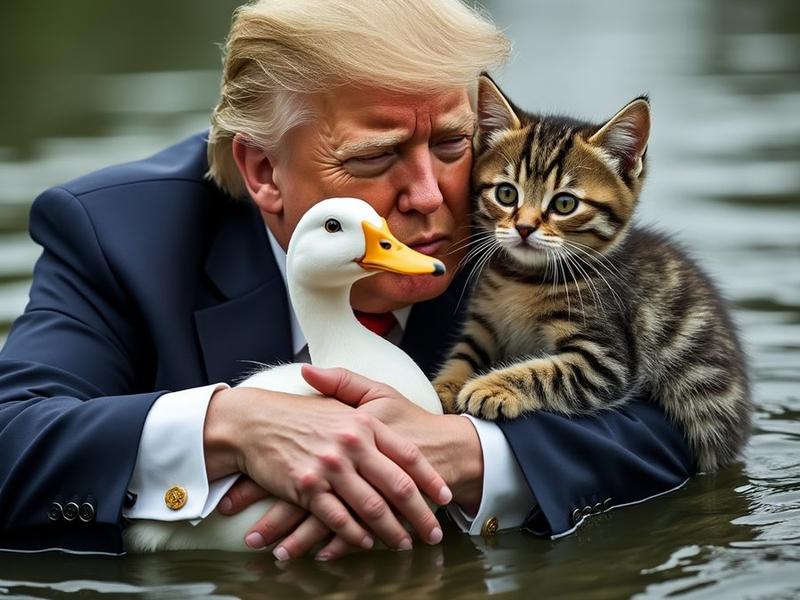
Stuart: Yes, his use has really increased along with the technology as it's gotten more popular. He really started using it at the very beginning of his campaign to be re-elected. There was a moment during the debate with Kamala Harris where he talked about Haitians eating cats and dogs in Ohio as a conspiracy theory. There was a big backlash to that, and he responded by posting images of him saving cats and dogs. His supporters liked that. They supported it, shared those images, thought it was funny.
That was his way of defusing criticism at the time, and showed the possibilities of this new technology to very quickly create images that feature a realistic version of the president with whatever he could imagine, whatever the people around him or other social media influencers could imagine. He's really just continued down that road since then, posting all kinds of stuff, as you mentioned, up until this most recent video.
Brigid Bergin: As you say, though, he's continued down this road, and yet it seems like there's been a shift. You were writing in this piece about how Trump has demonstrated a willingness to use AI-generated content to skewer opponents and stoke deeper tensions. I wonder if you can talk about some of the videos Trump has created that disparaged Democrats like Senator Chuck Schumer and Representative Hakeem Jeffries.
Stuart: Look, we don't totally know where these images and videos are coming from, if someone in the White House is making them. Oftentimes, they are credited to other influencers, so it's a little unclear exactly the origins. Recently, the two Democratic leaders talking about the shutdown, Trump posted one video that was edited with AI to replicate Chuck Schumer's voice — that's another use case, another technology that exists. You can clone voices — and made him say a bunch of disparaging things about the Democrats. Not using AI, but using old-fashioned video editing, they put a sombrero on Hakeem Jeffries and a mustache.
Then Hakeem Jeffries goes on television to talk about it, and that clip was posted later by the president using AI versions of himself depicted as a mariachi band playing behind him. Doubling down once again on criticism by using AI to, I guess, mock the criticism.
Brigid Bergin: A researcher you spoke to told you, "The more ridiculous the photo or video, the more likely it is to dominate our news feeds." How come what sometimes seems is the most blatantly fake content seems to garner so much attention?
Stuart: There's a visceralness to it, a potency to it. There's maybe a bit of excitement around that the technology can do this. You can put Trump or other popular figures in strange positions in ways that you couldn't do with previous tools. Photoshop has existed for a long time. People can edit images for a long time, but this is a visceral new way to do it. One of the examples that we put in the story was a video of President Obama being arrested by the FBI. That's an AI-generated video. It looks pretty convincing though. Even in the comments that we went through on Truth Social, a lot of people were asking if it was real.
It's just a very potent, powerful way to use imagery. Imagery is a very powerful political tool, and this is just another tool in the toolbox that people can use to make their images and ideas come to life.
Brigid Bergin: Let's go to Kerry in Greenwich Village. Kerry, you're on WNYC.
Kerry: Thanks so much. I just wanted to suggest that a lot of Trump followers actually aren't on social media, particularly the older ones. To judge from my family members, when I point out this sort of vulgarity and childishness, they're indifferent. It's just shocking to me that they could witness this degradation of culture and politics and be indifferent. I can't believe they're the only ones who feel this way among supporters.
Brigid Bergin: Kerry, thank you so much for your call. Stuart, in your reporting, was there any information or analysis about why it is some of these images, as we were talking about, that are extreme and sometimes seem to be mocking institutions, people are able to absorb, take with a grain of salt, not necessarily take as serious as those who maybe oppose those images do?
Stuart: You can't discount, really, the humor factor in this and what some people might see as crude and offensive. We've heard from a lot of Trump supporters through this and other reporting that they find it funny, and that's a big part of his brand and his political personality. In previous years, in previous presidencies, someone might issue an apology, someone might get fired for posting something on social media that maybe they shouldn't have, or cause blowback. Trump's political instinct is to double down, and people see that as a permission structure. That's the case with the AI content as well. It's opening up the door to using this.
We reported on Trump's use of AI, but other institutions have used it too in the federal government since Trump was sworn in. I think one of the prominent examples was ICE. The ICE account on X posted an AI-generated-- sort of looks like an anime of someone being arrested based on a real photograph. It's broadening out the permission structure, giving people more options for what they want to post. Then the supporters and people find it funny or counterintuitive, something that they wouldn't expect the president to post.
Brigid Bergin: Let's go to David in Brooklyn. David, I think you're calling in to say that you like these memes. Correct?
David: Yes. Good morning. I love your show. You're a great fill-in host. Thank you for taking my call. Yes, I think Trump is responding to a totally preposterous and ridiculous sentiment. They call it the No Kings rally, which is total propaganda. He was voted by a majority of the population, he won the popular vote, he won the Electoral College, and there's no kings at all. This government is shut down; he can't even open it. He said during the election, "I am going to deport every illegal," so there's nothing kings about him. The left goes with this preposterous propaganda against him. He is so good at doing this, taking the wind out of what they do, and he does it with humor. Big deal. I love it, it's great. It's the best thing that ever happened.
Brigid Bergin: David, can I ask you a question? We're getting a lot of text messages from other listeners who are not as much of a fan of this style memes. One of the sentiments that I've seen a couple different times are people writing a version of Republicans who support Trump's AI video and laugh at it are the same people who blasted Obama for disrespecting the presidency when he wore a tan suit. My question to you, as someone who finds this as a strategy that is effective, do you sense any double standard in terms of how some previous Democratic presidents have been treated?
David: Other than President Clinton remodeling the Oval Office into a bedroom, I have no problem with any color suit that Obama wore. Any president could wear any color suit they want. I found no disrespect. I don't think Obama ever disrespected the office, so I don't agree to that at all. No, I don't see that.
Brigid Bergin: David, thanks for calling, thanks for listening. We appreciate it. Stuart, clearly, David was locking in on the humor aspect of it. Is that some of what you're hearing from other folks who say that these are effective means of communication?
Stuart: Yes, definitely. It's nice to get a call like that. That's definitely a part of it. He posted a version of himself as the pope. He made a comment about that in an interview, I think, and yes, posted an AI version of himself. That's funny to some people, and to a lot of religious people, it wasn't as funny. I think you saw some unusual or unexpected pushback from that group. He's willing to test those boundaries and test those lines, and often will double down when faced with pushback. If people are upset about something or maybe what he's posting, he's more likely to post more of it.
I think you saw that in the Hakeem Jeffries example, where people were upset about the video, called it racist, and he was happy to post a second version of it. It's definitely his style and seems effective for a group of voters who appreciate that kind of humor.
Brigid Bergin: I want to play another clip. After the government shut down over funding earlier this month, Trump posted a video depicting himself and members of his cabinet in cloaks, with Russell Vought, the director of the United States Office of Management and Budget, depicted as the Grim Reaper. The video and its AI-generated lyrics are set to Blue Öyster Cult's (Don't Fear) The Reaper. Let's take a listen.
Russ Vought is the reaper
He wields the pen, the funds and the brain
Here comes the reaper
Dems you babies
Here comes the reaper
Gonna tie your hands
Here comes the reaper
Won’t be able to fly
Here comes the reaper
Baby, end your plan
Brigid Bergin: Stuart, you write about how the video was created by Dilley 3000 Meme Team. Can you tell us a bit more about who is making this content for the President?
Stuart: This is one example. They're sort of a guerrilla messaging outfit. They collaborate together online, they organize online. It's run by a podcaster, a former congressional candidate named Brenden Dilley. They make pro-Trump media of all kinds with the goal of making it go viral. He said a few times that the truth doesn't matter, all you have to do is go viral, reflecting their philosophy. By whatever means they post it, it gets in Trump's orbit and he's reposting it on his Truth Social account.
They've made a number of these types of content, and it's proven very successful for them. They're very active and very ruthless about it though. They'll go very far and try a bunch of different things to see what they can get to hit. It's an AI-generated video. It also uses a bunch of editing. It's a pretty sophisticated piece of material, even though the content is supposed to be funny, and talks about an issue that's maybe not so funny.
Brigid Bergin: Stuart, there's other groups. The Dor Brothers was another example you wrote about that has created some of this viral AI content, so-called AI artists. It sounds like these are folks who are doing this work. Do we know if they're being paid or commissioned by the Trump administration in any way?
Stuart: We don't know that. It wouldn't surprise me that, like this, as the technology gets more advanced and is easier to use, there's going to be more and more groups in a more official capacity using this content and using the tools to create it. This is the purpose of the story, a little bit, is to try to show that this tool is normalized now. What you might think of as photography in the past or video in the past, now it's AI. It's just going to be part of the political discussion. It has been since it was rolling out around 2022, since the image and video tools got sophisticated enough.
We have seen it in other elections. Far-right parties will use it to bring to life anti-immigrant messages using sometimes obviously fake images, but it is, again, the potency they get out of it to connect with voters. We'll probably see it in official channels and official campaigns, but then also these more guerrilla units that are bouncing around. The Dor Brothers, they're non-political. They're creating what they would think of as AI art, but that's another aspect to it. It's getting more sophisticated. There's money going into an investment, and companies and groups set up to be able to do it.
You can definitely imagine part of the political strategy budget is going to be poured into groups that are able to make content in the future, if not already.
Brigid Bergin: Stuart, my understanding is this kind of content is widely referred to as AI slop. It's a derogatory term used to describe the more nonsensical AI-generated content. You call it AI propaganda in your recent piece. When does this AI slop become propaganda?
Stuart: Well, it's coming from the President. It's pushing a political message. Even the cases where it looks like slop, as in looks very AI and fake, or it's trying to be funny, there's an underlying political message to it. Sometimes that message is just mockery, as the caller was trying to suggest with the excrement video, and other times it's attacking a specific group or a political opponent, a rival. There's a political underpinning to all this stuff, and that probably everything that Trump does, including all of his Truth Social posts, are aimed at that goal. We're seeing it again, more from other institutions. Agencies and political groups around the world are using it as well.
Brigid Bergin: Stuart, a listener wrote a text that reads, "AI-generated propaganda is a horrible new trend. How does your guest feel about California Governor Gavin Newsom fighting back against Trump using similar AI imagery? Isn't this the start of an ugly new trend among candidates of both parties?
Stuart: Yes, that's definitely the reality that we're entering. Newsom's willing to use the tool, and it's just a tool. It can be used for good or bad. It can be helpful. There's these videos Trump posted that are just him dancing with Elon Musk. It's political, and he's a collaborator — was at the time — and they had ideas for working together, but isn't demeaning necessarily or very strongly political. It's opening up that permission structure for people to use it, and it's almost irresistible, I think, now for a lot of political candidates.
We're also looking at lower down the totem pole for political candidates at the local level for them, and we hear this from AI advocates. It's a useful tool. It's a way for them to create better material that might resonate better with people with a much lower budget. The stuff is cheap, it's easy to use-
Brigid Bergin: Sure.
Stuart: -so we'll probably see more and more of that as well.
Brigid Bergin: Stuart A. Thompson is a reporter at The New York Times covering online influence. You're going to be very busy, I think. Thank you so much for making some time for us today.
Stuart: Thank you.
Copyright © 2025 New York Public Radio. All rights reserved. Visit our website terms of use at www.wnyc.org for further information.
New York Public Radio transcripts are created on a rush deadline, often by contractors. This text may not be in its final form and may be updated or revised in the future. Accuracy and availability may vary. The authoritative record of New York Public Radio’s programming is the audio record.
