
Trump Escalates Tensions Over Greenland
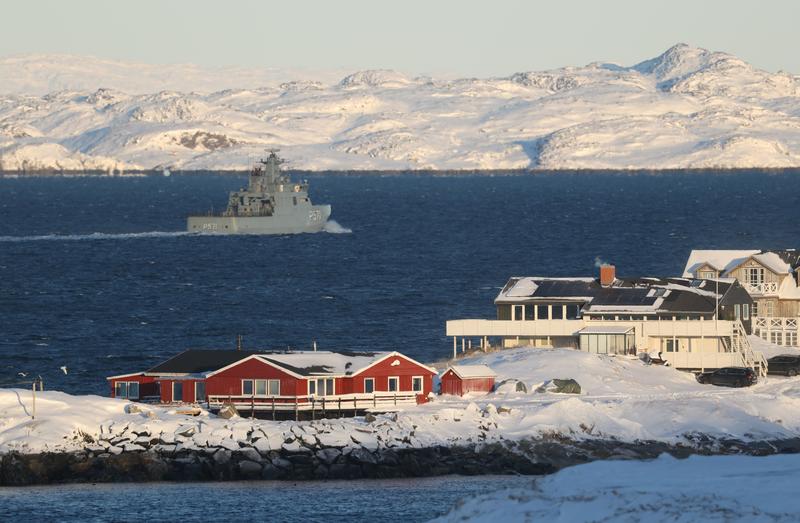
( Sean Gallup / Getty Images )
Title: Trump Escalates Tensions Over Greenland
[music]
Amina Srna: It's The Brian Lehrer Show. I'm Amina Srna, a producer for The Brian Lehrer Show, filling in for Brian today, who is off taking care of a family member who's dealing with a health issue. Coming up on today's show, we're going to talk about grocery prices. The high cost of food shopping was a part of Mayor Zohran Mamdani's affordability-themed campaign. He even proposed a pilot of city-owned grocery stores to try to combat the issue. My guest, urbanist Stephen Smith, wrote about another idea for the journal Vital City that he says will bring prices down, making it easier to build new grocery stores.
Plus, for our Health and Climate Tuesday series, we're going to talk with New York Times global health reporter Apoorva Mandavilli about how the United States may be about to lose its measles-free status. 2025 was the worst year for measles cases here in about two decades. The outbreaks are continuing right as vaccinations are lagging. We'll wrap today's show with a question: How cold is it? If you've been outside today, well, it's freezing. We want to hear your tips, too, on how to stay warm and safe when the high temperature for today is in the low to mid-20s. First, we begin with President Donald Trump's ongoing attempt and recent escalation to acquire Greenland.
Over the weekend, Trump has said the US Will impose additional tariffs on eight European countries until the US has had a deal to acquire Greenland. Trump proposed a 10% tariff starting February 1, which he says he will raise to 25% in June if Europe doesn't capitulate. Those countries are all members of NATO and have said they stand with NATO member Denmark and its autonomous territory, Greenland.
In multiple social media posts overnight, Trump shared private messages from world leaders, including one from French President Emmanuel Macron that reads, "I do not understand what you're doing on Greenland." President Trump is expected to leave for the World Economic Forum in Davos, Switzerland, this afternoon. He's scheduled to speak tomorrow. US Treasury Secretary Scott Bessent is already in Davos, and today he seemed to issue a warning to European leaders.
Scott Bessent: The worst thing countries can do is escalate against the United States.
Amina Srna: Trump has repeatedly said taking control of Greenland is vital for US national security, frequently citing concerns about Russia and China's Arctic influence. He has suggested purchasing Greenland, which is not for sale. The White House declared in a statement that using the military to annex Greenland is "always an option." According to a recent YouGov poll, about three-quarters of Americans oppose taking Greenland with military force, with majority opposition across the political spectrum. Joining us now to explain all the latest and what European leaders can do to defend Greenland is Matt Steinglass, Europe editor at The Economist. Matt, welcome to WNYC.
Matt Steinglass: Hi, Amina.
Amina Srna: Listeners, anyone out there listening with ties to Greenland, Denmark, or any of the European countries now in the crosshairs of Trump's additional tariff threats, what do you make of European leaders seemingly putting their foot down on Greenland? Long time coming, or are you worried about escalating tensions like a potential trade war? What are you hearing from news media outlets or friends and family back in your country? 212-433 WNYC. That's 212-433-9692.
You can also text that number, and as always, we can take any of your comments or questions on this, whether or not you have ties to Europe. 212-433 WNYC. That's 212-433-9692. All right, Matt, let's start with tariffs. What is the latest that Trump is threatening and why?
Matt Steinglass: The why question is subject to dispute, but what he is threatening is to raise tariffs from European Union countries to the United States by an additional 10% on top of the 15% that he already imposed back in April. We've done an analysis of what the impact of that would be. Tariffs, of course, make everybody poorer. They will hurt America's economy and Europe's economy. They'll hurt Europe's economy a bit more. Europe exports more to the US than the US Exports to Europe.
The analysis we did, back of the envelope-- Well, back of the envelope is too unkind to our economists. It's a good analysis, but you have to do some estimates. It looks like it would cost Europe's GDP about 0.04% of GDP if the US imposed those 10% tariffs on the eight countries who had sent troops to Greenland. That is hardly something that's going to drive Europe into recession.
Amina Srna: Oh, pardon? Go ahead; finish your thought, please.
Matt Steinglass: Well, the second point just that Trump says if Europe then doesn't respond to his threats, eventually the tariff would go up to 25% over the summer. That would hurt Europe a bit more.
Amina Srna: There was so much. I'll ask you a little bit more about your colleagues reporting on the tariffs and how it will impact European nations and also American consumers. First, there's been so much news over the weekend. Can you just remind listeners who may have missed it about the European troops in Greenland? Who sent how many over or broadly, what has been the response?
Matt Steinglass: The initial deployment was an attempt by NATO countries to respond to what Donald Trump said was his concern over Greenland, which is that there is a mounting security threat in the Arctic, largely from Russia and China. Those concerns are actually somewhat illusory, but responding to that complaint, some European countries sent a few troops. It was a small symbolic initial deployment of reconnaissance troops.
I can't remember the total, but we're talking about perhaps a couple of dozen people at the outside. That was the initial deployment, and that was what triggered the American response and the threats of tariffs. Since then, Denmark has deployed more troops. Several planes arrived today. The numbers that I've seen are in the hundreds.
Amina Srna: Let's go to the European response. Here's UK Prime Minister Keir Starmer on the tariff threat recently.
Keir Starmer: Alliances endure because they're built on respect and partnership, not pressure. That is why I said the use of tariffs against allies is completely wrong. It is not the right way to resolve differences within an alliance, nor is it helpful to frame efforts to strengthen Greenland's security as a justification for economic pressure.
Amina Srna: pretty clear pushback on Trump's proposed tariffs from UK Prime Minister Keir Starmer yesterday. Matt, can you tell us more about European leadership's responses?
Matt Steinglass: The threat of tariffs is a bit of a step change for European leaders. I think Europeans who had hesitated to acknowledge how far America's approach to Europe has diverged in this administration from previous ones have now recognized that things have really changed. In the way that European diplomats talk about the United States, there's been a real shift. You've seen very strong statements over the last couple of days from previously hesitant leaders like Friedrich Merz of Germany, stating that American threats of tariffs are completely inappropriate.
Greenland is part of Danish territory, and that the threat by a NATO ally to take territory from a fellow NATO ally poses very serious risk to the integrity of NATO. Also from European leaders who you might have expected to be more aligned with MAGA, such as Giorgia Meloni in Italy and the current leader of the Rassemblement Nationale party in France, a very populist, nationalist MAGA, but European-style party. Jordan Bardella was adamant that the United States threats towards the territory of a European country were unacceptable.
Amina Srna: EU leaders have threatened to deploy the bloc's anti-coercion instrument. It's being widely referred to in the media as the "big bazooka." Can you explain what that is?
Matt Steinglass: Yes. Normally, just to take a step back, the first tariff retaliation that's likely from Europe would be to bring back on the table a package that had been assembled last spring when President Trump initially unveiled tariffs against Europe, which is a retaliatory package of tariffs on $93 billion worth of American exports. Those would be more traditional tariffs on things like whiskey, which might induce European consumers to buy Irish or Scottish whiskey instead of Tennessee whiskey if they have that option. The anti-coercion instrument is much broader.
What it does is it allows the European Commission, the executive body of the EU, to look at an entire sector and say, "The United States is not going to be able to participate in that sector." It could block American companies from purchases by European governments. It could designate a sector like, let's say, tech, and say, "American companies in this sector are seen to be exercising inappropriate power, and we are going to hit them with heavy restrictions." It gives European bureaucrats a freedom to operate and how they would respond to American threats that they don't normally have.
Amina Srna: The Economist yesterday reported that Europeans are no longer shocked by the threat of tariffs. A good time to remind listeners that these countries already have tariffs in place, as you mentioned. Can you explain how they see further tariffs as a "nuisance," as you and your colleagues put it?
Matt Steinglass: Tariffs that are applied in the way that the current tariffs are outlined, there are a lot of ways to get around them for companies. For example, many European companies have operations in the United States as well. If you're an auto manufacturer, like BMW, let's say, who also has factories in the United States, then you can shift your sales in the United States more towards production that comes from the United States and so evade the tariffs more effectively.
Interestingly, these tariffs are targeted only at the eight European countries who had sent troops to Greenland, which means that you could possibly export to the United States via other EU countries that did not send troops to Greenland and evade the tariffs that are being threatened at the moment. There are some sectors in the EU that would be more heavily exposed. Pharmaceuticals, for example, sell a lot to the United States and have relatively few operations in the United States.
It would be harder for them to evade these kinds of tariffs. One of the effects of instituting tariffs would be to encourage European companies to produce more in the United States and get around the tariffs that way, but the revenues would still flow to the European countries.
Amina Srna: Let's go to a caller. Alex in Manhattan, you're on WNYC.
Alex: Hi. Can you hear me okay?
Amina Srna: Yes. Hi.
Alex: All right. Hi, good morning, and thank you for taking my call. I've just been looking for an answer for this, and that is with Trump threatening to take over Greenland. If Denmark is part of NATO, why do we need to threaten this action of taking over Greenland for its own protection? If Denmark is part of NATO, isn't Article 5 then going to be executed if Russia or China were to do anything Greenland, because that seems to be his premise, he's saying? If that's the case, isn't his point mute?
Amina Srna: Alex, thank you so much for your call. Matt, yes, we've covered this on the show before, but it bears repeating some of the reasons why the US has singled it wants Greenland. Some explicitly stated by the president and his cabinet, others put forth by analysis, but let's dig into what Alex is talking about there. Why is Greenland important when it comes to potential missile defense or defending the United States or Greenland itself?
Matt Steinglass: Well, Alex is absolutely right that Article 5 of NATO would protect Greenland already. More than that, the United States has a defense treaty with Denmark, signed 1951, that is extremely broad and allows the United States to deploy an essentially unlimited number of troops to Greenland if it wants to. If the United States is concerned about a security threat in Greenland, it has the freedom to deploy whatever military assets it wants to in order to protect against that threat.
In fact, Denmark has complained in recent years that the United States has decreased its military presence in Greenland. It's down to a fraction of what it was during the Cold War. Greenland is important in certain ways militarily. It's important for monitoring Russian submarine activity in the North Atlantic. It's important, as you mentioned, for missile defense. It's unclear why there would be any threat to those activities. The supposed threat of Russian and Chinese intervention appears to be imaginary.
No one has noticed an uptick in Russian or Chinese naval operations around Greenland. Russia has its hands full on Ukraine at the moment. It's very unclear what's actually going on here. It seems from the perspective of most European analysts; this does not seem to be driven by rational security or economic interests. It seems to be driven by either political interests on the part of the Republican Party or by a personal psychological commitment. It's Donald Trump's own psychological drive.
Amina Srna: I'll ask you about the psychological drive in a bit, but here's a text. "If the EU retaliates against US tariffs tied to Greenland, what concrete harm would that cause to the US Economy? Is that risk being underestimated?" Paul from Brooklyn asks. I know you're European editor for The Economist, but your colleagues crunched a couple of those numbers. You mentioned US Pharma would probably be impacted. Do you want to talk a little bit more about the harm to the US Economy? We know, or we have heard analysis on how tariffs impact the consumers more than the people exporting the goods, right?
Matt Steinglass: Yes. So far, the impact of the tariffs that were already imposed on Europe this spring has fallen almost entirely on American consumers. European companies have not dropped their prices in the US in order to take up some of the impact of the tariffs. The overall impact of the new tariffs it's slightly lower on the US than on Europe. It's not huge for either country. I think our analysis is that it would decrease America's GDP by about 0.02%. If they go up to 25%, then the impact of the US GDP would be 0.08%. These are not amounts that are going to have a tremendous impact on prosperity.
Amina Srna: Let's go to another caller, Deborah in Jersey City. Hi, you're in WNYC.
Deborah: Hi, good morning to you and your guests. The question nobody seems to be talking about or asking is Greenland's population is mostly Caucasian, at least from what I can see. He's always talking about why we can't have immigration from countries like Norway, Sweden, Denmark, which are mostly Caucasian. I think this is another way, which nobody is saying and nobody is asking for him to get add to the population of the country by a country that's a territory that's mostly Caucasian.
They're just using national security because if Greenland is a part of NATO, and if someone would attack it, and the other NATO countries would come to their defense, his argument for national security makes no sense. It seems to me this is just another way to add more Caucasian people, because we all know he's a racist and a bigot.
Amina Srna: Deborah, thank you so much for your call. Matt, I do believe that Greenland is a majority indigenous Greenlandic population. I think Deborah's call was going towards maybe the psychological reasons of Donald Trump that you were starting to talk about in an earlier answer. What would you like to say to Deborah, or making that segue to the psychological- the mindset of Donald Trump?
Matt Steinglass: Right. We should note first that I think you're right, that the majority of Greenland's population is Inuit, although a lot of people are mixed Inuit and Danish. The second point is that the population of Greenland is tiny. There are about 50,000 people who live there, which is probably smaller than Red Hook. I don't know. In terms of the population consequences, it's negligible. To move on to psychology, it's a country that's tiny in terms of population, quite large in terms of land mass. It's not quite as big as it looks on the Mercator projections of the map that you see, but it's still pretty big. It's bigger than Louisiana Purchase was in the 19th century.
The psychological boost that Donald Trump might get, or the political boost that he might get from adding a substantial landmass to America's territory, might be playing into is his reasoning. That's speculative. I'm not sure it's actually a good idea to speculate about what his motivations are, but it's certainly not a very rational calculus. The secondary, the possible rational calculus, which is often advanced, is Greenland is very rich in minerals. It's got a lot of rare earths. Those rare earths are largely buried under about a mile of ice. It's not an easy place to mine. The economic calculation doesn't seem to make a lot of sense either.
Amina Srna: We're getting some calls and texts on the rare earths, the rare earth elements. According to the BBC, China currently dominates the global rare earth supply chain, controlling about 90% of the world's processing and refining. How does Greenland compare in terms of untapped resources? Is that something that would help the US in Trump's mind, get away from depending on China?
Matt Steinglass: In the far future? Possibly. Rare earths are-- It's a bit of a misnomer. The elements aren't that rare, but they are concentrated very conveniently in some places. Geologists say that the way that they're concentrated in Greenland is somewhat unique and makes them easier to refine. The most expensive part of rare earths is the refining process rather than the mining process, usually. You could imagine that being the case in the distant future.
It depends how fast the Arctic melts. The mining calculus at the moment has not been there for big mining companies. That's another interesting aspect of this whole conflict: if mining companies wanted to go into Greenland and mine right now, they could get licenses from the Danish government and the Greenlandic government to do so. They're not banged at anybody's door.
Amina Srna: Some more context from CNN. "Greenland has over 1,100 identified mineral sites, but there are only two active mines and just eight active licenses for mining." Very hard, as you said, to get to because of that ice sheet. We're going to take a quick break. When we come back, we'll get into a couple more of the reasons why the US going aggressively after acquiring Greenland and what European leaders can do. Stay with us.
[music]
Amina Srna: It's The Brian Lehrer Show. I'm producer Amina Srna filling in for Brian today. We're joined by Matt Steinglass, Europe editor at The Economist. Matt, NATO allies have been subject to Trump tariffs, as we've discussed before, and Trump strong-armed several nations into increasing their military spending for NATO. NPR this morning reported that a lot of Trump's moves so far have been accepted by European leadership because of the war in Ukraine. Do you accept that framing, and how is this situation of Greenland different?
Matt Steinglass: Absolutely. That's been extremely important. Ukraine is dependent on American military supplies, less so now than a couple of years ago. Europe has really stepped up. Europe's production of a lot of arms has increased dramatically, and they have taken over, possibly, the majority of weapons supplies to Ukraine. For certain key arms, such as Patriot missiles to stop Russian ballistic missiles and for intelligence as well, America remains crucial. The arms at this point are being paid for by the Europeans. They're buying them from America, but they're still American-made arms. It would be very detrimental to Ukraine to have those cut off.
Amina Srna: What options does Europe have in keeping Greenland out of the hands of the US?
Matt Steinglass: The initial effort to deploy some troops was conceived as a way of making it a bit more complicated, uncomfortable, and difficult for America to take over. None of this is phrased this way openly by European governments. European governments say they are responding to America's requests to defend Greenland more strongly. Military analysts will say, "What they're trying to do is just make it look very awkward for the United States to push them out." If the United States wants to take Greenland militarily, it can.
Europe can't defend Greenland and wouldn't try. The European effort is to make that as diplomatically costly as possible to impose some economic costs, and possibly the long-run questions will be solved if this ever-- They'll cross that bridge when they come to it. They could, for example, refuse to recognize American assertions of control if the US tries to annex Greenland's territory that might not be recognized internationally.
Amina Srna: Greenland, as we've mentioned, is an island of predominantly indigenous people. My colleagues did look this up. The population is approximately 56,000 to 57,000 people, with over 89% being indigenous Greenlandic Inuit and about 7.5% Danish. In the news recently, there have been some social rifts between Greenlanders and the country of Denmark, of which it is an autonomous territory. There's been forced contraception of Greenlandic women and the forced removal of Greenlandic children to Denmark via so-called parental competency tests.
Given that context and the US now wanting to buy or take over Greenland with military force, what do Greenlanders want? Do they want independence from Denmark? Do they definitely not want to be a part of the US? What are the reports on the ground saying?
Matt Steinglass: You're absolutely Greenlanders are generally not tremendously happy with their continued dependence on Denmark. They view that as a colonial legacy. The polls that I've seen from the past year show that there is a majority support in Greenland for independence. That is a completely different question from whether they would like to be part of the United States rather than Denmark. There isn't recent polling on this.
The polls are from last year, but those indicated that less than 10% of Greenlanders would support joining the United States. When Greenland's prime minister says, "We choose the European Union, we choose Denmark," if the choice is presented that way, then Greenlanders will probably choose to stay in the EU. They would prefer to be independent.
Amina Srna: A listener texts, "Trump's proposed 'purchase' of Greenland from the unwilling 'owner' Denmark has been reported at $800 to $900 billion. If the US government can put together this price despite our debt and deficit, we can afford universal health care and support for public broadcasting, cancer research, and the arts. We've had bases in Greenland since the 1951 treaty. We don't need to buy it. Comment there.
I have not seen the price tag reported, but I think a question that goes to the listener's question would be, given the recent escalation in tensions, military threat, takeover, is the idea of purchasing Greenland even within the realm of possibility, or have European leaders soured? Actually, more importantly, who would the US Purchase Greenland from?
Matt Steinglass: The only sensible idea would be a promise to Greenlanders. I don't think people are talking about compensating Denmark somehow. Greenlanders have a treaty with Denmark that recognizes their right to hold a referendum on independence if they want to call one. They can decide their own fate. The only sensible idea here would be for the United States to pay citizens of Greenland as a part of a deal to take over the country, and in a way to compensate them for what Denmark spends on them at the moment.
It wouldn't cost $800 billion. I'm not sure it's sensible to talk about how much it would cost because it's not on the table, but if you offered every Greenlander a million dollars, that would be 50 billion.
Amina Srna: Let's go to another caller, Marvin in Brooklyn, you're on WNYC. Hi, Marvin.
Marvin: Hi. Thank you for taking my call. Thank you for doing such a wonderful job sitting in for Brian. I hope members are continuing to contribute. I think there are two items that haven't come up. One is to the extent that we can still be shocked by anything that Donald Trump says or does, that he would end up openly writing to the premier of Norway that I don't have to worry about peace anymore because you didn't give me the Nobel Peace Prize. Even Republicans should be repulsed by this indication of a lack of morality this person has.
The business about Greenland and alienating all of our closest allies is part and parcel of Trump's 18th century view of the world, which is ruining the American economy and our investments in research, in new technologies and is making sure that China dominates the 21st century because they're focused on 21st century industries, including renewables, robots, you name it, whatever is new. Trump is going for oil, is looking to take over other territories, and is leaving the United States without any friends in the world, and is still met by total acceptance by elected Republicans. It's astounding that this is allowed to go on.
Amina Srna: Marvin, thank you so much for your call. I'm just going to get a response from our guest for you before you-- I know, Matt, you have to go in just a few minutes. A couple of things in Marvin's call there. First, we didn't even touch the Nobel Peace Prize conversation that happened over the weekend between Trump and, I believe, the leaders of Norway and another Scandinavian country. Could you tell us a little bit about what happened there?
Matt Steinglass: You mean the conversation about in which Trump said that Norway had not rewarded him the Nobel Peace Prize and he might turn away from the idea, from supporting peace. The Norwegian government doesn't determine who gets the Nobel Peace Prize. It's awarded in Oslo by the Nobel Committee, but it's misplaced to think that the prime minister of Norway can decide who gets that prize. It's difficult to conduct diplomacy that way for European leaders. It's very unpredictable. It's confusing. I don't think anyone has really cracked the code of how to respond to these kinds of unconventional statements from Donald Trump. That's going to continue to be a challenge for the rest of his term.
Amina Srna: Well, we'll have to leave it there for today. Matt Steinglass is Europe editor at The Economist. Thank you so much for joining us today and explaining all of this.
Matt Steinglass: Thanks, Amina. Bye.
Copyright © 2026 New York Public Radio. All rights reserved. Visit our website terms of use at www.wnyc.org for further information.
New York Public Radio transcripts are created on a rush deadline, often by contractors. This text may not be in its final form and may be updated or revised in the future. Accuracy and availability may vary. The authoritative record of New York Public Radio’s programming is the audio record.
