Title: Tree City
[music]
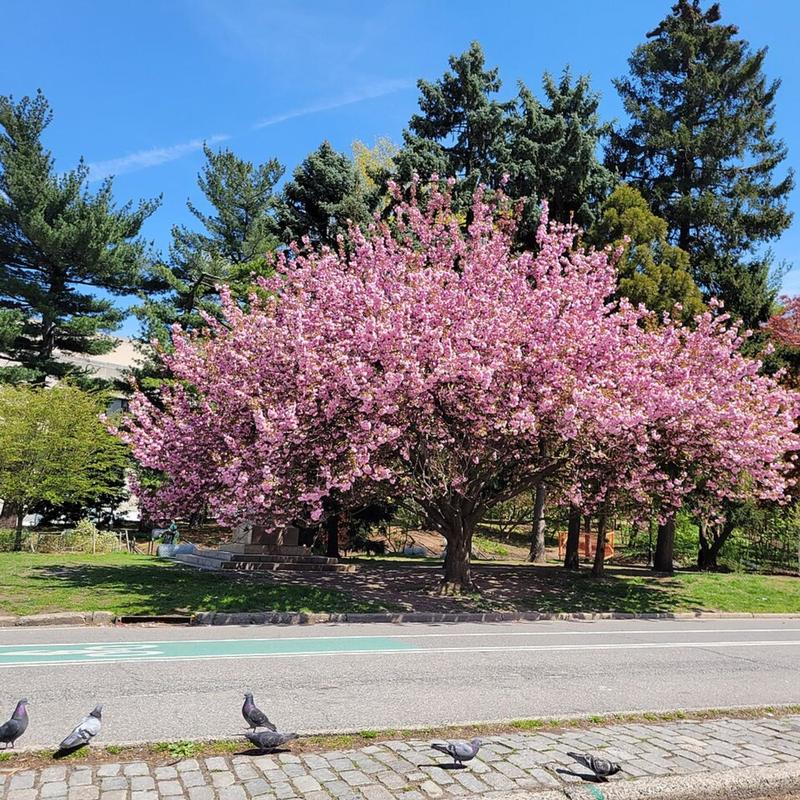
Brian Lehrer: Brian Lehrer on WNYC. For our last few minutes for today and for this week, we're going to look up a bit and talk about New York City's tree canopy, the trees that shade us from the sun in summer, and right now are in beautiful bloom in many places. Today, as the last Friday in April is Arbor Day, a day specifically set aside for planting trees, and the city in particular is planning to plant a lot of trees in the next few years to take that tree canopy from covering 23% of the city up to 30%. That means adding over a million trees, if my math is right.
This matters not just to scenery, also equity and public health, right? Lower-income areas of the city, this tend to have fewer street trees, leading to higher temperature spikes and heat waves and the dangers that come with them. With me to talk about New York City trees on this Arbor Day, including New York's designation as a Tree City, the city's brand new Urban Forest Plan, as well, we're joined by Dan Lambe, CEO of the Arbor Day Foundation, and Ben Osborne, assistant commissioner for forestry and horticulture at the New York City Parks Department. Dan and Ben, welcome to WNYC. Happy Arbor Day.
Dan Lambe: Happy Arbor Day to you. It's great to be with you, Brian.
Ben Osborne: Happy Arbor Day.
Brian Lehrer: Ben, I'll bet people are surprised to learn that New York City has an assistant commissioner for forestry. What do you do?
Ben Osborne: Thank you. Good morning, Brian. New York City is a tree city. We are a very, believe it or not, forested city. At the Parks Department, we are responsible for the care, maintenance, and planting of trees along our streets, in our landscape parks, and in our forests.
Brian Lehrer: Dan Lambe, are other cities paying this kind of attention to their tree canopies, as what I laid out in the intro, that New York is embarking on?
Dan Lambe: We are seeing more and more cities embracing trees as a must-have in this day, not just a nice-to-have. New York City is a world-class urban forest community. They've got great leadership driving the tree management in this city, but they're also leading the way as others strive to keep up with their innovation and their plans and their ambition. Indeed, more and more cities around the country and around the world are embracing trees and urban forestry today.
Brian Lehrer: Listeners, we have like five minutes, but in which you can call in if you're one of the tree stewards who volunteered to take care of trees on your block, perhaps, or to tell the assistant commissioner that your block really needs trees. 212-433-WNYC, 212-433-9692. You can call, or if it's quicker, you can text. Ben, how do you determine the need? Because you can't plant a tree on every block.
Ben Osborne: We can't plant a tree on every block right now, but we do have a plan to plant a tree on every block over the next nine years through our Neighborhood Tree Planting Plan. Our foresters survey every single inch of a block in the process of planning for our planting projects. While we're planting in every neighborhood across the city, at least every couple of years, we are focusing on the most heat and vulnerable neighborhoods as we speak.
Brian Lehrer: Matt in Hell's Kitchen has a tree question. Oh, Matt disappeared. He was asking, I think, why don't oak trees shed their leaves in the fall? Do they not, Ben?
Ben Osborne: No, it's a very interesting observation. Some oak trees do not shed their leaves in the fall, and they tend to do so in the spring. It's just one of those kind of quirks of different species.
Brian Lehrer: Dan, I see it's your Arbor Day Foundation that gave New York City this designation of a Tree City. What does that mean?
Dan Lambe: Tree City USA is a national recognition program for cities who meet core standards of tree care and tree management. It was started in 1976 with a really bold idea to encourage cities to be managing their trees more effectively. We're celebrating the 50th anniversary this year, and New York City has been a tree city for 30 years. That very first year in 1976, we had 42 cities, very modest beginning.
Today, we celebrate almost 3,600 communities from coast to coast and the territories who are managing and taking care of their trees, not just planting, but also managing their forests. It has become the backbone of urban forestry across the country. To have a city like New York City helping to show the way for others is really important, and people are paying attention.
Brian Lehrer: Ben, here's a creed occur from a listener in a text: "The appalling unfettered development in the Long Island City and Queensboro Plaza area has created a hideous treeless and grassless wasteland that is bad for children, pets, and adults alike." What do you really think? "Question is, can anything be done for this neighborhood?"
Ben Osborne: As I mentioned, through our neighborhood tree planting plan, we're going to be planting street trees in every single neighborhood in the city. It's also a requirement of new development that they plant street trees as part of their project. With each development does come street trees, as long as the space can accommodate it.
Brian Lehrer: Do you agree with what I said in the intro about the public health implications, not just the scenery implications?
Ben Osborne: Yes, trees are extremely important. They're not just a way to beautify our neighborhoods, but they are critical living infrastructure that provides public health benefits. It's long been known that trees, by cleaning the air and filtering particulates, can help with conditions such as asthma. More and more research is showing that just having trees around you can help with mental and physical health recovery from illness and even educational outcomes, just having trees outside the windows of schools.
Brian Lehrer: Dan, we have another listener who is unhappy about a tree that was cut down on their block, Fort Washington Avenue near Fort Tryon Park in Washington Heights, which makes me think we love trees, but it's also important that they're well cared for or they can be hazardous, especially with the stronger storms we're seeing. Is enough attention paid to that part of expanding the number of trees?
Dan Lambe: Expanding the tree canopy actually relies primarily on maintaining our existing trees. Through research done by our partners at The Nature Conservancy, we know that 90% of the increase in tree canopy that we saw between 2017 and 2021 was due to the growth of existing trees. It is critically important that we maintain and preserve those trees that we can. It is our priority to preserve trees wherever possible, but of course, we have to protect public safety. If a tree is dead or has defects that really can't be addressed through things like pruning, unfortunately, we will ultimately have to remove it.
Brian Lehrer: Another listener says they adopted three trees on a block where they were planted last summer. When they walk around, they see other newly planted trees not taken care of. In our last 30 seconds, Ben, I know the city comptroller, Mark Levine, echoes the benefits in the forest plan, but also, I think, says because of not unlimited funding, volunteers might also be needed. Can you give a shout-out, maybe a solicitation for volunteers for tree care in our last 15 seconds?
Ben Osborne: Absolutely. One of the pillars of the Urban Forest Plan is to engage communities, and that means engaging really every New Yorker to help care for the trees on their block. Please look for our stewardship events, and if you're interested, take part in our tree census that is happening this year.
Brian Lehrer: Ben Osborne is the assistant commissioner for forestry and horticulture at New York City Parks. Dan Lambe is the CEO of the Arbor Day Foundation. Happy Arbor Day, both of you. Thank you both so much for this. It was wonderful.
Dan Lambe: Thank you. Happy Arbor Day.
Brian Lehrer: Have a great weekend, everyone. Brian Lehrer on WNYC. Stay tuned for Alison.
Copyright © 2026 New York Public Radio. All rights reserved. Visit our website terms of use at www.wnyc.org for further information.
New York Public Radio transcripts are created on a rush deadline, often by contractors. This text may not be in its final form and may be updated or revised in the future. Accuracy and availability may vary. The authoritative record of New York Public Radio’s programming is the audio record.