
Transit News: Fare Hike, Bike Lanes, and Congestion Pricing's Birthday
( Noam Galai / Getty Images )
[MUSIC - Marden Hill: Hijack]
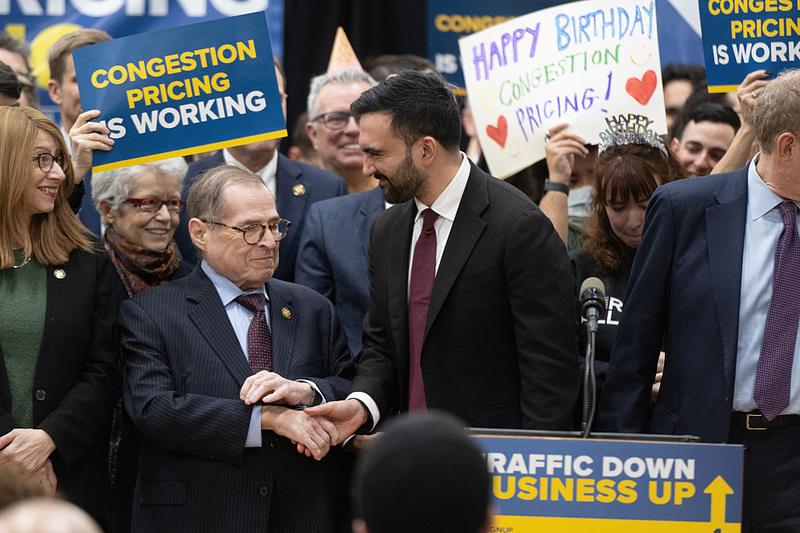
Amina Srna: It's The Brian Lehrer Show on WNYC. I'm Amina Srna, a producer here on the show, sitting in for Brian today. Now we'll recap all of the latest transportation news here in New York City. On Monday, elected officials, MTA Chair Janno Lieber and transit advocates celebrated congestion pricing's first birthday. According to the governor's office, morning rush hour traffic has sped up by 23%. Have you felt it? We'll take your calls on this in just a moment.
Subway commuters have definitely felt the new fare increase that went into effect on January 1st. It now costs $3 to take the train, up 10 cents and you have to tap to pay now that the OMNY has succeeded the MetroCard. More on this later in the segment.
In other related news, Mayor Zohran Mamdani has broken ground on improving the city's streets for cyclists. Perhaps you saw the mayor shovel in hand helping Transportation Department workers fill in the hazardous Williamsburg Bridge bump earlier this week. Since entering office, the mayor has recommitted to the redesign of McGuinness Boulevard in Greenpoint, Brooklyn, and restarted the planning of a controversial bike lane in Astoria, Queens. The mayor also appointed Mike Flynn as the city's transportation commissioner on day one of his term.
With us now to cover all of this is WNYC and Gothamist transit reporter Stephen Nessen. Hi, Stephen. Happy New Year.
Stephen Nessen: Happy New Year to you, Amina. Thanks for having me.
Amina Srna: Starting off with congestion pricing, on Monday, Governor Hochul, Mayor Mamdani, MTA Chair Janno Lieber and others held a birthday press conference with advocates to celebrate what they're describing as a successful year of congestion pricing. How does the government define success here? What metrics did they present to the public?
Stephen Nessen: Well, I guess like you were saying, traffic speeds are up in Manhattan. It may be very hard for drivers to discern a few percentage point increase in speed. For example, in Manhattan in the toll zone, I think vehicles are only going about 4.6% faster than they were before, but coming in and out of places like the Holland Tunnel, the MTA is reporting it's 51% faster than before congestion pricing, so that's something people definitely noticed. Lincoln Tunnel, 25%, Queensborough Bridge, 29% faster. Those are speeds I think that people can really feel, so that's one metric of success.
I think the other metric is the money that it's bringing in. The MTA estimated they're going to bring in about $500 million in the first year and sure enough, they did exactly that. I think they're patting themselves on the back for crunching the numbers very well and accurately. I think the other metric of success is that despite a lot of doom and gloom about how this is going to really destroy Manhattan, you remember President Trump tweeted, "New York is dead because of congestion pricing?" It was literally the complete opposite, that foot traffic was up, business did fine. I think even commercial rents are doing better than they were before. Even crashes are down in Manhattan. I think those are all positive things that the MTA and Hochul can point to as successes for the first year of congestion pricing.
Amina Srna: As you were mentioning there on the funds, they made an extra $50 million. What are the extra--?
Stephen Nessen: $500 million.
Amina Srna: Oh, I thought it was 550. I have that note wrong.
Stephen Nessen: 550. Yeah.
Amina Srna: Okay.
Stephen Nessen: About that, because it didn't start exactly on the new year. There's a few days they missed, but it's close.
Amina Srna: Right, but it's 50 million more than what was originally projected, right?
Stephen Nessen: It's pretty close. It's pretty close to what they were projecting.
Amina Srna: Okay, pretty much. All right. Anyway, what are these extra funds being used for?
Stephen Nessen: All of the money from congestion pricing, every single cent of it, is going toward improving transit service, subways, buses, even some of the money is going to the commuter railroads, but the vast majority of all that money is going toward new signals, new train cars. You've seen the new R211 train cars. They're on the B now, the D, the F, certainly the A and the C lines. The G's got the open gangway one. All that, all those new train cars are funded through congestion pricing.
I know that in the public's mind, it's like it's just a pit of money that the MTA collects from the $3 fare you were mentioning, but those fares just go to the operating budget, the day-to-day expenses, paying their workers' salaries, things like that. The congestion pricing money goes towards improving service through buying new stuff and investing in new signal equipment, for example, that eventually will speed up service and is speeding up service on some lines right now.
Amina Srna: Stephen, listeners might remember that the rollout of congestion pricing was delayed by Governor Hochul. She put the program on pause in 2024. Now she's celebrating its success. So how do you interpret the governor's decision to pause the implementation of the toll two years ago in hindsight.
Stephen Nessen: Congestion pricing was originally supposed to launch at the end of June 2024, and you probably recall, of course, that was an election year. To be fair, in retrospect, we don't have a smoking gun that shows Hochul paused congestion pricing because she wanted to win the election, but a lot of pundits, a lot of folks point to that as just it would have been harder. There was also congressional races. I think in Hochul's mind and the political mind of folks who are strategizing, it just didn't seem like a good move to start tolling drivers, rock the boat before an election. Who knows how it would tip voters? Maybe that would become a lightning rod issue that could cause Democrats to lose. There was even talk that Hakeem Jeffries was putting some pressure on Hochul not to do it.
We don't have any smoking gun evidence of that, but a lot of pundits, a lot of experts point to these conversations as indicators of why Hochul paused congestion pricing really a month before it was set to go into effect. Then after the election, she announces, "Okay, here's congestion pricing. Here's how we're going to do it." She announced, of course, we have the January 5th start date, 2025, and she also announced that the original price, which was supposed to be $15 for vehicles, is going to go down to $9 to start with. It'll go up to $12 in 2028 and up to the full $15 in 2031, but for now, we're sort of stable at this $9 rate, which she said is something New Yorkers can afford that. That's not as bad as, say, $15.
Amina Srna: Stephen, as you can imagine, we're already getting texters and callers on congestion pricing. One--
Stephen Nessen: I'm shocked.
Amina Srna: Shocking. Big deal. One listener texts, "I'm a commercial delivery driver, and I have noticed a big difference in congestion. It makes it so I can make the deliveries on time, and there's a noticeable decrease in pollution." Another listener texts on that similar point, "No mention of congestion pricing's effect on pollution," as a question. Stephen, you want to weigh in there? What is the governor's office saying about the impact on pollution?
Stephen Nessen: Sure. In fact, Cornell University came out with the first study looking at the impact of pollution from congestion pricing. What they found was really startling. They just looked at one year of data, and what they found was there was a 22% drop in fine particle pollution. That's those fine particles we mentioned, like when it's air quality alert day sort of thing and it's really bad. That's the fine particle pollution they found. There is a 22% drop in Manhattan in the toll zone. Even outside of the zone, like parts of New Jersey, Brooklyn, Queens, The Bronx, there was a 1% decrease.
That study was widely lauded and cited by the MTA and others. I did speak with experts who are like, "Hold on, hold on. You can't just do one year of study. There's so much that impacts air pollution, like the weather, for example," so they really cautioned against reading too much into that. Cornell says that they're obviously going to follow up and do more in depth studies. The MTA put out this 105-page report on the impacts of congestion pricing to coincide with that press conference this week and they were reluctant to mention pollution impacts at all. They said there doesn't appear to be a major change as of now, but they're going to keep monitoring it. They also said it's too soon to really measure any impact, but certainly, there's no dramatic, from their readings anyways, nothing worse and nothing particularly better either.
Amina Srna: Listeners, we can take a few of your calls on congestion pricing or some of the other transportation related news. Now that we've had congestion pricing for a year, how has it impacted your daily life? Officials are touting higher foot traffic in Manhattan, increased transit ridership, less cars on the road, increased traffic speeds, cleaner air and more as symbols of the program's success. Have you noticed these improvements? We can also take your calls on the Williamsburg Bridge bump, McGuinness Boulevard's redesign, and all of the other transit news. Call or text us at 212-433-WNYC. That's 212-433-9692.
Stephen, let's talk quickly about the fare hike that went into effect January 1st. Some on social media have been attributing this fare increase to the newly inaugurated mayor who promised free buses on the campaign trail. Do you want to do a little fact checking there for us?
Stephen Nessen: Yes, I can fact check that Mayor Mamdani has nothing to do with the MTA's biannual fare increases. This is baked into their financial plan. It's pretty reliable. We know every two years the fare goes up. It may be a shock to folks who maybe don't follow the news as closely or don't keep track, but basically, the fare goes up every two years. Pretty predictable and reliable. It's not a shocker like you were saying. It's only, I should say it's only 10 cents. Mentally, it is a big hurdle, though to hit the $3 mark. Even for me, I'm like, "Wow, $3, that's a lot of money these days." But with inflation and everything, the MTA says they have to keep raising the cost of everything. They have to increase their workers' salaries and everything like that, so they have these predictable fare increases.
Unlike NJ Transit, which hadn't done a fare increase for years and just shocked their riders with back-to-back fare increases. At least the MTA tries to keep it to essentially 2% a year, or generally, it works out to 4% every two years, but that has nothing to do with Mayor Mamdani. This was well planned well in advance. We covered it extensively, and the MTA has several public hearings about it, but $3 is a big mental hurdle. The MTA always talks about there used to be you could peg the cost of a MetroCard to a slice of pizza, but that's been blown out now because pizza is even way more expensive.
Amina Srna: The MetroCard also officially retired on January 1st, but you report OMNY's made a bumpy landing in stations across the city. What issues are riders encountering while tapping to pay?
Stephen Nessen: Well, I should preface my comment by saying that the MTA is always emphatic in letting me know that billions of riders tap this system and have no problem. They argue that the few that I've identified and found that have problems are outliers to the whole system as a whole, which works generally well. That said, when I started reporting on issues with OMNY, I've had some myself, my family has. It wasn't hard to find a lot of people who've had random issues over the last year especially, and they were concerned, as the MTA phases out the MetroCard, that OMNY is the only way to pay.
For example, you know, one of the most common problems I heard that really annoyed people and frustrated them was that when a card runs out of money, like your commuter benefit card, for example, that you might get from your company, it just shows that it doesn't work, you can't use it. There was some bug within the system that would have folks, once they added money, the OMNY machine still wouldn't let them use it. They'd have to cancel it and order another card, go through a whole bunch of shenanigans to get this sorted out. That was a frustration that folks were telling me about leading up to the full turnover to OMNY. That was one, yeah.
Amina Srna: Oh, well, let's sneak in a caller who's actually called in at the beginning of this segment with her OMNY frustrations. Suzanne in Manhattan, you're on WNYC. Hi, Suzanne.
Suzanne: Yeah, good morning. Thank you for taking my call. I have had the same issue you just mentioned, but the thing that's really annoying is I can't see my balance. The wonderful thing about the MetroCard is as you swipe, you could see if you're getting a transfer and your balance. Let's say if I take the bus down and I'm transferring to the subway, I'm charged again for a full fare, and there's really no way for me to do anything about it, it seems, because of my schedule. You mentioned Something about the 10 cents addition is for running the subway. Well, how about taking some of that money and fixing the OMNY card, because it's really not predictable.
Amina Srna: Suzanne, thank you so much for your call. Stephen, how do you want to respond to some potential solutions there?
Stephen Nessen: Yeah, Suzanne identified, I think the biggest gripe from everyone that I've spoken with, it's that when you tap, you don't see how much money is left on your card. That was such a basic thing the MetroCard can do, and it's mind boggling to the public that this brand new fancy system can't do that. The MTA does say they know that. They're working on that for the next iteration of what comes next. I think part of the challenge, technically speaking, which I'm not so in the weeds on how the behind the scenes computer magic that makes this all work, but because everyone's tapping with a different type of device, it does make it somewhat hard.
If you're using a credit card, for example, it's not going to necessarily show you how much money is on your credit card, but for a lot of folks also, you get the 12 taps and it's free for the rest of the week. That's also something that's very hard to keep track of. Some folks don't know when their week actually starts. That's something that I think hasn't been as transparent as the MTA perhaps could have done and which could have helped ease riders' minds as well to know like, was that a free transfer? Wasn't that a free transfer? Why doesn't it show that? Is this a free ride?
You had to just see when your last ride was a few cents cheaper and you knew, okay, after that it's free until I think Monday or Tuesday. I think that's the sort of transparency that a lot of folks want to see as OMNY moves forward. The MTA says they're working on it, but we really don't have any indication of when that feature is going to be available.
Amina Srna: A listener writes related to your point on transfers, "I'm very tired of getting double charged by OMNY transferring bus to subway and then there's nowhere to take your complaint." Stephen, as our transportation expert, is there a place that listeners can reach out to?
Stephen Nessen: They can reach out to the MTA. I've heard some horror stories from people trying to recover. Right. It's like $3. Is it worth spending 25, 30 minutes on the phone over $3? Not everyone has the time or the energy or necessarily wants to do that, but customer service is there. You're more than welcome to try to lodge a complaint, but I've heard a lot of frustration about that as well.
Amina Srna: Another complaint. "Now I'm paying up to $180 for 30 days. A week ago it was $132. Outrageous." That's, I mean, like you said, 10 cents, but it all starts to add up.
Stephen Nessen: Right. Well, the 30-day unlimited card is gone now, that is not an option, and the MTA hasn't really said how they're going to, or if they're going to be able to offer that at all going forward. I know that's a lot of frustration for folks who are really heavy users of the system.
Amina Srna: Let's go to a caller. Carrie in Manhattan. Hi, you're on WNYC.
Carrie: Hi, thanks for taking my call. I just wanted to mention about congestion pricing, the lack of the leaning on the horns outside my window. I face 8th Avenue near Madison Square Garden is just-- I mean, I'm thrilled with the whole thing. I think I'd love to pay even more for when I leave the city. But I just wanted to mention that because I didn't hear anyone say that, and it's just so much quieter outside my window than it used to be.
Amina Srna: Carrie, thank you so much for your call. Olivia in Manhattan is, I think, going to back you up. Hi, Olivia.
Olivia: Hi. Yes, Carrie, exactly. I lived at 49th and 9th for eight years and I've been at 72nd and Columbus, AKA 9th Avenue for nine years and the rush hour honking is gone. It's almost strange to hear-- if there are horns outside my window, something is amiss. There's some clownery going on or something. It has been game changing and it has been a direct result of congestion pricing traffic release. Also, the M11, I can actually take it and get somewhere now, the bus that goes down 9th Avenue. It used to be laughable. I would just walk and now I can actually take it and get somewhere.
Amina Srna: Olivia, thank you so much for your call. Stephen, some success stories there of congestion pricing in Manhattan, though I'll note a few people are asking about traffic and whether it's worse in the outer boroughs. Any reporting on just broadly noise pollution that you're following?
Stephen Nessen: Yeah, we've Definitely seen that 311 complaints about noise pollution in Manhattan is definitely down. That attests and speaks to the caller's experience as well. As far as like the spillover effect, which was one of the biggest concerns folks had, especially in the Bronx and parts of New Jersey, that just hasn't come to pass. There has not been a huge number of vehicles drastically trying to avoid the zone by flooding side streets or parts of Jersey and the Bronx. That hasn't happened.
Another thing that's really interesting is truck deliveries have really shifted as well, I think, because trucks pay so much more than regular vehicles. They have shifted their deliveries to overnight or doing these cargo drop-offs and not having trucks driving through the city blocking traffic, idling in traffic. That's gone down quite a bit as well and that also impacts traffic and air pollution as well.
Amina Srna: We have a couple of callers who are talking about their personal experiences with congestion pricing and how they use the roads. Now let's go to Gail in Jackson Heights. Hi, Gail, you're on WNYC.
Gail: Hi, thank you for taking my call. I mostly use the subway myself, but when I have to take my mother, who's in her late 90s, into the doctors that she has in Manhattan, as I have in the last week, I've noticed a great decrease in traffic. It takes me much, much less time. It's Easier over and back on the Queensborough Bridge. I've been encouraged to change many of her doctors to more local Queens doctors. She also lives in Queens, and they're fine. It's definitely made a change in terms of my pattern of travel. I appreciate the fact that it's more expensive for people who regularly take their cars in and out, but as a person who's mostly there as a pedestrian, I appreciate it.
Amina Srna: Stephen, let me get one more caller in with a personal experience. Carl on Staten Island. Hi, Carl. You're on WNYC.
Carl: Hey, good morning. First of all, let me say that I am in favor of congestion pricing. Secondly, I am not one of these people on Staten Island that whines about everything that goes on in the city. Occasionally I have to take my wife to Mount Sinai on 98th Street. I go through the Lincoln Tunnel. I'm literally below 60th Street for about five minutes. Shouldn't there be some sort of a medical exemption for people like me?
Amina Srna: Carl, thank you so much for your call. Stephen, two different kind of experiences there. What do you hear in those two calls?
Stephen Nessen: Gurus of transportation point to places like Singapore that have been doing this since like 1975, so they have a much more sophisticated system than we do. They charge based on what the traffic situation is in different parts of the city. If it's extra congested, they'll increase the rate to discourage people from driving. Some folks I've spoke with say that the next generation of congestion pricing in Manhattan should include something like that, which would maybe speak more to Carl's experience, which is like, if you're only in the zone for five minutes, why would you be charged the same rate as a delivery truck that's just driving around and around for hours and hours?
The usage is so different, so maybe there could be a more dynamic model where if you're just doing a quick trip in and out, you're not going to pay the full rate. But if you spend all day in the zone, you might pay more. The MTA certainly has hundreds and hundreds of cameras, so they know exactly where you are within the system. It's not unreasonable to think that that could happen, but right now, they don't have that. They do have some exemptions, but they're not giving exemptions to individuals for their own medical appointments.
Amina Srna: Stephen, before you go, let's talk about bikes, since there's been so much news there, starting with the Williamsburg Bridge bump. On Monday, Mayor Mamdani joined DOT workers in Manhattan to pave over this bump. What problem did it solve for cyclists?
Stephen Nessen: Well, this is like the smallest of small bore problems, but it's really, I think, a symbol that Mayor Mamdani is going to tackle the big and the small, nothing is too much for this guy. Basically, when bikers come over the Williamsburg Bridge, there was just sort of this little drop between the street, Delancey Street and the bridge, if you're going fast enough or you're not slowing down, you could catch a little bit of air. I spoke with some cyclists who were like, "Yeah, I like it. It's gnarly, man. It's cool. I like to catch some air there," but it's dangerous and a lot of folks have crashed.
Honestly, like, I was speaking with another transportation reporter. I was like, "Is this even on your top 10 radar?" he's like, "No, not at all," but it was just like a funny, small thing that the city could just do right away. They don't need to hold a hearing. They don't need to have meetings and meetings. It's like, hey, show up, put some pavement down, fix this problem that annoys everyone. think it's just an indication that Mayor Mamdani is fixing stuff left and right. Like, "There's a problem, we're going to fix it now." That's what that was about, anyways. That was just a couple days ago.
Amina Srna: On the more serious side, on Sunday, the mayor announced that the city will recommit to the redesign of McGuinness Boulevard. Why is the street in Greenpoint particularly hazardous for pedestrians and cyclists? And how will it change once the redesign is complete?
Stephen Nessen: Sure. McGuinness Boulevard is like the name. It's a boulevard. It's a busy intersection. I believe there were four lanes of traffic. Obviously, Greenpoint's changed so much. A lot of people commute between Long Island City and Greenpoint. This is a major roadway for that, and a lot of folks just commuting between Williamsburg and Greenpoint. There have been a lot of cyclist deaths, and a teacher died several years ago, Matthew Jensen, and I think it really galvanized a lot of effort and energy toward fixing this roadway, making it slower and safer, and putting a protected bike lane.
The city spent all this time and resource to come up with a plan for parking protected bike lanes where the cars park on one side and that protects cyclists so they can get where they're going. The city, during the Adams administration was all set to do this, and then at the last minute, Adams pulled the plug on it and announced they're not going to do it. They're going to do a modified version that would not create a parking protected bike lane. It would still allow two lanes of traffic to flow, and the original plan call called for reducing it to one lane of traffic.
More information came out, and we learned that perhaps Adams was being lobbied by some businesses and particularly the Argento family, who owned some delivery film business stuff over there, and they were worried about trucks. This spiraled into this big controversy, and Ingrid Lewis-Martin, who was one of Adam's top aides, got embroiled in this scandal and is currently facing federal charges in Manhattan federal court over this issue of taking money from the Argento family. She denies it, they deny it. That case is still out there, but it became a big symbol of the Adams administration willing to do things in the benefit of businesses as opposed to the public.
Mamdani coming out right out of the gate, undoing Adams' half job on McGuinness Boulevard, saying, "We're going to go back to the original plan, one lane of traffic and parking protected bike lanes in both directions all the way from, I believe, Meeker Street all the way to the Pulaski Bridge." It'll be a big change. Some members of the community, there's a petition with 6,000 signatures, are still against it, but cyclists say it's going to be a lot safer. Street advocates say it's going to reduce crashes and injuries and deaths, and it is a dangerous roadway. If you're cycling there and you're not protected, it could be dangerous, so this will make it a lot safer.
Amina Srna: Another controversial bike lane project that is back in the planning phase after the city lost a court battle with local businesses Yesterday, Mamdani announced that the DOT will come up with a new plan to install a bike lane on 31st Street in Astoria. What drove businesses to sue the city after the original plan was released?
Stephen Nessen: This one is a little more complicated than McGuinness Boulevard, which seemed to be a little more cut and dry. The city was all set to install this bike lane on 31st Avenue and several businesses, even a school, sued to stop it. I guess a judge found that the city hadn't done some of the basic procedural stuff to make that happen. Essentially, they had to have meetings with the FDNY and EMTs and other local businesses, and they didn't do that, so on procedural grounds, they halted the bike lane project. Not, necessarily on the design itself, but they are going to go back, they're going to do those meetings, they're going to work on a design that is maybe more appealing or suitable to the businesses and their concerns.
Again, a lot of businesses are always just worried about not being able to make deliveries or where they're going to drop people off. There's a school there, so folks are worried about students crossing the bike lane. They're going to work on some designs that sort of meet everyone's needs and, like you said, go back to the drawing board on this one.
Amina Srna: One more thing before you go. On Inauguration Day, the mayor appointed Mike Flynn to serve the Department of Transportation as its new commissioner. Who is Mike Flynn and does his resume align with this role?
Stephen Nessen: Yeah, I spoke with Sam Schwartz, who is a longtime traffic planner, and he was telling me just how thrilled he is that there's a real transportation expert at the helm of the Department of Transportation. You remember, Ydanis Rodriguez, who was the previous transportation commissioner, didn't necessarily come from a deep transit background. It was more of a political appointment as opposed to someone with a deep knowledge of transportation planning and urban planning and things like that. Mike Flynn fits those credentials, so folks are really optimistic.
I heard him speaking at that Mamdani event with the Williamsburg Bridge, and he seemed very straightforward. The one thing that he hinted at is he said, "There's much more to come," so I'm not sure. They're not giving an indication of what's coming next, but we can tell already they were tackling some of the things that got gummed up in the Adams administration like the 21st, like the Astoria bike lane, and McGuinness Boulevard. I think transportation advocates and transportation reporters are going to be looking at some of the things that went wrong during the Adams administration and seeing how the Mamdani administration is going to address them. I think there's a lot of optimism that someone like Mike Flynn is there at the department. The transportation experts are going to get a voice in the room again, is the vibe I'm getting.
Amina Srna: More to come in 2026. That's all the time we have for now. My guest has been WNYC and Gothamist transit reporter, Stephen Nessen. Steve, thanks so much for coming on today.
Stephen Nessen: Yeah, thank you so much for having me.
Copyright © 2026 New York Public Radio. All rights reserved. Visit our website terms of use at www.wnyc.org for further information.
New York Public Radio transcripts are created on a rush deadline, often by contractors. This text may not be in its final form and may be updated or revised in the future. Accuracy and availability may vary. The authoritative record of New York Public Radio’s programming is the audio record.
