
Thursday Morning Politics: Republicans Speaking Out Against Pres. Trump
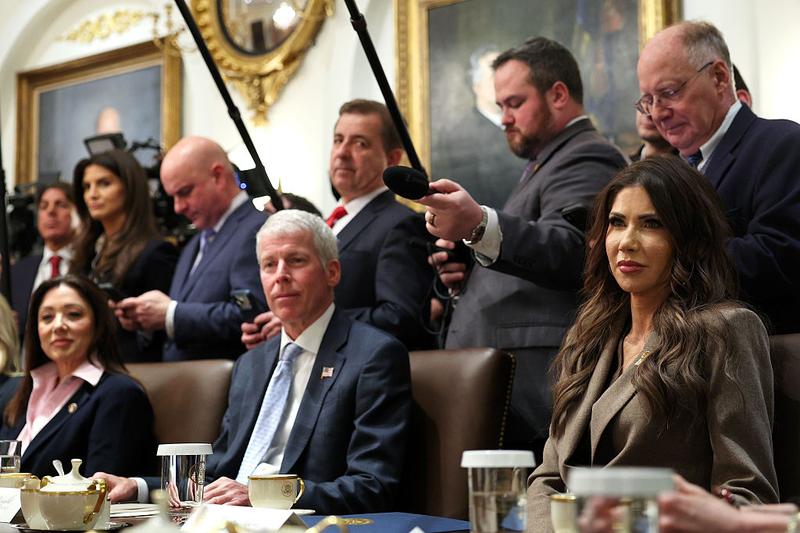
( Win McNamee / Getty Images )
Amina Srna: It's The Brian Lehrer Show on WNYC. I'm Amina Srna, a producer for The Brian Lehrer Show, filling in for Brian today, who is off taking care of a family member. Coming up on today's show, we're going to talk about some of the news on Rikers Island. Yesterday, a federal judge overseeing the troubled jail complex appointed a former CIA officer who ran Vermont's prison system as the so-called remediation manager for Rikers. We'll get into that in just over half an hour.
Plus, the dean of the Stanford University School of Medicine will join us later to talk about how AI is being integrated into medicine and the promise of it, but of course, also the potential pitfalls. They've incorporated artificial intelligence into the training at his medical school to try to prepare future doctors for this new world. We'll wrap today's show with a call-in for you to share what you're nostalgic for from 2016. Ten years ago.
Did you see that trend going around social media over the past few weeks? We're curious if you, our listeners, can help us put a finger on what's behind the impulse. Whether you posted something or not, start thinking about where you were in 2016 and what you might be nostalgic for from that year. It can be personal or political, or maybe both. We'll take your calls on that near the end of the show.
We begin today with the latest news from Congress. Senate Democrats are threatening not to vote for a spending package that would fund the government past Friday at midnight unless Republicans agree to limit funding for the Department of Homeland Security. This latest move after two American citizens were killed by U.S. Federal agents in Minneapolis this month.
Last year, Republicans pushed President Donald Trump's signature domestic policy bill through Congress, which allocated $190 billion over four years to DHS, including $75 billion for ICE. The Trump administration has shaken up its operations in Minneapolis after the high-profile shooting of Alex Pretti by federal agents over the weekend. U.S. Customs and Border Protection says two agents involved have been placed on administrative leave. President Trump has sent his border czar, Tom Homan, to Minneapolis to replace U.S. Border Patrol Chief Greg Bovino.
Bovino, along with Homeland Security Secretary Kristi Noem, have been facing the brunt of the criticism from the public and lawmakers on both sides of the aisle for their handling of immigration operations in Minneapolis. While the Senate Democrats are attempting to use a partial government shutdown as leverage, it may have been the response from Republican lawmakers that swayed the president to rethink his administration's actions in Minnesota. Joining us now to discuss that response and how it's played out in the White House over the week is Russell Berman, a staff writer for The Atlantic. Russell, welcome back to WNYC.
Russell Berman: Good to be with you.
Amina Srna: Let's start on the latest news. Senate Democrats are threatening not to vote for a spending package needed to fund the government past this Friday. If successful, their move would result in a partial shutdown starting on Saturday. That's unless Republicans agree to add limitations on funding for the Department of Homeland Security to constrain its immigration enforcement operations. What are Democrats asking for?
Russell Berman: Democrats want, they've settled on three main changes or reforms to ICE operations that they're pushing for in this bill. One would be ending what they call roving patrols and tightening up the warrants. Making sure that ICE actually needs a normal judicial warrant to enter somebody's home. They don't want them just roving the streets, looking, asking people for IDs, looking for people. They want, certainly, more targeted operations and targeted at the people that President Trump campaigned on prioritizing for deportation, those who have been convicted of felonies and beyond simply crossing the border illegally.
They also want what they're calling a uniform code of conduct and accountability, basically that ICE agents would have the same standards as any state and local police department or law enforcement operation officers in terms of when they can use force. They want to make sure, obviously, that there are independent investigations when there's a shooting, for example.
Then third, and probably most contentiously, in terms of whether they could get Republican support for this. They want ICE officers not to be wearing masks, to have their body cameras on at all times, to carry ID, to end this sort of people jumping out of a car, grabbing somebody. You have no way of identifying them, no way of confirming whether they're actually with the federal government or not. That's what they're pushing for here.
Now, in the interim, it sounds like there's a possibility that they may strike a deal with President Trump to avert a shutdown in the short term to buy time to negotiate these changes in DHS funding and DHS operations. We'll see over the next 24 or 48 hours whether that comes through.
Amina Srna: What about the Republicans? The New York Times reports this morning that making any changes to the spending measure would require buy-in from the Republicans. As someone who's been covering the GOP's response to the events in Minneapolis, are there any indications that they'll stand with their Democratic colleagues?
Russell Berman: Well, the first indication that maybe there might be a deal here is that Republicans didn't shoot down the Democratic demands out of hand. Before the shooting of Alex Pretti in Minneapolis last weekend, it was looking like this package of bills funding more than half of the federal government for the rest of the fiscal year, for essentially the next nine months, it looked like it was going to pass pretty easily in the Senate because it had already been negotiated, including the DHS bill. It was going to be voted on as a package.
Then, of course, the shooting happens, and Democrats immediately say, "We'll vote for five of those six bills, but we're not going to vote for the DHS bill after what happened unless we get these ICE reforms." If passed was prologue, you would have seen Republicans just say, "Absolutely not. We had a deal. You're either going to vote for this as a package like we agreed upon, or more than half of the federal government, including DHS, is going to shut down at the end of the month.
Instead, Republicans, who, of course, had been raising concerns themselves about what happened in Minneapolis over the weekend, they said, "Okay, well, let's talk. Let's try to figure out a deal." That's what they're doing. It's complicated because the House, which has already passed this package, if they make any changes to it, such as if they try to pass five of those bills, but not the DHS bill, the Homeland Security bill, the House would have to come back into session and vote again. They don't really want to do that if they can avoid it.
What they're talking about now, it seems, would be to again split off these bills, pass the five that they've already negotiated, and that Democrats are not objecting to take the DHS bill with the ICE funding out and instead pass a continuing resolution just for the Department of Homeland Security for a period of time that would allow them to reopen negotiations on the full year funding for DHS.
That's what Senate Minority Leader Chuck Schumer and President Trump in the White House it appears have been talking about. In that case, you might see a very brief lapse in appropriations, a shutdown for a couple of days while lawmakers on the House side come back to Washington. It would not be certainly a prolonged shutdown like the one we saw in the fall.
Amina Srna: Let's talk about what the Republicans are saying. For your latest in The Atlantic, co-authored with Jonathan Lemire, you write, "The statements from congressional Republicans after Saturday's shooting of Alex Pretti were relatively mild," but the statements kept coming one after another all through the weekend, and I'll add into earlier this week. We'll dig into some of the specifics, including the Republican candidate for governor in Minnesota and the NRA response. Can you first tell us about how Republican lawmakers are responding to that fatal shooting of Alex Pretti on Saturday and the Trump administration's messaging following that?
Russell Berman: Yes, of course. What was notable about what we heard from Republicans after this awful shooting was not the individual statements, in and of themselves were fairly mild. They weren't demanding that these ICE agents be immediately prosecuted. They weren't calling for immediately firing of federal leaders, government leaders. They were saying they were deeply troubled and disturbed, and calling for an investigation.
Collectively, it was the volume that there were so many of these statements that so many Republicans felt the need to weigh in, and not just by default in defense of ICE and the Trump administration. They were mildly critical of what happened, which is, of course, understandable. Somebody died in this awful shooting. The characteristics of the Republican controlled Congress during this first year plus of President Trump's term has been silence and acquiescence. We have not seen Republicans in Congress really stand up and speak out at all about what's been happening.
The fact that so many of them felt compelled to do so even mildly over the weekend and into earlier this week sent a really, I think, unmistakable message to Trump, which was enough. They have now lost patience with the aggressive, violent tactics that ICE and other immigration agents have been showing most recently in Minneapolis, but before that, in other cities where they've been surged into.
I think that more than anything else, or as much as anything else, is what caused the president to shift course. Obviously, as you mentioned, he removed Gregory Bovino, the commander at large in charge of essentially the Minnesota operation. Removed him, sent in Tom Holman, the border czar, who's, he has his own issues, Democrats have their own issues with him, but he is a calmer presence. He held a press conference this morning talking about trying to lower the temperature and de-escalate the situation in Minneapolis. I think it was the Republicans more than again, the Democrats or really anything else that forced this shift.
Amina Srna: Listeners, we can take your comments or questions on the latest, especially if we have some Republican or independent voters listening. How is the media response and maybe the response of Republican lawmakers played out for you? Do you think they've gone far enough, not too far, in their statements, or anyone else? What are you seeing in the news that's resonating? 212-433-WNYC. That's 212-433-9692. You can also text that number.
Russell, you write that the harshest Republican condemnation came from Chris Madel, the Republican candidate for governor of Minnesota. He dropped out of the race on Tuesday in part because of the federal deployment. Let's take a listen to about a minute of the video he posted on X with his resignation.
Chris Madel: I cannot support the national Republican stated retribution on the citizens of our state, nor can I count myself a member of a party that would do so. I support the originally stated goals of Immigration and Customs Enforcement's Operation Metro Surge in locating and deporting the worst of the worst from our state. I've seen many examples of ICE arresting non-U.S. citizens in Minnesota convicted of serious crimes, including murder, rape, and child sexual assault. No reasonable person should want these people here, and I am glad that they are gone.
Operation Metro Search has expanded far beyond its stated focus on true public safety threats. United States citizens, particularly those of color, live in fear. United States citizens are carrying papers to prove their citizenship. That's wrong. ICE has authorized its agents to raid homes using a civil warrant that need only be signed by a Border Patrol agent. That's unconstitutional, and it's wrong.
Amina Srna: A very direct message there from Mandel, who dropped out of the governor's race in Minnesota. Russell, why is this, in your opinion, the harshest condemnation? Is it solely because of the strongly worded message, or is it because it was coupled by the action, or a combination of both?
Russell Berman: Yes, certainly, both. It was the rhetoric and the action. As I mentioned, it just went much further beyond what we heard individually from Republicans in Congress, who, while they did speak up and voice concern, were far more measured in their concern. Chris Madel, on the other hand, he basically was agreeing with a lot of what the Democrats have been saying, which is just this is above and beyond anything that should be acceptable in America, what the ICE agents in Minneapolis have been doing, even before you take into account the fact that two citizens have been fatally shot in the last month.
Now, of course, we should note that it seems like he was not likely to win the nomination for governor of Minnesota in the Republican Party, or at least he said that. He also said he had a couple of other reasons for dropping out. Still, the fact that he decided to do this right after this incident over the weekend certainly got the attention, I think, that he was intending. He wanted to send, again, a very clear message to the administration and to the president. Certainly, he did that.
Amina Srna: You write about how the National Rifle Association and other guns rights advocates criticized comments from senior law enforcement officials, including FBI Director Kash Patel and DHS Secretary Kristi Noem, that blamed Pretti for carrying a firearm and said that people should not bring guns to public demonstrations. I want to play you a clip from Dana Loesch on CBS MORNINGS from about two days ago. She's a guns rights advocate, and she was the former face of the NRA as its spokesperson.
Dana Loesch: The administration needs to be a little careful with language. Language is incredibly important. We're not nitpicking and trying to police language for some sort of gatekeeping role. It's because certain words invoke certain statutes and certain penalties as a result of that. We have a duty to be very, very careful with the language that we use. I wish that Secretary Noem and others would be aware of that because simply approaching law enforcement with a firearm isn't indicative of ill intent, nor is it a crime.
Amina Srna: The NRA itself responded very strongly online to an assistant U.S. attorney in California appointed by the administration who posted on X saying that if a person approaches law enforcement with a gun, there is a "high likelihood that officers will be, quote, legally justified in shooting you." Can you talk about the NRA and guns rights advocates' responses to the administration, and particularly you write about how that really bothered President Donald Trump.
Russell Berman: This was a fascinating aspect of this whole thing, which is, again, as you mentioned, these top officials essentially blaming Pretti because he had a gun on him. Now, it's important to note that the videos showed that the officer had already disarmed him before they shot him. He was not, in that moment at all, a threat to them. Of course, he didn't brandish the weapon at all.
The Trump administration has been, like pretty much every recent Republican administration, in lockstep with gun rights advocates, the NRA, for the most part, in support of the Second Amendment and the idea that he was obeying the laws, not only federal gun laws, but the laws of Minnesota, which allow you to carry a concealed weapon. These advocates took issue with the idea that merely having a gun on your person at a demonstration or at a protest is not wrong. Certainly, should not lead to your death at the hands of federal agents. Arguably, that's the entire reason for the Second Amendment, is so that the government cannot disarm the citizenry.
Now, what was also interesting, of course, is that President Trump, even after you had this pushback from the NRA and other gun rights advocates, he said the same thing that they were objecting to, which was, "You can't bring a gun here. You can't do that." He was pretty firm. It might have been an indication of what his private attitude toward gun ownership and the gun debate is. It certainly did not reassure the NRA or Dana Loesch or anybody else after he doubled down on those comments.
Amina Srna: We're getting a couple of texts and calls. One listener writes, "ICE cannot be reformed. There is body cam footage of Pretti's death. His murderer was wearing a camera, and it was on. At least five people have already died in ICE concentration camps in this very young year. Democrats should be working for nothing less than the abolition of the department. Listeners, we asked for Republican and independent voters, or anybody else to call in. We can take a few more of your calls. 212-433-WNYC. That's 212-433-9692.
Russell, you write about how the shooting of Pretti evoked a response from GOP lawmakers in a way that the fatal shooting of Renee Good earlier in the month did not. The high-profile killings of those two Minneapolis residents and American citizens are only 2 of people who have been killed by federal agents or who have died while in ICE custody in 2026 so far. The listener texted about five people who have died in ICE custody. I read in The Guardian this morning that number's closer to eight. Al Jazeera this morning reported 10 people. We're talking about mainly the response of the shooting of two American citizens. Why do you think the Pretti killing evoked a stronger response from GOP lawmakers than anything else so far?
Russell Berman: As bad as the video of the killing of Renee Good was in terms of making it look like certainly there was no need for the officer to shoot her in that way, that one, in that case, Republicans essentially did what they usually do, which is take their cues from the message that the administration is offering. Of course, the message from the administration was immediate, which was that she was trying to run over this officer, he was acting in self-defense, and that this was a justified shooting by the ICE officer or by the immigration agent.
In the case of Alex Pretti, the video showed that he was down on the ground and certainly was not behind the wheel of a car. He had already, as we mentioned, been disarmed by the officers. It was essentially indefensible, and so they did not defend it. Now, of course, you also did have the administration, Stephen Miller and Kristi Noem and Greg Bovino rushing to the cameras or to Twitter to say, in the case of Stephen Miller, the White House Deputy chief of staff who's essentially running immigration policy, that describing Pretti as a would be assassin and suggesting he was a domestic terrorist, which is what they've been calling a lot of these protesters or demonstrators.
What was interesting is that the Republicans who watched the video for themselves did not echo those comments, and basically, were not able to watch the video and then say the ICE or the immigration agents who shot Pretti were justified in doing so.
Amina Srna: Here are two texts responding to this. If ICE were violating the Second Amendment, actually taking guns like they are the Fourth Amendment, our country would be in turmoil. MAGA policy is as "un-American as taking guns would be." Another listener writes, "This isn't a Republican versus Democrat issue. It's an American issue, a rule of law issue, a moral issue."
Russell, the administration, yesterday, ousted Greg Bovino from his role as the Border Patrol's commander at large and removed him from Minnesota. The Trump administration has sent Border Czar Tom Homan, as we've been talking about, there to replace Bovino. They're saying that that was the plan all along. What are you hearing about this move?
Russell Berman: If that was the case, it certainly wasn't made public. It certainly seemed that this was a direct response again, both to the shooting and the killing of Alex Pretti and the response, as we've mentioned. It's important to note that in the story that I wrote with Jonathan Lemire, we were hearing from aides both inside and outside the White House to the President about how he was watching the coverage of this through the weekend, as he is want to do. Of course, everybody over the weekend on the East Coast, at least, which includes the president, was stuck inside during this huge snowstorm and watching the coverage and not liking what he was seeing.
He was watching the video. He is watching how the media, even on his preferred channels, were characterizing the shooting. He was seeing and hearing from Republicans who were concerned and who were not defending what was happening. He acknowledged this. I think he did an interview with Fox News in which he acknowledged that Bovino has a certain, very public strutting about style that he was using in Minneapolis, and the president said that might not have been the best thing. He pretty much acknowledged that this shift was made in response specifically to this incident.
Amina Srna: A listener texted some pushback about our earlier conversation about Homan writing, "Come on, Tom Homan is a bribe-taking, immoral brute, not by any stretch of anyone's imagination, a calmer presence than anyone on earth. Don't soft pedal this." Russell, I think you were talking about how maybe Democrats are viewing Homan. What do we know about how they feel about Homan or maybe Homan compared to Noem and Bovino?
Russell Berman: Sure. The listener is correct. Democrats do not like Tom Homan. There are certainly allegations that he took a $50,000 bribe that he has denied, but that were rampant last year and may have contributed to the fact that he did not have quite so prominent a public position. This is all a matter of, certainly, the Overton window has moved on this issue. Compared with Greg Bovino, at least publicly in what his message has been and was this morning, he is more measured and projecting a bit of calm.
Certainly, he this morning, for example, he was defending ICE agents and saying that they were for the most part professional, but he was also saying that when they do not act professionally or in accordance with standards, they will be dealt with. I think are the words that he used, which is even though that certainly should be the default right in the government, that was not the message that Greg Bovino or Stephen Miller, for example, was delivering.
Miller was saying, and basically delivering a message to all immigration agents that essentially you have complete and absolute immunity from any kind of prosecution or accountability way, which basically sends the message that you will not be dealt with punitively in any way if you cross the line. Again, Holman is certainly not who Democrats would choose. They have a lot of issues with him. Compared with the immediate past leader of this operation, Bovino and Miller, and Noem, he does have a bit of a different style.
Amina Srna: It's The Brian Lehrer Show on WNYC. I'm Amina Srna, filling in for Brian today. We have to take a quick break. When we come back, we'll get to some of your texts and calls. Stay with us.
[music]
It's The Brian Lehrer Show on WNYC. I'm Amina Srna, a producer for the show, filling in for Brian today. We're joined by Russell Berman, staff writer at The Atlantic. Russell, you write that following the media coverage over the weekend and into earlier this week, you write Trump again asking aides and outside advisors if it had been an "okay shooting," trying to figure out whether the agents had made the right decision to fire. What did sources tell you about this line of questioning from the president?
Russell Berman: The president is always obsessed with how things are playing. Their default is they want to be able to defend whatever the agents are doing, whatever their administration is doing. By asking if this was an okay shooting, I think he was asking, "Can we defend this, and can everybody defend this?" The answer that he was getting was no. I think that's what caused him to shift course here. It seems we are also hearing is just he wants the attention away from Minneapolis. He wants the attention somewhere else.
That really factored into his decision to give his critics a little bit of what they want. He's not giving in completely, of course. Even Homan today, they're not yet at least withdrawing there what? Some 3,000 agents that they deployed to Minneapolis, a city that has in its police department only 600 police officers. This huge deployment. Homan said that they will consider redeploying or drawing down the number of agents there only if the local leadership, that's Mayor Frey and Governor Walz, agree to cooperate more with giving the federal government access to undocumented immigrants who might be in state jails and prisons.
We will see if these changes in leadership and rhetoric lead to actual changes on the ground. So far, that's not clear. It's also important to note that we just don't know how big of a shift this is. We know that it is a shift, but we don't know if it's a major one yet.
Amina Srna: Let's go to a call. Martin in Hoboken, New Jersey. You're on WNYC. Hey, Martin.
Martin: Hi. Thank you for taking my call. I just actually had a point of fact in the interview that I wanted to point out. Regarding the shooting of Alex Pretti in Minneapolis, Mr. Berman referenced the Minnesota concealed carry law. We need to be clear here. Mr. Pretti was open, carrying his handgun in a holster on his hip. This distinction is important. He was not trying to hide his weapon. It was on display. This is usually considered under the law, actually less dangerous, because the carrier is not trying to hide anything.
I'm not sure, actually, what the Minnesota law is for concealed carry, but he certainly was within his rights under the law to, in this instance, have an open carry. Just wondered if Mr. Berman would like to comment on that and clarify that for us.
Amina Srna: Martin, thank you so much for your call. Russell, you are a reporter that covers Congress and not necessarily gun laws in Minnesota. I wonder also how that conversation, it's been a big part of how the GOP lawmakers have been responding after the shooting in the media and publicly. I don't know. You want to come in on that comment?
Russell Berman: Yes, no, sure. As you mentioned, I'm not an expert in Minnesota gun laws, but what I do know is that nobody really is disputing that, as the caller referenced, he was carrying this firearm illegally. What you've heard from lawmakers, in addition to the NRA and activists and advocates for gun rights is echoing those concerns, which is, hey, whether or not this shooting was justified, and most people now say that it was not, they do not want to hear from the administration criticism of this person merely for carrying a weapon in accordance with the laws of Minnesota.
Amina Srna: Let's take another call. Here's Susanna in North Salem, New York, with a comment. Hi, Susanna, you're on WMYC.
Susanna: Good morning, and thank you for taking my call. Congress created ICE and funded ICE. Congress has the ability to defund and disable ICE. At the least, for now, the Democrats and Republicans shouldn't cave on unmasking these people and having their identification clearly seen. That's a start as we build momentum for disabling this terrible Gestapo. Thank you so much.
Amina Srna: Susanna, thank you so much for your call. Russell, here's a text from somebody who identifies as a Brooklyn GOP member. They write, "Trump's entire second term is antithetical to the concepts of conservative ideals, especially regarding a standing army being used for internal policing. Policing is a state and local function, not for the federal government, DHS, the FBI, and the whole police state apparatus we've built up since 911 needs to be retrenched massively." Any talk from GOP lawmakers or any indication of scaling DHS back in any meaningful way?
Russell Berman: You hear that from certain people like Senator Rand Paul in Kentucky and Congressman Thomas Massie, also of Kentucky, who do take a more libertarian view on all of this and have been fairly consistent on these issues. Broadly speaking, Republicans are certainly not going that far.
Although the Republican from Brooklyn makes a good point, which is what we're seeing in terms of the Trump administration's embrace of such an aggressive federal government, basically going in and manhandling, in some cases, state and local leaders in these Democratic run cities and states is contrary to what we would hear for years about federalism, certainly before that, with its own historic connotations, states rights. We would hear that from Republicans and conservatives. Certainly, what Trump has been doing writ large over the last year bears no resemblance to that conservative ideology. I think the Republican from Brooklyn makes an interesting point there.
Amina Srna: Listener texts, "Considering Trump operates from the Roy Cohn 'admit no wrong' ethos, is there a risk that some in Congress are seeing the recent damage control as accepting responsibility rather than the bare minimum?
Russell Berman: Yes, correct. This is correct in that Trump does not ever like to admit defeat, does not ever like to admit that they were wrong. They always put a positive gloss on whatever. Even you saw this with the Greenland and the framework for a future deal. After he was essentially talking about potentially invading and seizing Greenland by force, he came up with a way to not admit that he was backing down and painting whatever he had come up with as a victory or as a positive development. That's what you see here. It's not like he's really even admitting too much went wrong here. He's pivoting, and he's still trying to put a positive gloss on everything.
Republicans in Congress who do not want to get on Trump's bad side, they know that when they send these messages rhetorically, they have to be pretty careful in how they word it. We've seen that over and over again. As I mentioned, it was the volume of statements, rather than, individually, their content, that sent the message.
Amina Srna: As we wrap up the segment, I want to ask you about the new New York Times Siena University poll released last week that showed that 61% of Americans said that the tactics used by ICE had gone too far, including 71% of independents, though just 19% of Republicans. Almost 6 in 10 said they disapprove of Trump's handling of immigration, though 50% said they approve of the general policy to deport immigrants living here illegally.
Russell, as you know and as you will be reporting all year, it is an election year, so I don't know how you want to thread this needle, but can you explain why this is the last straw for Republicans, or maybe how they're weighing what is maybe their most central policy idea as a party, with the extreme policing of the Trump administration in Minnesota, in particular?
Russell Berman: Sure. If we step back, immigration enforcement, deportations, was the campaign promise that Trump made that you could argue whether or not you voted for him. I know many, most listeners probably did not. He could credibly claim a mandate to say that we are going to increase immigration enforcement and deportations, because he campaigned very clearly on that. There were signs of mass deportation now at the Republican National Convention. This is one of his signature issues.
Now we see that a year ago, he started with this popular mandate, maybe not a major one, but at least a slim one. Now he's completely underwater. He's completely unpopular, not only overall, but on his signature issue of immigration and deportations. As Republicans prepare for this difficult midterm election, they are seeing that, and that is a bright, blinking red light of warning. That, of course, is also causing them to, in their own careful way, send a message to Trump that we need to shift course if we do not want to get wiped out in November.
Amina Srna: Well, we'll be looking forward to your reporting over the next year. My guest has been Russell Berman, staff writer for The Atlantic magazine. His latest piece is titled It Wasn't Democrats Who Persuaded Trump to Change Course. Russell, thanks so much for coming on the show.
Russell Berman: Thanks for having me.
Amina Srna: Coming up next, who the new Rikers Island remediation manager is, it sounds so technical and how he might change things at the jail complex. Stay with us.
Copyright © 2026 New York Public Radio. All rights reserved. Visit our website terms of use at www.wnyc.org for further information.
New York Public Radio transcripts are created on a rush deadline, often by contractors. This text may not be in its final form and may be updated or revised in the future. Accuracy and availability may vary. The authoritative record of New York Public Radio’s programming is the audio record.
