
Thursday Morning Politics: Cease-Fire Deal; Government Shutdown Continues
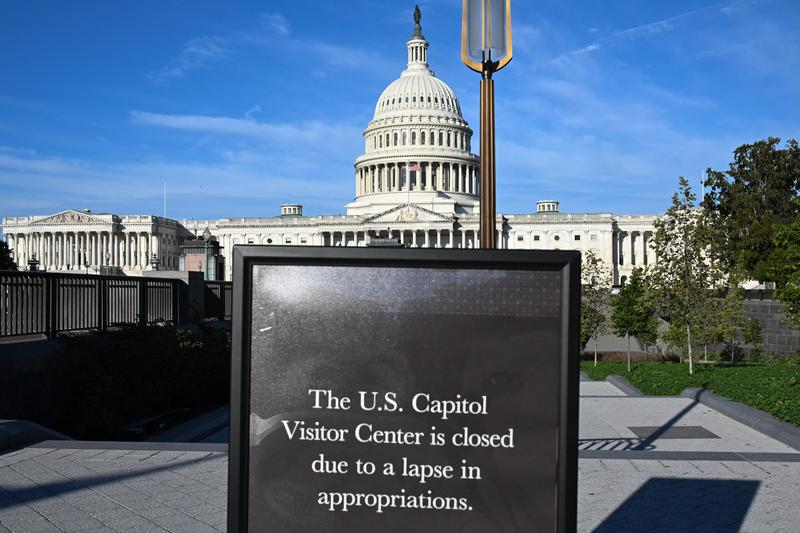
( ANDREW CABALLERO-REYNOLDS/AFP via / Getty Images )
Brian Lehrer: It's The Brian Lehrer Show on WNYC. Good morning again, everyone. Now we turn to national and some international politics. One intractable problem is finally showing some signs of progress. There's a peace deal between Israel and Hamas. I know there's some dispute over whether to call it a peace agreement or just a ceasefire, but it's showing promise that the release of all the remaining hostages might take place, maybe even as early as this weekend. Then there would be a ceasefire as step one. As you were just hearing in Michael's newscast, there are still things that have not been agreed to. I wonder if either side is going to go through with it. We'll see what our guest thinks.
Here in this country, the standoff continues between the Republicans in the White House and Congress and Democrats, and that is, of course, over another unchanged item, and that's the Senate vote on funding the government, federal employees furloughed or still working, but with no pay, and the House not in session. I don't know if you've heard yet a clip of Congressman Mike Lawler from north of New York City, Republican, and the House Minority Leader, Hakeem Jeffries from Brooklyn, screaming at each other yesterday.
To talk about both of these issues, and maybe a little bit about his new article in The Atlantic that links the threat by President Trump to put the governor of Illinois and the mayor of Chicago in jail, links that to the prosecution of Jim Comey, we have Jonathan Lemire, co-host of Morning Joe on MSNBC, contributing writer at The Atlantic, and author of The Big Lie: Election Chaos, Political Opportunism, and the State of American Politics After 2020. Jonathan, always good of you to make some time for us after your morning show. Welcome back to WNYC.
Jonathan Lemire: Always happy to be here. Good morning.
Brian Lehrer: It was very interesting to me, watching a little bit of Morning Joe today, that here are all these people who are usually so critical of Trump, Joe Scarborough himself, the former Democratic senator from Missouri, Claire McCaskill, Reverend Al Sharpton, all giving President Trump credit for major progress, as it appears to be, in the Middle East. Is there consensus that he deserves it?
Jonathan Lemire: There seems to be that Democrats, I spoke to a few last night, who said, "Look, we have to be honest about this. We'll be very critical of the president when he deserves our criticism," and they think that's most of the time, "but when he does something right, we should be able to say so." That's how this democracy is supposed to work. It does appear that we may. Again, we should apply the normal caveats. This is a fragile situation. The Middle East is always tricky.
There are always last-minute tripwires, but it does appear that phase one of a deal is close, which, as you just said a moment ago, would return the last hostages from Gaza back to Israel, the last survivors, and we believe soon thereafter, also some of the bodies of those who died in captivity. That could happen. US officials told me this morning, probably Monday is the day they're looking at now, so we're still a couple of days away. The president is really pushing this. We can get into it in a moment, but he did really lean on Prime Minister Netanyahu in the last few weeks. That's why he's getting credit from some to get this agreement to the finish line.
He himself, President Trump, expected to travel to the Middle East this weekend, perhaps to be part of the final negotiations and maybe speak to the Knesset, the parliament there in Israel, and maybe even be present for some of the hostages coming home.
Brian Lehrer: I realize you're a US national politics reporter and host, not in the Middle East, but do you have an understanding of why Hamas, from their point of view, would release all the hostages in exchange for something that is temporary, as far as we know, with respect to what Israel is promising to do in Gaza?
Jonathan Lemire: Certainly, foreign policy, national security, in my purview to a degree, but you're right. There's not always a clear answer here. I think the officials that I've spoken to say they believe that Hamas had took Trump's warning seriously of the last week or so, in particular. He said, "If this deal doesn't get done, you'll see." I won't quite quote him, but just basically, extraordinarily bad things happening in the enclave. Now, one would wonder how could it be much worse, considering that the IDF has pummeled a piece of land for two years now, but there is an agreement. Again, it has to be enforced. There are plenty of checkmarks along the way, that Israel would withdraw.
Now, to exactly where they would move the forces is still being sorted out. There's also the biggest sticking point is, I am told, some skepticism that Hamas would be willing to give up all of their weapons. Basically, you'd be allowed to live. You can survive another day, but you have to disarm. There's some skepticism whether the terror group will go through with that, but you are right to highlight that they're giving up their best bargaining chip here in terms of these hostages, but there seems to be enough pressure to at least get them to take a few steps away from the state of war.
Brian Lehrer: All right. We're going to get more into this as it develops on tomorrow's show with Gideon Rose from the Council on Foreign Relations. We will also be talking with him tomorrow about whoever the winner of the Nobel Peace Prize is, which gets announced tomorrow morning. Obviously, Jonathan, Trump has been angling for that peace prize. Do you know if they make the decision so much at the last minute that they could look at this agreement that he brokered and say, "Oh, now Trump deserves the Nobel Peace Prize," or is the vote already in?
Jonathan Lemire: I truthfully do not know. I'm actually looking here as you were calling it up. This is something I've been asking, too. The nomination deadline was January 31st. Now, it's possible that in those first 10 days of his administration, someone went ahead and nominated him for a Nobel Peace Prize. This time, perhaps it's more likely he would be getting it a year from now, if this does come to be, but he's made no secret of his attempts to get this prize. I think we should just briefly highlight what has changed here in the last couple of weeks was Trump being-- he's had frustrations with Netanyahu for some time.
Really, what was described to me by US officials briefed on the matter, what really upset him, pushed him past the line, if you will, was the strike in Doha, which the US did not receive really any notice of. This was the attempt to kill some of the Hamas negotiators. That said, first, the strike was not successful. It killed a couple of Qatari citizens, the Qataris acting as mediators here and close allies with President Trump. Trump was infuriated in its aftermath, struck a security deal with Qatar, almost offering Article 5-like protections. He made Netanyahu apologize to those in Doha. In fact, the White House then put out a picture even of Netanyahu on the phone making that phone call with Trump sitting next to him.
That was the moment where Trump really started to apply this pressure to Netanyahu, knowing that Netanyahu frankly needs his support for his reelection campaign in Israel next year. Trump is very popular in Israel. Netanyahu can't be seen as breaking with him. That's the moment where Trump was able to threaten withholding the US Military aid, perhaps, and Netanyahu finally came to the table.
Brian Lehrer: Interesting. A listener texts, "You don't get the Nobel Peace Prize when you're promoting war in your own country." Didn't Trump say or post something like, "We're going to show the people in Portland why we call it the Department of War?"
Jonathan Lemire: Yes, I was akin to that message. I mean, you're right. Also, we could get into the strikes in Venezuela or these boats off the coast of Venezuela. There are plenty of reasons why Trump's critics would say he does not deserve a Nobel Peace Prize. Also, Trump is very fond of recounting the, depending on the day, six or seven or eight, he says, conflicts he's stopped since taking office, and a couple of them, he's played a real role and deserves some credit. Others, decidedly not, India and Pakistan, for instance, say he had nothing to do with the resolution or the temporary resolution of their conflict.
Trump certainly is applying pressure as much as he can and leaned on even other leaders, including Netanyahu, to nominate him for a Nobel Peace Prize. We'll see if he ever gets one.
Brian Lehrer: Now back to domestic politics, where it seems like one day is just like another, with little to no movement on ending the impasse and on the government shutdown, with Republicans wanting what they call a "clean funding bill," an extender of the current year's budget or the previous year's budget through November 21st, and Democrats insisting they negotiate healthcare subsidies before the shutdown ends or in order to end the shutdown. The big question seems to be which side is winning the blame game. New Jersey Senator Cory Booker was with us on the show yesterday, and here's 30 seconds of what he said.
Senator Cory Booker: Let's just start with the absurdity that Donald Trump and Republicans control the White House, they control the Senate, they control the House of Representatives. They're running the administration. Donald Trump, by his own words, this is his quote. He said, "It is on the president of the United States to bring parties together and get budgets passed." He has the trifecta. He has the power. It is him that is causing this shutdown because he is responsible for bringing forward a budget that can get through the House and the Senate and to his desk.
Brian Lehrer: That was Senator Cory Booker, Democrat of New Jersey, on the show yesterday. One more clip. Republican Congressman Mike Lawler, who represents various areas north of New York City, tried what some are calling a stunt with Minority Leader Hakeem Jeffries, who represents Brooklyn, confronting Jeffries to ask him to sign on to a bill to renew Affordable Care Act or Obamacare subsidies for one year. Jeffries was dismissive and said his bill wouldn't make it to the floor, Lawler's bill. Here's an example of that very heated exchange. 15 seconds.
Congressman Hakeem Jeffries: Why are you here right now? Where are the rest of your Republican colleagues?
Congressman Mike Lawler: Didn't you want all the Republicans to be here? I'm here.
Congressman Hakeem Jeffries: Where are the rest of your Republican colleagues?
Congressman Mike Lawler: You wanted Republicans to be here. I'm here.
Congressman Hakeem Jeffries: Why are you--
Congressman Mike Lawler: By the way, you can pass an ACA extension right now. Sign on to this bill.
Congressman Hakeem Jeffries: Did your boss, Donald Trump--
Congressman Mike Lawler: Sign on to the bill.
Congressman Hakeem Jeffries: Is your boss, Donald Trump, behind this again?
Congressman Mike Lawler: HR--
Brian Lehrer: Jonathan, I don't know if you played the clips of that on Morning Joe today, but what happened there, as far as you know?
Jonathan Lemire: We did. You're right to suggest that there are many who say that Lawler is trying to create a stunt. They're trying to cover himself a little bit. He obviously represents a swing district, a district that President Biden won in the past. He's playing to a different set of constituents than a lot of his Republican colleagues. It is interesting how this government shutdown really has begun to center around those Affordable Care Act subsidies you just mentioned. We spent a long time on the show this morning about this. Steve Rattner brought out his charts, and the former Congressman, Joe Scarborough, notes that anytime a situation comes about healthcare, Republicans, his former party, tends to lose.
That's what's happening here is that after that first few days of this shutdown, where it seemed like it would be the Democrats who wouldn't be able to kind of keep the party cohesiveness more than a couple of days. Almost instantly, a couple of Democratic senators broke from the rest of them. Most people I spoke to in Washington, on both sides of the aisle, said, "Okay, Democrats' resolve simply isn't there. This is Schumer needing to make the statements, but this is going to wind up in a couple of days. They'll cave." That's not been the case. We're seeing polling suggest that, look, Americans aren't happy with either party, but they're more blaming the Republicans.
On its face, that's easy to understand. Republicans do indeed control the White House, the Senate, and the House of Representatives. They're the ones right now taking the blame. Certainly, polling also suggests, backing up Joe Scarborough's point, that the public trusts Democrats much more on healthcare. We've also highlighted how these subsidies really are most used by red states, Republican states even more so. They're used across the country, to be clear. It doesn't matter what your party ideology is, but it would be Republican states really bearing the brunt of this.
There's becoming, on that point, Brian, some anxiety. Just the last day or so, I picked up a little bit of anxiety from the GOP as to where this shutdown is going.
Brian Lehrer: There's a Marjorie Taylor Greene story here, isn't there?
Jonathan Lemire: There is. If you had said six months ago who is President Trump's most loyal foot soldier in the House, you might come up with the name Marjorie Taylor Greene, but we've had two significant exceptions to that since then. One, of course, she's out there on the Jeffrey Epstein files. That was a big part of her political identity, and she's not willing to let it go despite Trump telling her and other Republicans to do so.
Then, in the last couple of days, she's come out and oppose to this as well, saying-- and in some ways, this is old-fashioned constituent services here where she has said she's talked to people in her own district, and even included her two adult sons who would see their premiums soar, because of what's happening here with Obamacare. I think that she's, first of all, I'm told President Trump, not surprisingly, missed at her. I think she's represented-- first of all, she's more willing to speak her mind, perhaps to some of her colleagues.
If she's there now, it doesn't take a huge leap of imagination to think that some of her fellow Republicans will get there in the days ahead, the more they hear from people back home about what this is doing. That brings me to my last point in this particular answer, anyway, is just that those Congress members have a lot of time to hear things back at home because they're all back at home. That's the other thing that is not playing well right now. The fact that Speaker Johnson has kept the House on recess, has refused to bring them in.
I think some polling that I've seen and people have talked about, that's not sitting well with a lot of Americans who say, "Wait a minute, the government shut down. You guys aren't even at work trying to fix it."
Brian Lehrer: Here's a 10-second clip of Senate Minority Leader Chuck Schumer yesterday. This sounds to my ear like starting to gloat a little bit about where the polls are headed. Let's listen.
Senator Chuck Schumer: If you care about fixing the crisis, if you care about reopening the government, how the hell do you keep your House not in session for three weeks?
Brian Lehrer: There's that refusing to acknowledge that public sentiment is not on their side is the premise of that Chuck Schumer clip, but let me get back to that Mike Lawler, Hakeem Jeffries standoff for just a second. Why wouldn't Jeffries be interested in the substance of what Lawler says he's proposing, and that is to extend the current Obamacare subsidies that are the crux of the issue here for the Democrats for one full year until next year's fiscal year starts, I guess, October 1st, 2026. That's a pretty long time to extend the current Obamacare subsidy formula. Why wouldn't the Democrats be interested in that?
Jonathan Lemire: There are a couple of things here. First, I think we shouldn't lose sight of the politics here. They think this is a winning issue. They haven't had a lot go for them in the last year or so, Democrats, and they're not willing to give up on this. They do see the polls, and they can make, credibly, the argument that Speaker Johnson is keeping the House out of session because he doesn't want to bring them back and then have to swear in the new lawmaker from Arizona, which would then give Democrats and a handful of Republicans enough votes to push for the further release of Jeffrey Epstein material, [unintelligible 00:17:05] Johnson sent the House home early over the summer to not to deal with it.
In terms of the substance here, I think that there is no question that Democrats are interested in a longer-- they would like a longer extension than just a year. I think there is real skepticism that the Republicans would sign on for a year. They had floated a few weeks ago, you might remember, at the beginning of the shutdown, Republicans had pushed the idea that like, "Oh, let's just extend these subsidies for a few weeks and we try to hammer out a deal." I think a lot of Democrats think that's bait and switch, that this is their one leverage point. The Republicans would be willing to, not a year.
Maybe Jeffries would be willing to consider a year if that were a real offer, but if it's a much shorter one, which is what Democrats tell me they think Republicans are actually willing to propose, then they'd sign on to fund the government. They'd have to revisit the subsidies again soon anyway. At that moment, the Republicans might have less leverage against them to actually negotiate. In the interim, the Democrats have just voted to fund a government that is paring out ICE raids, that is deploying National Guard members to American cities, and so on and so on and so on.
I think the other point we haven't mentioned here is the president's threat to fire, or federal workers will refuse to pay them back pay if they do come back after furlough. That's another thing that is polling very poorly. Democrats, they just feel like they're not going to gamble on this in the short term.
Brian Lehrer: We're almost out of time. Give me one short thought on your latest article on The Atlantic, which ties the president's Truth Social post yesterday that the mayor of Chicago and the governor of Illinois, both Democrats, of course, who don't like this National Guard deployment to the Chicago area, that the governor and the mayor should be in jail for failing to protect ICE officers. I believe you tie it in The Atlantic to the prosecution of former FBI Director James Comey.
Jonathan Lemire: That's because retribution is here. I think we shouldn't lose sight of just how striking this is. This is the president of the United States calling for the arrest without evidence, without even any suggestion of charges, of two political opponents, the governor of Illinois, the mayor of Chicago, people he doesn't like, the people who are standing in the way of what he wants. That in itself is a place we've never really been before. Now, the counter, one might say as well, Donald Trump as a candidate and as president, he talks a lot about arresting people or wanting to punish his political foes, but nothing ever really happens.
It's clear that if it's true, in his first term, there were guardrails, including his own attorney general, who stood up to him and did not carry through prosecutions that he wanted of Hillary Clinton, John Kerry, Barack Obama, et cetera. That's where James Comey comes in, because for the first time, a prosecution is happening. A week or so ago, when Trump sent a direct message to Pam Bondi, he inadvertently posted it publicly, telling her he wanted some of his political foes to be charged. One of them then was, on a very flimsy pretense, having to bring in a replacement prosecutor to do so because the original one resigned because he wouldn't.
That is why this matters is that Trump now has no guardrails. He has applied attorney general. He's remade the government with people who are simply going to say yes to his wishes. Now, he has, as long threatened, carrying out his retribution against those he thinks has wronged him or those he believes are standing in his way. He himself has said, "Comey would not be the last."
Brian Lehrer: Jonathan Lemire, co-host of Morning Joe on MSNBC, contributing writer at The Atlantic, and the author of The Big Lie: Election Chaos, Political Opportunism, and the State of American Politics After 2020. Jonathan, we always appreciate that you stay up late with us on your clock. Thank you very much for today.
Jonathan Lemire: I appreciate it. I would offer condolences on the Yankees, but I wouldn't mean it.
Brian Lehrer: Yes, you wouldn't mean it. You mean, as a Red Sox fan, you can celebrate the Yankees losing to the Blue Jays, even though the Yankees just beat the Red Sox and they went home first? You can feel good about that?
Jonathan Lemire: I do. I take almost as much pleasure of a Yankee loss as a Red Sox win.
Brian Lehrer: Thanks, Jonathan. Bye-bye.
Copyright © 2025 New York Public Radio. All rights reserved. Visit our website terms of use at www.wnyc.org for further information.
New York Public Radio transcripts are created on a rush deadline, often by contractors. This text may not be in its final form and may be updated or revised in the future. Accuracy and availability may vary. The authoritative record of New York Public Radio’s programming is the audio record.
