
The Women Leading the Farmworker Movement
Title: The Women Leading the Farmworker Movement
[The Brian Lehrer Show Theme Music]
Brian Lehrer: It's The Brian Lehrer Show on WNYC. Good morning again, everyone. Later in the hour, we're going to talk about class consciousness and the New York Mets. I'm not kidding. Somebody wrote a book about class consciousness and the New York Mets. The that's coming up. For some Americans, today, March 31st, has been known as Cesar Chavez Day, but that is now changing, and many of you know why.
An investigation by The New York Times, published March 18th, found "extensive evidence that Cesar Chavez, the United Farm Workers co-founder, groomed and sexually abused young girls and women who worked in the movement." For many decades, the civil rights leader was revered as an icon, especially in the Latino community, but also far beyond. Streets and schools are named after him.
Today, as I say, March 31st, is supposed to be Cesar Chavez Day, a US federal commemorative holiday proclaimed by President Barack Obama in 2014, but now, many who idolized him and the larger farmworker community are obviously left shocked at the revelation. Today, many of those celebrations have been canceled or renamed. Joining us now is Chabeli Carrazana, economy and child care reporter for The 19th, the news organization named after the 19th Amendment, which gave women the right to vote. She recently reported on the women in the farmworkers' movement and how they are grappling with the explosive allegations against Chavez. Chabeli, thanks so much for joining us. Welcome to WNYC.
Chabeli Carrazana: Oh, thanks for having me, Brian.
Brian Lehrer: Listeners, how are you grappling with these revelations if you previously admired or even idolized Cesar Chavez? 212-433-WNYC, 212-433-9692. I don't know if on this New York City radio station we have any farmworkers listening, or maybe anybody who is related to anybody who ever was a farmworker and for whom Cesar Chavez was very relevant as a leader or as a symbol of farmworkers' rights, or I know Chavez's reputation and inspiration went beyond that, so how are you dealing with this? What do you think should happen next? 212-433-WNYC, 433-9692.
Chabeli, let's begin with The New York Times reporting. I mentioned very much in brief what they found. Do you want to expand on it at all, or what your take at The 19th is on The New York Times revelations?
Chabeli Carrazana: Sure. The Times spent about five years investigating their story. On the record were two women who are now in their 60s who were young teen girls at the time that they were assaulted and abused allegedly by Chavez when he was already in his 40s and already a really powerful organizer in the movement. Ana Murguia said Chavez first assaulted her when she was 13 years old. Debra Rojas said she was first assaulted at the age of 12 and later raped when she was 15 years old by Chavez.
Both of them were daughters of longtime organizers who worked beside him. In the years after the abuse, they both suffered from depression, panic attacks, substance abuse. It really marked their lives, but they never really came forward about it. They didn't feel like they could. It was a movement that was powerful. It was a man who was very powerful, and they did not feel like they would be listened to if they spoke up.
In fact, Rojas did talk about the abuse a couple of years ago, I think about a decade ago, and it was sort of brushed off. No one really paid much attention to her, and so she said, "I feel like he's been a shadow over my life," and she felt like it was time to come forward about it.
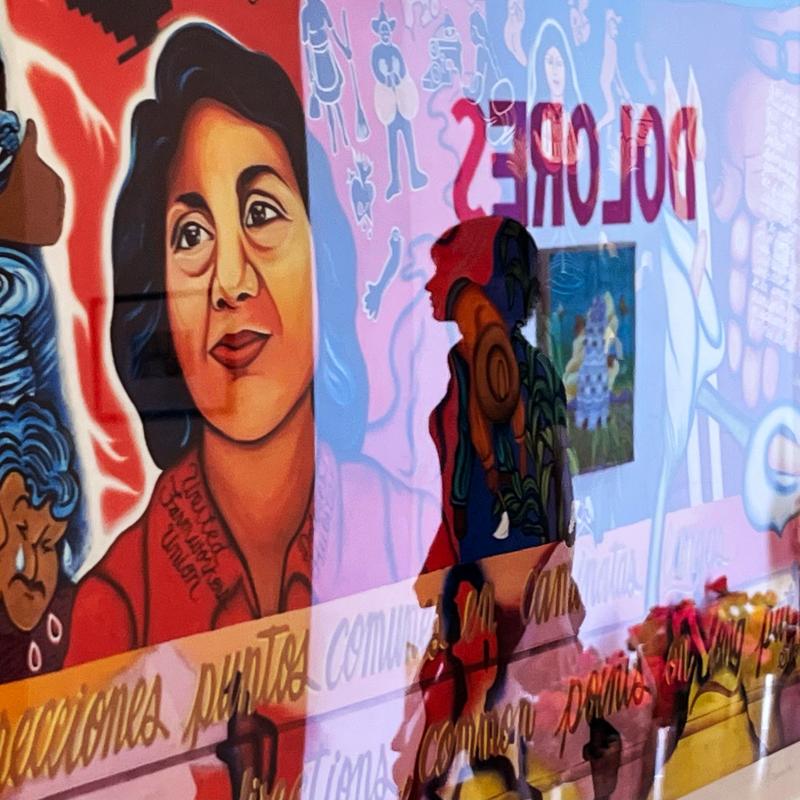
Brian Lehrer: Chavez co-founded the United Farm Workers Union alongside Dolores Huerta. Listeners might know her as the renowned activist who coined the rallying cry "Sí, se puede," which President Obama later used in an English language translation in his presidential campaign, "Sí, se puede," "Yes, we can." She also revealed the pattern of abuse perpetrated by Chavez. Among the allegations, she told The Times about emotional and physical abuse from her longtime organizing partner and at least two instances of rape.
I mentioned in the introduction that there are schools and streets named after Chavez. He was that much of an icon in the Latino community and more broadly out west. Can you talk about that at all for people, again, in the New York metro area where maybe he is not the civil rights icon who's on the top rung of the ladder? It wasn't just farmworkers, right? He became an icon for Latino rights in a larger sense and other things.
Chabeli Carrazana: It's hard to really overstate what an icon, what a hero he was for so many people, particularly for a community that has so few of them in the United States. There are so few Latinos that have been elevated to this position of having such a legacy that elevated the community. There was a really interesting line in one of The Times stories from today where they were talking about on mantels. Folks had photos of Jesus Christ, and then they had a picture of Cesar Chavez right next to him.
That's the level he was on for many folks. He inspired movements beyond that. So many of the people who are now in the farmworker movement were inspired by him. Particularly for Chicanos and folks in the Chicano Movement, the movement, to have a holiday named after him was really an effort to say, "We finally have a hero who stands for us. Let's recognize him." I think that is what makes this really complicated for folks, is that he was revered. It's really difficult to see the truth behind the way that he may have abused his power.
Brian Lehrer: One listener just writes a one-line text, "I shredded my mom's picture of him." Sam on the Lower East Side, you're on WNYC. Hi, Sam.
Sam: Hey, Brian. I grew up with Mr. Chavez being a huge icon. He was a friend of my father's. I grew up in Southern California. I didn't have a grape until I was about nine because we wouldn't eat them because [unintelligible 00:07:08] we were such supporters of the farmworkers. My father was his good friend. He stayed at our place when I was two years old. I once ran into him.
I mean, I went to a lecture he was giving in New Orleans at Loyola. I introduced myself using-- I have the same-- Sam is my father's name also. He said, "Oh, from Long Beach, from California. Are you kidding me? I remember your father. I remember I stayed on your floor, all this." To see him reduced so quickly into like an Epstein-type character or Weinstein for that matter. It's stunning and it's gut-punching. It just hurts. I just wanted to mention. I'm not a farmworker. I'm just-- California, you know.
Brian Lehrer: Yes. Sam, thank you very much. Thank you very much. Very emotional. There are so many stories like his out there, right, Chabeli?
Chabeli Carrazana: So many. After we read the allegations, I started to come up with a list of women in the farmworker movement that we wanted to hear from. One of the first ones that I was able to speak to was Mónica Ramírez. She's the founder of Justice for Migrant Women. Really her life's work is not just about justice for farmworkers and rights for them, but specifically talking about sexual assault and sexual abuse of migrant women.
The way that she described it to me was the community has been shaken to its foundation; really, really grappling with what this means for the folks who do the work that they do in part because of the work that Cesar Chavez did and who he was. One of the things that Mónica pointed out to me too, was the farmworker movement. The way she talks about a leaderful movement. Women have always been part of that leadership, but their work has often been made invisible sometimes by the very men who stood beside them.
Women have been the ones organizing meetings, helping to bring their co-workers, cooking, taking care of children, been such a big part of the movement and also in leadership positions. If we talk about Dolores Huerta and even Chavez's wife, Helen Chavez, played a lot of roles in the administrative-- of keeping this movement going and alive. So often, they're not part of the story.
That's not just true of the farmworker movement, right? That is true of every labor movement. Many movements in the United States, women are not often centered, but they do play a critical role behind the scenes. That's really where her head was at when I spoke to her about this, was thinking about the folks who have been here, have been working, have made the movement what it was, and moving away from just centering the one man, this one charismatic man who was the face of it.
Brian Lehrer: Yes. In response to the reporting, Dolores Huerta said she carried her secret for 60 years because "Building the movement and securing farmworkers' rights was my life's work. The formation of a union was the only vehicle to accomplish and secure those rights, and I wasn't going to let Cesar or anyone else get in the way." How tragic that in order to build that movement, as she experienced it, she had to carry that secret of his abuse.
Another listener writes, "I saw Dolores Huerta speak 30 years ago in Los Angeles. She did not appear enthusiastic to talk about Chavez. She wanted to focus on the movement. I am glad the names of many events for the holiday is changing to celebrate the movement, not the man. I am all for protecting the survivors." Is this day, which was Cesar Chavez Day, as designated by President Obama, because this is his birthday, March 31st, date of his birth, it's changing to Farmworkers Day in at least some places, is that something that you expect to catch on?
Chabeli Carrazana: We're seeing that in a lot of places. Some places have even changed it to Dolores Huerta, to name her instead. Farmworkers, most notably in California, this is where this movement took off, California has changed it already to Farmworkers Day. We are seeing that throughline of let's not make this just about the man, but rather the farmworker movement is about all of the folks who made this happen. I think that's really what folks are propping up today.
Brian Lehrer: Standing by is our colleague at WNYC, Robert Barba, who has long regarded Chavez as a personal hero. In fact, he told us a project he did on Chavez as a kid led him to becoming a journalist. Hey, Robert, thanks for coming on the show with us.
Robert: Thanks for having me, Brian.
Brian Lehrer: Did I get that characterization right?
Robert: Yes. It's 1995, I'm 13 years old, and I was selected by my history teacher to participate in this thing called National History Day. Classmate and I, we did a 10-minute video on Cesar Chavez, specifically on his 25-day hunger strike in 1968. During that project-- The project went on to win third place nationally, but as a part of it, I learned to research. I interviewed Dolores Huerta, I interviewed Helen Chavez, I interviewed one of his sons. It really truly is a fundamental part of who I am.
It is how I became a journalist. It kind of laid the path for me of, like, this is something you can do. This is something that you could spend the rest of your life doing, which is just telling the stories of people's lives.
Brian Lehrer: How are you feeling today then?
Robert: Well, every March 31st, long before it was declared a holiday, I always thought of him. It was something that really stuck out because beyond the project, he did become a personal hero. You mentioned he was a hero to Mexican Americans. I'm Mexican American, people from the West. I'm from Colorado. This is someone who resonated deeply with me. I always sort of meditated on this phrase that he had about what led him to stop eating and the the decision to choose nonviolence. Today I am celebrating the movement, and I'm thinking about the victims, and I'm recognizing him as a flawed figure.
Brian Lehrer: Yes. A listener texts, Robert, "Many heroes and many people are not all good or all bad. George Washington and Lincoln owned slaves," writes that listener. I don't know if, with your background, as you just described it, this is a local angle you might want to cover, but according to Patch, "Eight years after it was put up with pride, the name Cesar Chavez has been removed from a school in Yonkers" as of yesterday. This is having those kinds of local ramifications.
Robert: I think we're going to see that a lot.
Brian Lehrer: Thanks for joining us for a few minutes, Robert. I want to mention as we go back to our guest Chabeli from The 19th, that in your latest article, I just want to make sure I give you the chance to say this out loud. You spoke to women who are leading the modern farmworkers' movement. What's the place of women, as a group or however you want to characterize that, among farmworkers today?
Chabeli Carrazana: Women are leaders in so much of what's happening in terms of organizing in the labor movement broadly and certainly in the farmworkers' movement. Like I mentioned earlier, so often they are not centered, not talked about as much, not the ones who have the streets named after them or the schools named after them. Some of them are also telling me this has been a pervasive issue within this community work that women have been doing for many years to try to improve conditions of sexual harassment and assault against women.
I spoke to Magaly Licolli, who's the co-founder of an organization in Arkansas that's advocating for poultry workers. She said she was fired from a prior job for speaking up about accusations of sexual harassment and assault. She was not actually surprised hearing the allegations against Chavez. For her, it's this understanding that women have been silenced against this kind of injustice and to the point that Huerta made in her statements in order to protect the work.
One of the things that she said that really stuck to me was she never romanticized the immigrant community or the immigrant movement, sexual abuse happens in many movements, and it does not negate the work that's being done to secure worker power.
Brian Lehrer: By the way, a correction to the text that I just read out from the person who wrote, "People are not all good or bad. George Washington and Abraham Lincoln owned slaves." Abraham Lincoln did not own slaves. Probably that person meant to write Washington and Jefferson or something like that, but I didn't want to let that go uncorrected. Nick in Corning is going to raise, I think, even a certain kind of larger frame for this issue. Nick, you're on WNYC. Hello.
Nick: Hey, Brian. I'm going to try not to echo a lot of the points that were already made because I think that the conversation has been great so far. I really agree with everything. I was actually very happy to hear the journalist that just called in, that was really nice. Anyway, I think that the overarching theme here is idolatry, right? Whether you're Barack Obama or Donald Trump or Cesar Chavez or Martin Luther King or Bill Cosby or any of these figures, I think that society is beginning to evolve a bit, and I'm optimistic about it because it's time to stop naming things after the fallible people that may have a very significant role in the movement and the advocate work that's being done.
It's not about-- I love-- I have all of Obama's books. I have a lot of Martin Luther King's books. It's not directly about them, though. It's about the ideals that they brought here and gave to us in service. I think that it's time to really move away from naming days and events after individuals and start celebrating and representing the large community that really deserve the recognition and the praise and went through those hardships. That those people, I'm sure, would be happy and proud to advocate for and have the day really rightfully named after. It goes both ways, right? There's a lot of nuance there. There's no need to highlight the individual about it.
Brian Lehrer: Nick, thank you so much for calling in with that frame. What are you thinking as you hear him, Chabeli?
Chabeli Carrazana: I think that is what we're hearing a lot as well, is this instinct to prop up this one figure. I think Magaly, one of the folks I spoke to, one of the leaders I spoke to, talked about this. We have this instinct to prop up one figure and put the entire movement on this one person's back, this very tight, specific way that we recognize things, and we've done this for centuries.
Brian Lehrer: Yes, with so many things, "Now we will praise great men." It does help to sell an idea though, right? If there's a certain individual-- We know this in journalism too. If we tell the story of an individual, it might spark more of a reaction and maybe help to change things for the better more than if we just focus on the abstraction and the numbers.
Chabeli Carrazana: That's exactly what I was thinking, Brian. So many stories where we center a person and now suddenly folks pay attention, whereas it's been a problem this entire time. It just tells a better story if you have one person leading it. I don't know, folks' attention spans are limited. It's the way that we connect with things, and that's fair, but-
Brian Lehrer: But-- Yes.
Chabeli Carrazana: -who is going to be the face of a movement? The people. I think that's where folks are now.
Brian Lehrer: Well, Happy Farmworkers Day. Chabeli Carrazana, economy and child care reporter for The 19th. Her latest is titled, "The Women Leading the Farmworker Movement Won't Let It Be Defined by Cesar Chavez." Thanks so much for coming on.
Chabeli Carrazana: Thanks, Brian.
Copyright © 2026 New York Public Radio. All rights reserved. Visit our website terms of use at www.wnyc.org for further information.
New York Public Radio transcripts are created on a rush deadline, often by contractors. This text may not be in its final form and may be updated or revised in the future. Accuracy and availability may vary. The authoritative record of New York Public Radio’s programming is the audio record.
