
The War With Iran Widens
Title: The War With Iran Widens
[music]
Brian Lehrer: Brian Lehrer on WNYC. Dexter Filkins is with us, staff writer for The New Yorker the last 15 years. He previously had been the Los Angeles Times' New Delhi bureau chief. He covered the Iraq War for three years and was part of a Pulitzer Prize-winning New York Times team for coverage of Afghanistan and Pakistan.
He has also reported from New York, you know that place. Dexter Filkins is author of the book The Forever War, which covers a timeline from the rise of the Taliban in the '90s through September 11th and the US wars of regime change in Afghanistan and Iraq that followed. Very relevant right now, obviously, as people start to make that comparison, and the Trump administration tries to refute it. Dexter, thanks for coming on. Welcome back to WNYC.
Dexter Filkins: Thank you very much for having me.
Brian Lehrer: Can I just jump right in on the "no more forever wars" issue and your book The Forever War? Maybe with your reporting history, you have a grasp on how Trump plans to define success in this case and hang the Mission Accomplished flag and bring our troops home without staying a long time or looking like it ends in kind of a draw. Do you?
Dexter Filkins: Well, I don't think we know the outcome yet. There are no American troops on the ground inside of Iran, but my sense is that what Trump wants to do and what Israel wants to do is degrade or eliminate their ability to project any kind of power outside of the country and also degrade as much as they can their ability to shoot their own people in the streets, as they did en masse in January. At some point, and we don't know when that is, I think Trump will call it a day and say, "I've done my best for you. Now it's in your hands." That's a weird outcome, but I think it's probably the most likely.
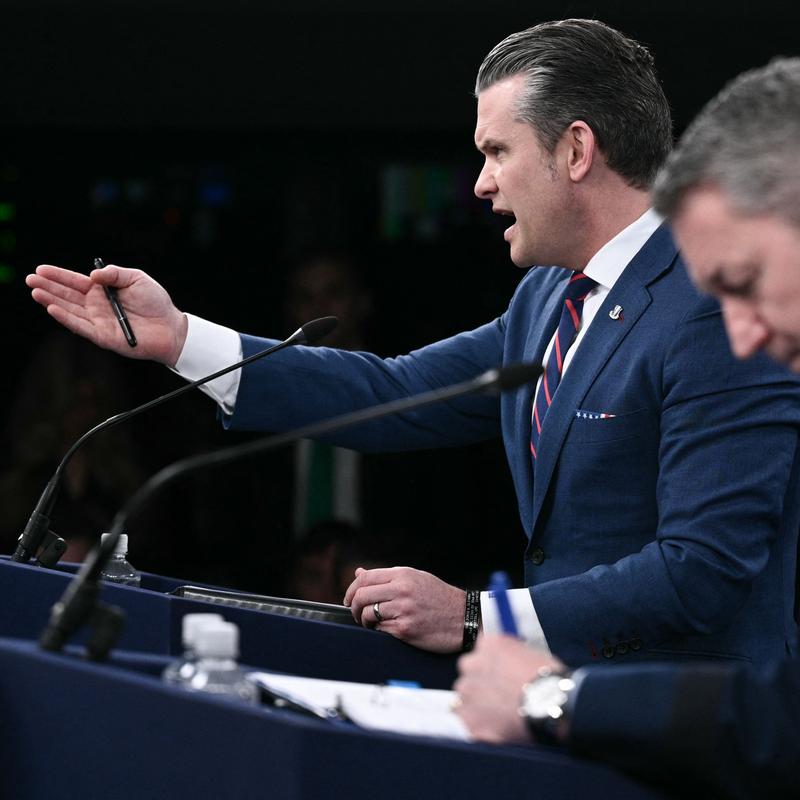
Brian Lehrer: "In your hands, Iranian people." We'll get back to that, but I want to play a clip of Defense Secretary, or Secretary of War, as they now prefer, Pete Hegseth, from his briefing yesterday, and ask you about it from a forever wars or US quagmire standpoint. I think these 20 seconds, though that briefing went on for quite a while, I think these 20 seconds were basically the heart of it yesterday.
[clip begins]
Pete Hegseth: In under a week, the two most powerful Air Forces in the world will have complete control of Iranian skies, uncontested airspace, and Iran will be able to do nothing about it. B-2s, B-52s, B-1s, Predator drones, fighters controlling the skies, picking targets.
[clip ends]
Brian Lehrer: That's the way Hegseth put it. He said in under a week they've done this and they're doing that. I saw an analysis before his news conference, which maybe gives it more credibility, that says, "Hegseth's bravado aside, he's basically right. The forever war, Iraq/Afghanistan analogy, will end very soon because maybe even by the end of this week-" this analysis went, "-Iran will run out of missiles while the US will not, and so maybe in a pretty short time this will turn out to be very one-sided. The Americans and Israelis and Gulf State Arabs will be safe from Iranian retaliation, and Iran will be militarily defanged for a generation to come."
Does that sound plausible to you? Then the narrative would be very different from what it is right now.
Dexter Filkins: Well, we're in the middle of the thing, so it's not wise to try to call it yet, but I think what Hegseth was referring to was that the United States and Israel, they've basically wiped out Iranian air defenses, and what that means is that our planes can just go in there and hang around without really any danger that they're going to be shot down. That makes their jobs a lot easier because they don't have to use really sophisticated missiles to fire, they can just drop what they call dumb bombs on their targets, but the problem that isn't quite solved yet are the drones and the ballistic missiles that Iran has been firing out of the country, but those launches are dropping substantially in numbers.
Like from day one and day two, they've dropped like a rock because the US has taken out-- they're taking out the launchers every day, and so I think we're going to get to a point where that capability is gone or pretty much gone. Then you're left with this very, very degraded Iranian government with the Republican Guards vicious but kind of defanged, most likely to be still in charge. I think that's probably where we're going to end up, but it might not be too long from now. I think they're making a lot of progress.
Brian Lehrer: Yes. We know they've given many-- and shifting reasons for the war. That's been one of the main topic of discussions here and in so much of journalism the last few days, New York Times columnist Frank Rooney wrote yesterday, "Those promoting and defending this war are spreading out a buffet of reasons and goals and asking us, skeptics, to pick the dish that most appeals to us.
Dexter Filkins: [chuckles]
Brian Lehrer: I thought that was a good way, a little snarky, but maybe accurate to put the PR strategy at this point. Do you have a take on the question, why did the US really decide to do this?
Dexter Filkins: Yes. I think there are two reasons. One is that the Iranians had begun to produce ballistic missiles again, and essentially, they were producing them at a faster rate than the United States is producing interceptors, the missiles that can intercept the Iranian ballistic missiles. The US production capability is pretty limited there, and so the math was not working in our favor. That was disturbing.
Then you had this moment of opportunity when basically the whole leadership of Iran met in Ali Khamenei's, the Supreme Leader's compound. They had the intelligence, and they decided to take the shot. I think that's why it started on the day that it did, but I think the reason why Trump decided to go to war, when he did, is because of that first problem, which is that the equation was going to tilt and further tilt away from the United States-- favor of the United States and Israel, basically, so "Let's do it now rather than later, when it'll be a lot more difficult." I think that's the calculation, whether you agree with it or not.
Brian Lehrer: If they accomplish that goal with respect to the missiles, does that stop Iran from fueling proxy wars around the region? Like even October 7th, 2023, Hamas seen by many people as possible because Iran funds Hamas to the extent that it does. Same thing with Hezbollah. Same thing with other groups whose targets might not even be Israel, but some of the Gulf states. Does this stop that in the scenario that you're laying out that might be the US's version of victory?
Dexter Filkins: I think so. Just for your listeners who don't spend a lot of time on this stuff, the Iranians essentially built an empire across the Middle East, what they called the Shiite Crescent, even if some of those groups like Hamas were not Shiite. We're talking about Hamas, who they funded, Hezbollah, very, very powerful army in Lebanon, which they built and trained and directed, the Assad regime in Syria, all those are either gone, like, Assad, lives in Russia now, or they've been really, really substantially degraded.
I think the first effect of all this is going to be the ability of Iran to project power outside of its own country, I think, is going to drop to-- At least for the time being, it's going to drop to zero because they're not going to have the money or the material or anything.
They're going to barely have a government, if that. I think the question, which is very uncertain now, can't really be answered is, "What capacity is the Iranian government going to have inside of Iran[unintelligible 00:09:09] to suppress their own people, if we get another uprising, like nationwide uprising, hundreds of thousands of people in the streets again, like we had in January, what's going to happen then?" I think that's the biggest question of all.
Brian Lehrer: That brings me to a question about getting Iranians involved, as we've heard Trump do since Saturday, when he said, "Rise up, take back your country. This is your best shot." The US is reportedly asking Kurdish fighters in Western Iran and Kurds in Iraq to move into Western Iran to try to take over at least that part of the country. Do you have a sense of why that kind of ground operation might matter militarily if the goal is to destroy the missile capability and the nuclear program?
Because I'll ask you about when this miserably failed with the deaths of so many Kurds back in the first Bush administration. Do you have a sense of why they may be asking Kurds to even cross the border from Iraq to fight on the ground in Iran right now?
Dexter Filkins: No, but I wouldn't hold your breath for that to have any consequence. I just don't think anything like that is really serious. I doubt it's going to work. Iran is a country of 90 million people. It's huge. It's Persians, it's Kurds, it's Azeris, it's Baluchis, it's a big and diverse country, and I don't think a handful of Kurds are going to take over, but the important thing to remember, the most important thing to remember is this is a regime that has very, very little public support.
We've seen that over the years, starting in 1999, when you had the first big uprising against the regime, again in 2009. They came in rapid succession. Basically the trigger for what's happening now, the original trigger in January, where the regime probably killed, nobody knows, but the estimates are around 30,000 civilians, most of them in the streets, to put down a nationwide very popular rebellion. This is not a popular government.
I think when President Trump says, "We'll bring the Kurds and whatever," I think it's in the context of this is an embattled and very deeply unpopular regime, but he's putting it in the hands of the Iranian people and saying-- at some point he's going to say, "Okay, I've done my part. Now it's up to you."
Brian Lehrer: Yes. My guest, if you're just joining us, is Dexter Filkins, New Yorker staff writer and author of the book The Forever War. Bringing in the Kurds reminds me of another part of our military history that relates to asking the people themselves to rise up and change the regime. Maybe you have a take from your time covering Iraq, after the first Gulf War, what we call the First Gulf War, 1991, the George H.W. Bush War. After Iraq invaded Kuwait, Bush decided against aiming for regime change in Iraq, largely betting that he didn't want Americans getting killed in a bloody ground war, marching to Baghdad to get Saddam Hussein.
Instead, he asked the Kurds and others to rise up, this is all reminding me of that, and take the government themselves. The result, as you know, was a bloodbath of Kurdish fighters who didn't have the forces to topple the regime or fight their military. Now the BBC reported just last hour that Kurdish leaders are saying they will not do this unless Americans lead the way. Is this another case of the sorry history of the US in the Middle East hanging over the mission today?
Dexter Filkins: I don't think so. I think this is different, actually, because I think what Trump has said and what he's trying to do is pretty much the opposite of that, because he watched, as we all did, the Iranian regime massacre their own people in January, which they've done many, many times to stay in power. He said, "I'm going to send help." He turned the two aircraft carriers around and sent them into the Gulf, where they are now.
I think it's hard, as you point out, to pinpoint the exact objective of this operation, but one of the effects, clearly, of this military operation is going to be to substantially degrade the ability of the Iranian government to suppress its own people. That, to me, is the bottom line.
Brian Lehrer: How does it do that, though? Because you don't need missiles and a nuclear program to shoot demonstrators in the street. You just need regular guns in your military, so-
Dexter Filkins: That's right.
Brian Lehrer: -how does it do that?
Dexter Filkins: Well, if you look at the bombing targets, they're hitting everything from Iranian Republican Guard barracks, and those are the elite forces. There's like 150,000 of them. Then you have a militia, kind of untrained guys with guns called the Basij, and that's about 400,000 people. They're hitting all that stuff, all of it, and all over the country, they're bombing police stations in the country. I think that they clearly are trying to set the conditions for a rebellion to succeed.
If the rebellion that happened in January happened again, they're trying to set the conditions to make it more likely that that rebellion would succeed. I think that's pretty clear. They are trying to substantially degrade the ability of-- They're trying to do a couple of things. One is to degrade the ability of the Iranians to project power outside of their country but also inside the country.
Again, at some point, and I don't know when that point is going to come, but Trump is going to say, "All right--" Let's assume the government's still standing, I think he's going to say, "Okay, look, we've done a lot, we've killed a lot of these guys and we've diminished their power substantially. It's up to you now." What's Iran going to look like then, what's the government going to look like then, is it still going to be standing, is it going to have any power at all, is it just going to be kind of a pathetic rump state, we don't know, we don't know yet because we don't know how long this is going to go on, and it's going to be Trump's call.
Brian Lehrer: I want to ask you one more question that has a historical context, and then we're out of time. The issue of American service member deaths in a kind of big historical context that I think Hegseth has an agenda about, and maybe Trump too, what people call Vietnam War syndrome, that ever since the failed Vietnam War, which the US lost, and never convinced the American people of the need for. It's been politically difficult to send US troops into battle to die.
Now some American service members are dying. The fact that the Iraq War repeated the pattern of Americans dying for what exactly nobody knew has only reinforced it. That's why they've relied, in Trump's terms, so heavily on air power alone, in theory, in these military actions. I think Hegseth, who fashions himself a fierce warrior, and wants to reclaim that image for the United States more, wants to take a shot at trying to make war, with US troops on the ground, and particularly US deaths, acceptable again as a way to lean into US power. I'm just curious if you, with all the war reporting you've done over the years, have any impression like that too, or if you think it matters to anything.
Dexter Filkins: No, I think it matters, but I would disagree with that analysis. I think, first, the idea that Americans are reluctant to send troops abroad after Vietnam, I think that was disproven by Afghanistan and Iraq. They stayed there for years. They died by the thousands before there was any really huge numbers of Americans saying, "Please bring them home." I think Trump made clear in the campaign that he didn't want to get into forever wars, particularly in the Middle East. He made that very clear.
I can't imagine at any point that Trump would commit ground forces to fight in Iran. It's inconceivable to me. Maybe I'm wrong. I think the other-- it's what you said. I think that the United States is trying to conduct this operation and ideally to conduct regime change in Iran but only with air power, which is basically invulnerable at this point. I don't think that's likely to work, but I would be genuinely shocked if President Trump decided to send American troops into Iran.
Brian Lehrer: Yes, I guess where he may be sorely tested in that respect is if he starts to look like a loser in any way, and he's so insistent on looking like a winner, but I guess we will find out, or maybe we won't have to find out. Dexter Filkins, staff writer for The New Yorker. Thank you very much for joining us.
Dexter Filkins: Thank you, sir. Thanks for having me.
Copyright © 2026 New York Public Radio. All rights reserved. Visit our website terms of use at www.wnyc.org for further information.
New York Public Radio transcripts are created on a rush deadline, often by contractors. This text may not be in its final form and may be updated or revised in the future. Accuracy and availability may vary. The authoritative record of New York Public Radio’s programming is the audio record.
